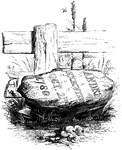
"Place of execution. The place of Andre's execution is now designated by a stone, lying on the right of a lane which runs from the highway from Tappan village to old Tappan, on the westerly side of a large peach orchard owned by Dr. Bartow, about a quarter of a mile from Washington's head-quarters. The stone is a small bowlder, on the upper surface of which is inscribed 'Andre executed Oct. 2d, 1780.' It is about three feet in length. This stone was placed there and inscribed in 1847, by a patriotic merchant of New York. A more elegant and durable monument should be erected upon the spot."—Lossing, 1851

Andre's Execution

"Place of execution. The place of Andre's execution is now designated by a stone, lying on the right…
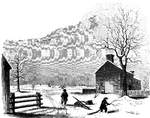
"View of the battle-ground near Princeton. This view, looking north, is from the carriage gate of Mr. John Clarke, owner of the house in which General Mercer died, which is situated about seventy rods from the Trenton turnpike. That dwelling is represented in the foreground of the picture, on the extreme right. The distant view includes almost the whole field of action. Near the center of the picture, over the head of the dark figure, is seen the house of William Clark, and his out-buildings. The barn, a little more to the left, with a tree in front, is upon the spot from whence Mercer rushed forward to the hedge-fence. That fence was upon the line of the present turnpike, denoted in the sketch by the fence passing down the slope beyond the large tree on the extreme left. The 'high ground' for which both parties were aiming, to secure advantage, is seen in the extreme distance. The dark spot between the tree in the second field and the barn denotes the spot where Mercer fell. The house of William Clark, in the distance, is about a quarter of a mile from the one in the foreground, where Mercer died. The hollow between the two houses was the space between the belligerents when Washington advanced to the support of Mercer. The place of conflict is about a mile and a quarter south of Princeton. The turnpike passes directly through it."—Lossing, 1851

Princeton battle-ground

"View of the battle-ground near Princeton. This view, looking north, is from the carriage gate of Mr.…
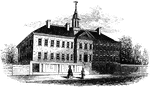
"The Walnut Street Prison. This edifice was erected in 1774, and taken down in 1836. The beautiful new Athenaeum occupies a portion of the ground on Sixth Street, and the remainder is covered by elegant dwellings. It is a singular fact that the architect who constructed it was the first person incarcerated in it. He was a Whig, and, having incurred the displeasure of the British, he was locked up in that prison. The <em>Public Ledger</em> of June 26th, 1837, gives an account of an armorial drawing, representing, in bold relief, a cuirass, casque, gorget, and Roman battle-ax, with radiating spears, which was made upon an arch of one of the second story cells, by Marshall, an English engraver, who was confined there for many years for counterfeiting the notes of the United States Bank. He was the son of the notorious 'Bag and Hatchet Woman,' of St. Giles's, London, who followed the British army in its Continental campaigns, and gathered spoils from the slain and wounded on the field of battle. Those who were dead, were readily plundered, and the wounded as readily dispatched. This woman and son were master-spirits in the purlieus of St. Giles's, among robbers and counterfeiters. The gang were at length betrayed, and the parent and child fled to this country, bringing with them considerable wealth in money and jewels. They lived in splendid style in Philadelphia, riding in a gorgeous cream-colored phaeton, drawn by richly-caparisoned horses, driven tandem. Their means were soon exhausted, when the son married, and commenced business as an engraver. He counterfeited notes of the United States Bank, was detected, and in 1803 was sentenced to eighteen years' confinement and hard labor in the Walnut Street Prison, then the State Penitentiary. While he was in prison, his mother, who had wondered away from Philadelphia in poverty and destitution, was executed in another state for a foul murder and arson."—Lossing, 1851

Walnut Street Prison

"The Walnut Street Prison. This edifice was erected in 1774, and taken down in 1836. The beautiful new…
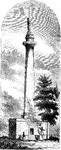
"Washington Monument. The following are the inscriptions on the monument: East front: 'To George Washington, by the State of Maryland. Born 23d February, 1732. Died 14th December, 1799.' South front: 'To George Washington, President of the United States, 4th March, 1789. Returned to Mount Vernon, 4th March, 1797.' West front: To George Washington. Trenton, 25th December, 1776. Yorktown, 19th October, 1781.' North Front: 'To George Washington. Commander-in-chief of the American armies, 15th June, 1775. Commission resigned at Annapolis, 23d December, 1783.'"—Lossing, 1851

Washington Monument

"Washington Monument. The following are the inscriptions on the monument: East front: 'To George Washington,…
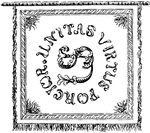
"Pulaski's Banner. On one side of the banner are the letters U. S., and in a circle around them the words Unita Virtus Forcior; 'United valor is stronger.' The letter C in the last word is incorrect; it should be T."&mdash;Lossing, 1851

Pulaski's Banner Front

"Pulaski's Banner. On one side of the banner are the letters U. S., and in a circle around them the…
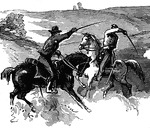
"Desperate skirmish at Old Church, near Tunstall's Station, VA., between a squadron of the Fifth United States Cavalry and Stuart's Confederate Cavalry, June 13th, 1862- death of the Confederate Captain Latane. The Confederate cavalry raid was first to Old Church, where they had a skirmish with a squadron of the Fifth United States Cavalry, who gallantly cut their way through the greatly superior numbers of the enemy, killing a Confederate captain. The Confederates then proceeded to Garlick's Landing, on the Pamunkey River, and only four miles from the White House; thence to Baltimore Crossroads, near New Kent Courthouse, on their way to Richmond, which they reached by crossing the Chickahominy, between Bottom's Bridge and James River."&mdash; Frank Leslie, 1896

Old Church

"Desperate skirmish at Old Church, near Tunstall's Station, VA., between a squadron of the Fifth United…
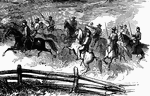
"Desperate skirmish at Old Church, near Tunstall's Station, VA., between a squadron of the Fifth United States Cavalry and Stuart's Confederate Cavalry, June 13th, 1862- death of the Confederate Captain Latane. The Confederate cavalry raid was first to Old Church, where they had a skirmish with a squadron of the Fifth United States Cavalry, who gallantly cut their way through the greatly superior numbers of the enemy, killing a Confederate captain. The Confederates then proceeded to Garlick's Landing, on the Pamunkey River, and only four miles from the White House; thence to Baltimore Crossroads, near New Kent Courthouse, on their way to Richmond, which they reached by crossing the Chickahominy, between Bottom's Bridge and James River."&mdash; Frank Leslie, 1896

Old Church

"Desperate skirmish at Old Church, near Tunstall's Station, VA., between a squadron of the Fifth United…
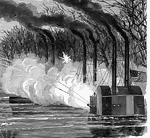
"Bombardment of Fort Henry, Tennessee River, Tenn., by the Mississippi Flotilla, Flag Officer Foote, February 6th, 1862. Flag Officer Foote's official report- United States Flagship Cincinatti, off Fort Henry, Tennessee River, February 6th, 1862: 'The gunboats under my command- the <em>Essex</em>, Commander Porter; the <em>Carondelet</em>, Commander Walker; the <em>Cincinnati</em>, Commander Stembel; the <em>St. Louis</em>, Lieutenant Commanding Paulding; the <em>Conestoga</em>, Lieutenant Commanding Phelps; the <em>Taylor</em>, Lieutenant Commanding Gwin; and the <em>Lexington</em>, Lieutenant Commanding Shirk. After a severe and rapid fire of one hour and a quarter, have captured Fort Henry and have taken General Lloyd Tilghman and his staff as prisoners. The surrender to the gunboats was unconditional, as we kept an open fire upon the enemy until their flag was struck. In half an hour after the surrender I handed the fort and the prisoners over to General Grant, commanding the army, on his arrival at the fort in force. The <em>Essex</em> had a shot in her boiler, after fighting most effectually for two thirds of the action, and was obliged to drop down the river. She, with the other gunboats, officers and men, fought with the greatest gallantry. The <em>Cincinnati</em> received thirty-one shots and had one man killed and eight wounded, two seriously. The fort, with twenty guns and seventeen mortars, was defended by General Tilghman with the most determined gallantry.'" —Leslie, 1896

Bombardment of Fort Henry

"Bombardment of Fort Henry, Tennessee River, Tenn., by the Mississippi Flotilla, Flag Officer Foote,…
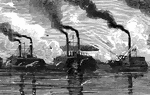
"Bombardment of Fort Henry, Tennessee River, Tenn., by the Mississippi Flotilla, Flag Officer Foote, February 6th, 1862. Flag Officer Foote's official report- United States Flagship Cincinatti, off Fort Henry, Tennessee River, February 6th, 1862: 'The gunboats under my command- the <em>Essex</em>, Commander Porter; the <em>Carondelet</em>, Commander Walker; the <em>Cincinnati</em>, Commander Stembel; the <em>St. Louis</em>, Lieutenant Commanding Paulding; the <em>Conestoga</em>, Lieutenant Commanding Phelps; the <em>Taylor</em>, Lieutenant Commanding Gwin; and the <em>Lexington</em>, Lieutenant Commanding Shirk. After a severe and rapid fire of one hour and a quarter, have captured Fort Henry and have taken General Lloyd Tilghman and his staff as prisoners. The surrender to the gunboats was unconditional, as we kept an open fire upon the enemy until their flag was struck. In half an hour after the surrender I handed the fort and the prisoners over to General Grant, commanding the army, on his arrival at the fort in force. The <em>Essex</em> had a shot in her boiler, after fighting most effectually for two thirds of the action, and was obliged to drop down the river. She, with the other gunboats, officers and men, fought with the greatest gallantry. The <em>Cincinnati</em> received thirty-one shots and had one man killed and eight wounded, two seriously. The fort, with twenty guns and seventeen mortars, was defended by General Tilghman with the most determined gallantry.'" —Leslie, 1896

Bombardment of Fort Henry

"Bombardment of Fort Henry, Tennessee River, Tenn., by the Mississippi Flotilla, Flag Officer Foote,…
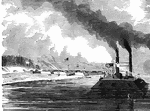
"Bombardment of Fort Henry, Tennessee River, Tenn., by the Mississippi Flotilla, Flag Officer Foote, February 6th, 1862. Flag Officer Foote's official report- United States Flagship Cincinatti, off Fort Henry, Tennessee River, February 6th, 1862: 'The gunboats under my command- the <em>Essex</em>, Commander Porter; the <em>Carondelet</em>, Commander Walker; the <em>Cincinnati</em>, Commander Stembel; the <em>St. Louis</em>, Lieutenant Commanding Paulding; the <em>Conestoga</em>, Lieutenant Commanding Phelps; the <em>Taylor</em>, Lieutenant Commanding Gwin; and the <em>Lexington</em>, Lieutenant Commanding Shirk. After a severe and rapid fire of one hour and a quarter, have captured Fort Henry and have taken General Lloyd Tilghman and his staff as prisoners. The surrender to the gunboats was unconditional, as we kept an open fire upon the enemy until their flag was struck. In half an hour after the surrender I handed the fort and the prisoners over to General Grant, commanding the army, on his arrival at the fort in force. The <em>Essex</em> had a shot in her boiler, after fighting most effectually for two thirds of the action, and was obliged to drop down the river. She, with the other gunboats, officers and men, fought with the greatest gallantry. The <em>Cincinnati</em> received thirty-one shots and had one man killed and eight wounded, two seriously. The fort, with twenty guns and seventeen mortars, was defended by General Tilghman with the most determined gallantry.'" —Leslie, 1896

Bombardment of Fort Henry

"Bombardment of Fort Henry, Tennessee River, Tenn., by the Mississippi Flotilla, Flag Officer Foote,…
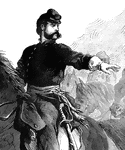
"Major General Burnside assuming command of the Army of the Potomac- issuing orders to his staff. 'Headquarters, Army of the Potomac, November 10th, 1862. In accordance with General Orders, No. 182, issued by the President of the United States, I hereby assume command of the Army of the Potomac. Patriotism, and the exercise of my every energy in the direction of this army, aided by the full and hearty co-operation of its officers and men, will I hope, under the blessing of God, insure its success. Having been a sharer of the privations, and a witness of the bravery of the old Army of the Potomac in the Maryland campaign, and fully identified with them in their feelings of respect and esteem for General McClellan, entertained through a long and most friendly association with him, I feel that it is not as a stranger I assume command. To the Ninth Army Corps, so long and intimately associated with me, I need say nothing; our histories are identical. With diffidence for myself, but with a proud confidence in the unswerving loyalty and determination of the gallant army now intrusted to my care, I accept its control, with the steadfast assurance that the just cause must prevail. A. E. Burnside, Major General Commanding.' Our illustration represents the general issuing orders to his staff immediately after assuming command." &mdash; Frank Leslie, 1896

General Burnside

"Major General Burnside assuming command of the Army of the Potomac- issuing orders to his staff. 'Headquarters,…
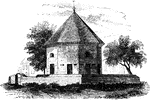
"The Old Magazine. This view is from the square, looking southeast. South of it is a neat frame building, which was occupied by President Tyler before his election to the office of Vice-president of the United States."&mdash;Lossing, 1851

Old Magazine

"The Old Magazine. This view is from the square, looking southeast. South of it is a neat frame building,…
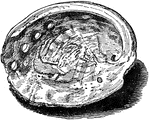
"A general name on the Pacific coast of the United States for marine shells of the family <em>Haliotid&aelig; </em>(which see), having an oval form with a very wide aperture, a narrow, flattened ledge or columella, and a subspiral row of perforations extending from the apex to the distal margin of the shell."&mdash;Wright, 1902

Abalone

"A general name on the Pacific coast of the United States for marine shells of the family Haliotidæ

"The belly; that part of the body of a mammal which lies between the thorax and the pelvis; In <em>entomology</em>, the hind body, the posterior one of the three parts of a perfect insect, united with the thorax by a slender connecting portion, and containing the greater part of the digesting apparatus."-Wright, 1902

Abdomen

"The belly; that part of the body of a mammal which lies between the thorax and the pelvis; In entomology,…
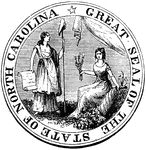
"Great Seal of the State of North Carolina."&mdash;Lossing, 1851

North Carolina Seal

"Great Seal of the State of North Carolina."—Lossing, 1851

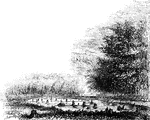
"Pyle's Pond. About a quarter of a mile northwest from this pond, is the spot where the battle occurred. It was then heavily wooded; now it is a cleared field, on the plantation of Colonel Michael Holt. Mr. Holt planted an apple-tree upon the spot where fourteen of the slain were buried in one grave. Near by, a persimmon-tree indicates the place of burial of several others."—Lossing, 1851

Pyle's Pond

"Pyle's Pond. About a quarter of a mile northwest from this pond, is the spot where the battle occurred.…
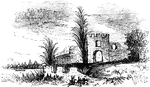
"Ruins of Oglethorpe's Barracks at Frederica. This is from a sketch made by W. W. Hazzard, Esq., in 1851. Mr. Hazzard writes: 'These ruins stand on the left bank or bluff of the south branch of the Alatamaha River, on the west side of St. Simon's Island, where the steamers pass from Savannah to Florida.' This fort was a scene of hostilities during the war of the Revolution, and also that of 1812; and is one of the most interesting military relics of our country. Mr. Hazzard states that, in his field in the rear of it, his men always turn up 'bomb-shells and hollow shot whenever they plow there.' The whole remains are upon his plantation at West Point."&mdash;Lossing, 1851

Frederica

"Ruins of Oglethorpe's Barracks at Frederica. This is from a sketch made by W. W. Hazzard, Esq., in…
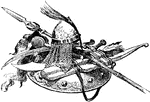
"Saracen Arms. Charlemagne now had to deal with certain non-Germanic peoples who were threatening his borders. These were the Saracens, Slavs, and Avars. The Mohammedan Saracens, or Moors, had gained possession of the whole of Spain, but there were still small fragments of the ancient Visigothic kingdom in the north. It was to save these little Christian states from their Mohammedan oppressors, as well as to round out the limits of his own kingdom, that Charlemagne undertook a campaign against the Saracens."&mdash;Colby, 1899

Saracen Arms

"Saracen Arms. Charlemagne now had to deal with certain non-Germanic peoples who were threatening his…
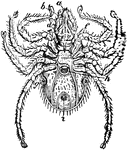
"An order of the class Arachinida, includes those insects, as the mites, ticks, itch-insects, etc., which are without a definite line of demarktationbetween the unsegmented abdomen appearing united in one."-Whitney, 1902

Acarida

"An order of the class Arachinida, includes those insects, as the mites, ticks, itch-insects, etc.,…

Sheaths at base of stem with edges united to form tube.

Eleocharis

Sheaths at base of stem with edges united to form tube.

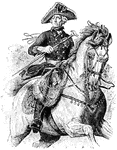
"Frederick II (The Great, 1740-1786). The young Frederick had been brought up in a rough school. His father's strict training and brutal ways made his life miserable. He could not gratify his waste for study, nor enjoy any liberty of action. Heavy tasks were imposed upon him and he was scolded and punished for the slightest disobedience. Once he tried to escape, but the attempt failed and his tutor who had aided him was hanged. He himself narrowly escaped execution by the decree of a court-martial. The king's death released him from this tyranny and he now found himself the inheritor of a strong state and a splendid army. He was ambitious of military fame and wished to raise Prussia to the first place among European states."&mdash;Colby, 1899

Frederick the Great

"Frederick II (The Great, 1740-1786). The young Frederick had been brought up in a rough school. His…
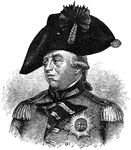
"George III (1760-1815). The first two Hanoverian kings were ignorant of English politics and obliged to rely on their ministers. Moreover, they cared more for Hanover than for England. But George II had English ideas. He was born and educated in England, and he made up his mind that he would rule in the manner of the old kings. He tried to restore the power of the crown at the expense of Parliament. In private morals and social relations he was better than his predecessors, and his character inspired respect. He had the loftiest ideas of royal dignity, and the greater part of his reign was taken up with the struggles with Parliament. But though he had some good qualities, he was narrow-minded, ill-educated, and imprudent. During the first twenty-four years of his reign he managed to estrange his people, check the prosperity of the nation, and lose forever the American colonies. His reign therefore was disastrous. The details of the struggle with the American colonies and the rise of the United States to the foremost rank among nations do not properly fall within the scope of this work. It is sufficient here to state that by the treaty of 1783 England's control over the thirteen colonies was lost forever. During the latter part of the reign of George III he was incapacitated for ruling. He was stricken with insanity, and the government passed into the hands of the prince regent, afterwards George IV. The most interesting side of the reign from the point of view of general history is the relations of England with foreign powers and the part where she played in the wars that arose from the French Revolution."&mdash;Colby, 1899

George III, King of England

"George III (1760-1815). The first two Hanoverian kings were ignorant of English politics and obliged…
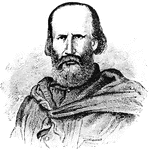
"Garibaldi was a patriot who started up a revolt in Sicily and took possession of the island, then passed over to Naples and overthrew the tyrant. This was done without the consent of Sardinia, but that kingdom profited none the less from its results. About the same time trouble with the papal states had led to the sending of a Sardinian army into the pope's dominions, and the annexation of the greater part of them to Sardinia. Garibaldi, after his success in Naples and Sicily, saluted the Sardinian king as King of Italy, and by a vote of the people Naples and Sicily joined Sardinia. A parliament of united Italy was opened in 1861, but ten years passed before unity was complete."—Colby, 1899

Garibaldi

"Garibaldi was a patriot who started up a revolt in Sicily and took possession of the island, then passed…
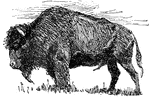
"The Buffalo. As the game upon which they depended moved about the country, so the Indians roved in search of it. The buffalo was an animal every part of which the Indian used. He cooked or dried the flesh, for food. He tanned or otherwise dressed the skin and used it for his bed, and he cut it up for ropes and cords. The marrow served for fat. The sinews made bowstrings. The hair was twisted into ropes and halters, and spun and woven into a coarse cloth, the bones made war clubs, and the shoulder blades were used for hoes. They made canoes from the bark of trees, and paddled along the rivers and lakes. By looking at a map which has no State lines upon it, one can see what a network of waterways covers the country now occupied by the United States."&mdash;Scudder, 1897

Buffalo

"The Buffalo. As the game upon which they depended moved about the country, so the Indians roved in…
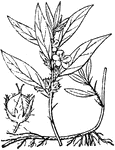
Sepals united at base into a tube enclosing the ovary and later the fruit; leaves with spines in axils.
Hydrolea

Sepals united at base into a tube enclosing the ovary and later the fruit; leaves with spines in axils.

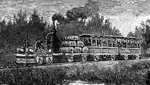
"The first passenger locomotive built in the United States. A year after the Enterprise sailed for India, the first railroad in the United States was opened in Massachusetts, from the Quincy quarries to tide water. It was only two miles long, and was used for hauling granite; the cars were drawn by horses. It was the first use of rails in America. In 1830 the first passenger railway in America was opened. It extended westward from Baltimore about fifteen miles, and now forms a part of the Baltimore and Ohio Railroad. The cars were at first drawn by horses, but a locomotive was used the next year. Its first locomotive was built by Peter Cooper, who made later the generous and useful gift of the Cooper Union to the city of New York. Now began the construction of railroads in various directions; in the next twenty years nearly ten thousand miles of road were built. This mileage has constantly been increased, until in 1895 there were in operation in the United States nearly one hundred and eighty thousand miles of railway."—Scudder, 1897

Passenger Train

"The first passenger locomotive built in the United States. A year after the Enterprise sailed for India,…
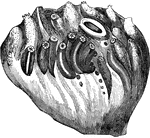
"The compound ascidians, or <em>Botryllidae</em>, are united togetyher by the coalescence of of their mantles, so as to form a leathery or gelatinous mass, ususally attached to stones or sea-weed; in this the seperate animals are imbedded round a common canal, many of them being adorned with beautiful colors, and these masses are of an almost infinte variety of forms." &mdash; Goodrich, 1859

Compound ascidians

"The compound ascidians, or Botryllidae, are united togetyher by the coalescence of of their…
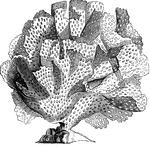
"The compound ascidians, or <em>Botryllidae</em>, are united togetyher by the coalescence of of their mantles, so as to form a leathery or gelatinous mass, ususally attached to stones or sea-weed; in this the seperate animals are imbedded round a common canal, many of them being adorned with beautiful colors, and these masses are of an almost infinte variety of forms." &mdash; Goodrich, 1859

Compound Ascidians

"The compound ascidians, or Botryllidae, are united togetyher by the coalescence of of their…
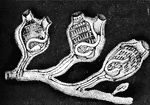
"The <em>Clavellinidae</em>, or <em>Social Ascidians</em>, are united by means of a sort of creeping stem, which runs along the surface of submarine objects, and gives rise at intervals to short footstalks, at the extremity of which the animals are supported." &mdash; Goodrich, 1859

Social Ascidians

"The Clavellinidae, or Social Ascidians, are united by means of a sort of creeping…
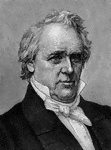
In 1859, John Brown collected a small body of men, white and black, in the mountains of Maryland. He made a sudden attack upon Harper's Ferry, where there was a United States arsenal, which he seized and held for a few hours. The attack was a direct assault upon slavery. Brown had resolved to carry the war into what he regarded as the enemy's country, and he expected to see the slaves flock to his standard. There were few at the North who knew of his purpose; and the country, North and South, was amazed at the act. John Brown was wounded and taken prisoner; some of his associates were killed, and some were taken with him. He was tried by the State of Virginia, sentenced, and hanged. His action was generally condemned by the people, but many declared him a martyr to freedom, and accused slavery of provoking him to the deed. His act, moreover, deepened the feeling of the South that the North was in a hostile attitiude; and public opinion at the South held the North responsible for Brown's movement."—Scudder, 1897

John Brown

In 1859, John Brown collected a small body of men, white and black, in the mountains of Maryland. He…
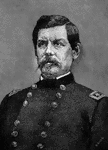
"George Brinton McClellan was born at Philadelphia, December 3, 1826. He was for two years a student in the University of Virginia, but in 1842 he became a cadet at West Point, where he was the youngest in his class. He made his mark, however, for, on graduating in 1846, he stood second in general rank, and first in engineering. He engaged in the Mexican War, and took part in the siege of Vera Cruz, along with Lee and Beauregard. He was brevetted captain, and after the war he was employed by the government in surveys beyond the Mississippi. When the Crimean War occurred, Captain McClellan was one of a commission sent by the United States government to examine the military systems of Europe, and to report on the better organization of the American army. He made an important report, on his return, and then retired from the service, and became president of the Ohio and Mississippi Railroad. He was living in Cincinnati when the war broke out, and the governor of Ohio at once commissioned him major general of the Ohio militia. He had most winning qualities and an unblemished character, so that he attached every one who came in contact with him. Near the close of the war, he became the Democratic candidate for the Presidency. He was elected governor of New Jersey in 1877, and died at Orange, in that State, October 29, 1885."—Scudder, 1897

George B. McClellan

"George Brinton McClellan was born at Philadelphia, December 3, 1826. He was for two years a student…

"John Ericsson was born in Sweden, July 31, 1803. He early showed great inventive skill and was employed as an engineer in the Swedish service. He resigned in 1826 and went to England to introduce an engine he had invented. In 1829 he won a prize for the best locomotive engine, and invented a hot-air engine. He came to New York in 1839 and built the United States steamer Princeton. He was busily engaged in perfecting his hot-air engine and applying it to the propulsion of vessels, and upon the outbreak of the war he put himself at the service of the United States government. After the war he constantly displayed his inventive genius in various constructions. He died March 8, 1889."—Scudder

John Ericcson

"John Ericsson was born in Sweden, July 31, 1803. He early showed great inventive skill and was employed…
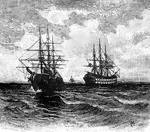
"Laying the Atlantic Cable. In 1866, a previous attempt in 1858 having failed, a telegraphic cable was laid upon the bed of the Atlantic between America and Europe. This cable was followed by others; but a closer connection between the United States and the Old World than any effected by the telegraph is formed by the constant passage back and forth of people. With the close of the war, immigration, which had suffered a check, increased rapidly. From 1871 to 1880 nearly three millions, and from 1881 to 1890, more than five millions, of people migrated to the United States. During the present decade, up to 1897, three millions of immigrants have swelled the population of the century. From 1789 to 1894, a period of one hundred and five years, the United States has absorbed an alien population of about eighteen millions."&mdash;Scudder, 1897

Atlantic Cable

"Laying the Atlantic Cable. In 1866, a previous attempt in 1858 having failed, a telegraphic cable was…

"[Late 19th Century/Early 20th Century] United States Army Ambulance"-Whitney, 1902

Army Ambulance

"[Late 19th Century/Early 20th Century] United States Army Ambulance"-Whitney, 1902

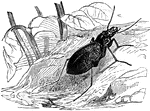
"The Blue Carabus, <em>C. cyaneus</em>, is an inch and a quarter long, the body oval, flat, and above of a brilliant blue." &mdash; Goodrich, 1859

Blue Carabus

"The Blue Carabus, C. cyaneus, is an inch and a quarter long, the body oval, flat, and above…
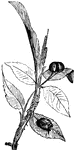
"The numerous species of <em>Coccinellae</em> feed upon <em>aphides</em>, or <em>Plant lice</em>, both in the larva and perfect states, and are often seen on fruit-trees, as the pear, peach, and plum, and on rose-bushes and other shrubs." &mdash Goodrich, 1859

Ladybird

"The numerous species of Coccinellae feed upon aphides, or Plant lice, both…

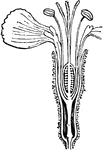
"Anthophore (From Gray's "Genera of Plants of the United States)"-Whitney, 1902

Anthophore

"Anthophore (From Gray's "Genera of Plants of the United States)"-Whitney, 1902

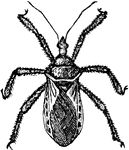
"Apiomerus crassipes, a species widely distributed in the United States."-Whitney, 1902

Apiomerus

"Apiomerus crassipes, a species widely distributed in the United States."-Whitney, 1902

"The Troilus Butterfly, <em>Papilio Troilus</em>, is a superb insect, the wings denticulated, black, spotted with yellow, and terminated by a swallow-tail. It lives on spice-wood and sassafras-trees; is rare in the Northern States; common in the Southern, and in the West Indies." &mdash; Goodrich, 1859

Troilus Butterfly

"The Troilus Butterfly, Papilio Troilus, is a superb insect, the wings denticulated, black,…
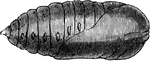
"Among the larger and more splendid moths of our own country is the Luna Moth, or Green Emperor Moth, <em>attacus luna</em> a large and beautiful species, common in the Northern United States. The wings, which are drawn out into what appears like a long tail, are of a light yellowish-green color, marked with eye-spots near the middle. The expanse of the wings is four inches. The caterpilar lives on walnut-trees, and spins a cocoon of which silk might be made. Many of these cocoons may be picked up on the ground, in autumn or spring, beneath the trees frequented by these insect."  &mdash; Goodrich, 1859

Chrysalis of the Luna Moth

"Among the larger and more splendid moths of our own country is the Luna Moth, or Green Emperor Moth,…
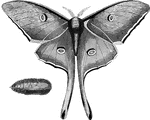
"Among the larger and more splendid moths of our own country is the Luna Moth, or Green Emperor Moth, <em>attacus luna</em> a large and beautiful species, common in the Northern United States. The wings, which are drawn out into what appears like a long tail, are of a light yellowish-green color, marked with eye-spots near the middle. The expanse of the wings is four inches. The caterpilar lives on walnut-trees, and spins a cocoon of which silk might be made. Many of these cocoons may be picked up on the ground, in autumn or spring, beneath the trees frequented by these insect."  &mdash; Goodrich, 1859

Luna Moth

"Among the larger and more splendid moths of our own country is the Luna Moth, or Green Emperor Moth,…
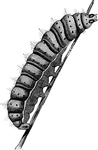
"Among the larger and more splendid moths of our own country is the Luna Moth, or Green Emperor Moth, <em>attacus luna</em> a large and beautiful species, common in the Northern United States. The wings, which are drawn out into what appears like a long tail, are of a light yellowish-green color, marked with eye-spots near the middle. The expanse of the wings is four inches. The caterpilar lives on walnut-trees, and spins a cocoon of which silk might be made. Many of these cocoons may be picked up on the ground, in autumn or spring, beneath the trees frequented by these insect."  &mdash; Goodrich, 1859

Caterpillar of the Luna Moth

"Among the larger and more splendid moths of our own country is the Luna Moth, or Green Emperor Moth,…
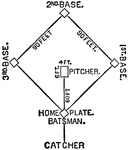
"Base Ball is a field game played principally in the United States. It originated in the English school-boy game of "rounders;" but it has been so improved and so generally played as to merit its name of "the National game of America." The plaing of baseball has become largely a business or a "profession," and skilled players receive large salaries. As an amateur game, however, it is also most popular."&mdash;(Charles Leonard-Stuart, 1911)

Baseball Diamond

"Base Ball is a field game played principally in the United States. It originated in the English school-boy…
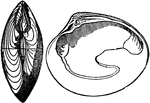
"Bivalves are those mollusks whose coverings consist of two concave shelly plates or valves united by a hinge."&mdash;(Charles Leonard-Stuart, 1911)

Bivalve

"Bivalves are those mollusks whose coverings consist of two concave shelly plates or valves united by…
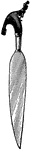
"A Bolo is a short, broad, lance-shaped weapon; used by the Filiinos in their operations against the American troops. The blade is about 18 inches in length by nearly 3 inches in breadth at its broadest dimension. It tapers from the middle toward the haft as well as toward the point, making it strongly resemble the ancient short sword. It is not double edged, however, but tapers from a thick back to an extremely keen edge. In April 1904, the United States troops operating in the Philippines, were supplied with bolos."&mdash;(Charles Leonard-Stuart, 1911)

Filipino Bolo

"A Bolo is a short, broad, lance-shaped weapon; used by the Filiinos in their operations against the…
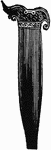
"A Bolo is a short, broad, lance-shaped weapon; used by the Filiinos in their operations against the American troops. The blade is about 18 inches in length by nearly 3 inches in breadth at its broadest dimension. It tapers from the middle toward the haft as well as toward the point, making it strongly resemble the ancient short sword. It is not double edged, however, but tapers from a thick back to an extremely keen edge. In April 1904, the United States troops operating in the Philippines, were supplied with bolos."&mdash;(Charles Leonard-Stuart, 1911)

Filipino Bolo Sheath

"A Bolo is a short, broad, lance-shaped weapon; used by the Filiinos in their operations against the…
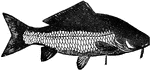
"Carp is a fresh-water fish. It is a native of Asia, but has been extensively introduced into the United States."&mdash;(Charles Leonard-Stuart, 1911)

Carp

"Carp is a fresh-water fish. It is a native of Asia, but has been extensively introduced into the United…
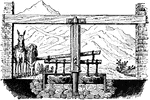
"Mexican Arrastre. A rude apparatus used in Mexico, and to some extent in the United States, for grinding and at the same time amalgamating ores containing free gold or silver."-Whitney, 1902

Arrastre

"Mexican Arrastre. A rude apparatus used in Mexico, and to some extent in the United States, for grinding…
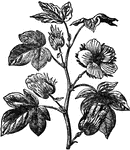
"Cotton is a vegetable hair or filament constituting the wing of the seed of the different species of Gossypium, a plant growing both in the temperate and tropical climates, indigenous in Asia, Africa, and south America. All the varieties of the plant require a dry and sandy soil. In general it flourishes most luxuriantly and yields produce of the best quality on the coast. In the United States a large proportion of the crop is grown W. of the Mississippi."&mdash;(Charles Leonard-Stuart, 1911)

Cotton Plant

"Cotton is a vegetable hair or filament constituting the wing of the seed of the different species of…
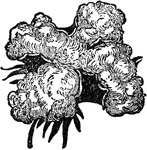
"Cotton is a vegetable hair or filament constituting the wing of the seed of the different species of Gossypium, a plant growing both in the temperate and tropical climates, indigenous in Asia, Africa, and south America. All the varieties of the plant require a dry and sandy soil. In general it flourishes most luxuriantly and yields produce of the best quality on the coast. In the United States a large proportion of the crop is grown W. of the Mississippi."&mdash;(Charles Leonard-Stuart, 1911)

Cotton Flower

"Cotton is a vegetable hair or filament constituting the wing of the seed of the different species of…
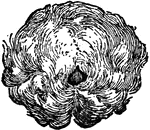
"Cotton is a vegetable hair or filament constituting the wing of the seed of the different species of Gossypium, a plant growing both in the temperate and tropical climates, indigenous in Asia, Africa, and south America. All the varieties of the plant require a dry and sandy soil. In general it flourishes most luxuriantly and yields produce of the best quality on the coast. In the United States a large proportion of the crop is grown W. of the Mississippi."&mdash;(Charles Leonard-Stuart, 1911)

Cotton Flower

"Cotton is a vegetable hair or filament constituting the wing of the seed of the different species of…
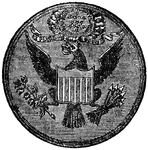
"The Eagle is a gold coin of the United States, value $10; half-eagle, $5; quarter-eagle, $2.50, double eagle, the largest gold coin of this country, $20."&mdash;(Charles Leonard-Stuart, 1911)

Eagle on Seal of United States

"The Eagle is a gold coin of the United States, value $10; half-eagle, $5; quarter-eagle, $2.50, double…
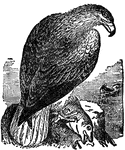
"The Erne is one of the 'bare-legged' eagles. The genus includes some seven species, represented apparently in all parts of the world except South America. A notable species is the white-headed or bald eagle, the emblem of the United States. This erne is common in North America, both by the coasts and by inland lakes, and also occurs in Northern Europe. The general color is brown, but the head and neck of the adults are milky-white, and the same is true of the rounded tail."&mdash;(Charles Leonard-Stuart, 1911)

Erne

"The Erne is one of the 'bare-legged' eagles. The genus includes some seven species, represented apparently…
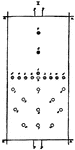
"Football is a field game played in the United States, Great Britain, Canada, and Australia. The game is said to have originated among the Romans, but it was under the guidance of the public schools of Great Britain that it advanced and became popular."&mdash;(Charles Leonard-Stuart, 1911)

Football Field at Kick-Off

"Football is a field game played in the United States, Great Britain, Canada, and Australia. The game…
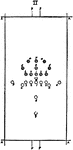
"Football is a field game played in the United States, Great Britain, Canada, and Australia. The game is said to have originated among the Romans, but it was under the guidance of the public schools of Great Britain that it advanced and became popular."&mdash;(Charles Leonard-Stuart, 1911)

Football Field at Scrimmage

"Football is a field game played in the United States, Great Britain, Canada, and Australia. The game…
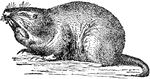
"Gopher is a name given by the early French settlers in the United States to various animals which honeycomb the ground by burrowing in it. In Illiois and canada it was given to a gray burrowing squirrel, in Wisconsin to a striped squirrel, and in Missouri to a burrowing pouched rat. All these are mammals; but in Georgia the term is applied to a snake, and in Florida to a turtle."&mdash;(Charles Leonard-Stuart, 1911)

Gopher

"Gopher is a name given by the early French settlers in the United States to various animals which honeycomb…
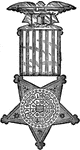
"The Grand Army of the Republic was a patriotic organization in the United States composed of the National veterans of the Civil War. It was organized in Decatur, Ill., April 6, 1866, by Dr. B. F. Stephenson. Badge of the G.A.R.&ndash; Reverse"&mdash;(Charles Leonard-Stuart, 1911)

Badge of the Grand Army of the Republic

"The Grand Army of the Republic was a patriotic organization in the United States composed of the National…
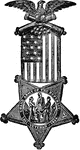
"The Grand Army of the Republic was a patriotic organization in the United States composed of the National veterans of the Civil War. It was organized in Decatur, Ill., April 6, 1866, by Dr. B. F. Stephenson. Badge of the G.A.R.&ndash; Obverse"&mdash;(Charles Leonard-Stuart, 1911)

Badge of the Grand Army of the Republic

"The Grand Army of the Republic was a patriotic organization in the United States composed of the National…
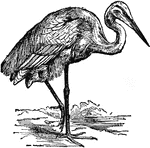
"Heron is the common name of birds of the genus Ardea. The herons are distinguished by having a long bill cleft beneath the eyes, a compressed body, long slender legs naked above the tarsal joint, three toes in front, the two outer united by a membrane, and by moderate wings. The tail is short, rounded, and composed of 10 or 12 feathers. The common heron is about three feet in length from the point of the bill to the end of the tail, builds its nest in high trees, many being sometimes on one tree. Its food consists of fish, frogs, mollusks, mice, moles, and similar small animals. It has an insatiable voracity, and digests its food with great rapidity. It haunts fresh water streams, marshes, ponds, and lakes, as also the seashore."&mdash;(Charles Leonard-Stuart, 1911)

Heron

"Heron is the common name of birds of the genus Ardea. The herons are distinguished by having a long…
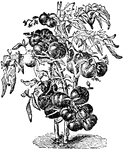
"Tomato, or Love Apple, is a plant of the natural order Solanace&aelig;. It is one of a genus of several species, all natives of South America, chiefly on the Peruvian side. In the United States and other countries in which the summer is warm and prolonged, it has long been cultivated for the excellent qualities of the fruit as an article of diet. Though belonging to a natural order of plants usually regarded with suspicion on account of the powerfully poisonous properties of many of the species comprised in it, it is now recognized as one of the most important and valuable of vegetables grown for human food."&mdash;(Charles Leonard-Stuart, 1911)

Tomato Plant

"Tomato, or Love Apple, is a plant of the natural order Solanaceæ. It is one of a genus of several…