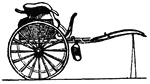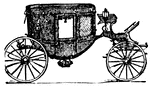
A Calash is a light carriage on low wheels, seats 4 inside, and can, through a movable top and front, be used as either a closed or open vehicle.

Calash

A Calash is a light carriage on low wheels, seats 4 inside, and can, through a movable top and front,…
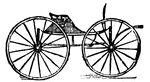
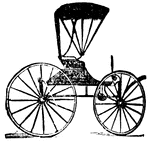
A Buggy is a light four-wheeled vehicle in common use in the late 19th century.

Buggy

A Buggy is a light four-wheeled vehicle in common use in the late 19th century.

A Buggy is a light four-wheeled vehicle in common use in the late 19th century.

Top Buggy

A Buggy is a light four-wheeled vehicle in common use in the late 19th century.

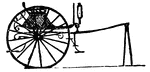
A Gig is a light two-wheeled vehicle drawn by one horse.

Gig

A Gig is a light two-wheeled vehicle drawn by one horse.

A Stanhope is a  light two or four-wheeled carriage, named afer Lord Stanhope, for whom it was invented.

Stanhope

A Stanhope is a light two or four-wheeled carriage, named afer Lord Stanhope, for whom it was invented.
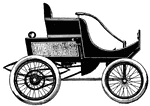
A steam runabout, a light American automobile.

Runabout

A steam runabout, a light American automobile.

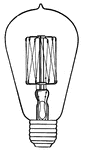
Tungsten incandescent lamp.

Electric Light, Tungsten Incandescent Lamp

Tungsten incandescent lamp.

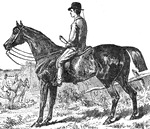
A light hunting horse with rider.

A light hunting horse

A light hunting horse with rider.

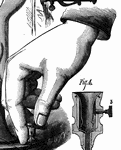
Hand attaching wire to an Edison light bulb.

Hand and light bulb

Hand attaching wire to an Edison light bulb.

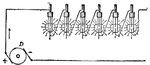
The System of Arc Lights is a device used to obtain electric light by conducting a current of electricity through a resisting medium, as a gas or a carbon wire.

System of Arc Lights

The System of Arc Lights is a device used to obtain electric light by conducting a current of electricity…
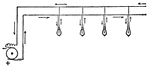
The System of Incandescent Lights is a device in which electric light is obtained by conducting a current of electricity through a resisting medium, as a gas or a carbon wire.

System of Incandescent Lights

The System of Incandescent Lights is a device in which electric light is obtained by conducting a current…
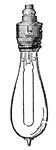
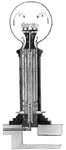
Electrical incandescent light bulb.

Incandescent

Electrical incandescent light bulb.

Lamps using natural gas to produce light. Uses convention make the lamp very efficient.

Gas Lighting

Lamps using natural gas to produce light. Uses convention make the lamp very efficient.
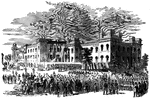
At the time this picture was drawn the handsome arsenal of the government of Charleston, South Carolina, was an object of great interest. An immense amount of ammunition was stored there, and raids upon it were expected at any moment. It was watched and guarded with great care by detachments of the Washington Light Infantry. It was afterward seized by the State authorities on December 28, 1860.

United States Arsenal at Charleston

At the time this picture was drawn the handsome arsenal of the government of Charleston, South Carolina,…
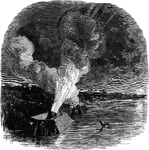
"Siege of Island No. 10, on the Mississippi River- night bombardment by the Federal mortar boats, ten o'clock P. M., March 18th, 1862. On the 16th of March, 1862, the mortar fleet and the gunboats, consisting of the <em>Cincinnati, Pittsburg, St. Louis, Silver Wave, Carondelet, Mound City, Conestoga, Louisville, Rob Roy, Alps, Wilson, Lake Erie, Great Western</em> and <em>Torrence</em>, and nine mortar boats, arrived near the Point. These were accompanied by several tugboats. On the 18th they opened fire, which, after some hours' delay, was returned by the Confederate batteries. This continued for several days, with very little loss to the Federal troops, owing to the iron casing of the vessels. The study of mortar firing is very interesting. Our sketch represents the manner in which the smoke rolls, and a small column frequently splits out when the shell passes. The shell itself can be seen at night during its entire flight, the fuse having the appearance of a star, which appears and disappears as the shell rolls through the air, very like the twinkling of the celestial orbs. The explosion of the shell at night is a magnificent and fearful sight, sending a glow of surpassing brightness around it as though some world of combustible light had burst." &mdash; Frank Leslie, 1896

Siege of Island

"Siege of Island No. 10, on the Mississippi River- night bombardment by the Federal mortar boats, ten…
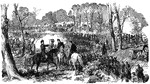
"Battle of Pea Ridge, Ark., fought March 6th, 7th and 8th, 1862, between the Federal forces, 13,000 strong, under Generals Curtis, Sigel, and Asboth, and the combined Confederate army of the Southwest, 25,000 strong, under Generals Van Dorn, Price and McCulloch- total defeat of the Confederates. The official report of this battle by General Curtis is as follows: "On Thursday, March 6th, the enemy commenced an attack on my right wing, assailling and following the rear guard of a detachment under General Sigel to my main lines on Sugar Creek Hollow, but ceased firing when he met my re-enforcements about 4 P.M. Early on the 7th I ordered an immediate advance of the cavalry and light artillery, under Colonel Osterhaus, with orders to attack and break what I supposed would be the re-enforced line of the enemy. This movement was in progress when the enemy commenced an attack on my right. The fight continued mainly at these points during the day, the enemy having gained the point held by the command of Colonel Carr at Cross Timber Hollow, but was entirely repulsed, with the fall of the commander, McCulloch. At sunrise on the 8th my right and centre renewed the firing, which was immediately answered by the enemy with renewed energy. I immediately ordered the centre and right wing forward, the right turning the left of the enemy and cross firing on his centre. This final position of the enemy was in the arc of a circle. A charge of infantry extending throughout the whole line completely routed the entire Confederate force, which retired in great confusion, but rather safely through the deep, impassable defiles of cross timber."" — Frank Leslie, 1896

Battle of Pea Ridge

"Battle of Pea Ridge, Ark., fought March 6th, 7th and 8th, 1862, between the Federal forces, 13,000…
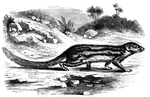
The <em>G. striata</em> is distinguished by its coloring, which consists of brown bands or strips on a light yellowish ground. The body is ten inches long, and the tail long and bushy." —Goodrich, 1885

Striped Galidictis

The G. striata is distinguished by its coloring, which consists of brown bands or strips on…
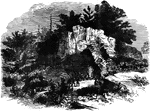
"Killing's Cave, on the banks of the Potomac, near Sharpsburg, the place of refuge of many citizens during the battle of Antietam. A glance at the map of the battle of Antietam will enable our readers to perceive how terribly exposed the little town of Sharpsburg was during the conflict, situated as it was almost between two fires; for, however anxious the Federal generals might be to spare the town, it was impossible to prevent many of the shot and shell from falling into its midst. In the cellar of the Kretzer mansion were congregated men, women and children, all spellbound as they listened to the terrible thunder of the battle. They could tell by the whiz and the awful explosions every now and then how near to them was the work of destruction; and their terror rose to perfect agony whe a shell exploded before one of the opening which gave them a dim light and was the chief means of ventiliation in this chamber of horrors. Of a similar character is our sketch of the cave of refuge near Sharpsburg, and situated on the banks of the Potomac."— Frank Leslie, 1896

Killing's Cave

"Killing's Cave, on the banks of the Potomac, near Sharpsburg, the place of refuge of many citizens…
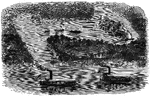
"Bird's-eye view of the burning of a Confederate schooner in Quantico or Dumfries Creek, Potomac River, on the night of October 11th, 1861. On the 10th of October, 1861, Lieutenant Harrell, commanding the steamer <em>Union</em>, of the Potomac Flotilla, stationed at the mouth of Aquia Creek, learning that the Confederates had fitted out a large schooner in Quantico or Dumfries Creek, and had collected a considerable body of troops there, with the intention of crossing the Potomac, determined that the vessel should be destroyed. He accordingly organized an expedition, and with one boat and two launches entered the mouth of the creek about half-past two o'clock on the morning of the 11th. The schooner was discovered some distance up, in charge of a single sentry, who fled and gave the alarm. She was immediately boarded and set on fire; and when her destruction was rendered certain Lieutenant Harrell's men returned to their boats and pulled again for the steamer. Their position was fully revealed by the light of the burning schooner, and they were fired upon continuously from both banks of the narrow stream, but not one of them was injured, though their clothing in many instances was perforated with bullets. The success of the enterprise was complete."— Frank Leslie, 1896

Confederate Schooner

"Bird's-eye view of the burning of a Confederate schooner in Quantico or Dumfries Creek, Potomac River,…
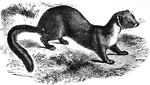
"Its head is somewhat triangular , the muzzle pointed, the eyes prominent and lively; the body much elongated and very flexible; the tail long, thick, and bushy; the toes naked, but at times, probably in winter, covered beneath with think soft hair. The fur is of two corts - the inner extremely soft, short, copious, and of a light, yellowish-gray color; the outer very long, shining, ash-colored at the roots, brown at hte extremity, but of different degrees of intensity at different parts of the body." &mdash; S. G. Goodrich, 1885

Marten

"Its head is somewhat triangular , the muzzle pointed, the eyes prominent and lively; the body much…
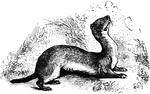
An animal of the genus Mustela, having a long slender body, short legs, long slender tail, and light colored fur.

Weasel

An animal of the genus Mustela, having a long slender body, short legs, long slender tail, and light…
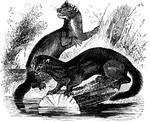
"The mink has a long slender body, the color varying in different species, is generally dark brown, with a light spot under the throat. When seen in the woods or fields the animal appears black, and hence "black as a mink" is a proverbial expression among us." &mdash; S. G. Goodrich, 1885

Mink

"The mink has a long slender body, the color varying in different species, is generally dark brown,…
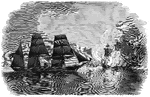
"'The Pirate's Decoy' Captain Semmes, of the Confederate privateer <em>Alabama</em>, decoying ships toward him by burning a prize vessel. The plan that Captain Semmes adopted to bring fish to his net was as follows: Whenever he captured a ship, after taking from her all that he and his officers wanted, he lay by her until dark, and then set her on fire. The light of the burning ship could be seen many miles, and every other ship within seeing distance stood toward the light, thinking to rescue a number of poor fellows from destruction. The pirate kept in the immediate vicinity, awaiting the prey that was sure to come, and the next morning the poor fellows who to serve the cause of humanity had gone many miles out of their course found themselves under the guns of the <em>Alabama</em>, with the certainty that before another twenty-four hours they would share the fate of the ship they went to serve."&mdash; Frank Leslie, 1896

The Pirate's Decoy

"'The Pirate's Decoy' Captain Semmes, of the Confederate privateer Alabama, decoying ships…
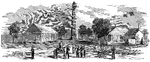
"Tybee Island, Savannah River, Ga.- Views of the lighthouse and barracks- destruction of the lighthouse by the Confederates. Among the numerous structures erected by the United States on the long line of the stormy Atlantic coast for the benefit of the commerce of the world and the safety of the mariners of all nations, none were finer or more useful than the lighthouse on Tybee Island, at the mouth of the Savannah River, familiarly known to sailors as Tybee Light. It was a fixed light, one hundred and eight feet high, and could be seen at a distance of twelve miles. In common with all the other lights on the Confederate coast, it was extinguished by the Georgians soon after the secession of their State. The day after the Federal fleet made its appearance off the mouth of the Savannah River, the Confederates set fire to the interior of the lighthouse, which was burnt, and the costly reflectors destroyed. A similar vandalic measure was resorted to by the Confederates of Charleston, when the Stone Fleet appeared off that harbor. They blew up the celebrated 'Charleston Light.'"— Frank Leslie, 1896

Tybee Island

"Tybee Island, Savannah River, Ga.- Views of the lighthouse and barracks- destruction of the lighthouse…
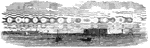
"Fort Taylor, Key West, Fla. Key West, the most western of the Pine Islands, is about sixty miles southwest of Cape Sable, Florida. Its length is four miles, and its width is one mile. Its elevation from the sea does not exceed twenty feet. Its formation is of coral. The name is a corruption of Cago Hueso, or Bone Key, and has no relation to the position of the island, which is not the most western of the reef. On Whitehead's Point, the southwest extemity of the island, is a fixed light, eighty-three and a half feet above the level of the sea. Fort Taylor is a large, first-class fortification, commanding the harbor of Key West at its entrance. The foritication forms an irregular quadrangle, having three channel curtains. It is three hundred yards off the beach and on the southwest point of the island, and stands in a depth of seven or twelve feet of water. The foundation is granite, and the upper works are of brick. The scrap walls have a solidity of eight feet, rising forty feet above the water level. It is proyided with three tiers- two of casemate and one of barbette- and mounts one hundred and twenty-eight 10-inch Columbiad guns on the seaward front, and forty-five heavy pieces toward the beach."&mdash; Frank Leslie, 1896

Fort Taylor

"Fort Taylor, Key West, Fla. Key West, the most western of the Pine Islands, is about sixty miles southwest…
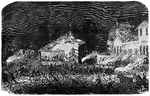
"The war in Georgia. Wagon train passing Resaca at night. Our correspondent wrote: 'No general probably ever attempted a task like Sherman's, so far removed from the base of his operations. The line of railroad is so precarious a dependence that we can well understand the present attempt of the Confederate Wheeler to save Atlanta, and perhaps destroy Sherman by demolishing the road to Chattanooga, burning bridges, blocking up tunnels, etc. The supplies are forwarded to Sherman under great danger, and the advantage is taken of the darkest nights. Our sketch would be interesting from its picturesque beauty, did not the importance invest it with an interest of a far deeper character. A wagon train is passing through the now battle-famous Resaca, guided in the darkness by the light of torches.'"— Frank Leslie, 1896

War in Georgia

"The war in Georgia. Wagon train passing Resaca at night. Our correspondent wrote: 'No general probably…
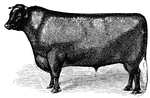
"The head is small and finely formed, the eye bright and clear, the horn light in substance and waxy in color; the chest dep, broad, and full, the brisket set prominently forward, the crops or spaces behind the shoulders full, hips wide, lions broad, the hair soft, the skin mellow and elastic; the colors full red, full white, or any combination of these." &mdash; S. G. Goodrich, 1885

Short Horn Cattle

"The head is small and finely formed, the eye bright and clear, the horn light in substance and waxy…
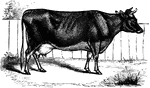
"The Jersey cattle has a small deer-like head, muzzle fine and dark and encircled by a light color, horns small, crumpled, and of amber color, chest broad and deep, back straight, tail fine, udder full in form, well up behind and running well forward, milk veins prominent, escutcheon or milk mirror high and broad and full on thighs." &mdash; S. G. Goodrich, 1885

Jersey Cattle

"The Jersey cattle has a small deer-like head, muzzle fine and dark and encircled by a light color,…
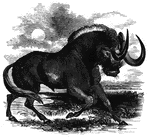
"The Gnu has a formidable pair of horns, leading first downward and then pulling upward, and has been called the <em>Horned Horse</em>. It is about the size of a well-grown ass; the neck, body, and tail resemble those of a small horse; the pace is a species of light gallop." &mdash; S. G. Goodrich, 1885

Gnu

"The Gnu has a formidable pair of horns, leading first downward and then pulling upward, and has been…
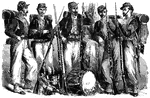
"Group of Ellsworth's Chicago Zouave Cadets. No military organization during the war was more brilliant than the Chicago Zouave Cadets, with their striking and gay uniforms; their flowing red pants; their jaunty crimson caps; their peculiar drab gaiters and leggings, and the loose blue jackets, with rows of small, sparkling buttons, and the light-blue shirt beneath. In all their evolutions the Zouaves displayed great precision."&mdash; Frank Leslie, 1896

Zouave Cadets

"Group of Ellsworth's Chicago Zouave Cadets. No military organization during the war was more brilliant…
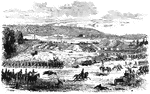
"Battle of Belmont, Mo., opposite Columbus, Ky, November 7th, 1861- Federal forces commanded by U. S. Grant; Confederate forces, by Leonidas Polk. Explanation: 1. Brigadier General Grant and staff directing the movements of the troops. 2. Brigadier General McClernand leading the charge at the head of the Thirty-first Illinois. 3. Thirty-first Illinois, Colonel Logan. 4. Body of Lieutenant Colonel Wendtz, Seventh Ohio. 5. Body of Captain Pulaski, aid-de-camp to McClernand, killed while leading the charge. 6. Caisson ordered to the field from the rear. 7. Twenty-seventh Illinois, Colonel Buford, taking the camp colors of the Confederates. 8. Thirtieth illinois, colonel Fouke. 8A. Twenty-second Illinois, Colonel Dougherty. 9. Light artillery, Captain Taylor. 10. Seventh Ohio, Colonel 11. Captain Schwartz, acting chief of artillery, taking the Confederate battery. 12. Watson's Louisiana field battery. 13. Confederate artillery horses. 14. Battery of heavy ordinance at Columbus. 15. Encampment near Columbus. 16. Confederate ferryboat. 17. Columbus"— Frank Leslie, 1896

Battle of Belmont

"Battle of Belmont, Mo., opposite Columbus, Ky, November 7th, 1861- Federal forces commanded by U. S.…
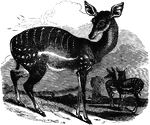
"Is one of the most celebrated of antilopes; it is about two feet high at the shoulder; its limbs are slender but vigorous, and all its actions are light and spirited. In full flight it lays the horns back nearly on the shoulders, and seems to skim over the level plain almost without touching it." &mdash; S. G. Goodrich, 1885

Female Gazelle

"Is one of the most celebrated of antilopes; it is about two feet high at the shoulder; its limbs are…
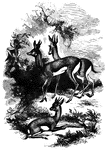
"Is one of the most celebrated of antilopes; it is about two feet high at the shoulder; its limbs are slender but vigorous, and all its actions are light and spirited. In full flight it lays the horns back nearly on the shoulders, and seems to skim over the level plain almost without touching it." &mdash; S. G. Goodrich, 1885

Ariel Gazelle

"Is one of the most celebrated of antilopes; it is about two feet high at the shoulder; its limbs are…
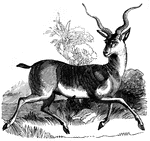
"Its length is four feet; its height two and a half; the legs are long and delicate; the body round, but light and well formed; the head small; the eyes large, lively, and expressive; the ears long, cylindrical, and in continual motion; and the horns forming a complete spiral of two or three turns, wrinkled at the base, distinctly annulated in the middle, and smooth for a couple of inches next the points." &mdash; S. G. Goodrich, 1885

Common Antelope

"Its length is four feet; its height two and a half; the legs are long and delicate; the body round,…
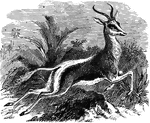
"Is perhaps the most graceful and the most beautifully varied in its colors, of all the antilope. imagination cannot concieve a quadruped more light and airy in form, more delicate in its proprtions, or whose movements are executed with more natural ease and grace." &mdash; S. G. Goodrich, 1885

Spring-Boc

"Is perhaps the most graceful and the most beautifully varied in its colors, of all the antilope. imagination…
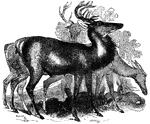
"It is about the size of the European fallow-deer, and resmebles it in temper and character; the color is brown in the summer and gray-brown in winter; the fawns are spotted with white; the tail white beneath, and carried erect when running; the length of the body is five feet five and a half; the height three to three and a half; the weight one hundred and twenty to two hundred pounds. In its form it is light and elegant, and in its movements exceedingly graceful." &mdash; S. G. Goodrich, 1885

Male American Deer

"It is about the size of the European fallow-deer, and resmebles it in temper and character; the color…
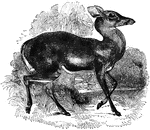
"It is about the size of the European fallow-deer, and resmebles it in temper and character; the color is brown in the summer and gray-brown in winter; the fawns are spotted with white; the tail white beneath, and carried erect when running; the length of the body is five feet five and a half; the height three to three and a half; the weight one hundred and twenty to two hundred pounds. In its form it is light and elegant, and in its movements exceedingly graceful." &mdash; S. G. Goodrich, 1885

Female American Deer

"It is about the size of the European fallow-deer, and resmebles it in temper and character; the color…
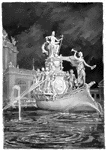
"The World's Fair at Chicago. Central portion of MacMonnies Fountain- effect of electric light."—E. Benjamin Andrews 1895

World's Fair

"The World's Fair at Chicago. Central portion of MacMonnies Fountain- effect of electric light."—E.…
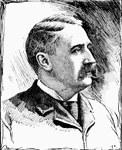
"Charles F. Brush was an inventor, specifically in the field of electricity."&mdash;E. Benjamin Andrews 1895

Charles F. Brush

"Charles F. Brush was an inventor, specifically in the field of electricity."—E. Benjamin Andrews…
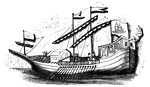
A Spanish caravel. The vessels furnished by Isabella were only <em>caravels</em>, light coasting ships, without decks, and furnished with cars like the ancient gallys.

spanish caravel

A Spanish caravel. The vessels furnished by Isabella were only caravels, light coasting ships,…
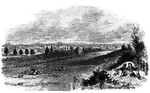
This view is taken from near the house of Mr. Neilson, looking northwest. In the foreground, on the right, are seen the remains of the intrenchments which here crossed the road from Fort Neilson, the fortified long barn. The light field in the distance, toward the right of the picture, with a small house within it, is the ld clearing called 'Freeman's Farm.'

Battle-ground

This view is taken from near the house of Mr. Neilson, looking northwest. In the foreground, on the…
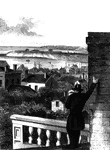
View of Oswego Harbor, 1848. This view is from the top of the United States Hotel, looking east-northeast. It was hastily sketched during the approach of a thunder-storm, and the "huge herald drops" came down just as I traced the distant water-line of the lake. The objects by the figure in the foreground are the balustrade and chimney of the hotel, now (1848) a summer boarding-house for strangers. The first height beyond the water on the right is the point on which stands Fort Oswego. The land in the far distance, on the same side, is Four-mile point, behind which Montcalm landed his forces. On the left is seen the light-house upon one of the stone piers, and beyond it spread out the waters of Lake Ontario.

Oswego Harbor

View of Oswego Harbor, 1848. This view is from the top of the United States Hotel, looking east-northeast.…
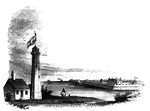
Distant view of Fort Niagra. This view is from the west side of the Niagra River, near the light-house. The fort is on the east side (right side of the picture), at the mouth of the river. The steam-boat seen in the distance is out on Lake Ontario.

Fort Niagra

Distant view of Fort Niagra. This view is from the west side of the Niagra River, near the light-house.…
Leaves without midribs evident when examined against transmitted light; flowers yellow.

Heteranthera

Leaves without midribs evident when examined against transmitted light; flowers yellow.
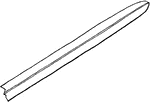
Leaves with midribs evident when examined against light; flowers inconspicuous, not yellow.

Potamogeton

Leaves with midribs evident when examined against light; flowers inconspicuous, not yellow.
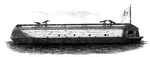
"American Floating Battery. I am indebted to the kindness of Peter Force, Esq., of Washington city (editor of 'The American Archives'), for this drawing of one of the American floating batteries used in the siege of Boston. It is copied from an English mauscript in his possession, and is now published for the first time. I have never met with a description of those batteries, and can judge of their construction only from the drawing. They appear to have been made of strong planks, pierced, near the water-line, for cars; along the sides, higher up, for the light and musketry. A heavy gun was placed in each end, and upon the top were four swivels."&mdash;Lossing, 1851

Floating Battery

"American Floating Battery. I am indebted to the kindness of Peter Force, Esq., of Washington city (editor…
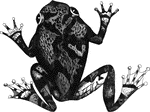
"Is of a brownish or light ash-color, and is found under logs and the bark of decayed trees." — Goodrich, 1859

Squirrel Tree-toad

"Is of a brownish or light ash-color, and is found under logs and the bark of decayed trees." — Goodrich,…
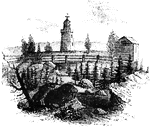
"Rear view at Stony Point. This sketch presents a rear view of the old embankments of the fort, and of the light-house, which is seen by all travelers upon the river, just before entering the Highlands. The beacon stands exactly in the center of the fort, upon the site of the magazine. There was a covered way toward the water on the north side of the hill, and about twenty yards in the rear are some prominent remains of the ravelins which extended across the point."&mdash;Lossing, 1851

Stony Point

"Rear view at Stony Point. This sketch presents a rear view of the old embankments of the fort, and…
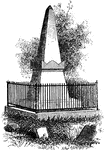
"Van Wart's monument. The following are the inscriptions upon this monument: North Side: 'Here repose the mortal remains of Isaac Van Wart, an elder in the Greenburgh church, who died on the 23d of May, 1828, in the 69th year of his age. Having lived the life, he died the death, of the Christian. South Side: 'The citizens of the county of West Chester erected this tomb in testimony of the high sense they entertained for the virtuous and patriotic conduct of their fellow-citizen, as a memorial sacred to public graditute.' East Side: 'Vincent, Amor Patriae. Nearly half a century before this monument was built, the conscript fathers of America had, in the Senate chamber, voted that Isaac Van Wart was a faithful patriot, one in whom the love of country was invincible, and this tomb bears testimony that the record is true.' West Side: 'Fidelity. On the 23d of September, 1780, Isaac Van Wart, accompanied by John Paulding and David Williams, all farmers of the county of West Chester, intercepted Major Andre, on his return from the American lines in the character of a spy, and, notwithstanding the large bribes offered them for his release, nobly disclaimed to sacrifice their country for gold, secured and carried him to the commanding officer of the district, whereby the dangerous and traitorous conspiracy of Arnold was brought to light, the insiduous designs of the enemy, baffled, the American army saved, and our beloved country free.'"—Lossing, 1851

Van Wart's Monument

"Van Wart's monument. The following are the inscriptions upon this monument: North Side: 'Here repose…
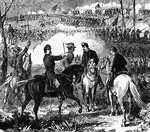
"Battle of Pea Ridge, Ark., fought March 6th, 7th and 8th, 1862, between the Federal forces, 13,000 strong, under Generals Curtis, Sigel, and Asboth, and the combined Confederate army of the Southwest, 25,000 strong, under Generals Van Dorn, Price and McCulloch- total defeat of the Confederates. The official report of this battle by General Curtis is as follows: 'On Thursday, March 6th, the enemy commenced an attack on my right wing, assailling and following the rear guard of a detachment under General Sigel to my main lines on Sugar Creek Hollow, but ceased firing when he met my re-enforcements about 4 P.M. Early on the 7th I ordered an immediate advance of the cavalry and light artillery, under Colonel Osterhaus, with orders to attack and break what I supposed would be the re-enforced line of the enemy. This movement was in progress when the enemy commenced an attack on my right. The fight continued mainly at these points during the day, the enemy having gained the point held by the command of Colonel Carr at Cross Timber Hollow, but was entirely repulsed, with the fall of the commander, McCulloch. At sunrise on the 8th my right and centre renewed the firing, which was immediately answered by the enemy with renewed energy. I immediately ordered the centre and right wing forward, the right turning the left of the enemy and cross firing on his centre. This final position of the enemy was in the arc of a circle. A charge of infantry extending throughout the whole line completely routed the entire Confederate force, which retired in great confusion, but rather safely through the deep, impassable defiles of cross timber.'" — Frank Leslie, 1896

Battle of Pea Ridge

"Battle of Pea Ridge, Ark., fought March 6th, 7th and 8th, 1862, between the Federal forces, 13,000…
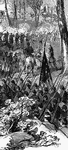
"Battle of Pea Ridge, Ark., fought March 6th, 7th and 8th, 1862, between the Federal forces, 13,000 strong, under Generals Curtis, Sigel, and Asboth, and the combined Confederate army of the Southwest, 25,000 strong, under Generals Van Dorn, Price and McCulloch- total defeat of the Confederates. The official report of this battle by General Curtis is as follows: 'On Thursday, March 6th, the enemy commenced an attack on my right wing, assailling and following the rear guard of a detachment under General Sigel to my main lines on Sugar Creek Hollow, but ceased firing when he met my re-enforcements about 4 P.M. Early on the 7th I ordered an immediate advance of the cavalry and light artillery, under Colonel Osterhaus, with orders to attack and break what I supposed would be the re-enforced line of the enemy. This movement was in progress when the enemy commenced an attack on my right. The fight continued mainly at these points during the day, the enemy having gained the point held by the command of Colonel Carr at Cross Timber Hollow, but was entirely repulsed, with the fall of the commander, McCulloch. At sunrise on the 8th my right and centre renewed the firing, which was immediately answered by the enemy with renewed energy. I immediately ordered the centre and right wing forward, the right turning the left of the enemy and cross firing on his centre. This final position of the enemy was in the arc of a circle. A charge of infantry extending throughout the whole line completely routed the entire Confederate force, which retired in great confusion, but rather safely through the deep, impassable defiles of cross timber.'" — Frank Leslie, 1896

Battle of Pea Ridge

"Battle of Pea Ridge, Ark., fought March 6th, 7th and 8th, 1862, between the Federal forces, 13,000…
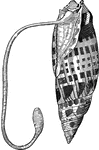
"Noted for a very long proboscis, sometimes twice the length of the shell. The latter is turretted, smooth, white, and spotted with light red." &mdash; Goodrich, 1859

Bishop's mitre shell

"Noted for a very long proboscis, sometimes twice the length of the shell. The latter is turretted,…
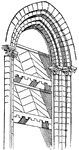
"A vertical series of sloping roofs or broad slats, inclined outward and downward, forming the filling of a belfry-light, and designed to admit ventilation to the timber frame while protecting the interior from rain and wind, and to direct downward the sound of the bells."-Wright, 1902

Abat-vent

"A vertical series of sloping roofs or broad slats, inclined outward and downward, forming the filling…
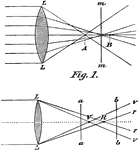
"In <em>optics</em>, a deviation in the rays of light when unequally refracted by a lens or reflected by a mirror, so that they do not converge and meet in a point or focus, but separate, forming an indistinct image of the object, or an indistinct image with prismatically colored edges."-Wright, 1902

Aberration

"In optics, a deviation in the rays of light when unequally refracted by a lens or reflected…
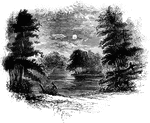
"Trading Ford. This view of the Trading Ford, where greene, with Morgan and his light troops, crossed the Yadkin, is from the east side of the river. It is just at the foot of an island, about a mile and a half below the great bridge on the road to Salisbury. The river is usually fordable between the island and the stakes seen in the picture; below that point the water is deep."&mdash;Lossing, 1851

Trading Ford

"Trading Ford. This view of the Trading Ford, where greene, with Morgan and his light troops, crossed…
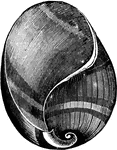
"The <em>B. velum</em> is very elegant, and of a light-brown color; the apex and base are both white, bordered with dark brown bands." &mdash; Goodrich, 1859

Bulla velum

"The B. velum is very elegant, and of a light-brown color; the apex and base are both white,…
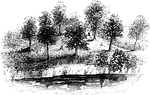
"Site of Fort Watson."—Lossing, 1851

<p>The Siege of Fort Watson was an American Revolutionary War confrontation in South Carolina that began on April 15, 1781 and lasted until April 23, 1781. Continental Army forces under Henry "Light Horse Harry" Lee and South Carolina militia under Francis Marion besieged Fort Watson, a fortified British outpost that formed part of the communication and supply chain between Charleston and other British outposts further inland.

<p>The attackers, lacking artillery, were unable to make a dent in the fortified works, and failed in attempts to deny the garrison of a water supply. They then devised a plan to build a tower from which sharpshooters could fire into the fort's walls. Fort Watson was once again attacked by the Americans on April 23, with the British forces unable to control the walls due to musket fire from the tower. They surrendered shortly afterwards.

Fort Watson

"Site of Fort Watson."—Lossing, 1851 The Siege of Fort Watson was an American Revolutionary War confrontation…
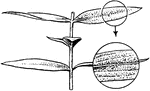
Leaf, when examined against light with lens, showing semitransparent dots; flowers yellow or pink.
Hypericum

Leaf, when examined against light with lens, showing semitransparent dots; flowers yellow or pink.

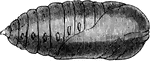
"Among the larger and more splendid moths of our own country is the Luna Moth, or Green Emperor Moth, <em>attacus luna</em> a large and beautiful species, common in the Northern United States. The wings, which are drawn out into what appears like a long tail, are of a light yellowish-green color, marked with eye-spots near the middle. The expanse of the wings is four inches. The caterpilar lives on walnut-trees, and spins a cocoon of which silk might be made. Many of these cocoons may be picked up on the ground, in autumn or spring, beneath the trees frequented by these insect."  &mdash; Goodrich, 1859

Chrysalis of the Luna Moth

"Among the larger and more splendid moths of our own country is the Luna Moth, or Green Emperor Moth,…
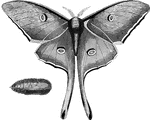
"Among the larger and more splendid moths of our own country is the Luna Moth, or Green Emperor Moth, <em>attacus luna</em> a large and beautiful species, common in the Northern United States. The wings, which are drawn out into what appears like a long tail, are of a light yellowish-green color, marked with eye-spots near the middle. The expanse of the wings is four inches. The caterpilar lives on walnut-trees, and spins a cocoon of which silk might be made. Many of these cocoons may be picked up on the ground, in autumn or spring, beneath the trees frequented by these insect."  &mdash; Goodrich, 1859

Luna Moth

"Among the larger and more splendid moths of our own country is the Luna Moth, or Green Emperor Moth,…