
"Felidæ or Felinæ is the cat tribe, a family of carnivorous quadrupeds, including the domestic cat, lions, tigers, panthers, leopards, and lynxes. The felidæ are found in all parts of the world except Australia. "—(Charles Leonard-Stuart, 1911)

Tiger Head

"Felidæ or Felinæ is the cat tribe, a family of carnivorous quadrupeds, including the domestic…
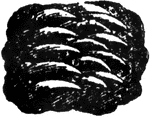
"Felidæ or Felinæ is the cat tribe, a family of carnivorous quadrupeds, including the domestic cat, lions, tigers, panthers, leopards, and lynxes. The felidæ are found in all parts of the world except Australia. "—(Charles Leonard-Stuart, 1911)

Partial Tiger Tongue

"Felidæ or Felinæ is the cat tribe, a family of carnivorous quadrupeds, including the domestic…
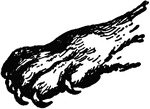
"Felidæ or Felinæ is the cat tribe, a family of carnivorous quadrupeds, including the domestic cat, lions, tigers, panthers, leopards, and lynxes. The felidæ are found in all parts of the world except Australia. "—(Charles Leonard-Stuart, 1911)

Tiger Paw

"Felidæ or Felinæ is the cat tribe, a family of carnivorous quadrupeds, including the domestic…
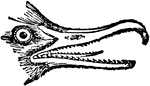
"The Goosander is a web-footed bird in the duck family. The adult male, which measures 26 inches in length, has the head and upper part of the neck of a rich shining green, the feathers of the crown and back of the head elongated, the back black and gray, the wings black and white, the breast and belly of a delicate reddish-buff color. The bill, legs, and feet are orange-red. the female, which is rather smaller, has the head reddish-brown, with a less decided tuft than the male, and much grayer plumage. The goosander is a native of the Arctic regions, extending into the temperate parts of America, Europe and Asia."—(Charles Leonard-Stuart, 1911)

Goosander

"The Goosander is a web-footed bird in the duck family. The adult male, which measures 26 inches in…
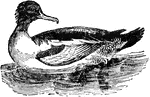
"The Goosander is a web-footed bird in the duck family. The adult male, which measures 26 inches in length, has the head and upper part of the neck of a rich shining green, the feathers of the crown and back of the head elongated, the back black and gray, the wings black and white, the breast and belly of a delicate reddish-buff color. The bill, legs, and feet are orange-red. the female, which is rather smaller, has the head reddish-brown, with a less decided tuft than the male, and much grayer plumage. The goosander is a native of the Arctic regions, extending into the temperate parts of America, Europe and Asia."—(Charles Leonard-Stuart, 1911)

Goosander

"The Goosander is a web-footed bird in the duck family. The adult male, which measures 26 inches in…
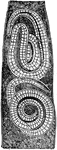
"Trichina Spiralis is the name given to a peculiar nematoid worm which inhabits the muscles, usually of the pig. The viviparous females, originally living in rats, being about eight days after entering the intestines of their second host, a pig, to give birth to the larvæ, which pass into various parts of the body, especially the muscles, where they coil up in a sack, or cyst, which eventually becomes calcareous and whitish. When pork thus infected is eaten the worms are set free in the stomach of their third host (man), and in three or four days there become sexually mature, each female being capable of producing 1,000 young."—(Charles Leonard-Stuart, 1911)

Trichina Spiralis

"Trichina Spiralis is the name given to a peculiar nematoid worm which inhabits the muscles, usually…
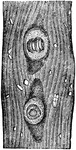
"Trichina Spiralis is the name given to a peculiar nematoid worm which inhabits the muscles, usually of the pig. The viviparous females, originally living in rats, being about eight days after entering the intestines of their second host, a pig, to give birth to the larvæ, which pass into various parts of the body, especially the muscles, where they coil up in a sack, or cyst, which eventually becomes calcareous and whitish. When pork thus infected is eaten the worms are set free in the stomach of their third host (man), and in three or four days there become sexually mature, each female being capable of producing 1,000 young."—(Charles Leonard-Stuart, 1911)

Trichina Spiralis

"Trichina Spiralis is the name given to a peculiar nematoid worm which inhabits the muscles, usually…
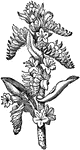
"Viper's Bugloss is a genus of plants. The species are large herbaceous plants or shrubs, rough with tubercles and hairs. Their flowers are often very beautiful. the common viper's bugloss, a large annual plant, is a native of Great Britain and of most parts of Europe growing in dry places, not infrequently in cornfields. Its flowers are at first reddish, and afterward blue. It derives its name, viper's bugloss, from spots on its stem, which somehat resemble those of the viper, and the property of healing viper's bites was therefore ascribed to it. Other herbaceous species are found in North and South America, and other parts of the world. Shrubby species are found chiefly in the Canaries and South Africa."—(Charles Leonard-Stuart, 1911)

Viper's Bugloss

"Viper's Bugloss is a genus of plants. The species are large herbaceous plants or shrubs, rough with…
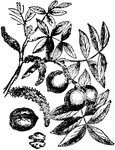
"Walnut is a genus comprising seven or eight species of beautiful trees. The common walnut is a native of Persia and the Himalayas, but has long been cultivated in all parts of the S. of Europe. The date of its introduction is unknown, but it was certainly cultivated by the Romans in the reign of Tiberius. It is a lofty tree of 60 to 90 feet, with large spreading branches. The leaves have two to four pairs of leaflets, and a terminal one."—(Charles Leonard-Stuart, 1911)

Walnut

"Walnut is a genus comprising seven or eight species of beautiful trees. The common walnut is a native…
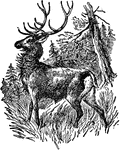
"Wapiti is the name given by the North American Indians to an animal, a native of North America, ranging from the Carolinas to lat. 56-57 degrees N. It is closely allied to but considerably larger than the stag, standing about 54 inches at the shoulder; yellowish brown on upper parts; sides gray, long coarse hair in front of neck, like a dewlap; antlers large, brow-tine duplicated. It frequents low grounds, or woody tracts near savannahs or marshes. The venison is of little value, as it is coarse and dry; but the hide makes excellent leather. It is called also, but erroneously, the elk and gray moose."—(Charles Leonard-Stuart, 1911)

Wapiti

"Wapiti is the name given by the North American Indians to an animal, a native of North America, ranging…
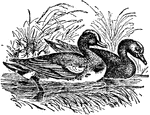
"Wigeon is one of the most popular birds with the American sportsman. Length about eighteen inches; the male has the forehead and top of head white, cheeks and hinged part of the neck reddish-chestnut, upper parts grayish-white, irregularly zigzagged with black, wing coverts white tipped with black, primaries dark brown, speculum green, edged with black; throat rufous, breast and belly white; the female has sober plumage of various shades of brown. The wigeon is one of the commonest ducks of the extreme N. of Europe, frequenting grassy swamps, lakes, and rivers, and feeding in the daytime, chiefly on aquatic vegetation. The American wigeon is larger than the European or common wigeon, and has the upper parts finely waved transversely with black and reddish-brown, top of head and under parts white. It breeds chiefly in the N. parts of America and is common in winter on the coasts of the United States and in the rice fields. The flesh of both species is esteemed for the table, and they are hunted both for food and for sport."—(Charles Leonard-Stuart, 1911)

Wigeon

"Wigeon is one of the most popular birds with the American sportsman. Length about eighteen inches;…
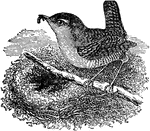
"Wren is a genus of birds, having a slender, slightly curved, and pointed bill; the wings very short and rounded; the tail short, and carried erect; the legs slender, and rather long. Their plumage is generally dull. They are abundant in the neotropical region, less common in the nearctic, palæarctic, and parts of the Oriental regions. They live on or near the ground, seeking for insects and worms among low brushes, and in other similar situations. The common or European wren is found in all parts of Erurope, and in Morocco and Algeria, and in Asia Minor and Northern Persia. The common wren is more abundant in the N. than in the central and S. parts of Europe. It frequents gardens, hedges, and thickets. Its flight is not long sustained; it merely flits from bush to bush, or from one stone to another, with very rapid motion of the wings. It sometimes ascends trees, nearly in the manner of creepers."—(Charles Leonard-Stuart, 1911)

Wren

"Wren is a genus of birds, having a slender, slightly curved, and pointed bill; the wings very short…
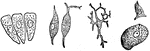
"A, columnar cells found lining various parts of the intestines (called <em>columnar epthelium</em>); B, cells of a fusiform or spindle shape found in the loose tissue under the skin and in other parts (called <em>connective-tissue cells</em>); C, cell having many processes or projections - such are found in some kinds of connective tissue; D, primitive cells composed of protoplasm with nucleus, and having no cell wall." &mdash; Blaisedell, 1904

Various forms of cells

"A, columnar cells found lining various parts of the intestines (called columnar epthelium);…
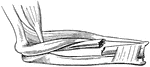
"When a bone is broken, blood trickles out between the injured parts, and afterwards gives place to a sticky, watery fluid, which gradually becomes thicker, like a syrup or jelly. This is slowly replaced by a new bone structure and forms a kind of cement to gold together the broken ends." — Blaisedell, 1904

Broken Radius

"When a bone is broken, blood trickles out between the injured parts, and afterwards gives place to…
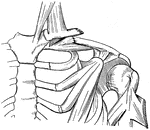
"When a bone is broken, blood trickles out between the incjured parts, and afterwards gives place to a sticky, watery fluid, which gradually becomes thicker, like a syrup or jelly. This is slowly replaced by a new bone structure and forms a kind of cement to gold together the broken ends." — Blaisedell, 1904

Broken Clavicle

"When a bone is broken, blood trickles out between the incjured parts, and afterwards gives place to…
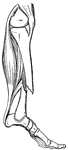
"When a bone is broken, blood trickles out between the injured parts, and afterwards gives place to a sticky, watery fluid, which gradually becomes thicker, like a syrup or jelly. This is slowly replaced by a new bone structure and forms a kind of cement to gold together the broken ends." — Blaisedell, 1904

Broken Tibia

"When a bone is broken, blood trickles out between the injured parts, and afterwards gives place to…
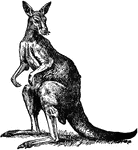
"The Kangaroo is an animal of Australia, first observed by a party of sailors on the coast of New South Wales. The great kangaroo has large hind legs, with a huge tail, short fore limbs, and is about the height of a man. It is a vegetable feeder, and is destructive to the crops of the settlers in the less inhabited parts of Australia; in the long-settled districts it is much rarer. Its ordinary method of progression is by a series of great leaps, 10 to 15 feet or more. Many species are known to exist."&mdash;(Charles Leonard-Stuart, 1911)

Kangaroo

"The Kangaroo is an animal of Australia, first observed by a party of sailors on the coast of New South…
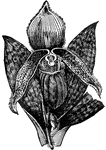
"Lady's Slipper is a genus of plants. The genus is remarkable for the large inflated lip of the corolla. Several very beautiful species are natives of the colder parts of North America."&mdash;(Charles Leonard-Stuart, 1911)

Lady's Slipper

"Lady's Slipper is a genus of plants. The genus is remarkable for the large inflated lip of the corolla.…
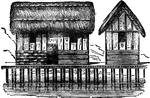
"The earliest account of lake dwellings is to be found in Herodotus, who describes a Thracian tribe living, in 520 B.C., in a small mountain lake of what is now Rumelia. The custom of constructing these habitations has come down to the present day. The fisherman of Lake Prasias, near Salonica, still inhabit wooden cottages built over the water, as the Thracian tribes did, and in the East Indies the practice of building lake settlements is very common. The lake dwellings proper of Switzerland came to light during the winter months of 1853-1854, when the water of the lakes fell much below its ordinary level. Dr. Keller, who first described these lake dwellings, says that the main platform was made of round timbers, rarely of split boards, covered with a bed of mud; the walls and sides were in great measure of interlaced branches, the interstices filled with moss, and daubed with clay. In his opinion, all the evidence goes to show they were rectangular in shape. It is probable that the huts were thatched, and the parts used as dormitories strewn with straw or hay."&mdash;(Charles Leonard-Stuart, 1911)

Lake Dwellings

"The earliest account of lake dwellings is to be found in Herodotus, who describes a Thracian tribe…
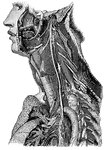
"Showing its distribution by its branches and ganglia to the larynx, pharynx, heart, lungs, and other parts." — Blaisedell, 1904

Trunk of the Pneumogastric Nerve

"Showing its distribution by its branches and ganglia to the larynx, pharynx, heart, lungs, and other…
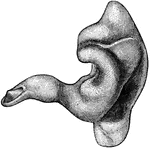
"A Cast of the External Auditory Canal. The auditory canal is a passage in the solid potion of the temporal bone. It is lined by skin on which there are fine hairs, and a set of glands secreting earwax, which serves to moisten the parts, catch particles fo dust, and keep away small insects." &mdash; Blaisedell, 1904

External auditory canal

"A Cast of the External Auditory Canal. The auditory canal is a passage in the solid potion of the temporal…
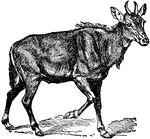
"The Nylghau is the largest of the few true antelopes found in India, where it is confined to the central parts. It frequents forests and low jungles, associating in small herds."&mdash;(Charles Leonard-Stuart, 1911)

Nylghau

"The Nylghau is the largest of the few true antelopes found in India, where it is confined to the central…
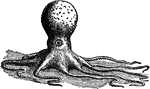
"The Octopus is the typical genus of the family Octopodid&aelig;. The body is oval, warty, or cirrose, finless; arms long, unequal, suckers in two rows, mantle supported in front by the branchial septum. In the male the third right arm is hectocotylized. Found on the coasts of the temperate and tropical zones. Forty-six species are known, varying in length from one inch only to a number of feet. They are solitary animals, frequenting rocky shores, and are very active and voracious, the females oviposit on seaweeds or in empty shells. The term 'octopus' is applied in the United States to monopolies supposed to resemble the octopus in their grasping and voracious character."&mdash;(Charles Leonard-Stuart, 1911)

Octopus

"The Octopus is the typical genus of the family Octopodidæ. The body is oval, warty, or cirrose,…
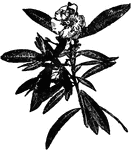
"The Oleander is the common and sweet-scented oleander. They have lanceolate coriaceous leaves, with parallel veins and fine roseate flowers. The former is a native of India, now naturalized in many warm countries. Sweet-scented oleander is wild in Central India, Scinde, Afghanistan, and the outer Himalayas to 5,500 feet. Often cultivated in India, etc. All parts of the plants, especially the root, are poisonous."&mdash;(Charles Leonard-Stuart, 1911)

Oleander

"The Oleander is the common and sweet-scented oleander. They have lanceolate coriaceous leaves, with…
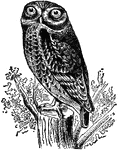
"The owl is a popular name for any nocturnal, raptorial bird, of which about 200 species are known. Their classification is in a very unsettled state. Willoughby's division into two sections&ndash; one having 'ears' or 'horns,' as the tufts of feathers on their heads were called, the other destitute of such appendages&ndash; was shown to be unnatural by Geoffroy St. Hilaire. The prevailing color of the plumage is brown, with a tinge of rusty-red, and it is exceedingly loose and soft, so that their flight (even in the larger species) is almost noiseless, enabling them to swoop upon their prey, which they hunt in the twilight. All owls cast up in the form of pellets the indigestible parts of the food swallowed. These castings may be seen under any owl-roost, and show plainly the great service these birds render to man in destroying rats and mice. They range over the whole globe."&mdash;(Charles Leonard-Stuart, 1911)

Rock Owl

"The owl is a popular name for any nocturnal, raptorial bird, of which about 200 species are known.…
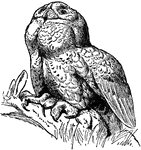
"The owl is a popular name for any nocturnal, raptorial bird, of which about 200 species are known. Their classification is in a very unsettled state. Willoughby's division into two sections&ndash; one having 'ears' or 'horns,' as the tufts of feathers on their heads were called, the other destitute of such appendages&ndash; was shown to be unnatural by Geoffroy St. Hilaire. The prevailing color of the plumage is brown, with a tinge of rusty-red, and it is exceedingly loose and soft, so that their flight (even in the larger species) is almost noiseless, enabling them to swoop upon their prey, which they hunt in the twilight. All owls cast up in the form of pellets the indigestible parts of the food swallowed. These castings may be seen under any owl-roost, and show plainly the great service these birds render to man in destroying rats and mice. They range over the whole globe."&mdash;(Charles Leonard-Stuart, 1911)

Great Snow Owl

"The owl is a popular name for any nocturnal, raptorial bird, of which about 200 species are known.…
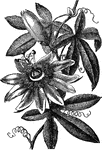
"Pasiflora is the passion-flower. Generally climbing herbs or shrubs. Fruit succulent, seeds many. Found chiefly in tropical America. The three stigmas seemed to the devout Roman Catholics of South America to represent nails; one transfixing each hand, and one the feet of the crucified Saviour; the five anthers, His five wounds; the rays of the corona, His crown of thorns, or the halo of glory around His head; the digitate leaves, the hands of those who scourged Him; the tendrils, the scourge itself; while, finally, the 10 parts of the perianth were the 10 apostles&ndash; that is, the 12 wanting Judas who betrayed, and Peter who denied, his Lord."&mdash;(Charles Leonard-Stuart, 1911)

Passion Flower

"Pasiflora is the passion-flower. Generally climbing herbs or shrubs. Fruit succulent, seeds many. Found…
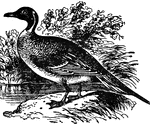
"The Pintail Duck has the upper parts and flanks ash, with narrow stripes of black; under parts white; head umber-brown; tail pointed. It inhabits the N. of America and Europe."&mdash;(Charles Leonard-Stuart, 1911)

Pintail Duck

"The Pintail Duck has the upper parts and flanks ash, with narrow stripes of black; under parts white;…
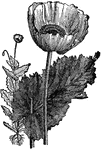
"Poppy is a genus of plants, of which there are numerous species, mostly natives of Europe and Asia, some of them found in the very N. regions, but most of them in the warmer temperate parts. By far the most important species is that known as the opium poppy, also called the white poppy and the oil poppy. But the same species is important on account of the bland fixed oil of the seeds, and is much cultivated as an oil plant. Poppy oil is as sweet as olive oil, and is used for similar purposes. It is imported into the United States in considerable quantities from India. A variety with double flowers is cultivated in flower gardens, under the name of carnation poppy. <em>a,</em> whole plant"&mdash;(Charles Leonard-Stuart, 1911)

Opium Poppy

"Poppy is a genus of plants, of which there are numerous species, mostly natives of Europe and Asia,…
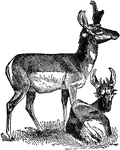
"The Prong-horn Antelope inhabits the W. parts of North America, from 53 degrees N. to the plains of Mexico and California. It is rather more than four feet in length, and stands three feet at the shoulder. Pale fawn above and on the limbs; breast, abdomen, and rump white. The horns are branched, and are shed annually."&mdash;(Charles Leonard-Stuart, 1911)

Prong-horn Antelope

"The Prong-horn Antelope inhabits the W. parts of North America, from 53 degrees N. to the plains of…
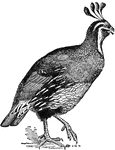
"The Quail is a small game bird; the Virginia species is common in North America, and so far south as Honduras. It is larger than the European quail, and is better eating. The California crested quail is another American species. THe quail, genus Coturnix, is widely distributed over the Eastern Hemisphere, visiting Europe in early summer and returning S. in the autumn, when immense numbers are caught and fattened for the market. Length about seven inches, general color reddish-brown, with buff streaks on the upper surface; throat rufous; head, dark brown above, striped with ocherous white, sides reddish-brown, lower parts pale buff, fading into white on belly. Color less bright in the hen bird, and the rufous tinge absent from the throat. They nest on the ground, laying from 9 to 15 pyriform, yellowish-white eggs, blotched with dark-brown. The males are polygamous and extremely pugnacious."&mdash;(Charles Leonard-Stuart, 1911)

Lophortyx Californicus Quail

"The Quail is a small game bird; the Virginia species is common in North America, and so far south as…
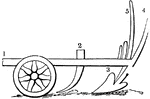
"A plough. Among the Greek and Romans the three most essential parts of the plough were-the plough tail, the share-beam, that is, the piece of wood to which the share is fixed, and the pole. In the time and country of Virgil it was the custom to force a tree into the crooked form of the buris, or plough-tail. The upper end of the buris being held by the ploughman, the lower part, below its junction with the pole, was used to hold the dentale or share-beam, which was either sheathed with metal, or driven bare into the ground, according to circumstances. The term vomer was sometimes applied to the end of the dentale. The image distinctly shows the pole (1), the coulter (2), the dentale (3), the buris (4), and the handle (5)." &mdash; Smith, 1873

Aratrum

"A plough. Among the Greek and Romans the three most essential parts of the plough were-the plough tail,…
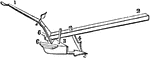
"A plough. Among the Greek and Romans the three most essential parts of the plough were-the plough tail, the share-beam, that is, the piece of wood to which the share is fixed, and the pole. In the time and country of Virgil it was the custom to force a tree into the crooked form of the buris, or plough-tail. The upper end of the buris being held by the ploughman, the lower part, below its junction with the pole, was used to hold the dentale or share-beam, which was either sheathed with metal, or driven bare into the ground, according to circumstances. The term vomer was sometimes applied to the end of the dentale. The image distinctly shows the buris (1), the temo (2), the dentale (3), the culter (4), the vomer (5), and the aures (6)." &mdash; Smith, 1873

Aratrum

"A plough. Among the Greek and Romans the three most essential parts of the plough were-the plough tail,…
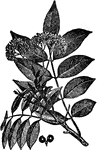
"The Quassia is a tree cultivated in the West Indies and the parts adjacent. It has terminal clusters of large, red flowers, and unequally pinnate leaves. It comes to this country in logs or billets, and is retained as chips or raspings. It is given as an extract, an infusion, or a tincture. An infusion of it is used to poison flies."&mdash;(Charles Leonard-Stuart, 1911)

Quassia

"The Quassia is a tree cultivated in the West Indies and the parts adjacent. It has terminal clusters…

"A Ring is any circle or section of a cylinder. Rings of gold, silver, and of other metals and materials have been worn in all times and countries, and while they have been used to decorate the ears, neck, nose, lips, arms, legs, and toes, finger rings have always occupied the most important and significant place among such ornaments. From the earliest period of civilized relationships the finger ring was a convenient means for carrying the signet of its wearer. Fig. 2 shows a form of betrothal ring called a gimmel, or linked ring, which was used in later times; the upper figure shows the three parts brought together, the lower figures the parts separately."&mdash;(Charles Leonard-Stuart, 1911)

Ring

"A Ring is any circle or section of a cylinder. Rings of gold, silver, and of other metals and materials…
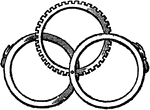
"A Ring is any circle or section of a cylinder. Rings of gold, silver, and of other metals and materials have been worn in all times and countries, and while they have been used to decorate the ears, neck, nose, lips, arms, legs, and toes, finger rings have always occupied the most important and significant place among such ornaments. From the earliest period of civilized relationships the finger ring was a convenient means for carrying the signet of its wearer. Fig. 2 shows a form of betrothal ring called a gimmel, or linked ring, which was used in later times; the upper figure shows the three parts brought together, the lower figures the parts separately."&mdash;(Charles Leonard-Stuart, 1911)

Ring

"A Ring is any circle or section of a cylinder. Rings of gold, silver, and of other metals and materials…
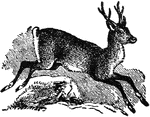
"A Roe (Capreolus caprea) is a small species of deer inhabiting Europe and some parts of Western Asia. It was once plentiful in Wales and in the hilly parts of England, as well as in the S. of Scotland, but is now very rare."&mdash;(Charles Leonard-Stuart, 1911)

Roebuck

"A Roe (Capreolus caprea) is a small species of deer inhabiting Europe and some parts of Western Asia.…
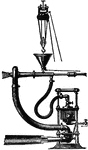
"Sand Blast is one of the most wonderful uses of sand, by means of which glass, stone, metals, or any other hard substance may be cut or engraved. If a stream of sharp sand be let fall from a high box (as high as the ceiling of a room) through a tube on to a plate of glass held under it, the sand will cut away little grains of the glass till at length the whole surface will be cut or scratched and it will look like ground glass. If, instead of cutting the glass all over, it is wanted to engrave a pattern or figure on it, the workman has only to cover the parts of the glass which he does not want cut with a stencil plate made of leather, rubber, paper, wax, etc., for the sand will not cut any soft substance. Metals and stones may also be cut by means of the sand blast, which will not only scratch the surface, but will cut it away to any depth."&mdash;(Charles Leonard-Stuart, 1911)

Sand Blast Apparatus

"Sand Blast is one of the most wonderful uses of sand, by means of which glass, stone, metals, or any…
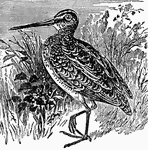
"Snipe is the name of a common family of birds. The common American snipe is about equal in size to the common snipe of Europe, and much resembles it also in plumage. The tail has 16 feathers. This species is abundant in summer in the N. parts of the United States and in Canada, and in the more S. States in winter. It is much in request for the table, and is often caught in snares. It is much esteemed as a delicious and well-flavored dish."&mdash;(Charles Leonard-Stuart, 1911)

Snipe

"Snipe is the name of a common family of birds. The common American snipe is about equal in size to…
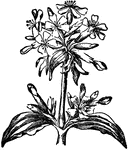
"Soapwort (Saponaria), a genus of plants of the natural order Caryophyllace&aelig;; so called because the bruised leaves produce a lather like soap when agitated in the water. Common soapwort grows by the roadside in the United States from New England to Georgia. It is a native of many parts of Europe, and is found on way sides, river banks, and thickets; in Great Britain it is found in alluvial meadows and under hedges. It has handsome pink-like flowers."&mdash;(Charles Leonard-Stuart, 1911)

Soapwort

"Soapwort (Saponaria), a genus of plants of the natural order Caryophyllaceæ; so called because…
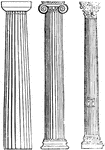
"A pillar or column. The use of the trunks of trees placed upright for supporting buildings, unquestionably led to the adoption of similar supports wrought in stone. As the tree required to be based upon a flat square stone, and to have a stone or tile of similar form fixed on its summit to preserve it from decay, so the column was made with a square base, and was covered with an abacus. Hence the principal parts of which every column consists are three, the base, the shaft, and the capital. In the Doric, which is the oldest style of Greek architecture, we must consider all the columns in the same row as having one common base, whereas in the Ionian and Corinthian each column has a seperate base, called spira. The capitals of these two latter orders show, on comparison with the Doric, a much richer style of ornament; and the character of lightness and elegence is further obtained in them by their more slender shaft, its height being much greater in proportion to its thickness. Of all these circumstances some idea may be formed by the inspection of the three accompanying specimens of pillars. The first on the left hand is Doric, the second Ionic, and the third Corinthian." &mdash; Smith, 1873

Columna

"A pillar or column. The use of the trunks of trees placed upright for supporting buildings, unquestionably…
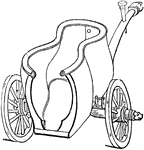
"A chariot, a car. These terms appear to have denoted those two wheeled vehicles for the carriage of persons, which were open overhead, thus differing from the corpentum, and closed in front, in which the differed from the cisium. The most essential articles in the construction of the currus were, 1. The rim. 2. The axle. 3. The wheels, which revolved upon the axle and were prevented from coming off by the insertion of pins into the extremities of the axles. The parts of the wheel were: a. The nave. b. The spokes. c. The felly. d. The tire. 4. The pole." &mdash; Smith, 1873

Currus

"A chariot, a car. These terms appear to have denoted those two wheeled vehicles for the carriage of…
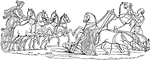
"A chariot, a car. These terms appear to have denoted those two wheeled vehicles for the carriage of persons, which were open overhead, thus differing from the corpentum, and closed in front, in which the differed from the cisium. The most essential articles in the construction of the currus were, 1. The rim. 2. The axle. 3. The wheels, which revolved upon the axle and were prevented from coming off by the insertion of pins into the extremities of the axles. The parts of the wheel were: a. The nave. b. The spokes. c. The felly. d. The tire. 4. The pole." &mdash; Smith, 1873. This picture shows a Quadrigae.

Currus

"A chariot, a car. These terms appear to have denoted those two wheeled vehicles for the carriage of…
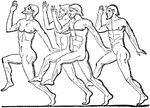
"The Olympic games were of greater efficacy than the Amphictyonic Council in promoting the spirit of union among the various branches of the Greek race, and in keeping alive a feeling of their common origin. They were open to all persons who could prove their Hellenic blood, and were frequented by spectators from all parts of the Grecian world. They were celebrated at Olympia, on the banks of the alpheus, in the territory of Elis." &mdash; Smith, 1882

Foot-race

"The Olympic games were of greater efficacy than the Amphictyonic Council in promoting the spirit of…
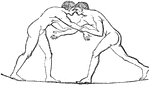
"The Olympic games were of greater efficacy than the Amphictyonic Council in promoting the spirit of union among the various branches of the Greek race, and in keeping alive a feeling of their common origin. They were open to all persons who could prove their Hellenic blood, and were frequented by spectators from all parts of the Grecian world. They were celebrated at Olympia, on the banks of the alpheus, in the territory of Elis." &mdash; Smith, 1882

Wrestling

"The Olympic games were of greater efficacy than the Amphictyonic Council in promoting the spirit of…
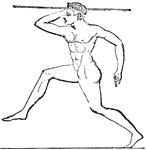
"The Olympic games were of greater efficacy than the Amphictyonic Council in promoting the spirit of union among the various branches of the Greek race, and in keeping alive a feeling of their common origin. They were open to all persons who could prove their Hellenic blood, and were frequented by spectators from all parts of the Grecian world. They were celebrated at Olympia, on the banks of the alpheus, in the territory of Elis." &mdash; Smith, 1882

Hurling the javelin

"The Olympic games were of greater efficacy than the Amphictyonic Council in promoting the spirit of…
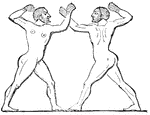
"The Olympic games were of greater efficacy than the Amphictyonic Council in promoting the spirit of union among the various branches of the Greek race, and in keeping alive a feeling of their common origin. They were open to all persons who could prove their Hellenic blood, and were frequented by spectators from all parts of the Grecian world. They were celebrated at Olympia, on the banks of the alpheus, in the territory of Elis." &mdash; Smith, 1882

Boxing

"The Olympic games were of greater efficacy than the Amphictyonic Council in promoting the spirit of…
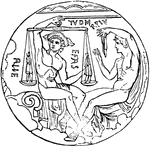
"A balance, a pair of scales. The principal parts of this instrument were: 1. The beam. 2. The two scales, called in Latin lances. The beam was made without a tongue, being held by a ring or other appendage, fixed in the centre. The annexed woodcut represents Mercury and Apollo engaged in exploring the fates of Achilles and Memnon, by weighing the attendent genius of the one against that of the other." &mdash; Smith, 1873

Libra

"A balance, a pair of scales. The principal parts of this instrument were: 1. The beam. 2. The two scales,…
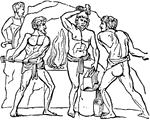
"A hammer, a mallet. In the hands of the farmer the mallet of wood served to break down the clods and to pulverize them. The butcher used it in slaying cattle, by striking the head, and we often read of it as used by the smith upon the anvil. When several men were employed at te same anvil it was a matter of necessity that they should strike in time, and Virgil, accordingly says of the Cyclopes, "inter se brachia tollunt in numerum." The scene which he describes is represented in the annexed woodcut, taken from an ancient bas-relief, in which Vulcan, Brontes, and Steropes, are seen forging the metal, while the third Cyclops, Pyracmon, blows the bellows. Beside the anvil is seen the vessel of water in which the hot iron or bronze was immersed. But besides the employment of the hammer upon the anvil for making all ordinary utensils, the smith wrought with this instrument figures which were either small and fine, some of their parts being beaten as thin as paper, and being in very high relief, as in the bronzes of Siris, or of colossal proportions, being composed of seperate plates riveted together." &mdash; Smith, 1873

Malleus

"A hammer, a mallet. In the hands of the farmer the mallet of wood served to break down the clods and…
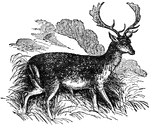
A species of deer well known in Britain, being very commonly kepts in parks, as it is also in most parts of Europe.

Fallow Deer

A species of deer well known in Britain, being very commonly kepts in parks, as it is also in most parts…

"A bridge. As the rivers of Greece were small, and the use of the arch known to them only to a limited extent, it is probable that the Greek bridges were built entirely of wood, or, at best, were nothing more than a wooden platform supported upon stone piers at each extremity. Pliny mentions a bridge over the Acheron 1000 feet in length; and also says that the island Euboea was joined to Boeotia by a bridge; but it is probably that both these works were executed after the Roman conquest. The Romans were the first people who applied the arch to the construction of bridges, by which they were enabled to erect structures of great beauty and solidity, as well as utility. The width of the passage-way in a roman bridge was commonly narrow, as compared with modern structures of the same kind, and corresponded with the road leading to and from it. It was divided into three parts. the centre one, for horses and carriages, was denominated agger or iter; and the raised foot paths on each side decursoria, which were enclosed by parapet walls similar in use and appearance to the pluteus in the basilica." — Smith, 1873

Pons Cestius

"A bridge. As the rivers of Greece were small, and the use of the arch known to them only to a limited…
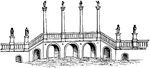
"A bridge. As the rivers of Greece were small, and the use of the arch known to them only to a limited extent, it is probable that the Greek bridges were built entirely of wood, or, at best, were nothing more than a wooden platform supported upon stone piers at each extremity. Pliny mentions a bridge over the Acheron 1000 feet in length; and also says that the island Euboea was joined to Boeotia by a bridge; but it is probably that both these works were executed after the Roman conquest. The Romans were the first people who applied the arch to the construction of bridges, by which they were enabled to erect structures of great beauty and solidity, as well as utility. The width of the passage-way in a roman bridge was commonly narrow, as compared with modern structures of the same kind, and corresponded with the road leading to and from it. It was divided into three parts. the centre one, for horses and carriages, was denominated agger or iter; and the raised foot paths on each side decursoria, which were enclosed by parapet walls similar in use and appearance to the pluteus in the basilica." — Smith, 1873

Pons Aelius

"A bridge. As the rivers of Greece were small, and the use of the arch known to them only to a limited…
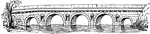
"A bridge. As the rivers of Greece were small, and the use of the arch known to them only to a limited extent, it is probable that the Greek bridges were built entirely of wood, or, at best, were nothing more than a wooden platform supported upon stone piers at each extremity. Pliny mentions a bridge over the Acheron 1000 feet in length; and also says that the island Euboea was joined to Boeotia by a bridge; but it is probably that both these works were executed after the Roman conquest. The Romans were the first people who applied the arch to the construction of bridges, by which they were enabled to erect structures of great beauty and solidity, as well as utility. The width of the passage-way in a roman bridge was commonly narrow, as compared with modern structures of the same kind, and corresponded with the road leading to and from it. It was divided into three parts. the centre one, for horses and carriages, was denominated agger or iter; and the raised foot paths on each side decursoria, which were enclosed by parapet walls similar in use and appearance to the pluteus in the basilica." — Smith, 1873

Pons Ariminum

"A bridge. As the rivers of Greece were small, and the use of the arch known to them only to a limited…

"A bridge. As the rivers of Greece were small, and the use of the arch known to them only to a limited extent, it is probable that the Greek bridges were built entirely of wood, or, at best, were nothing more than a wooden platform supported upon stone piers at each extremity. Pliny mentions a bridge over the Acheron 1000 feet in length; and also says that the island Euboea was joined to Boeotia by a bridge; but it is probably that both these works were executed after the Roman conquest. The Romans were the first people who applied the arch to the construction of bridges, by which they were enabled to erect structures of great beauty and solidity, as well as utility. The width of the passage-way in a roman bridge was commonly narrow, as compared with modern structures of the same kind, and corresponded with the road leading to and from it. It was divided into three parts. the centre one, for horses and carriages, was denominated agger or iter; and the raised foot paths on each side decursoria, which were enclosed by parapet walls similar in use and appearance to the pluteus in the basilica." — Smith, 1873

Pons Trajan

"A bridge. As the rivers of Greece were small, and the use of the arch known to them only to a limited…
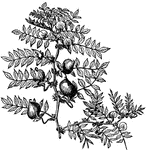
It grows wild around the shores of the Mediterranean and many parts of the East, producing a puffy pod, containing one or generally two nested seeds with two swellings on one side. It is much used in olios Spain, is an important article in French cookery and has been cultivated from a very early period in the warmer regions of the old world.

Chick Pea

It grows wild around the shores of the Mediterranean and many parts of the East, producing a puffy pod,…
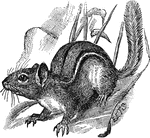
A name of a hackee or chirping squirrel of the United States. usually a small striped species about 6 inches long, with a tail about 4 inches long. it is reddish brown in the upper parts and has two white stripes and four black ones on the sides.

Chipmunk

A name of a hackee or chirping squirrel of the United States. usually a small striped species about…
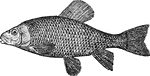
A catostomine fish with the air bladder dvided into two parts and no lateral line.

Chub Sucker

A catostomine fish with the air bladder dvided into two parts and no lateral line.

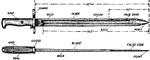
"The bayonet is a cutting and thrusting weapon consisting of three principal parts, viz, the <em>blade</em>, <em>guard</em>, <em>grip</em>." &mdash; Moss, 1914

Bayonet

"The bayonet is a cutting and thrusting weapon consisting of three principal parts, viz, the blade,…

"The parts are the butt, A; small, B; magazine well, C; barrel bed, D; air chamber, E, which reduces the charring effect og a heater barrel on the stock; small butt plate screw hole and seat for the butt plate tang, F; butt swivel plate seat, G; mortise for receiver tang lug and hole for rear guard screw, H; mortise for sear and slot for trigger, I; cut-off thumb-piece recess, J; mortise for recoil on the receiver, K; bed for fixed base, L; grasping grooves, N; shoulder for lower band, O; bed for band spring, P; shoulder for upper band, Q; channels for decreasing weight, R; upper band screw hole, S; and the stock screw hole, T. The large hole in butt is for decreasing weight, and the smaller one is a pocket for the combination oiler and thong case." &mdash; Moss, 1914

Stock, top view

"The parts are the butt, A; small, B; magazine well, C; barrel bed, D; air chamber, E, which reduces…

"The parts are the butt, A; small, B; magazine well, C; barrel bed, D; air chamber, E, which reduces the charring effect og a heater barrel on the stock; small butt plate screw hole and seat for the butt plate tang, F; butt swivel plate seat, G; mortise for receiver tang lug and hole for rear guard screw, H; mortise for sear and slot for trigger, I; cut-off thumb-piece recess, J; mortise for recoil on the receiver, K; bed for fixed base, L; grasping grooves, N; shoulder for lower band, O; bed for band spring, P; shoulder for upper band, Q; channels for decreasing weight, R; upper band screw hole, S; and the stock screw hole, T. The large hole in butt is for decreasing weight, and the smaller one is a pocket for the combination oiler and thong case." &mdash; Moss, 1914

Stock, right side view

"The parts are the butt, A; small, B; magazine well, C; barrel bed, D; air chamber, E, which reduces…