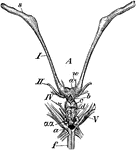
"Brain of Skate (Raia batis), an elasmobranchiate fish. A, from above; s, olfactory bulbs; a, cerebral hemispheres, united in the middle line; b, thalamencephalon; c, mesencephalon; d, cerebellum; aa, plaited bands formed by the restiform bodies; I, II, IV, V, first (olfactory), second (optic), fourth, and fifth pairs of cerebral nerves; f, medulla oblongata; w, a blood-vessel. " -Whitney, 1911

Skate Brain

"Brain of Skate (Raia batis), an elasmobranchiate fish. A, from above; s, olfactory bulbs; a, cerebral…
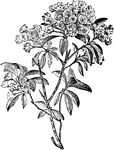
Kalmia latifolia, commonly called Mountain-laurel or Spoonwood, is a flowering plant in the family Ericaceae, native to the eastern United States, from southern Maine south to northern Florida, and west to Indiana and Louisiana.

Mountain-laurel

Kalmia latifolia, commonly called Mountain-laurel or Spoonwood, is a flowering plant in the family Ericaceae,…
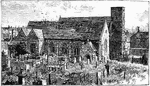
Monkwearmouth is an area of Sunderland located at the north side of the mouth of the River Wear. It was one of the three original settlements on the banks of the River Wear along with Bishopwearmouth and Sunderland, the area now known as the East End. It includes the area around St. Peter's Church and was once the main centre of Wearside shipbuilding and coalmining in the town. It is now host to a campus of the University of Sunderland and the National Glass Centre. It is served by the three Church of England churches of the Parish of Monkwearmouth. The locals of the area were called "Barbary Coasters". The borough stretches from Wearmouth Bridge to the harbour mouth on the north side of the river and is one of the oldest parts of Sunderland.

Monkwearmouth Church

Monkwearmouth is an area of Sunderland located at the north side of the mouth of the River Wear. It…
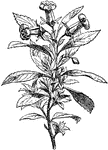
"Escallonia macrantha. Escallonia is a South American genus of trees or shrubs, of the natural order Saxifragaceae, allied to the Itea of the United States." -Whitney, 1911

Escallonia

"Escallonia macrantha. Escallonia is a South American genus of trees or shrubs, of the natural order…
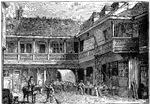
The Tabard, an inn that stood on the east side of Borough High Street in Southwark, was established in 1307, when the abbot of Hyde purchased the land to construct a hostel for himself and his brethren, when business took them to London, as well as an inn to accommodate the numerous pilgrims headed on annual pilgrimage to the Shrine of Thomas Beckett in Canterbury Cathedral. The Tabard is famous as the place owned by Harry Bailey, the host in Geoffrey Chaucer's Canterbury Tales, and is described in the first few lines of Chaucer's work as the location where the pilgrims first meet on their journey to Canterbury in the 1380s.

Tabard Inn

The Tabard, an inn that stood on the east side of Borough High Street in Southwark, was established…
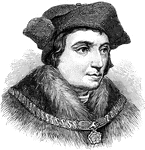
Sir Thomas More (7 February 1478 – 6 July 1535) was an English lawyer, author, and statesman who in his lifetime gained a reputation as a leading humanist scholar, and occupied many public offices, including Lord Chancellor (1529–1532), in which he had a number of people burned at the stake for heresy. More coined the word "utopia", a name he gave to an ideal, imaginary island nation whose political system he described in the eponymous book published in 1516. He was beheaded in 1535 when he refused to sign the Act of Supremacy that declared Henry VIII Supreme Head of the Church in England.

Sir Thomas More

Sir Thomas More (7 February 1478 – 6 July 1535) was an English lawyer, author, and statesman who…
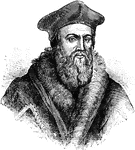
Thomas Cranmer (2 July 1489 – 21 March 1556) was a leader of the English Reformation and Archbishop of Canterbury during the reigns of Henry VIII and Edward VI. He helped build a favourable case for Henry's divorce from Catherine of Aragon which resulted in the separation of the English Church from union with the Holy See. Along with Thomas Cromwell, he supported the principle of royal supremacy in which the king was considered sovereign over the Church within his realm.

Thomas Cranmer

Thomas Cranmer (2 July 1489 – 21 March 1556) was a leader of the English Reformation and Archbishop…

William Tyndale (sometimes spelled Tindall or Tyndall; (c. 1494 – 1536) was a 16th-century Protestant reformer and scholar who translated the Bible into the Early Modern English of his day. While a number of partial and complete Old English translations had been made from the seventh century onward, and Middle English translations particularly during the 14th century, Tyndale's was the first English translation to draw directly from Hebrew and Greek texts, and the first to take advantage of the new medium of print, which allowed for its wide distribution (it is worth mention that some scholars claim he made this translation from Latin[citation needed]). In 1535, Tyndale was arrested, jailed in the castle of Vilvoorde outside Brussels for over a year, tried for heresy and burnt at the stake.

William Tyndale

William Tyndale (sometimes spelled Tindall or Tyndall; (c. 1494 – 1536) was a 16th-century Protestant…
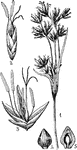

The twig-rush, a characteristic plant of the bogs of the northeastern United States.

The Twig Rush

The twig-rush, a characteristic plant of the bogs of the northeastern United States.

A typical peat-bog sedge, characteristic of the peat-bogs of the northeastern United States.

Peat Bog

A typical peat-bog sedge, characteristic of the peat-bogs of the northeastern United States.
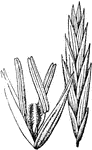
The large cane, which forms the cane brakes of the southern states. It grows from 10 to 20 feet in height with leaves 1 to 2 inches wide.

The Large Cane

The large cane, which forms the cane brakes of the southern states. It grows from 10 to 20 feet in height…
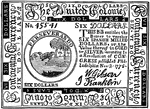
This six dollar bill is an example of Continental paper money of the United colonies issued in 1776.
Continental Paper Money

This six dollar bill is an example of Continental paper money of the United colonies issued in 1776.

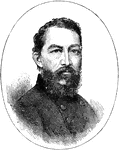
(1831-1888) Philip Sheridan was a United States Army officer and Union General in the Civil War.

General Philip Henry Sheridan

(1831-1888) Philip Sheridan was a United States Army officer and Union General in the Civil War.
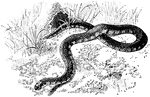
The Mud Snake (Farancia abacura) is a reptile in the Colubridae family of colubrid snakes native to the southeastern United States.

Mud Snake Slithering through Grass

The Mud Snake (Farancia abacura) is a reptile in the Colubridae family of colubrid snakes native to…
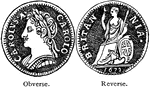
The obverse and reverse sides of the farthing depicting Charles II. The farthing was an English coin equal to one quarter of a penny.

Obverse and Reverse Sides of Farthing of Charles II

The obverse and reverse sides of the farthing depicting Charles II. The farthing was an English coin…
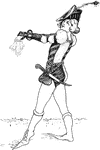
Piers Gaveston, 1st Earl of Cornwall (c. 1284 – 19 June 1312) was the favorite, and possibly lover, of King Edward II of England. A Gascon by birth, Piers was the son of Sir Arnaud de Gabaston, a soldier in service to King Edward I of England. Arnaud had been used as a hostage by Edward twice; on the second occasion, Arnaud escaped captivity, and fled to England with his son. Both then entered the royal household, where Gaveston behaved so well and so virtuously that the King declared him an example for his own son, Prince Edward.

Piers Gaveston

Piers Gaveston, 1st Earl of Cornwall (c. 1284 – 19 June 1312) was the favorite, and possibly lover,…
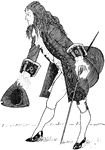
Beau Nash (18 October 1674 - 3 February 1762), born Richard Nash, was a celebrated dandy and leader of fashion in 18th-century Britain. He is best remembered as the Master of Ceremonies at the spa town of Bath.

Beau Nash

Beau Nash (18 October 1674 - 3 February 1762), born Richard Nash, was a celebrated dandy and leader…
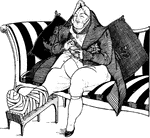
George IV or George Augustus Frederick (12 August 1762 – 26 June 1830) was king of the United Kingdom of Great Britain and Ireland and Hanover from 29 January 1820 until his death. He had earlier served as The Prince Regent when his father, George III, suffered from a relapse into insanity from an illness that is now suspected to have been porphyria. The Regency, George's nine-year tenure as Prince Regent, which commenced in 1811 and ended with George III's death in 1820, was marked by victory in the Napoleonic Wars in Europe.

George IV

George IV or George Augustus Frederick (12 August 1762 – 26 June 1830) was king of the United…
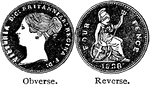
The obverse and reverse sides of the fourpenny piece, or groat, an English silver coin worth fourpence.
Fourpenny Piece of Queen Victoria

The obverse and reverse sides of the fourpenny piece, or groat, an English silver coin worth fourpence.

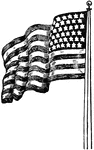
An illustration of a backwards United States flag.

Backwards United States Flag

An illustration of a backwards United States flag.

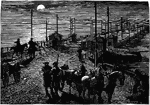
An illustration of soldiers guarding Long Bridge in Arlington, Virginia.

Soldiers Guarding Long Bridge

An illustration of soldiers guarding Long Bridge in Arlington, Virginia.
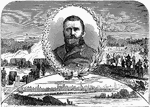
Ulysses S. Grant, born Hiram Ulysses Grant (April 27, 1822 – July 23, 1885), was an American general and the 18th President of the United States (1869–1877). He achieved international fame as the leading Union general in the American Civil War.

Ulysses S. Grant

Ulysses S. Grant, born Hiram Ulysses Grant (April 27, 1822 – July 23, 1885), was an American general…
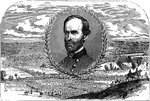
William Tecumseh Sherman (February 8, 1820 – February 14, 1891) was an American soldier, businessman, educator and author. He served as a General in the Union Army during the American Civil War (1861–65), for which he received recognition for his outstanding command of military strategy as well as criticism for the harshness of the "scorched earth" policies that he implemented in conducting total war against the Confederate States. Military historian Basil Liddell Hart famously declared that Sherman was "the first modern general".

General Sherman

William Tecumseh Sherman (February 8, 1820 – February 14, 1891) was an American soldier, businessman,…
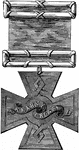
The Kearny Cross was a military decoration of the United States Army, which was first established in 1862 during the opening year of the American Civil War. The original decoration was known as the Kearny Medal and was adopted as an unofficial medal by the officers of the 1st Division, 3rd Corps, of the Union Army of the Potomac, which had served under Major General Philip Kearny.

Kearny Cross

The Kearny Cross was a military decoration of the United States Army, which was first established in…
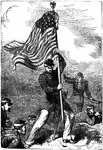
An illustration of a soldier planting a United States flag in the ground.

Planting of US Flag

An illustration of a soldier planting a United States flag in the ground.

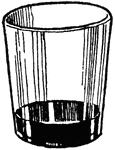
An illustration of a glass quarter full.

Glass Quarter Full

An illustration of a glass quarter full.

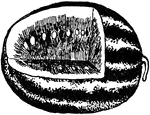
An illustration of a watermelon with a quarter missing.

Watermelon

An illustration of a watermelon with a quarter missing.

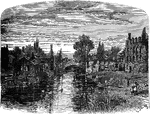
An illustration of the ruins of Chambersburg, Pennsylvania.

Chambersburg

An illustration of the ruins of Chambersburg, Pennsylvania.

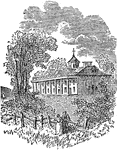
Mount Vernon, located near Alexandria, Virginia, was the plantation home of the first President of the United States, George Washington. The mansion is built of wood in neoclassical Georgian architectural style, and the estate is located on the banks of the Potomac River.

Mt. Vernon

Mount Vernon, located near Alexandria, Virginia, was the plantation home of the first President of the…
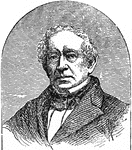
Edward Everett (April 11, 1794 – January 15, 1865) was a Whig Party politician from Massachusetts. Everett was elected to the United States House of Representatives and United States Senate, and also served as President of Harvard University, United States Envoy Extraordinary and Minister Plenipotentiary to Britain, and Governor of Massachusetts before being appointed United States Secretary of State by President Millard Fillmore to fill the vacancy caused by the death of Daniel Webster.

Edward Everett

Edward Everett (April 11, 1794 – January 15, 1865) was a Whig Party politician from Massachusetts.…
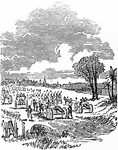
An illustration of Savannah, Georgia.

Savannah, Georgia

An illustration of Savannah, Georgia.

An illustration of the Capitol building in Washington DC.

Capitol Building

An illustration of the Capitol building in Washington DC.

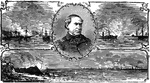
David Glasgow Farragut (July 5, 1801 – August 14, 1870) was a flag officer of the United States Navy during the American Civil War. He was the first rear admiral, vice admiral, and admiral of the Navy. He is remembered in popular culture for his order at the Battle of Mobile Bay, usually paraphrased: "Damn the torpedoes, full speed ahead!".

David Glasgow Farragut

David Glasgow Farragut (July 5, 1801 – August 14, 1870) was a flag officer of the United States…
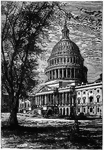
The United States Capitol serves as the seat of government for the United States Congress, the legislative branch of the U.S. federal government. It is located in Washington, D.C., on top of Capitol Hill at the eastern end of the National Mall. Although not in the geographic center of the District of Columbia, the Capitol is the origin by which the quadrants of the district are divided. Officially, both the east and west sides of the Capitol are referred to as "fronts." Historically, however, the east front was initially the side of the building intended for the arrival of visitors and dignitaries.

Capitol Building

The United States Capitol serves as the seat of government for the United States Congress, the legislative…
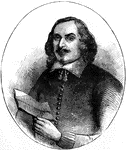
Edward Winslow (1595 – 1655) was an American Pilgrim leader on the Mayflower. He served as the governor of Plymouth Colony in 1633, 1636, and finally in 1644. He was born in Droitwich, Worcestershire, England, on October 18, 1595. In 1617 he removed to Leiden, united with John Robinson's church there, and in 1620 was one of the "pilgrims" who emigrated to New England on the Mayflower and founded the Plymouth colony.

Edward Winslow

Edward Winslow (1595 – 1655) was an American Pilgrim leader on the Mayflower. He served as the governor…
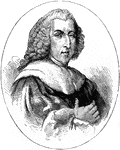
Peter Stuyvesant (originally Pieter or Petrus; Peter is never mentioned in historical records) (c. 1612 – August 1672) served as the last Dutch Director-General of the colony of New Netherland from 1647 until it was ceded provisionally to the English in 1664. He was a major figure in the early history of New York City. The Bedford-Stuyvesant section of Brooklyn, New York, United States is named after him.

Peter Stuyvesant

Peter Stuyvesant (originally Pieter or Petrus; Peter is never mentioned in historical records) (c. 1612…
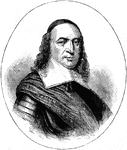
Benjamin Franklin (January 17, 1706 – April 17, 1790) was one of the Founding Fathers of the United States of America. A noted polymath, Franklin was a leading author and printer, satirist, political theorist, politician, scientist, inventor, civic activist, statesman, and diplomat. As a scientist, he was a major figure in the Enlightenment and the history of physics for his discoveries and theories regarding electricity. He invented the lightning rod, bifocals, the Franklin stove, a carriage odometer, and the glass harmonica. He formed both the first public lending library in America and first fire department in Pennsylvania.

Benjamin Franklin

Benjamin Franklin (January 17, 1706 – April 17, 1790) was one of the Founding Fathers of the United…
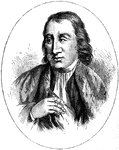
Samuel Adams (September 27, 1722 – October 2, 1803) was a statesman, political philosopher, and one of the Founding Fathers of the United States. As a politician in colonial Massachusetts, Adams was a leader of the movement that became the American Revolution, and was one of the architects of the principles of American republicanism that shaped the political culture of the United States.

Samuel Adams

Samuel Adams (September 27, 1722 – October 2, 1803) was a statesman, political philosopher, and one…
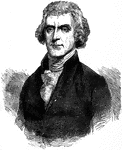
Thomas Jefferson (April 13, 1743 – July 4, 1826) was the third President of the United States (1801–1809), the principal author of the Declaration of Independence (1776), and one of the most influential Founding Fathers for his promotion of the ideals of republicanism in the United States. Major events during his presidency include the Louisiana Purchase (1803) and the Lewis and Clark Expedition (1804–1806).

Thomas Jefferson

Thomas Jefferson (April 13, 1743 – July 4, 1826) was the third President of the United States (1801–1809),…
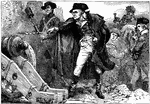
An illustration of George Washington lighting a cannon at the siege of Yorktown.

George Washington at Siege of Yorktown

An illustration of George Washington lighting a cannon at the siege of Yorktown.
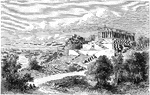
Walhalla, or German Temple of Fame and Honor is a neo-classical hall of fame located on the Danube River 10 km east of Regensburg, in Bavaria, Germany. The exterior is a close imitation of the Parthenon (a temple of the Greek goddess Athena), and is constructed of gray marble. It was the idea of 20-year-old Crown Prince Ludwig I of Bavaria in 1807, at a time when the German states were defeated and occupied by Napoleon. It was meant as a place for the commemoration of great figures and events in ethnic German history, at the time covering 1,800 years, beginning with the Battle of the Teutoburg Forest (AD 9). Whereas the Valhalla of Norse mythology was home to those gloriously slain in battle, Ludwig's Walhalla was intended not only for warriors but also for scientists, writers, clerics and specifically also for women.

Exterior of Walhalla

Walhalla, or German Temple of Fame and Honor is a neo-classical hall of fame located on the Danube River…
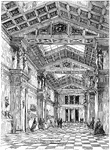
Walhalla, or German Temple of Fame and Honor is a neo-classical hall of fame located on the Danube River 10 km east of Regensburg, in Bavaria, Germany. It was the idea of 20-year-old Crown Prince Ludwig I of Bavaria in 1807, at a time when the German states were defeated and occupied by Napoleon. It was meant as a place for the commemoration of great figures and events in ethnic German history, at the time covering 1,800 years, beginning with the Battle of the Teutoburg Forest (9 AD). Whereas the Valhalla of Norse mythology was home to those gloriously slain in battle, Ludwig's Walhalla was intended not only for warriors but also for scientists, writers, clerics and specifically also for women. The walls are lined with marble, and the ceiling is very richly gilded and decorated. The busts that are placed in rows along the walls are, as far as possible, likenesses of celebrated Germans deemed worthy of a place in the Temple of Fame.

Interior of Walhalla

Walhalla, or German Temple of Fame and Honor is a neo-classical hall of fame located on the Danube River…
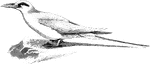
The Tropic Bird " are chiefly found in the tropical regions of the south; ... this species breeds as far north as the tropic of Cancer, while they frequent the West Indies, and occasionally stray to the Eastern United States, or even Newfoundland. All these tropic or Boatswain-birds, as they are denominated, have satin-like white plumage- often with a tinge of pink-varied by blackish bars or patches above, and black marks near the eye..." A. H. Evans, 1900

Tropic Bird Sitting on a Ledge

The Tropic Bird " are chiefly found in the tropical regions of the south; ... this species breeds as…
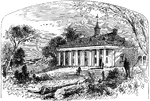
Mount Vernon, located near Alexandria, Virginia, was the plantation home of the first President of the United States, George Washington. The mansion is built of wood in neoclassical Georgian architectural style, and the estate is located on the banks of the Potomac River.

Mount Vernon

Mount Vernon, located near Alexandria, Virginia, was the plantation home of the first President of the…
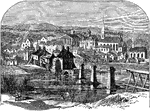
Fredericksburg is an independent city in the Commonwealth of Virginia located 50 miles south of Washington, D.C., and 58 miles north of Richmond. As of the 2000 census, the city had a population of 19,279. The Bureau of Economic Analysis combines the city of Fredericksburg with neighboring Spotsylvania County for statistical purposes. It is a part of the Washington Metropolitan Area.

Fredericksburg, VA

Fredericksburg is an independent city in the Commonwealth of Virginia located 50 miles south of Washington,…
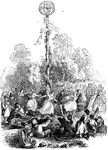
An illustration of a May day celebration. May Day occurs on May 1 and refers to any of several public holidays. In many countries, May Day is synonymous with International Workers' Day, or Labour Day, which celebrates the social and economic achievements of the labour movement. As a day of celebration the holiday has ancient origins, and it can relate to many customs that have survived into modern times. Many of these customs are due to May Day being a cross-quarter day, meaning that (in the Northern Hemisphere where it is almost exclusively celebrated) it falls approximately halfway between the spring equinox and summer solstice.

May Day Celebration

An illustration of a May day celebration. May Day occurs on May 1 and refers to any of several public…
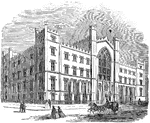
An illustration of the University of New York. New York University (NYU) is a private, nonsectarian, research university in New York City. NYU's main campus is situated in the Greenwich Village section of Manhattan. Founded in 1831, NYU is the largest private, nonprofit institution of higher education in the United States, with an enrollment of more than 50,000 students.

New York University

An illustration of the University of New York. New York University (NYU) is a private, nonsectarian,…

An illustration of two pennies.

Pennies

An illustration of two pennies.

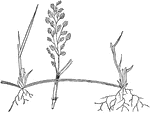
Creeping Meadow Grass (Eragrostis reptans) is found on the gravelly banks of rivers, from New England to the Western States. It is a delicate and beautiful grass, with short, nearly awl-shaped leaves, smooth, long spikelets, loose sheaths, slightly hairly on the margin;, panicles from one to two inches long. An annual growing fromn 6 to 15 inches high, it flowers in August. Shown is its panicle and creeping root-stalk , spikelets, palea, stamens, seed, and surface of a rootlet.

Creeping Meadow Grass

Creeping Meadow Grass (Eragrostis reptans) is found on the gravelly banks of rivers, from New England…
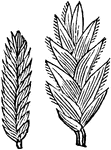
Creeping Meadow Grass (Eragrostis reptans) is found on the gravelly banks of rivers, from New England to the Western States. It is a delicate and beautiful grass, with short, nearly awl-shaped leaves, smooth, long spikelets, loose sheaths, slightly hairly on the margin; panicles from one to two inches long. An annual growing fromn 6 to 15 inches high, it flowers in August. Shown is a magnified spikelet.

Creeping Meadow Grass

Creeping Meadow Grass (Eragrostis reptans) is found on the gravelly banks of rivers, from New England…
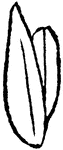
Creeping Meadow Grass (Eragrostis reptans) is found on the gravelly banks of rivers, from New England to the Western States. It is a delicate and beautiful grass, with short, nearly awl-shaped leaves, smooth, long spikelets, loose sheaths, slightly hairly on the margin; panicles from one to two inches long. An annual growing fromn 6 to 15 inches high, it flowers in August. The palea is shown here.

Creeping Meadow Grass

Creeping Meadow Grass (Eragrostis reptans) is found on the gravelly banks of rivers, from New England…
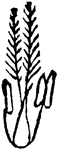
Creeping Meadow Grass (Eragrostis reptans) is found on the gravelly banks of rivers, from New England to the Western States. It is a delicate and beautiful grass, with short, nearly awl-shaped leaves, smooth, long spikelets, loose sheaths, slightly hairly on the margin; panicles from one to two inches long. An annual growing fromn 6 to 15 inches high, it flowers in August. The stamens are shown here.

Creeping Meadow Grass

Creeping Meadow Grass (Eragrostis reptans) is found on the gravelly banks of rivers, from New England…
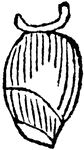
Creeping Meadow Grass (Eragrostis reptans) is found on the gravelly banks of rivers, from New England to the Western States. It is a delicate and beautiful grass, with short, nearly awl-shaped leaves, smooth, long spikelets, loose sheaths, slightly hairly on the margin; panicles from one to two inches long. An annual growing fromn 6 to 15 inches high, it flowers in August. The seed is shown here.

Creeping Meadow Grass

Creeping Meadow Grass (Eragrostis reptans) is found on the gravelly banks of rivers, from New England…
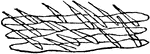
Creeping Meadow Grass (Eragrostis reptans) is found on the gravelly banks of rivers, from New England to the Western States. It is a delicate and beautiful grass, with short, nearly awl-shaped leaves, smooth, long spikelets, loose sheaths, slightly hairly on the margin; panicles from one to two inches long. An annual growing fromn 6 to 15 inches high, it flowers in August. A magnified surface of a rootlet is shown here.

Creeping Meadow Grass

Creeping Meadow Grass (Eragrostis reptans) is found on the gravelly banks of rivers, from New England…
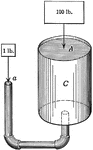
Illustration of a hydraulic machine. "A principle known as Pascal's Law states that pressure exerted on a liquid in a closed vessel is transmitted equally and undiminished in all directions." If a, A, p, and P respectively represent the areas and pressures, then the following proportion holds: a:A = p:P.

Hydraulic Machine Exerting Pressure

Illustration of a hydraulic machine. "A principle known as Pascal's Law states that pressure exerted…
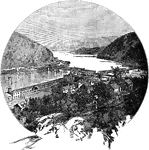
Harpers Ferry is a historic town in Jefferson County, West Virginia. It is located at the confluence of the Potomac and Shenandoah Rivers where the United States of Maryland, Virginia, and West Virginia meet. It is best known for John Brown's raid on the Armory in 1859 and its role in the Civil War.

Harpers Ferry

Harpers Ferry is a historic town in Jefferson County, West Virginia. It is located at the confluence…
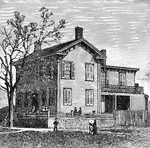
National Historic home of President Abraham Lincoln in Springfield, Illinois. Abraham Lincoln lived here from 1844 to 1861 before becoming the 16th President of the United States.

Home of President Abraham Lincoln

National Historic home of President Abraham Lincoln in Springfield, Illinois. Abraham Lincoln lived…
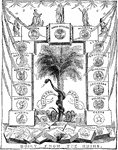
A political cartoon of the Southern states being built from the ruins after the Civil War.

Southern Republic Built from the Ruins

A political cartoon of the Southern states being built from the ruins after the Civil War.
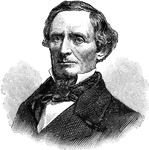
Jefferson Finis Davis (1808 – 1889) served as President of the Confederate States of America for its entire history of 1861 – 1865 during the American Civil War. After the war, Davis was captured in 1865 and charged with treason. Though not convicted, he was stripped of his eligibility to run for public office.

Jefferson Davis

Jefferson Finis Davis (1808 – 1889) served as President of the Confederate States of America for…
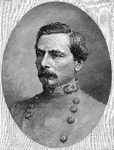
Pierre Gustave Toutan Beauregard (1818 - 1893) was a Louisiana-born author, civil servant, politician, inventor, and general for the Confederate States Army during the American Civil War. He was the victor at the First Battle of Bull Run near Manassas, Virginia and commanded armies through the Battle of Shiloh in Tennessee and the Siege of Corinth in northern Mississippi.

General Pierre Gustave Toutant Beauregard

Pierre Gustave Toutan Beauregard (1818 - 1893) was a Louisiana-born author, civil servant, politician,…