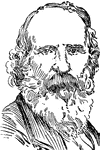
An American painter and portrait artist. Page origianlly studied for the ministry at the Andover Theological Seminary, though in later life he became a Swedenborgian. he received his training in art from Samuel F. B. Morse at the National Academy of Design, and in 1836 he became a National Academician.

William Page

An American painter and portrait artist. Page origianlly studied for the ministry at the Andover Theological…
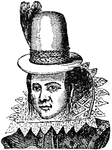
Daughter of Powhatan, a distinguished Indian chief, born in 1595; died off Gravesend, England, in March, 1617. Her early life was spent among the Indians in Virginia. In 1607 she became connected with the early history of America by saving the life of Capt. John Smith, and otherwise showed friendship for the English colonists.

Pocahontas

Daughter of Powhatan, a distinguished Indian chief, born in 1595; died off Gravesend, England, in March,…
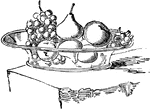
"Painting of still life. On a wall of a house at Pompeii." —D'Anvers, 1895

Still Life Painting from Pompeii

"Painting of still life. On a wall of a house at Pompeii." —D'Anvers, 1895
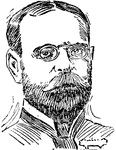
Musical leader and composer, born in Washington, D. C., in 1854. He developed remarkable talent for music in early life, being noted as a performer in theater orchestras when only twelve years of age.

John Sousa

Musical leader and composer, born in Washington, D. C., in 1854. He developed remarkable talent for…
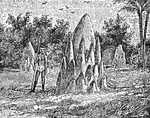
A class of insects confined chiefly to the tropics. They resemble in their mode of life the true ants, but belong to a different order. Most species make their nests on the ground, but some build their dwellings among the brances of trees.

Termites

A class of insects confined chiefly to the tropics. They resemble in their mode of life the true ants,…
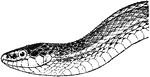
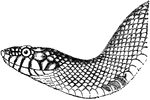
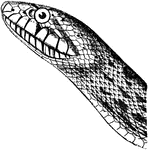
Any species of North American snake within the genus Thamnophis.

Garter-snake

Any species of North American snake within the genus Thamnophis.

Snakes that feed on rodents and that can get quite large in size.

King Snake

Snakes that feed on rodents and that can get quite large in size.

A very large snake native to North America. It is known to reach lengths of up to twelve feet.

Pine Snake

A very large snake native to North America. It is known to reach lengths of up to twelve feet.
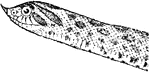
A dweller in high, dry upland fields, where the soil is so slightly compacted that burrowing is easy, for nothing delights it more than to worm its way through light soils.

Hog Nosed Snake

A dweller in high, dry upland fields, where the soil is so slightly compacted that burrowing is easy,…
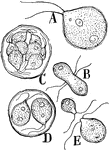
This illustration shows the features in the life history of Chlamydomonas: A, character of the motile plant. B, conjugation of isogamous gametes. C, a plant dividing to form numerous small male gametes. D, a plant forming two large female gametes. E, male and female gametes about to conjugate.

Chlamydomonas

This illustration shows the features in the life history of Chlamydomonas: A, character of the motile…
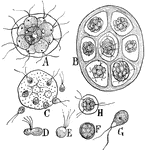
This illustration shows the features in the life history of Pandorina: A, a colony of plants. B, each plant of the colony dividing to form a new colony. C, the plants of a colony escaping as gametes. D, the conjugation of two gametes of unequal size. E, later stage in the conjugation. F, gametospore or resting spore. G, Large zoospore formed from the gametospore. H, a colony formed by the division of the zoospore, G.

Pandorina

This illustration shows the features in the life history of Pandorina: A, a colony of plants. B, each…
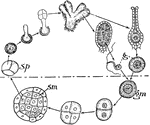
This illustration shows a diagram of the life history of Ricciocarpus. The upper portion of the figure represents the sexual generation and the lower portion, the asexual. The former generation begins with the formation of the spores, sp, from the mother-cell and ends with the formation of the gametes, g. The asexual generation begins with the gametospore, gm, and ends with the spore mother cells, sm.

Ricciocarpus

This illustration shows a diagram of the life history of Ricciocarpus. The upper portion of the figure…
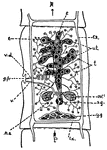
This diagram shows some stages in the life history of the tapeworm. A, Cysticercus or Bladderworm stage, before the "head" protrudes from the bladder; B, same, later stage; C, Strobila, or chain of proglottides, many being omitted; D, embryo such as fill the uterus of the mature proglottides. It is protected by a shell. b, bladder; ex., excretory canals; g, genital pore; h, head or scolex provided with hooks and suckers (s); u, uterus in a mature posterior proglottis; z, one of budding or segment formation. The numerals show the approximate number of segments, reckoning from the front.

Tapeworm

This diagram shows some stages in the life history of the tapeworm. A, Cysticercus or Bladderworm stage,…
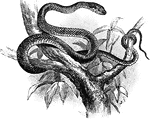
A common green snake coiled in a small tree.

Green Snake

A common green snake coiled in a small tree.

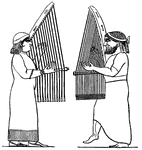
The Assyrians held music in honor, and empoyed it for liturgical purposes, as well as those of social and private life. Among the discoveries at Nineveh and Babylon are many of a musical character. Strong bearded men are playing upon harps which are of a triangular form, but of a different structure from most.

Assyrian Music

The Assyrians held music in honor, and empoyed it for liturgical purposes, as well as those of social…
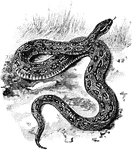
A venemous Indian serpent.

Daboya

A venemous Indian serpent.

A book name of the serpent like lizards of the genus Acontias, translating the generic term: so called from the manner in which is darts upon its prey.

Dart Snake

A book name of the serpent like lizards of the genus Acontias, translating the generic term: so called…
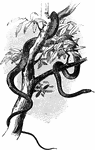
The narrow ended dendroaspis, otherwise known as the tree asp, tree snake, or mamba. It is about 6 feet long, slender, and a good climber. Its color is olive brown washed with green.

Tree Asp

The narrow ended dendroaspis, otherwise known as the tree asp, tree snake, or mamba. It is about 6 feet…
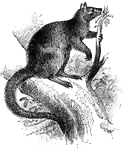
They are adapted for arboreal life, having the tail less robust tan that of the ground kangaroos, and the limbs better proportioned, with stronger claws. They move in trees by leaping.

Tree Kangaroo

They are adapted for arboreal life, having the tail less robust tan that of the ground kangaroos, and…
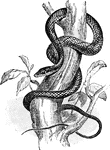
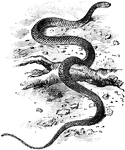
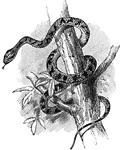
A tree snake of the dendrophis genus coiiled around a tree trunk.

Tree Snake

A tree snake of the dendrophis genus coiiled around a tree trunk.

A genus of venumous serpents.

Diemenia

A genus of venumous serpents.

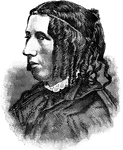
An abolitionist, and writer of more than 10 books. Her most famous piece was <em>Uncle Tom's Cabin</em> which describes life in slavery.

Harriet Beecher Stowe

An abolitionist, and writer of more than 10 books. Her most famous piece was Uncle Tom's Cabin

A serpent whose bite causes intense thirst.

Dipsas

A serpent whose bite causes intense thirst.

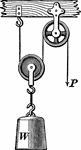
"A movable pulley is one whos block is movable. One end of the cord is fastened to the beam, and the weight is sspended from the pulley, the other end of the cord being drawn by the application of a force P. A little consideration will show that if P moves through a certain distance, say 1 foot, W will move through half that distance, or 6 inches; hence, a pull of 1 pound at P will life 2 pounds at W." &mdash; Hallock, 1905

Movable Pulley

"A movable pulley is one whos block is movable. One end of the cord is fastened to the beam, and the…
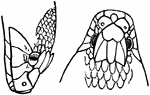
"In popular language, the name of all those large serpents which kill their prey by entwining themselves around it, and constricting it in their coils; but by zoologists of the present day, limited as the name of a genus to a very small portion of their number, all of which are natives of the warm parts of America." &mdash; Chambers, 1881

Boa

"In popular language, the name of all those large serpents which kill their prey by entwining themselves…
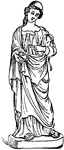
"In the classical mythology, the goddess of Health- the daughter of Aesculapius. She was worshipped at Athens, Corinth, Argos, and other important cities, and in works of art is usually represented as a blooming virgin, with a snake, the symbol of health, which drinks from a cup held in her hand." &mdash; Chambers, 1881

Hygieia

"In the classical mythology, the goddess of Health- the daughter of Aesculapius. She was worshipped…
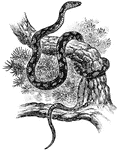
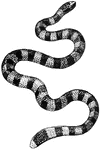
A serpent having carinate scales.

Pine Snake

A serpent having carinate scales.

A snake found in salt water.

Sea Snake

A snake found in salt water.

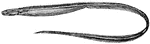
A eel with a spines all the way down its length.

Spiny Back Eel

A eel with a spines all the way down its length.

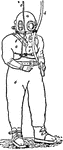
"The diving dress envelops the whole body of the diver, the upper portion a being the "helmet," the intermediate portion b the "breast-plate," and the lower portion c the "dress." The hose by which the air is supplied is shown at d, and e is the "life" or "signal" line, which is attached to the diver's waist, and by which he makes signals and is hauled to the surface. The water-proof material of which the dress is made is very generally sheet india-rubber covered on both sides with tanned twill to protect the india-rubber from injury." &mdash; Encyclopedia Britannica, 1893

Diving Dress

"The diving dress envelops the whole body of the diver, the upper portion a being the "helmet," the…
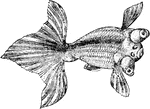
"In China and the warmer parts of Japan a fish extremely similar to the Crucian carp of Europe is of very common occurrence in ponds and other still waters. In the wild state its colors do not differ from those of a Crucian carp, and like that fish it is tenacious of life and easily domesticated. Albinos seem to be rather common and as in other fishes, the color of most of these albinos is a bright orange or golden yellow; occasionally even this shade of color is lost, the fish being more or less pure white or silvery." &mdash; Encyclopedia Britannica, 1893

Goldfish

"In China and the warmer parts of Japan a fish extremely similar to the Crucian carp of Europe is of…
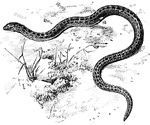
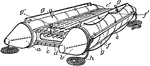
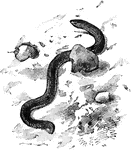
A snake slithering on dirt.

Snake

A snake slithering on dirt.

A boat used in emergency of a sinking ship.

Life Raft

A boat used in emergency of a sinking ship.

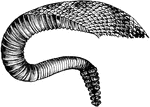
The rattling tail of the rattle snake.

Rattlesnake Tail

The rattling tail of the rattle snake.

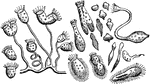
"A term etymologically applicable to any very small animal, and limited in actual use to those which are microscopical. Animalcules exist in prodigious numbers, and of many different kinds, their size being such that multitudes of them find ample space for all the movements of an active life within a single drop of water; and they abound almost wherever there is moisture, at least wherever organic matter is present." &mdash; Chambers' Encyclopedia, 1875

Animalcule

"A term etymologically applicable to any very small animal, and limited in actual use to those which…
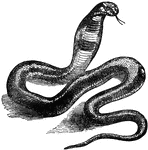
"A venomous serpent, the name of which has come down from ancient times; the vague descriptions of ancient authors, however, causing uncertainty as to the species. It is very generally supposed to be the Naja Haje, the El Haje or Haje Nasher of the Arabs, which is very common in Egypt and Cyprus, and often appears in hieroglyphic and other sculptures as one of the sacred animals of ancient Egypt." &mdash; Chambers' Encyclopedia, 1875

Asp

"A venomous serpent, the name of which has come down from ancient times; the vague descriptions of ancient…
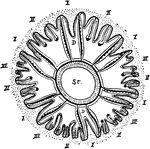
"Transverse section through a zooid of Cladocora. The corallum shaded with dots, the mesogloca represented by a thick line. Thirty-two septa are present, six in the entocoeles of the primary cycle of mesenteries, I; six in the entocoeles of the secondary cycle of mesenteries, II; four in the entocoeles of the tertiary cycle of mesenteries, II, only four pairs of the latter being developed; and sixteen in the entocoeles between the mesenterial pairs. D, D, Directive mesenteries; st, stomodaeum." &mdash; The Encyclopedia Britannica, 1910

Cladocora

"Transverse section through a zooid of Cladocora. The corallum shaded with dots, the mesogloca represented…
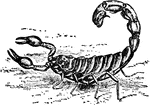
"Drawing from life of the desert scorpion, Buthusaustralis." &mdash; The Encyclopedia Britannica, 1910

Scorpion

"Drawing from life of the desert scorpion, Buthusaustralis." — The Encyclopedia Britannica, 1910
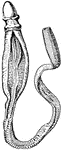
"Ptychodera flava (New Caledonia), from above; about life size." &mdash; The Encyclopedia Britannica, 1910

Ptychodera Flava

"Ptychodera flava (New Caledonia), from above; about life size." — The Encyclopedia Britannica,…
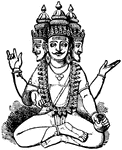
"A Sanskrit word the Universal Power or ground of all existence, and also (in its masculine form with long final syllable) a particular deity, the first person in the Triad (Brahma, Vishnu, and Siva) of the Hindus. The personal god Brahma is represented as a red or golden-colored figure with four heads and as many arms, and he is often accompanied by the swan or goose. He is the god of the fates, master of life and death, yet he is himself created, and is merely the agent of Brahma, the Universal Power." &mdash; Winston's Encyclopedia, 1919

Brahma

"A Sanskrit word the Universal Power or ground of all existence, and also (in its masculine form with…
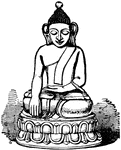
"The sacred name of the founder of Buddhism, an Indian sage who appears to have lived in the 5th century B.C. His personal name was Siddhartha, and his family name Gautama; and he is often called also Sakya-muni. His father was the king of Kapilavastu, a few days' journey north of Benares. Siddhartha, filled with a deep compassion for the human race, left his father's court, and lived for years in solitude and contemplation till he had penetrated the mysteries of life and become the Buddha. He then began to teach his new faith, in opposition to the prevailing Brahmanism, commencing at Benares. Among his earliest converts where the monarchs of Magadha and Kosala, in whose kingdoms he chiefly passed the latter portion of his life, respected, honored, and protected." &mdash; Winston's Encyclopedia, 1919

Buddha

"The sacred name of the founder of Buddhism, an Indian sage who appears to have lived in the 5th century…
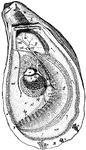
"Anatomy of the Oyster. A. Hinge or anterior umbonal end of the left valve of an adult oyster, upon which the soft parts of the animal are represented as they lie in situ, but with the greater part of the mantle of the right side removed. a u. The auricle of the right side of the heart contracted. B. Posterior or ventral end of the left valve, which in life is usually directed upward more or less, and during the act of feeding and respiration is separated slightly from the margin of its fellow of the opposite side to admit the water for respiration, and which also contains the animal's food in suspension. b m. Body-mass, traversed superficially by the generative ducts g e. b j. The organ of Bojanus, or 'renal' organ, of the right side of the oyster. (The ducts which it sends into the manle are not shown, nor is its connection with the genito-urinary sinus s indicated.)" &mdash; Winston's Encyclopedia, 1919

Oyster

"Anatomy of the Oyster. A. Hinge or anterior umbonal end of the left valve of an adult oyster, upon…
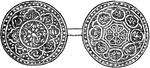
"Coin struck in Tibet, from specimen in India Library; inscribed "27th year (of cycle=1772 A.D.) from the princely residence of Golden"." &mdash;The Encyclopedia Britannica, 1910

Tibet Coin

"Coin struck in Tibet, from specimen in India Library; inscribed "27th year (of cycle=1772 A.D.) from…
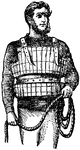
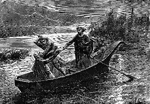
A man wearing a life jacket with a line in his hand.

Sailor

A man wearing a life jacket with a line in his hand.

As a kind of joke, John, King Henry's youngest son, had been called Lackland, because he had nothing when his brothers each had some great dukedom. The name suited him only too well before the end of his life. The English made him king at once. Richard had never had any children, but his brother Geoffery, who was older than John had left a son named Arthur, who was about twelve years old, and who rightly the Duke of Normandy and Count of Anjou. King Philip, who was always glad to vex whoever was king of England, took Arthur under his protection, and promised to get Normandy out of John's hands. However, John had a meeting with him and persuaded him to desert Arthur, and marry his son Louis to John's own niece, Blanche, who had a chance of being queen of part of Spain. Still Arthur lived at the French King's court, and when he was sixteen years old, Philip helped him to raise an army and go to try his fortune against his uncle. He laid siege to Mirabeau, a town where his grandmother, Queen Eleanor, was living. John, who was then in Normandy, hurried to her rescue, beat Arthur's army, made him prisoner and carried him off, first to Romen, and then to the strong castle of Falaise. Nobody quite knows what was done to him there. The governor, Hubert de Burgh, once found him fighting hard, though with no weapon but a stool, to defend himself from some ruffians who had been sent to put out his eyes. Hubert saved him from these men, but shortly after this good man was sent elsewhere by the king, and John came himself to Falaise. Arthur was never seen alive again, and it is believed that John took him out in a boat in the river at night, stabbed him with his own hand, and threw his body in the river.

Murder of Prince Arthur

As a kind of joke, John, King Henry's youngest son, had been called Lackland, because he had nothing…
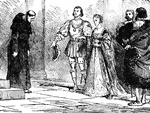
Henry VIII was married six times during his life. First, to Catherine of Aragon, Anne Boleyn, Jane Seymor, Anne of Cleves, Catherine Howard, and Catherine Parr.

Henry the VIII and His Wives

Henry VIII was married six times during his life. First, to Catherine of Aragon, Anne Boleyn, Jane Seymor,…
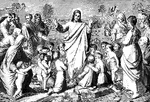
A painting by Johann Overbeck. It is a replica in the Meyer Collection, Hamburg. The painting is from the last decade of the artist's life.

Christ Blessing Little Children

A painting by Johann Overbeck. It is a replica in the Meyer Collection, Hamburg. The painting is from…
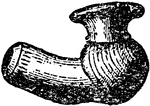
Clay pipe bowls are ritualistic pipes used in ceremonies and daily life.

Clay Pipe Bowl

Clay pipe bowls are ritualistic pipes used in ceremonies and daily life.

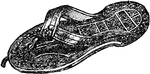
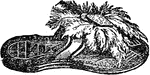
An African sandal used in daily life.

Sandals

An African sandal used in daily life.

An African sandal used in daily life.

Sandals

An African sandal used in daily life.

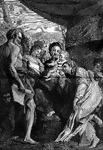
This Correggio piece has a story behind it of a painter named Parmigiano who risked his life to save the painting. The painting can be found in the Parma Gallery in Italy.

The Madonna and Child with St. Jerome and the Magdalen

This Correggio piece has a story behind it of a painter named Parmigiano who risked his life to save…
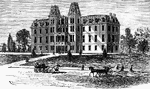
The basis for funding for the college was established by the Morrill Act, passed by the US Congress in 1862, which provides for donation of public land (land grants) to the states. The land could then be sold at public auction to establish a permanent fund to support a college where the "leading object shall be, without excluding other scientific and classical studies and including military tactics, to teach such branches of learning as are related to agriculture and mechanical arts...in order to promote the liberal and practical education of the industrial classes in the several pursuits and professions in life."

Agricultural and Mechanical College of Texas

The basis for funding for the college was established by the Morrill Act, passed by the US Congress…
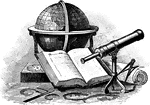
Still life arrangement including a globe, telescope, book, right angle, rolled map, and dividers.

Still Life with Globe and Telescope

Still life arrangement including a globe, telescope, book, right angle, rolled map, and dividers.
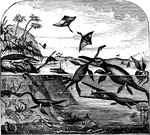
In this age the animals and plants begin to resemble existing species. The age is characterized mainly by the preponderance of reptiles, many of which were very large, as, for example, the <em>plesiosaurus</em>, an animal with a long, snake-like neck and a huge body, or the <em>ichthyosaurus</em>, with a head like a crocodile and short neck and large body. Both of these animals were furnished with fin-like paddles, and lived in water.

Reptiles

In this age the animals and plants begin to resemble existing species. The age is characterized mainly…
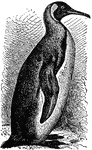
A bird not capable of flight that lives in freezing temperatures.

Penguin

A bird not capable of flight that lives in freezing temperatures.

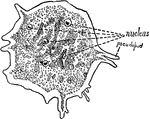
A single celled organism that is one of the building blocks of life.

Amoeba

A single celled organism that is one of the building blocks of life.

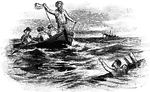
A sailor being tossed a life line after ship wrecked.

Shipwrecked Sailor

A sailor being tossed a life line after ship wrecked.

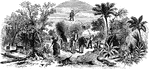
A collage of different types of organic life including deer in a forest, farmers harvesting wheat, and an alligator in a tropical region.

Organic Life, Collage of

A collage of different types of organic life including deer in a forest, farmers harvesting wheat, and…
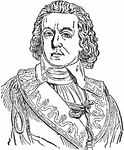
A French Jacobin, born in Province, in 1755, of an ancient family; served as second lieutenant in the regiment of Languedoc until 1775. He made, about this time, a voyage to the Isle-de-France, the governor of which was one of his relations, and entered into the garrison of Pondicherry. On his return, he gave himself up to gambling and women, and dissipated his fortune. The Revolution broke out. He immediately showed himself an opponent of the Court, and had a seat in the <em>tiers-etat</em>, while his brother was sitting in that of the nobility. July 14, 1789, he took part in the attack upon the Bastille, and Aug. 10, 1792, upon the Tuileries. In 1792 he was elected a member of the National Convention, and voted for the unconditional death of Louis XVI. He was sent, in 1793, to the South of France, and commanded the left wing of the besieging army under Dugommier, and it was here that he first met Napoleon Bonaparte, then captain of artillery. The patriotic reputation of Barras was so well established that he abd Freron were the only representatives not denounced by the popular societies. Robespierre, however, was friend of his, and often wished to arrest him. Barras, knowing this, became one of the principle actors of the 9th Thermidor, and put himself at the head of the troops which surrounded Robespierre at the Hotel de Ville. In 1794 he was named one of the Committee of Public Safety, and became a great enemy to the members of the members of the "Mountain." In February, 1795, he was elected President of the Convention, and, in that capacity, declared Paris in a state of siege, when the Assembly was attacked by the populace. Afterward, when the Convention was assailed, Bonaparte, by Barras' advice, was appointed to command the artillery; and that general, on the 13th Vendemaire, decisively repressed the royalist movement. For his services, Barras was now named one of the Directory, and took a prominent part in the changes which that body unerwent until Napoleon's <em>coup d'etat</em> on the 18th Brumaire, which effectually overthrew the power of Barrras and his colleagues. His life, from this date, was, generally speaking, one of retirement. He died in Paris, Jan. 29, 1829. His "Memoirs" appeared in 1895.

Comte de Barras

A French Jacobin, born in Province, in 1755, of an ancient family; served as second lieutenant in the…
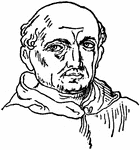
One of the most distinguished masters of the Floretine school of painting, born at Savignano, in Tuscany, in 1469. His subjects are mostly religious, and the greater part belong to the later period of his life. He was a warm adherent of Savonarola, after whose tragical end in 1500 he took the habit of the cloister. He imparted to Raphael his knowledge of coloring, and acquired from him a more perfect knowledge of perspective. He died in Florence in 1517.

Fra Bartolommeo

One of the most distinguished masters of the Floretine school of painting, born at Savignano, in Tuscany,…