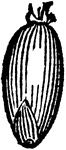
Wild Oat Grass (Danthonia spicata), also referred to as White Top grass, and Old Fog grass, is common in dry, sunny pastures, with a stem one foot high, slender with short leaves. Narrow sheaths, bearded. The panicle is simple and there are seven flowered spikelets. The lower palea broadly ovate, loosely hairy on the back, longer than its awl-shaped teeth. Perennial and flowers in June. Shown is a seed of this grass.

Wild Oat Grass

Wild Oat Grass (Danthonia spicata), also referred to as White Top grass, and Old Fog grass, is common…
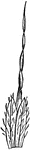
Wild Oat Grass (Danthonia spicata), also referred to as White Top grass, and Old Fog grass, is common in dry, sunny pastures, with a stem one foot high, slender with short leaves. Narrow sheaths, bearded. The panicle is simple and there are seven flowered spikelets. The lower palea broadly ovate, loosely hairy on the back, longer than its awl-shaped teeth. Perennial and flowers in June. Shown is the lower pale.

Wild Oat Grass

Wild Oat Grass (Danthonia spicata), also referred to as White Top grass, and Old Fog grass, is common…
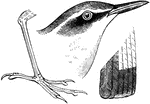
"Bill shorter than head, slender, straight, depressed at base, compressed at end, notched. Wings long, pointed, the tip formed by the 2d-4th quills, the 1st spurious, scarcely or not one-fourth as long as the 2d. Tail much shorter than wing, square. Tarsi booted, but with 4 scutella below in front; long and slender, much exceeding the middle toe and claw; lateral toes of about equal lengths, very short, the tips of their claws not reaching the base of the middle claw; claws little curved; feet thus adapted to terrestrial habits." Elliot Coues, 1884

Stone Chats

"Bill shorter than head, slender, straight, depressed at base, compressed at end, notched. Wings long,…
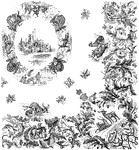
This table cloth is was made for the Queen Victoria of the United Kingdom. It has scenery of deer stalking, a sport that prince Albert enjoyed at the time.

Table Cloth

This table cloth is was made for the Queen Victoria of the United Kingdom. It has scenery of deer stalking,…
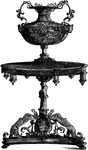
This table and vase are an Italian design. The vase stands on a pedestal and has a wide short body, while its handles are designed in a scrolling effect. The table is richly decorated with figures at the base.

Table and Vase

This table and vase are an Italian design. The vase stands on a pedestal and has a wide short body,…
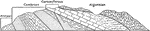
"Diagrammatic structure section of the Wasatch Range in Ogden Canyon." -Lee, 1915

Rock Layers Showing Geological Periods

"Diagrammatic structure section of the Wasatch Range in Ogden Canyon." -Lee, 1915
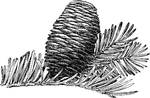
"A. grandis (Grand Fir) - Fig. 60.- tree, 200-300ft.: trunk becoming 4ft. in diam. lvs. thin and flexable, deeply grooved, very dark green above and silvery white beneath: cones cylindrical, 2-4 in. long, rounded or retuse at the apex, the broad scales somewhat squarrose and irregularly serrate and furnished with a short point." L.H. Bailey, 1917

Grand Fir Tree Cone

"A. grandis (Grand Fir) - Fig. 60.- tree, 200-300ft.: trunk becoming 4ft. in diam. lvs. thin and flexable,…
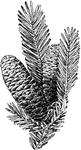
Abies Balsamea (Balsam Fir) or Balm of Gilead Fir, lvs. dark green and lustrous above, pale below, rounded or obtusely short pointed and occasionally emarginate, acute or acuminate on fertile branches: cones oblong, cylindrical, purple, 2&1/2-4 in. long; bracts shorter or rarely slightly longer than their scales." L.H. Bailey, 1917

Balsam Fir Tree Cone

Abies Balsamea (Balsam Fir) or Balm of Gilead Fir, lvs. dark green and lustrous above, pale below, rounded…
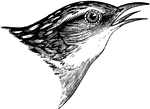
"Short-billed Marsh Wren. Cistothorus platensis. Upper parts brown, the crown and most of the back blackish, streaked with white. below, whitish, shaded with clear brown across the breast and along the sides, and especially on the flanks and crissum, the latter more or less indistinctly barred with dusky (often inappreciable). A whitish line over the eye. Wings and tail marked as in the last species. Upper tail-coverts decidedly barred. Bill blackish above, whitish below, extremely small, scarcely half as long as the head; feet brown." Elliot Coues, 1884

Short-billed Marsh Wren

"Short-billed Marsh Wren. Cistothorus platensis. Upper parts brown, the crown and most of the back blackish,…
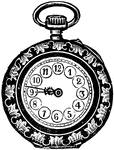
A pocket watch from Switzerland in 1907.

Swiss Pocket Watch

A pocket watch from Switzerland in 1907.

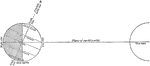
"Relative positions of the earth and the sun on June 21, the summer solstice. Summer and long days north of the Equator; winter and short days south of it." -Wiswell, 1913

Summer Solstice

"Relative positions of the earth and the sun on June 21, the summer solstice. Summer and long days north…
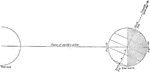
"Relative positions of the earth and the sun on December 21, the winter solstice. Winter and short days north of the Equator; summer and long days south of it. 1, North Frigid Zone; 2, North Temperate Zone; 3, Torrid Zone; 4, South Temperate Zone; 5, South Frigid Zone." -Wiswell, 1913

Winter Solstice

"Relative positions of the earth and the sun on December 21, the winter solstice. Winter and short days…
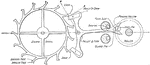
"Waltham Lever Escapement. A device for the governing of speed is the one thing on which accurate time measuring depends." -Hill, 1921

Lever Escapement

"Waltham Lever Escapement. A device for the governing of speed is the one thing on which accurate time…
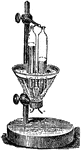
"We may compare currents by the quantities of a given electrolyte which they decompose in a given time. Faraday's voltameter is intended for this purpose. As compared with a galvanometer, the voltameter has the obvious disadvantage that it cannot measure a current at once, but only after the current has been flowing for some time." -Hazeltine, 1894

Faraday's Voltameter

"We may compare currents by the quantities of a given electrolyte which they decompose in a given time.…
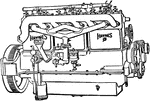
"Oil pump and filler added to motor. Oil is poured in the spout which is at the left of the carburetor. It runs down into the reservoir and is pumped up through the engine a little at a time." -Bodmer, 1917

Building an Automobile, Step 08: Oil Pump and Filler

"Oil pump and filler added to motor. Oil is poured in the spout which is at the left of the carburetor.…
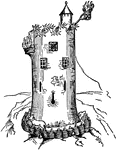
"A French watch tower of the fifteenth century in time of the siege. The tower is lighted by means of beacons and is protected by dogs. Ruins of such a tower can still be seen at Godesberger on the Rhine." -Bodmer, 1917

Medieval Watch Tower

"A French watch tower of the fifteenth century in time of the siege. The tower is lighted by means of…
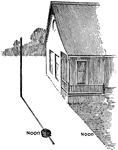
"A form of Sun-dial that is as god to-day as any dial for determining noon." -Bodmer, 1917

Modern Sundial

"A form of Sun-dial that is as god to-day as any dial for determining noon." -Bodmer, 1917
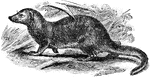
The Common Kusimanse (Crossarchus obscurus), also known as the Long-nosed Kusimanse, is a small, diurnal kusimanse or dwarf mongoose. The Common Kusimanse has a vaguely weasel-shaped body with dark brown fur that is thick, with a wiry texture down the back, and fine and soft on the underside. It has short legs, a short, relatively stiff tail, long claws, small ears, small, dark colored eyes, and an elongated nose.

Common Kusimanse

The Common Kusimanse (Crossarchus obscurus), also known as the Long-nosed Kusimanse, is a small, diurnal…
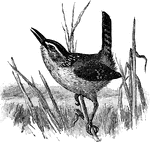
The Marsh Wren (Cistothorus palustris) is a small North American songbird of the wren family. It is sometimes called Long-billed Marsh Wren to distinguish it from the Sedge Wren, also known as Short-billed Marsh Wren. Adults have brown upperparts with a light brown belly and flanks and a white throat and breast. The back is black with white stripes. They have a dark cap with a white line over the eyes and a short thin bill.

Marsh Wren

The Marsh Wren (Cistothorus palustris) is a small North American songbird of the wren family. It is…
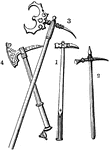
An illustration of four various axes: "1, Horseman's hammer of about the time of Edward IV; 2, Martel-de-fer, time of Henry VIII; 3, Martel-de-fer, time of Edward VI; 4, Martel-de-fer with hand-gun, time of Queen Elizabeth." -Century, 1889

Four Axes

An illustration of four various axes: "1, Horseman's hammer of about the time of Edward IV; 2, Martel-de-fer,…
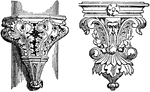
"Ornamental Brackets. Bracket, a short piece or combination of pieces, generally more or less triangular in outline, and projecting from a wall or other surface." -Vaughan, 1906

Ornamental Brackets

"Ornamental Brackets. Bracket, a short piece or combination of pieces, generally more or less triangular…
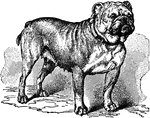
"Bulldog, a variety of the common dog, remarkable for its short, broad muzzle, and the projection of its lower jaw, which causes the lower front teeth to protrude beyond the upper." -Vaughan, 1906

Bulldog

"Bulldog, a variety of the common dog, remarkable for its short, broad muzzle, and the projection of…
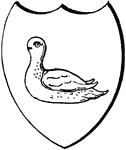
A martlet is a heraldic charge depicting a mythical bird, similar in appearance to the swallow, but with short tufts of feathers in the place of legs (swifts have such small legs that they were believed to have none at all).

Martlet

A martlet is a heraldic charge depicting a mythical bird, similar in appearance to the swallow, but…
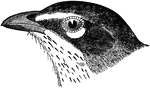
"Yellow-breasted Chat or Icteria virens. Bright olive-green, below golden-yellow, belly abruptly white; lore black, isolating the white under-eyelid from a white superciliary line above and a short white maxillary line below; wings and tail unmarked, glossed with olive; bill blue-black; feet plumbeous." Elliot Coues, 1884

Yellow-breasted Chat

"Yellow-breasted Chat or Icteria virens. Bright olive-green, below golden-yellow, belly abruptly white;…
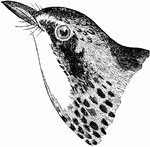
"Myiodioctes canadensis. Canadian Fly-catching Warbler. Canada Warbler. Bluish-ash; crown speckled with lanceolate black marks, crowded and generally continuous on the forehead; the latter divided lengthwise by a slight yellow line; short superciliary line and edges of eyelids yellow; lores black, continuous with black under the eye, and this passing as a chain of black streaks down the side of the neck and prettily encircling the throat like a necklace of jet; excepting these streaks and the white under tail-coverts, the entire under parts are clear yellow; wings and tail unmarked; feet flesh-colored." Elliot Coues, 1884

Canada Warbler

"Myiodioctes canadensis. Canadian Fly-catching Warbler. Canada Warbler. Bluish-ash; crown speckled with…
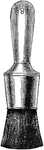
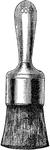
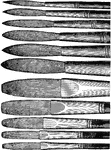
The stencil brush is a specialist brush with short firmly packed bristles.

Stencil Brushes

The stencil brush is a specialist brush with short firmly packed bristles.

The stencil brush is a specialist brush with short firmly packed bristles.

Stencil Brushes

The stencil brush is a specialist brush with short firmly packed bristles.

The fresco bristle brushes are round shaped with either short, medium or long bristles. They are used for fresco painting.

Fresco Bristle Brushes

The fresco bristle brushes are round shaped with either short, medium or long bristles. They are used…
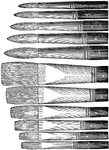
The artist's bristle brushes are flat brushes with either short, medium or long bristles. They are used by artists in both water or oil colors.

Artist's Bristle Brushes

The artist's bristle brushes are flat brushes with either short, medium or long bristles. They are used…
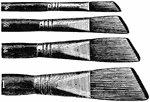
These artist's bristle brushes are usually flat with either short , medium or long bristles.

Artist's bristle Brushes

These artist's bristle brushes are usually flat with either short , medium or long bristles.
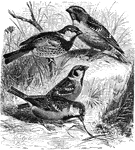
"Exotic Sparrow's - lowest pair - Passer domesticus (The Sparrow. Philip Sparrow. House Sparrow.) above pair - Passer montanus (Mountain Sparrow). House Sparrow - upper parts ashy-gray; middle of back and scapulars boldly streaked with black and bay. A dark chestnut; median tipped with white, forming a conspicuous wing-bar, bordering which is a black line. Greater coverts and inner quills with central black field bordered with bay. Tail dusky-gray, unmarked. Lower parts ashy, gray or whitish; chin and throat jet black, spreading on the breast and lores, bordered on side of neck with white. Bill blue-black; feet brown. Mountain Sparrow - Somewhat like the last, but smaller and otherwise different. Crown and nape a peculiar purplish-brown. Lores, chin, and throat-patch narrow and short, not spreading on breast, contrasted with ashy-white on side of head and neck; ear-coverts blackish. Back and scapulars streaked with black and bay, the streaking reaching to the purplish nape; rump and tail plain grayish-brown. Wings marked much as in P. domesticus, with a black and white bar across tips of median coverts, but also a narrow white bar across tips of greater coverts. Primaries more varied with ochrey-brown on outer webs, forming a basal spot and other edging. Below, ashy-gray, shaded on sides, flanks, and crissum with grayish-brown. Bill blue-black; feet brown." Elliot Coues, 1884

Exotic Sparrow's

"Exotic Sparrow's - lowest pair - Passer domesticus (The Sparrow. Philip Sparrow. House Sparrow.) above…
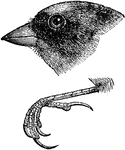
"Bill small, short, straight, very acute, more or less compressed, the lateral outlines usually a little concave, those of culmen and gonys straight; commissure straight to the slight angulation. Base of bill thickly beset with a ruff of antrorse plumules, concealing the small nasal fossae and round nostrils. Wings longer than tail, pointed by first 3 primaries. Tail rather long for this group, forked. Feet small and weak, but tarsi longer than middle toes without claw; lateral toes of equal lengths, their claw-tips falling beyond base of middle claw. Hind claw much longer, stouter and more curved than the middle, exceeding its digit in length. Size small; plumage streaky with dusky, white, and flaxen colors, crown crimson, face and throat blackish; sexes otherwise dissimilar; with rosy or carmine on breast, wanting in. Scarcely different from Linota (flavirostris, etc.) the pattern of coloration being the most available distinction." Elliot Coues, 1884

Red-poll Linnets

"Bill small, short, straight, very acute, more or less compressed, the lateral outlines usually a little…
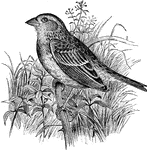
"Coturniculus passerinus. Yellow-winged Sparrow. Quail Sparrow. Grasshopper Sparrow. Edge of wing conspicuously yellow; lesser wing-coverts greenish-yellow; a yellow loral spot; short line over eye buffy-yellow. Crown with median stripe of pale brownish-yellow. Below, ochraceous or pale buff or tawny, fading to whitish on belly, not evidently streaked, though a few dark touches may appear on sides of breast. Above, singularly variegated with black, gray, yellowish-brown and a peculiar purplish-bay, in short streaks and specks; the crown being nearly black with sharp median brownish-yellow stripe, the middle of the back chiefly black with bay and brownish-yellow edgings of the feathers, the cervical region and rump chiefly bay and gray. When the feathers are not disturbed, the peculiar pattern of the cervical region separates that of the crown and back; the markings extend on the sides of the neck, but the sides of the head are plain, like the under parts. Wing-coverts and inner secondaries variegated in intricate pattern, the general effect like the back. Primaries and tail-feathers plain dusky, with narrow light edgings; outer tail-feathers paler, but not white. Feet flesh-colored." Elliot Coues, 1884

Yellow-winged Sparrow

"Coturniculus passerinus. Yellow-winged Sparrow. Quail Sparrow. Grasshopper Sparrow. Edge of wing conspicuously…
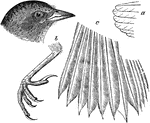
"Ammodramus. Seaside Sparrow. Bill remarkably slender and lengthened for this family, with culmen toward end, gonys straight, and sometimes an evident lobation of the cutting edge of the upper mandible. Wings short and rounded, yet longer than tail; inner secondaries, though not elongate, reaching nearly to end of primaries when wing is closed; point formed by 2d-4th quills. Feet large and stout, reaching outstretched about to the end of tail; tarsus about equal to middle toe and claw in length; lateral toes of equal lengths, very short, their claws under reaching base of middle claw. Tail shorter or not longer than wings, much rounded, of narrow, stiffish, sharp-pointed feathers. Embracing small streaky marsh sparrows, especially of the sea-coast, but not exclusively maritime, as long supposed; remarkable for slenderness of the bill, sharp narrow tail-feathers, and stout feet fitted for grasping slender swaying reeds. Edge of wing bright yellow; a yellow spot of buff stripe on head; upper parts olive-gray or quite blackish, streaky." Elliot Coues, 1884

The Details of a Seaside Sparrow

"Ammodramus. Seaside Sparrow. Bill remarkably slender and lengthened for this family, with culmen toward…
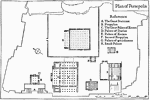
A plan of Persepolis, near Shiraz, Iran, from the time of Darius I (549–486 BC) until the downfall of the Achaemenid dynasty (330 BC). This is an example of Persian architecture of the time. "The plan shows the general configuration of the platform on which the palaces of Persepolis are built, which covered an area of about1,600,000 sq. ft. The principal approach to it was at the north–west end." — The Enctclopædia Britannica, a Dictionary of Arts, Sciences, Literature and General Information, 1910.

Plan of Persepolis, 513 BC

A plan of Persepolis, near Shiraz, Iran, from the time of Darius I (549–486 BC) until the downfall…
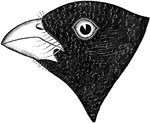
"Zamelodia. Song Grosbeak. Bill extremely heavy, with the lower mandible as deep as the upper or deeper, the commissural angle strong, far in advance of the feathered base of the bill, the rictus overhung with a few long stiff bristles. Wing with outer 4 primaries abruptly longer than 5th. Tail shorter than wing, even or scarcely rounded. Feet short and stout. Embracing two larger species, of beautiful and striking colors, the sexes dissimilar. Male black and white, with carmine-red or orange-brown; Female otherwise, but with lining of wings yellow. Brilliant songsters; nest in trees and bushes; eggs spotted." Elliot Coues, 1884

Song Grosbeak Bill

"Zamelodia. Song Grosbeak. Bill extremely heavy, with the lower mandible as deep as the upper or deeper,…
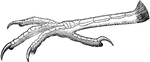
"Quiscalus. Grackle. The feet are large and strong, and the birds spend much of their time on the ground, where they walk or run instead of advancing by leaps." Elliot Coues, 1884

Grackle Foot

"Quiscalus. Grackle. The feet are large and strong, and the birds spend much of their time on the ground,…
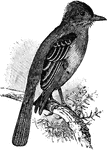
"Myiarchus crinitus. Great Crested Flycatcher. Decidedly olivaceous above, a little browner on head, where the feathers have dark centres; throat and fore pure dark ash; rest of under parts bright yellow, the two colors meeting abruptly; primaries margined on both edges with chestnut; secondaries and coverts edges and tipped with yellowish-white; tail with all the feathers but the central pair chestnut on the whole of the inner web (excepting perhaps a very narrow space next the shaft); outer web of outer feathers with yellowish; middle feathers, outer webs of the rest, and wings except as stated, dusky-brown. The foregoing phrases are intended to be chiefly antithetical to those used in describing cinerescens, below, No. 375. Other diagnostic points are: bill dark but not quite black, pale at base below; stout and comparatively short, hardly or not as long as tarsus, the latter perhaps never .90, the olive back, ash throat, and yellow belly severally pure in color; all tail-feathers but middle pair so extensively rufous on inner webs that a mere line, if any, of fuscous persists next the shaft (compare erythrocercus and cooperi), and this fuscous line,if any, running of same narrowness to ends of the feathers (compare cinerescens); never more than a trace of rufous on outer webs." Elliot Coues, 1884

Great Crested Flycatcher

"Myiarchus crinitus. Great Crested Flycatcher. Decidedly olivaceous above, a little browner on head,…
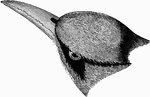
"Momotus caeruleiceps. Blue-headed Saw-bill. The central tail-feathers are long-exserted, and spatulate by absence of webs along a part of the shaft - a mutilation effected, it is said, by the birds themselves; the bill is about as long as the head, gently curved; the nostrils are rounded, basal, exposed; the wings are short and rounded; the tarsi are scutellate anteriorly. It is greenish, with blue head." Elliot Coues, 1884

Blue-headed Saw-bill

"Momotus caeruleiceps. Blue-headed Saw-bill. The central tail-feathers are long-exserted, and spatulate…
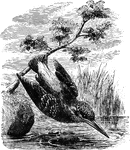
Alcedo Ispida. European Kingfisher. Small bird, upper parts blue-green; under parts orange; rump and back azure-blue head large; rufous patch on ear; stripe on neck blue-green; bill long and black with some red at base; short tail.

Common Kingfisher

Alcedo Ispida. European Kingfisher. Small bird, upper parts blue-green; under parts orange; rump and…
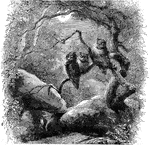
"Scops. Little Horned Owls. Screech Owls. Like the miniature Bubo in form (all our species under a foot long). Skull and ear-parts symmetrical; latter small, simply elliptical, with rudimentry operculum; facial disc moderately developed; plumicorns evident; nostrils at edge of cere, which is not inflated, and shorter than the rest of the culmen. Wings rounded, but long, about twice the length of the short rounded tail, about to the end which they fold; in our species the 4th and 5th primaries longest, the 1st quite short; 3 or 4 outer primaries sinuate or emarginate on inner webs. Tarsus feathered (in our species), but toes only partly bristly (in the S. asio group) or quite naked (as in S. Flammeola). Plumage dichromatic in some cases; i.e. some individuals of the same species normally mottled gray, while others are reddish, the two phases very distinct when fully developed, but shading insensibly into each other, and entirely independent of age, season, or sex. In normal plumage, a white or whitish scapular stripe; lower parts with lengthwise blotches or shaft-lines and crosswise bars or waves of blackish or dark colors; upper parts with black or blackish shaft-lines on a finely-dappled brown or gray ground (more or less obliterated in the red phase); facial disc black-bordered nearly all around; wing-quills spotted or marbled on outer webs, barred on inner webs. Tail with light and dark bars. A large and nearly cosmopolitan genus, especially rich in tropical species; but only two are known to inhabit N. Am. one of them running into several local races very difficult to characterize satisfactorily." Elliot Coues, 1884

Screech Owls

"Scops. Little Horned Owls. Screech Owls. Like the miniature Bubo in form (all our species under a foot…
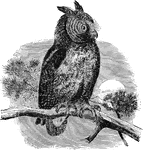
Scops. Little Horned Owls. Screech Owls. Like the miniature Bubo in form (all our species under a foot long). Skull and ear-parts symmetrical; latter small, simply elliptical, with rudimentry operculum; facial disc moderately developed; plumicorns evident; nostrils at edge of cere, which is not inflated, and shorter than the rest of the culmen. Wings rounded, but long, about twice the length of the short rounded tail, about to the end which they fold; in our species the 4th and 5th primaries longest, the 1st quite short; 3 or 4 outer primaries sinuate or emarginate on inner webs. Tarsus feathered (in our species), but toes only partly bristly (in the S. asio group) or quite naked (as in S. Flammeola). Plumage dichromatic in some cases; i.e. some individuals of the same species normally mottled gray, while others are reddish, the two phases very distinct when fully developed, but shading insensibly into each other, and entirely independent of age, season, or sex. In normal plumage, a white or whitish scapular stripe; lower parts with lengthwise blotches or shaft-lines and crosswise bars or waves of blackish or dark colors; upper parts with black or blackish shaft-lines on a finely-dappled brown or gray ground (more or less obliterated in the red phase); facial disc black-bordered nearly all around; wing-quills spotted or marbled on outer webs, barred on inner webs. Tail with light and dark bars. A large and nearly cosmopolitan genus, especially rich in tropical species; but only two are known to inhabit N. Am. one of them running into several local races very difficult to characterize satisfactorily." Elliot Coues, 1884

Screech Owl

Scops. Little Horned Owls. Screech Owls. Like the miniature Bubo in form (all our species under a foot…
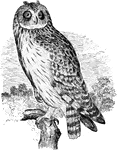
"Asio accipitrinus. Short-eared Owl. Marsh Owl. Ear-tufts inconspicuous, much shorter than middle toe and claw, few-feathered. First and 2d primaries emarginate on inner webs. Above, completely variegated, chiefly in streaks, with fulvous or tawny, and dark brown; breast much the same, but other under parts paler ochrey, usually bleaching on the belly, which in sparely but sharply streaked (never barred) with dark brown; feet pale tawny or whitish, usually immaculate; lining of wings interruptedly whitish. Wing-quills varied, mostly in large pattern, and tail pretty regularly barred (about 5 bars) with the two colors of the upper parts. Facial area white or nearly so, but with a large black eye-patch; the disc minutely speckled with fulvous and blackish, bordered with white internally and usually having a blackish patch behind the ear; radiating feathers of the oper-culum streaked with blackish and fulvous. Iris bright yellow; bill and claws dusky-bluish; the naked granular soles yellowish. The ear-opening of this species is extremely large, being two inches or more across the longest way." Elliot Coues, 1884

Short-eared Owl

"Asio accipitrinus. Short-eared Owl. Marsh Owl. Ear-tufts inconspicuous, much shorter than middle toe…
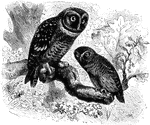
"Nyctala - Saw-whet Owls. Skull and ear-parts highly unsymmetrical, the the latter of great size, and fully operculate. Head very large (as in Strix), without plumicorns; facial disc complete, with centric eye. Nostril at edge of the cere, which is inflated or not. Tail from 1/2 to 2/3rds as long as the wing, rounded. Third and 4th primaries longest; 1st quite short; 2 or 3 emarginate on inner webs. Feet thickly and closely feathered to the claws. In this interesting genus the ear-parts are of great size, and reach the extreme of asymmetry, the whole skull seeming misshapen." Glaucidium. Gnome Owls. Sparrow Owls. Pygmy owls. Size very small. Head perfectly smooth; no plumicorns; ear-parts small, non-operculate; facial disc very incomplete, the eye not centric. Nostril circular, opening in the tumid cere; bill robust. Tarsus fully and closely feathered, but toes only bristly for the most part. Wings short and much rounded, the 4th primary longest, the 1st quite short, the 3 outer ones emarginate, and next one or two sinuate. Tail long, about 3/4ths as long as the wing, even or nearly so. Claws strong, much curved. A large genus of very small owls, mostly of tropical countries. The numerous species, chiefly of warm parts of America, are in dire confusion, but the only two known to inhabit N. Am. are well determined. The plumage of many or most species is dichromatic, as in Scops, there being a red and a gray phase independently of age, season, or sex; but the red is not known to occur in our G. gnoma. The upper parts are marked with spots or lines; bars, or rows of spots, cross the wings and tail; the under parts are streaked; there is a cervical collar." Elliot Coues, 1884

Saw-whet and Sparrow Owls

"Nyctala - Saw-whet Owls. Skull and ear-parts highly unsymmetrical, the the latter of great size, and…
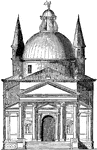
"More than one cause served to render the compositions of Palladio so celebrated. He possessed an especial felicity in the arrangement of his ground-plans, particularly in instances where he had an unlimited space for disposal. His command, moreover, of good proportion , rendered his combinations of civic and sacred buildings most pleasing to the eye; whilst the columnar arrangement of his entrances conveyed an agreeable, and at the same time, dignified impression. Consequently the works of Palladio, although often composed of heterogeneous elements, remained for a long period the model for an entire style; and even in the eighteenth century, when the total deterioration of architecture, as exemplified in what is called by the Germans "the Zopf-und-Perrücken Styl" (pigtail and periwig style), led architects again in the direction of the classical, the designs of Palladio became anew a subject of study. Even in present day they are often immoderately praised by those who are not really conversant with the principles and requirements of art, and who are ignorant of the history of the development of architecture."Il Redentore, more properly Chiesa del Santissimo Redentore (Church of the Most Holy Redeemer), is Andrea Palladio's great domed church on Giudecca, one of the islands of Venice. Located on the waterfront of the Canale della Giudecca, it dominates the skyline of the island.The Redentore was built in thanksgiving for deliverance from the plague that decimated Venice from 1575 to 1576, in which some 46,000 people, 25-30 percent of the population, died. The Senate commissioned the great architect Palladio to design it. Construction began in May 1577. The building was in a satisfactory stage and was consecrated in 1592.

St. Saviour's, Venice

"More than one cause served to render the compositions of Palladio so celebrated. He possessed an especial…
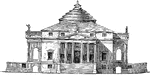
"More than one cause served to render the compositions of Palladio so celebrated. He possessed an especial felicity in the arrangement of his ground-plans, particularly in instances where he had an unlimited space for disposal. His command, moreover, of good proportion , rendered his combinations of civic and sacred buildings most pleasing to the eye; whilst the columnar arrangement of his entrances conveyed an agreeable, and at the same time, dignified impression. Consequently the works of Palladio, although often composed of heterogeneous elements, remained for a long period the model for an entire style; and even in the eighteenth century, when the total deterioration of architecture, as exemplified in what is called by the Germans "the Zopf-und-Perrücken Styl" (pigtail and periwig style), led architects again in the direction of the classical, the designs of Palladio became anew a subject of study. Even in present day they are often immoderately praised by those who are not really conversant with the principles and requirements of art, and who are ignorant of the history of the development of architecture."Villa Capra "La Rotonda" is a Renaissance villa just outside Vicenza, northern Italy, designed by Andrea Palladio. The correct name is Villa Almerico-Capra. It is also known as La Rotonda, Villa Rotunda, Villa La Rotonda, and Villa Almerico. The name "Capra" derives from the Capra brothers, who completed the building after it was ceded to them in 1591. Like other works by Palladio in Vicenza and the surrounding area, the building is conserved as part of the World Heritage Site "City of Vicenza and the Palladian Villas of the Veneto".

Villa by Palladio

"More than one cause served to render the compositions of Palladio so celebrated. He possessed an especial…
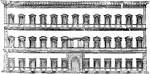
Palazzo Farnese is a prominent High Renaissance palace in Rome, which currently houses the French Embassy in Italy."The pupils of Bramante and other renowned architects pursued the path which he had marked out; as, for example, Balthazar Peruzzi (1481 to 1536) as the principle of his works may be mentioned the Farnesia at Rome; Ant. di Sangallo of Florence (died 1546), whose principle work is the Farnese Palace at Rome. The third story of this palace is, however, the work of Michel-Angelo. The Farnese Palace forms to a certain extent the type of distinct class in the architecture of Roman palaces, and its chief characteristic is, that the façades are not divided by any orders of columns or pilasters, but the same effect and impression are produced by the architraves, cornices, and plinths of the windows, which invariably have rectilineal terminations, as well as the doors, and also by the string-courses which divide the storeys, and by a far-projecting cornice: at the same time especial consideration is devoted to the effect of good proportions. Ornaments are by sparingly introduced; whilst, on the other hand, the corners are generally marked by rustications.These palaces convey the impression of solidity without cumbersomeness, or richness without luxury, and above all, of simplicity in conjunction with dignity."

Farnese Palace at Rome

Palazzo Farnese is a prominent High Renaissance palace in Rome, which currently houses the French Embassy…
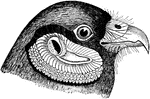
"Circinae. Harriers. Face surrounded with an incomplete ruff (as in most owls); orifice of ear about as large as the eye, and in some cases at least with a decided conch (in this picture). Bill rather weak, not toothed or notched. Bill thickly beset with many curved radiating bristles surpassing in length the cere, which is large and tumid; tomia lobed or festooned, but neither toothed nor notched. Nostrils ovate-oblong, nearly horizontal. Superciliary shield prominent. Tarsus long and slender, scutellate before and mostly so behind, reticulate laterally; toes slender, the middle with its claw much shorter than the tarsus; a basal web between the outer and middle; all tuberculate underneath; Claws very large and sharp, much curved. Wings very long and ample; 3d and 4th quills longest; 1st shorter than 6th; outer 3-5 (in our species 4) emarginate on inner webs; 2d-5th emarginate on outer webs. Tail very long, about 2/3rds as long as the wing, nearly even or rounded, the folded wings falling short of its end. " Elliot, Coues, 1884

Harrier Ear Parts

"Circinae. Harriers. Face surrounded with an incomplete ruff (as in most owls); orifice of ear about…
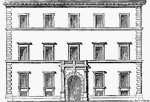
This image "presents a type of the majority of the palaces if the Roman Renaissance style, at least so far as regards the architectural features and their arrangement; for the most important palaces in this style are both more imposing by their great length, whilst at the same time they are less simple and less correct in their details."The Verospi Palace, or The Palazzo Verospi, is located on the main street in Rome, the Via Del Corso.

Verospi Palace, Rome

This image "presents a type of the majority of the palaces if the Roman Renaissance style, at least…
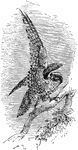
"Falcons. Bill furnished with a sharp tooth and notch near the end of the cutting edge of the upper mandible (sometimes two such teeth), and the end of under mandible truncated, with notch near the tip. Nostrils circular, high in the cere, with a prominent central tubercle. Inter-nasal septum extensively ossified. Palate with a median keel anteriorly. Superciliary shied prominent, in one large piece. Shoulder-joint strengthened by union of scapular process of the coracoid with the clavicle as in Micrastur, Herpetothers, and the Polyborinae alone of Flaconidae. Wings strong, long, and pointed, with rigid and usually straight and tapering flight-feathers; the tip formed by the 2d and 3d quills, supported nearly to their ends by the 1st and the 4th, both of which are longer then the 5th; only one or two outer primaries emarginate on inner webs near the end. Tail short and stiff, with more or less tapering rectrices. Feet strong, rather short, the tarsus of less length than the tibia, feathered more or less extensively, elsewhere irregularly reculate in small pattern varying with the genera or subgenera; never scutellate in single series before or behind. Middle toe very long; talons very short." Elliot Coues, 1884

Falcons

"Falcons. Bill furnished with a sharp tooth and notch near the end of the cutting edge of the upper…
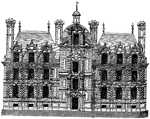
The Château de Beaumesnil was begun in 1633 by Jacques de Nonant for his wife Marie Dauvet Desmaret. Construction lasted until 1640.Today, Beaumesnil is a commune, the lowest level of administrative division in the French Republic, in the Eure department in Haute-Normandie in northern France."Although Du Cerceau was obligated to leave France in the year 1604, the impulse which he had given in the direction of the above-mentioned manner led to its being generally adopted. The new buildings were more correct, but less picturesque than those built during the earlier period of the French Renaissance, and a certain insipidity seems to characterize the various structures erected during the reigns of Henry IV., and especially Louis XIII. As is shown [here], a combination of free-stone and brick was restored to in such a way that the former was employed for the mouldings, and for the quoins and dressings of the doors and windows, whilst brick was used for the spaces between. In the case of the windows the free-stone introduced assumed the forms of quoins. If ornamentation had been previously excessive, it now retired into the background, and was only employed in moderation; and the method of its treatment began to be distinguished from that of the former period. The forms of the details above all began to lose in purity: rustications were inappropriately introduced in the walls and columns, and the roofs were made high and steep, which gave the rest of the building a heavy and squat appearance, whilst the numerous turret-shaped chimneys, which were necessitated by these high roofs, formed a peculiar feature in the construction. The Roccoco, or Baroque Style, was beginning at the same time to exert its influence. Commencing from the second half of the seventeenth century, this new architectural deviation became prevalent in all civilized countries, owing to the splendor and influence of the French power and manners, and the influence of Italian art was consequently paralyzed. [This image] gives a characteristic example of French architecture of this period of the Later Renaissance, showing the peculiarities which have been described above."

Château de Beaumesnil

The Château de Beaumesnil was begun in 1633 by Jacques de Nonant for his wife Marie Dauvet Desmaret.…

Les Invalides in Paris, France, is a complex of buildings in the city's 7th arrondissement containing museums and monuments, all relating to the military history of France, as well as a hospital and a retirement home for war veterans. The buildings house the Musée de l'Armée, the military museum of the Army of France, the Musée des Plans-Reliefs, and the Musée d'Histoire Contemporaine, as well as the burial site for some of France's war heroes, notably Napoleon Bonaparte."The principal architectural activity of this period was displayed by Jules Hardouin Mansard, who was head architect to the king and the head of the influential school, as Lenôtre at the same time was principal horticulturist. Mansard built the palaces of Versailles (1647-1708, Marly, the Grand Trianon, as also the Invalides at Paris [shown here]."

Invalides at Paris

Les Invalides in Paris, France, is a complex of buildings in the city's 7th arrondissement containing…

The Palace of Versailles, or simply Versailles, is a royal château in Versailles, the île-de-France region of France. In French, it is known as the Château de Versailles."It was principally the above-mentioned system of Roccoco decoration and architectural detail which characterized the architecture of the time of Louis XV.; it is, consequently, sometimes designated as the style of Louis XV. [This image] gives a portion of an interior drawn in perspective.""Internal arrangement and decoration are the main characteristics of the style of this period, and in this direction the best results were doubtless produced. Large and lofty rooms, as well as scope for display, were indispensable; consequently this style of embellishment was most happily carried out in each state apartments, especially in the princely castles and palaces, or, as the French call them, the "Hôtels" of the aristocracy."

Saloon in the Palace of Versailles

The Palace of Versailles, or simply Versailles, is a royal château in Versailles, the île-de-France…
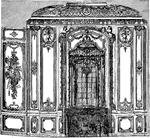
The Palace of Versailles, or simply Versailles, is a royal château in Versailles, the île-de-France region of France. In French, it is known as the Château de Versailles."It was principally the above-mentioned system of Roccoco decoration and architectural detail which characterized the architecture of the time of Louis XV.; it is, consequently, sometimes designated as the style of Louis XV." This image depicts the entire wall."Internal arrangement and decoration are the main characteristics of the style of this period, and in this direction the best results were doubtless produced. Large and lofty rooms, as well as scope for display, were indispensable; consequently this style of embellishment was most happily carried out in each state apartments, especially in the princely castles and palaces, or, as the French call them, the "Hôtels" of the aristocracy."

Saloon in the Palace of Versailles

The Palace of Versailles, or simply Versailles, is a royal château in Versailles, the île-de-France…

The Panthéon (Latin Pantheon, from Greek Pantheon, meaning "Every god") is a building in the Latin Quarter in Paris, France. It was originally built as a church dedicated to St. Genevieve, but after many changes now combines liturgical functions with its role as a famous burial place. It is an early example of Neoclassicism, with a façade modeled on the Pantheon in Rome, surmounted by a small dome that owes some of its character to Bramante's "Tempietto". Located in the 5th arrondissement on the Montagne Sainte-Geneviève, the Panthéon looks out over all of Paris. Its architect, Jacques-Germain Soufflot, had the intention of combining the lightness and brightness of the gothic cathedral with classical principles. Soufflot died before his work was achieved, and his plans were not entirely followed. The transparency he had planned for his masterpiece was not attained. Nevertheless, it is one of the most important architectural achievements of its time and the first great neoclassical monument."Toward the end of the reign of Louis XV. a reaction set in, which was caused partly by the excess and caprice displayed in the application of this style, and partly by the tide again setting in the direction of the antique. This evidence by the Colonnades de la Place de Concorde, and by the Church of Ste. Geneviève, which was begun by Soufflot in the year 1755, and subsequently received the name of Pantheon [shown here]. From thenceforth imitations of ancient buildings came into vogue, as they also did in other countries."

West Front of the Pantheon at Paris

The Panthéon (Latin Pantheon, from Greek Pantheon, meaning "Every god") is a building in the Latin…
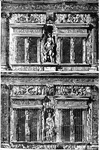
The Heidelberg Castle (in German language named: Heidelberger Schloss) is a famous ruin in Germany and landmark of Heidelberg. The castle ruins are among the most important Renaissance structures north of the Alps.The castle has only been partially rebuilt since its demolition in the 17th and 18th centuries. It is located 80 m (262 ft) up the northern part of the Königstuhl hillside, and thereby dominates the view of the old downtown. It is served by an intermediate station on the Heidelberger Bergbahn funicular railway that runs from Heidelberg's Kornmarkt to the summit of the Königstuhl.The earliest castle structure was built before AD 1214 and later expanded into 2 castles circa 1294; however, in 1537, a lightning-bolt destroyed the upper castle. The present structures had been expanded by 1650, before damage by later wars and fires. In 1764, another lightning-bolt destroyed some rebuilt sections."The Renaissance style was not employed in Germany before the middle of the sixteenth century, and the most noteworthy instances of it are the Belvedere of Ferdinand I., on the Hradschin at Prague, and the so-called Otto Henry buildings at Heidelberg Castle (1556-1559) The Façade of the last-mentioned structure, of which [this image] represents [a portion], in peculiar for a richness and variety of details which almost border on excess. At the same time a certain heaviness prevails, which forms a contrast to the graceful elegance of the best Italian buildings in the same style: in fact these faults may be said to characterize the productions of the German Renaissance style in general."

Façade of the Otto Heinrich Building in Heidelberg Castle

The Heidelberg Castle (in German language named: Heidelberger Schloss) is a famous ruin in Germany and…
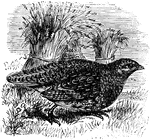
"Coturnix. Bill smaller and much slenderer than that of any of the foregoing genera of Odontophorinae; nasal fossae feathered, except on the tumid nasal scale. Wings of moderate length, little vaulted and not rounded, pointed by the 1st-3d quills, the 1st not shorter than the next. First primary emarginate on inner web; 2d and 3d sinuate on outer web. Tail extremely short and slight, not half as long as the wing, pointed, its feathers very soft, the central pair lanceolate. Feet small; tarsus shorter than middle toe and claw, slightly feathered above in front, with two rows of alternating large scutella in front, two rows of smaller rounded scales meeting in a ridge behind, the sides filled in with small plates. Size smaller than that of any of the foregoing species; pattern of coloration somewhat as in Ortyx; sexes nearly alike." Elliot Coues, 1884

European Partridge

"Coturnix. Bill smaller and much slenderer than that of any of the foregoing genera of Odontophorinae;…
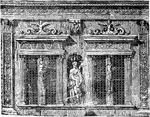
The Heidelberg Castle (in German language named: Heidelberger Schloss) is a famous ruin in Germany and landmark of Heidelberg. The castle ruins are among the most important Renaissance structures north of the Alps.The castle has only been partially rebuilt since its demolition in the 17th and 18th centuries. It is located 80 m (262 ft) up the northern part of the Königstuhl hillside, and thereby dominates the view of the old downtown. It is served by an intermediate station on the Heidelberger Bergbahn funicular railway that runs from Heidelberg's Kornmarkt to the summit of the Königstuhl.The earliest castle structure was built before AD 1214 and later expanded into 2 castles circa 1294; however, in 1537, a lightning-bolt destroyed the upper castle. The present structures had been expanded by 1650, before damage by later wars and fires. In 1764, another lightning-bolt destroyed some rebuilt sections."The Renaissance style was not employed in Germany before the middle of the sixteenth century, and the most noteworthy instances of it are the Belvedere of Ferdinand I., on the Hradschin at Prague, and the so-called Otto Henry buildings at Heidelberg Castle (1556-1559) The Façade of the last-mentioned structure, of which [this image] represents [a portion], in peculiar for a richness and variety of details which almost border on excess. At the same time a certain heaviness prevails, which forms a contrast to the graceful elegance of the best Italian buildings in the same style: in fact these faults may be said to characterize the productions of the German Renaissance style in general."

Façade of the Otto Heinrich Building in Heidelberg Castle

The Heidelberg Castle (in German language named: Heidelberger Schloss) is a famous ruin in Germany and…
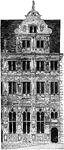
The Heidelberg Castle (in German language named: Heidelberger Schloss) is a famous ruin in Germany and landmark of Heidelberg. The castle ruins are among the most important Renaissance structures north of the Alps.The castle has only been partially rebuilt since its demolition in the 17th and 18th centuries. It is located 80 m (262 ft) up the northern part of the Königstuhl hillside, and thereby dominates the view of the old downtown. It is served by an intermediate station on the Heidelberger Bergbahn funicular railway that runs from Heidelberg's Kornmarkt to the summit of the Königstuhl.The earliest castle structure was built before AD 1214 and later expanded into 2 castles circa 1294; however, in 1537, a lightning-bolt destroyed the upper castle. The present structures had been expanded by 1650, before damage by later wars and fires. In 1764, another lightning-bolt destroyed some rebuilt sections."The Renaissance style was not employed in Germany before the middle of the sixteenth century, and the most noteworthy instances of it are the Belvedere of Ferdinand I., on the Hradschin at Prague, and the so-called Otto Henry buildings at Heidelberg Castle (1556-1559). The Façade of the last-mentioned structure" "in peculiar for a richness and variety of details which almost border on excess. At the same time a certain heaviness prevails, which forms a contrast to the graceful elegance of the best Italian buildings in the same style: in fact these faults may be said to characterize the productions of the German Renaissance style in general. A further instance of this is afforded by [this image], which represents a portion of the façade , though, properly speaking, it belongs to the Roccocco style."

Façade of the Building of Henry the Wise in Heidelberg Castle (1601-1607)

The Heidelberg Castle (in German language named: Heidelberger Schloss) is a famous ruin in Germany and…
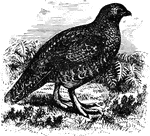
"Lagapus. The densely-feathered feet resemble those of rabbits. No particular feathers on head or neck. Tarsi and toes densely feathered. Tail short, little rounded, normally of 14 broad feathers, with long upper coverts, some of which resemble rectrices, the central pair of these usually reckoned as rectrices, making 16. A naked red comb over eye." Elliot Coues, 1884

Red Game of Britain

"Lagapus. The densely-feathered feet resemble those of rabbits. No particular feathers on head or neck.…