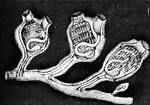
"The <em>Clavellinidae</em>, or <em>Social Ascidians</em>, are united by means of a sort of creeping stem, which runs along the surface of submarine objects, and gives rise at intervals to short footstalks, at the extremity of which the animals are supported." &mdash; Goodrich, 1859

Social Ascidians

"The Clavellinidae, or Social Ascidians, are united by means of a sort of creeping…
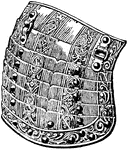
"One of a series of short pieces of metal sliding in slot-holes formed in overlapping plates of armor, replacing the common appliance of riveting to straps of leather or similar material. Image: Tasset of Plates, Almain-rivet Armor, 15th century."-Whitney, 1902

Almain-rivet

"One of a series of short pieces of metal sliding in slot-holes formed in overlapping plates of armor,…
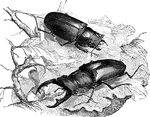
"In the European Stag Beetle, <em>Lucanus cervus</em>, as well as the <em>L. dama</em> of our country, called the <em>Horn Beetle</em>, the leaves are short and distinct, rendering the club pectinated." &mdash; Goodrich, 1859

Stag Beetle

"In the European Stag Beetle, Lucanus cervus, as well as the L. dama of our country,…

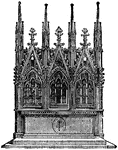
"Gothic Altar. An Altar is an erection made for the offering of sacrifices for memorial purposes, or for some other object. An altar designed for sacrifice is mentioned in Scripture as early as the time of Noah."&mdash;(Charles Leonard-Stuart, 1911)

Gothic Altar

"Gothic Altar. An Altar is an erection made for the offering of sacrifices for memorial purposes, or…
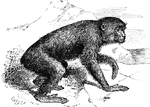
"The tailless ape or magot of Barbary; This ape is notable for its intelligence and docility, and has been the "showman's ape" from time immemorial."-Whitney, 1902

Barbary Ape

"The tailless ape or magot of Barbary; This ape is notable for its intelligence and docility, and has…
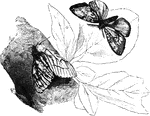
"The Zigzag, <em>Bombyx dispar</em>, has a short trunk or tube, not suited for suction; the male is much smaller than the female; his superior wings being bown with black zigzag figures. The female is whitish with black spots on her wings. This is a European species which sometimes does immense damage to the fruit-trees." &mdash; Goodrich, 1859

Zigzag

"The Zigzag, Bombyx dispar, has a short trunk or tube, not suited for suction; the male is…

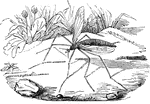
"The tipulidae have the proboscis short, terminated by a pair of fleshy lips, inclosing two bristles." &mdash; Goodrich, 1859

Crane Fly

"The tipulidae have the proboscis short, terminated by a pair of fleshy lips, inclosing two bristles."…
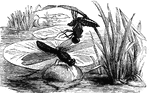
"Among the larger kinds of dragon-fly is the <em>Libellula depressa</em> of Linnaeus, common in Europe, and popularly called <em>Eleanor</em>; the abdomen is large, short, and flat, and composed of nine rings or segments; the wings are diaphanous, and the flight is exceedingly short." &mdash; Goodrich, 1859

Eleanor Dragonfly

"Among the larger kinds of dragon-fly is the Libellula depressa of Linnaeus, common in Europe,…
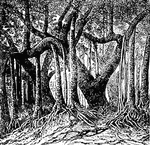
"The Banyan Tree is a species of the genus ficus. It is regarded as a sacred tree by the Hindus. Its branches produce long shoots, or aerial roots, which descend to the ground and penetrate the soil; so that, in course of time, a single tree becomes a vast umbrageous tent, supported by numerous columns."&mdash;(Charles Leonard-Stuart, 1911)

Banyan Tree

"The Banyan Tree is a species of the genus ficus. It is regarded as a sacred tree by the Hindus. Its…
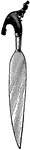
"A Bolo is a short, broad, lance-shaped weapon; used by the Filiinos in their operations against the American troops. The blade is about 18 inches in length by nearly 3 inches in breadth at its broadest dimension. It tapers from the middle toward the haft as well as toward the point, making it strongly resemble the ancient short sword. It is not double edged, however, but tapers from a thick back to an extremely keen edge. In April 1904, the United States troops operating in the Philippines, were supplied with bolos."&mdash;(Charles Leonard-Stuart, 1911)

Filipino Bolo

"A Bolo is a short, broad, lance-shaped weapon; used by the Filiinos in their operations against the…
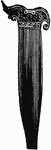
"A Bolo is a short, broad, lance-shaped weapon; used by the Filiinos in their operations against the American troops. The blade is about 18 inches in length by nearly 3 inches in breadth at its broadest dimension. It tapers from the middle toward the haft as well as toward the point, making it strongly resemble the ancient short sword. It is not double edged, however, but tapers from a thick back to an extremely keen edge. In April 1904, the United States troops operating in the Philippines, were supplied with bolos."&mdash;(Charles Leonard-Stuart, 1911)

Filipino Bolo Sheath

"A Bolo is a short, broad, lance-shaped weapon; used by the Filiinos in their operations against the…
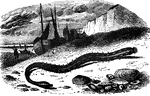
"Errantia means <em>wandering</em>, and is applied to numerous species, of which the Lob-worm or Lug-worm, <em>Arenicola piscatorum</em>, is a common example. This animal, much used by fishermen for bait, is nearly a foot long, and is found on sandy parts of the coast, where it bores into the sand left wet by the retiring tide; its head is large and rounded, quite destitute of eyes or tentacula, and furnished with a short, unarmed proboscis. The feet are very small, and confined to the anterior part of the body, while the branchial tufts, which are of considerable size, are placed on each side of the middle segments." &mdash; Goodrich, 1859

Lob-worm

"Errantia means wandering, and is applied to numerous species, of which the Lob-worm or Lug-worm,…
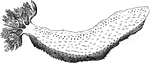
"<em>Sea-Cucumbers</em> are of various forms, some of the species being found in nearly all seas. They generally live among sea-weed or in mud, and are supposed to seize their prey by their tentacles. They have the power of elongating and contracting their forms so as at one time to appear like worms, and at another to assume the shape of an hour-glass." &mdash; Goodrich, 1859

Common sea-cucumber

"Sea-Cucumbers are of various forms, some of the species being found in nearly all seas. They…
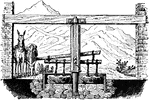
"Mexican Arrastre. A rude apparatus used in Mexico, and to some extent in the United States, for grinding and at the same time amalgamating ores containing free gold or silver."-Whitney, 1902

Arrastre

"Mexican Arrastre. A rude apparatus used in Mexico, and to some extent in the United States, for grinding…
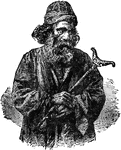
"A Dervish is a Mohammedan monk or religious fanatic, who makes a vow of poverty and austerity of life. There are several orders, some living in monasteries, some as hermits, and some as wandering mendicants. Some, called dancing dervishes, are accustomed to spin or whirl themselves round for hours at a time, till they work themselves into a state of frenzy, when they are believed to be inspired."&mdash;(Charles Leonard-Stuart, 1911)

Dervish

"A Dervish is a Mohammedan monk or religious fanatic, who makes a vow of poverty and austerity of life.…
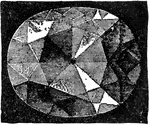
"Most of the great diamonds distinguished for beauty and size have very interesting histories. one of the most famous is the Koh-i-Nur, or Koohinoor, 'Mountain of Light.' The legend is that it was carried by the hero Karna, whose deeds are celebrated in the 'Mahabharata.' It made its first appearance in history in the 14th century, when Ala-ed-din brought it to Delhi. At that time it was supposed to weigh 793 carats."&mdash;(Charles Leonard-Stuart, 1911)

The Kohinur Diamond

"Most of the great diamonds distinguished for beauty and size have very interesting histories. one of…
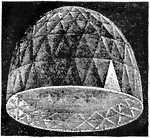
"Another important diamond is the one at the point of the scepter of the Russian empire, known as the Orloff, which weighs 194 and three quarters carats. At one time it formed the eye of an idol in the temple of Seringham in Mysore, whence it was stolen. It was in the throne of Nadir Shah, and after his murder it was bought by an Armenian merchant in 1772 at the price of 450,000 silver rubles and the title of nobility. By the gift of Prince Orloff, a favorite of Catherine II., from whom it derived its name, it came into her possession. Some writers believe that this and the Koh-i-Nur are the two parts of the 'Great Mogul' diamond."&mdash;(Charles Leonard-Stuart, 1911)

The Great Mogul Diamond

"Another important diamond is the one at the point of the scepter of the Russian empire, known as the…
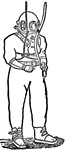
"Diving Apparatuses are contrivances by means of which divers are enabled to remain a considerable time under water. As the most skillful divers are unable to remain under water more than two or three minutes without artificial respiration, means have been devised by hermetically sealed helmets, diving bells, and diving dresses, so that they can stay for several hours at a time at considerable depths of water and at the same time carry on their work."&mdash;(Charles Leonard-Stuart, 1911)

Diving Dress

"Diving Apparatuses are contrivances by means of which divers are enabled to remain a considerable time…
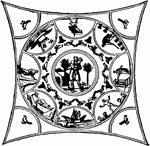
"A Fresco is a kind of painting performed on fresh plaster, or on a wall covered with mortar not quite dry, and with water colors. The plaster is only to be laid on as the painting proceeds, no more being done at once than the painter can dispatch in a day. The colors, being prepared with water, and applied over plaster quite fresh, become incorporated with the plaster, and retain their beauty for a great length of time."&mdash;(Charles Leonard-Stuart, 1911)

Fresco Ceiling

"A Fresco is a kind of painting performed on fresh plaster, or on a wall covered with mortar not quite…
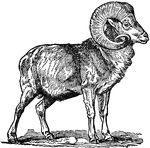
"Goat is the domestic goat, which exists, in a wild or semi-wild state, in all the European mountain ranges. The males fight furiously with each other in the rutting time. They have an offensive smell. "&mdash;(Charles Leonard-Stuart, 1911)

Big Horn Goat

"Goat is the domestic goat, which exists, in a wild or semi-wild state, in all the European mountain…
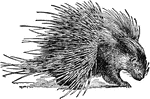
"Hedgehog is a quadruped distinguished by having the body covered with spines instead of hair. The skin of the back is provided with a great orbicular muscle which enables the animal to roll itself up in the form of a ball. The tail is very short. There are several species&mdash;some authorities enumerate 14. The best known is the common hedgehog. This species has a long nose, the nostrils bordered on each side by a loose flap; the hind feet have five toes; the ears are short, rounded, naked and dusky; the upper part of the face, sides, and rump covered with strong, coarse hair, of a yellowish ash color, the back with sharp strong spines of a whitish tint with a bar of black through their middle. They are usually abot 10 inches long, the tail about one. Their usual residence is in small thickets, and they feed on fallen fruits, roots, and insects; they are also fond of flesh, either raw or roasted. The hedgehog defends himself from the attacks of other animals by rolling himself up, and thus exposing no part of his body that is not furnished with a defense of spines. It may be rendered domestic to a certain degree, and has been employed to destroy cockroaches which it pursues with avidity. In the winter the hedgehog wraps itself in a warm nest, composed of moss, dried hay and leaves, and remains torpid till spring."—(Charles Leonard-Stuart, 1911)

Hedgehog

"Hedgehog is a quadruped distinguished by having the body covered with spines instead of hair. The skin…
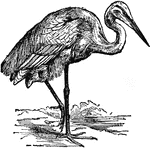
"Heron is the common name of birds of the genus Ardea. The herons are distinguished by having a long bill cleft beneath the eyes, a compressed body, long slender legs naked above the tarsal joint, three toes in front, the two outer united by a membrane, and by moderate wings. The tail is short, rounded, and composed of 10 or 12 feathers. The common heron is about three feet in length from the point of the bill to the end of the tail, builds its nest in high trees, many being sometimes on one tree. Its food consists of fish, frogs, mollusks, mice, moles, and similar small animals. It has an insatiable voracity, and digests its food with great rapidity. It haunts fresh water streams, marshes, ponds, and lakes, as also the seashore."&mdash;(Charles Leonard-Stuart, 1911)

Heron

"Heron is the common name of birds of the genus Ardea. The herons are distinguished by having a long…
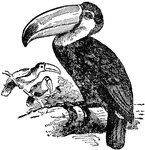
"The Toucan, in ornithology, is the popular name of any bird of the genus Rhamphastos. They are all natives of tropical America, and are easily distinguished by their enormous bill, irregularly toothed along the margin of the mandibles. In the true toucans the ground color of the plumage is generally black; the throat, breast, and rump adorned with white, yellow, and red; the body is short and thick; tail rounded or even, varying in length in the different species, and capable of being turned up over the back when the bird goes to roost."&mdash;(Charles Leonard-Stuart, 1911)

Toucan

"The Toucan, in ornithology, is the popular name of any bird of the genus Rhamphastos. They are all…
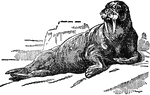
"The walrus, also called the morse, seahorse, and sea cow, is now confined to the regions within the Arctic Circle, though its extinct ancestors had a much wider geographical range. It is a large carnivorous marine mammal, ordinarily from 10 to 12 feet long, with a girth of nearly as much; it is said that it sometimes attains a length of 20 feet; muzzle abruptly truncated, with long and remarkably strong, bristly, moustaches, small eyes; external ear wanting, though the orifice is distinctly visible; body large and sack-like, tapering toward the tail; hind limbs short, connected by a membrane which covers the tail, fore limbs strong and stumpy, all with five digits. The hide is of a tawny brown color, with difficulty penetrated by bullets, and has been likened to a tough flexible coat of mail. The upper canines are developed in adults of both sexes into immense tusks, each from 15 inches to two feet long and weighing 10 pounds and upward."&mdash;(Charles Leonard-Stuart, 1911)

Walrus

"The walrus, also called the morse, seahorse, and sea cow, is now confined to the regions within the…
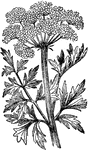
"Water Dropwort is a genus of plants of the natural order Umbellifer&aelig;. A number of species are natives of Great Briatin, large perennial plants, with a strong and generally disagreeable aromatic smell, and compound or decomposed leaves. The common water dropwort and the hemlock water dropwort, or water hemlock, are both common in wet places in Great Britain and throughout Europe, and both are narcotic acid poisons. The roots of the latter have some resemblance to parsnips, and hence fatal accidents have frequently occurred. The fine-leaved water dropwort, called water fennel by the Germans, is also common in ditches and ponds both in Great Britain and on the Continent. It is not so poisonous as the other species just named. It was at one time erroneously regarded as a specific against pulmonary consumption; but it has been advantageously employed in pulmonary complaints."&mdash;(Charles Leonard-Stuart, 1911)

Hemlock Water Dropwort

"Water Dropwort is a genus of plants of the natural order Umbelliferæ. A number of species are…
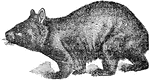
"The Wombat is a burrowing marsupial from Australia and Van Dieman's Land, and the islands of Bass' Strait. It is from two to three feet long, with a short tail; of clumsy form, with stout limbs and a blunt muzzle; coat thick, of long, coarse, brownish-gray, wooly hair; head large, flat, broad, with small eyes and ears; fore feet with five and hind feet with four digits; soles broad and naked. The dentition resembles that of the Rodentia, especially in the chisel-like incisors. The wombat is nocturnal in habits, a vegetable feeder, digging up roots with its claws. It is of small intelligence, but is gentle, and capable of domestication to a limited extent. It is hunted for its flesh, which is highly esteemed and is said to resemble pork."—(Charles Leonard-Stuart, 1911)

Hairy Nosed Wombat

"The Wombat is a burrowing marsupial from Australia and Van Dieman's Land, and the islands of Bass'…
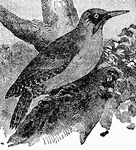
"Woodpecker is the popular name of the old Linn&aelig;an genus Picus, now greatly divided. Woodpeckers have a slender body, powerful beak, and protrusile tongue, which is sharp, barbed, and pointed, and covered with a glutinous secretion derived from glands in the throat, this coating being renewed every time the tongue is drawn within the bill. The tail is stiff and serves as a support when the birds are clinging to the branches or stems of trees. Woodpeckers are very widely distributed, but abound chiefly in warm climates. They are solitary in habit, and live in the depths of forests. Fruits, seeds, and insects constitute their food, and in pursuit of the latter they exhibit wonderful dexterity, climbing with astonishing quickness on the trunks and branches of trees, and when, by tapping with their bills, a rotten place has been discovered, they dig vigorously in search of the grubs or larv&aelig; beneath the bark."&mdash;(Charles Leonard-Stuart, 1911)

Green Woodpecker

"Woodpecker is the popular name of the old Linnæan genus Picus, now greatly divided. Woodpeckers…
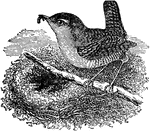
"Wren is a genus of birds, having a slender, slightly curved, and pointed bill; the wings very short and rounded; the tail short, and carried erect; the legs slender, and rather long. Their plumage is generally dull. They are abundant in the neotropical region, less common in the nearctic, pal&aelig;arctic, and parts of the Oriental regions. They live on or near the ground, seeking for insects and worms among low brushes, and in other similar situations. The common or European wren is found in all parts of Erurope, and in Morocco and Algeria, and in Asia Minor and Northern Persia. The common wren is more abundant in the N. than in the central and S. parts of Europe. It frequents gardens, hedges, and thickets. Its flight is not long sustained; it merely flits from bush to bush, or from one stone to another, with very rapid motion of the wings. It sometimes ascends trees, nearly in the manner of creepers."&mdash;(Charles Leonard-Stuart, 1911)

Wren

"Wren is a genus of birds, having a slender, slightly curved, and pointed bill; the wings very short…
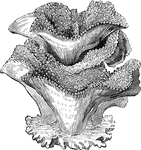
"These animals are generally called <em>Tree-corals</em>, on account of the forms of the polypidons which they build and in which they live. They are very small, and possess twelve short tentacles placed in a circle around the mouth; they occupy the cells in the polypidom, which is of a porus nature, the openings of the cells being placed at the summits of tubercular prominences of greater or lesser elevations. " &mdash; Goodrich, 1859

Tree-coral

"These animals are generally called Tree-corals, on account of the forms of the polypidons…
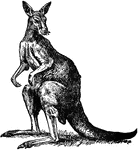
"The Kangaroo is an animal of Australia, first observed by a party of sailors on the coast of New South Wales. The great kangaroo has large hind legs, with a huge tail, short fore limbs, and is about the height of a man. It is a vegetable feeder, and is destructive to the crops of the settlers in the less inhabited parts of Australia; in the long-settled districts it is much rarer. Its ordinary method of progression is by a series of great leaps, 10 to 15 feet or more. Many species are known to exist."&mdash;(Charles Leonard-Stuart, 1911)

Kangaroo

"The Kangaroo is an animal of Australia, first observed by a party of sailors on the coast of New South…
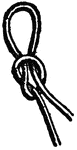
"Knots and splices include all the various methods of tying, fastening, and joining ropes or cords. Generally, the requirements of a useful knot may be stated to be that it should neither 'slip' nor 'jam'&ndash; I. e. that, while it holds without danger of slipping while the strain is on it, when slackened it should be easily untied again. The simplest knot is the common one tied on the end of a thread or cord to prevent it slipping. By passing a loop instead of the end of the cord the common slip knot (fig. 1) is formed."&mdash;(Charles Leonard-Stuart, 1911)

Knots and Splices

"Knots and splices include all the various methods of tying, fastening, and joining ropes or cords.…
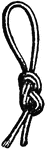
"Knots and splices include all the various methods of tying, fastening, and joining ropes or cords. Generally, the requirements of a useful knot may be stated to be that it should neither 'slip' nor 'jam'&ndash; I. e. that, while it holds without danger of slipping while the strain is on it, when slackened it should be easily untied again. A useful fixed loop is got by tying a simple knot, or the 'figure of 8 knot' (2) on the loop of a cord."&mdash;(Charles Leonard-Stuart, 1911)

Knots and Splices

"Knots and splices include all the various methods of tying, fastening, and joining ropes or cords.…
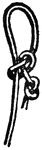
"Knots and splices include all the various methods of tying, fastening, and joining ropes or cords. Generally, the requirements of a useful knot may be stated to be that it should neither 'slip' nor 'jam'&ndash; I. e. that, while it holds without danger of slipping while the strain is on it, when slackened it should be easily untied again. One of the simplest and most useful running knots for a small cord is made by means of two simple knots (3)."&mdash;(Charles Leonard-Stuart, 1911)

Knots and Splices

"Knots and splices include all the various methods of tying, fastening, and joining ropes or cords.…
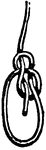
"Knots and splices include all the various methods of tying, fastening, and joining ropes or cords. Generally, the requirements of a useful knot may be stated to be that it should neither 'slip' nor 'jam'&ndash; I. e. that, while it holds without danger of slipping while the strain is on it, when slackened it should be easily untied again. The most secure method of fastening a line to, say, a bucket is the standing bowline (4); and a running bowline is formed by passing the end a through the loop b, thus making a running loop."&mdash;(Charles Leonard-Stuart, 1911)

Knots and Splices

"Knots and splices include all the various methods of tying, fastening, and joining ropes or cords.…
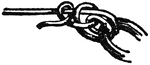
"Knots and splices include all the various methods of tying, fastening, and joining ropes or cords. Generally, the requirements of a useful knot may be stated to be that it should neither 'slip' nor 'jam'&ndash; I. e. that, while it holds without danger of slipping while the strain is on it, when slackened it should be easily untied again. Another good knot to make fast a bucket is the anchor bend (5)."&mdash;(Charles Leonard-Stuart, 1911)

Knots and Splices

"Knots and splices include all the various methods of tying, fastening, and joining ropes or cords.…
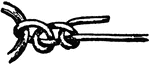
"Knots and splices include all the various methods of tying, fastening, and joining ropes or cords. Generally, the requirements of a useful knot may be stated to be that it should neither 'slip' nor 'jam'&ndash; I. e. that, while it holds without danger of slipping while the strain is on it, when slackened it should be easily untied again. Out of the score or so of methods of fastening a boat's painter the one which will be found most useful is the well-known two half-hitches (6)."&mdash;(Charles Leonard-Stuart, 1911)

Knots and Splices

"Knots and splices include all the various methods of tying, fastening, and joining ropes or cords.…
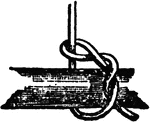
"Knots and splices include all the various methods of tying, fastening, and joining ropes or cords. Generally, the requirements of a useful knot may be stated to be that it should neither 'slip' nor 'jam'&ndash; I. e. that, while it holds without danger of slipping while the strain is on it, when slackened it should be easily untied again. The timber hitch (7) is useful for attaching a line to a spar or a stone."&mdash;(Charles Leonard-Stuart, 1911)

Knots and Splices

"Knots and splices include all the various methods of tying, fastening, and joining ropes or cords.…
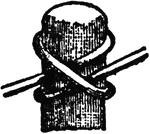
"Knots and splices include all the various methods of tying, fastening, and joining ropes or cords. Generally, the requirements of a useful knot may be stated to be that it should neither 'slip' nor 'jam'&ndash; I. e. that, while it holds without danger of slipping while the strain is on it, when slackened it should be easily untied again. The clove hitch (8) is invaluable for many purposes. It is very simple and cannot slip."&mdash;(Charles Leonard-Stuart, 1911)

Knots and Splices

"Knots and splices include all the various methods of tying, fastening, and joining ropes or cords.…
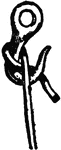
"Knots and splices include all the various methods of tying, fastening, and joining ropes or cords. Generally, the requirements of a useful knot may be stated to be that it should neither 'slip' nor 'jam'&ndash; I. e. that, while it holds without danger of slipping while the strain is on it, when slackened it should be easily untied again. A simple method of fastening a rope to a hook is the blackwall hitch (9), where the strain on the main rope jams the end so tightly against he hook that it cannot slip. "&mdash;(Charles Leonard-Stuart, 1911)

Knots and Splices

"Knots and splices include all the various methods of tying, fastening, and joining ropes or cords.…

"Knots and splices include all the various methods of tying, fastening, and joining ropes or cords. Generally, the requirements of a useful knot may be stated to be that it should neither 'slip' nor 'jam'&ndash; I. e. that, while it holds without danger of slipping while the strain is on it, when slackened it should be easily untied again. There are many methods for shortening a rope temporarily, one of them being the sheepshank, the simplest form of which is shown in fig. 10."&mdash;(Charles Leonard-Stuart, 1911)

Knots and Splices

"Knots and splices include all the various methods of tying, fastening, and joining ropes or cords.…

"Knots and splices include all the various methods of tying, fastening, and joining ropes or cords. Generally, the requirements of a useful knot may be stated to be that it should neither 'slip' nor 'jam'&ndash; I. e. that, while it holds without danger of slipping while the strain is on it, when slackened it should be easily untied again. Of the methods for uniting the ends of two cords the simplest and one of the most secure is the common reef knot (11), which must be carefully distinguished from the granny (12), which will jam it it does not slip; the reef knot will do neither."&mdash;(Charles Leonard-Stuart, 1911)

Knots and Splices

"Knots and splices include all the various methods of tying, fastening, and joining ropes or cords.…
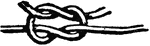
"Knots and splices include all the various methods of tying, fastening, and joining ropes or cords. Generally, the requirements of a useful knot may be stated to be that it should neither 'slip' nor 'jam'&ndash; I. e. that, while it holds without danger of slipping while the strain is on it, when slackened it should be easily untied again. Of the methods for uniting the ends of two cords the simplest and one of the most secure is the common reef knot (11), which must be carefully distinguished from the granny (12), which will jam it it does not slip; the reef knot will do neither."&mdash;(Charles Leonard-Stuart, 1911)

Knots and Splices

"Knots and splices include all the various methods of tying, fastening, and joining ropes or cords.…
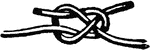
"Knots and splices include all the various methods of tying, fastening, and joining ropes or cords. Generally, the requirements of a useful knot may be stated to be that it should neither 'slip' nor 'jam'&ndash; I. e. that, while it holds without danger of slipping while the strain is on it, when slackened it should be easily untied again. For very small cords or thread the best knot is the weaver's (13)."&mdash;(Charles Leonard-Stuart, 1911)

Knots and Splices

"Knots and splices include all the various methods of tying, fastening, and joining ropes or cords.…

"Knots and splices include all the various methods of tying, fastening, and joining ropes or cords. Generally, the requirements of a useful knot may be stated to be that it should neither 'slip' nor 'jam'&ndash; I. e. that, while it holds without danger of slipping while the strain is on it, when slackened it should be easily untied again. The fisherman's knot is a very useful one for anglers, and is formed by a simple knot in each cord being slipped over the other (14); when drawn taut it is very secure, and it is easily separated by pulling the short ends."&mdash;(Charles Leonard-Stuart, 1911)

Knots and Splices

"Knots and splices include all the various methods of tying, fastening, and joining ropes or cords.…
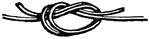
"Knots and splices include all the various methods of tying, fastening, and joining ropes or cords. Generally, the requirements of a useful knot may be stated to be that it should neither 'slip' nor 'jam'&ndash; I. e. that, while it holds without danger of slipping while the strain is on it, when slackened it should be easily untied again. A useful method of uniting large ropes is shown in figure 15: tie a simple knot on the end of one rope and interlace the end of the other, and draw taut. This tie may also be made with the figure of 8 knot."&mdash;(Charles Leonard-Stuart, 1911)

Knots and Splices

"Knots and splices include all the various methods of tying, fastening, and joining ropes or cords.…
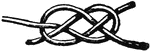
"Knots and splices include all the various methods of tying, fastening, and joining ropes or cords. Generally, the requirements of a useful knot may be stated to be that it should neither 'slip' nor 'jam'&ndash; I. e. that, while it holds without danger of slipping while the strain is on it, when slackened it should be easily untied again. For very large ropes the carrick bend (16) is the simplest and most secure. The bowline bend is formed by looping two bowline knots into each other."&mdash;(Charles Leonard-Stuart, 1911)

Knots and Splices

"Knots and splices include all the various methods of tying, fastening, and joining ropes or cords.…
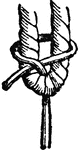
"Knots and splices include all the various methods of tying, fastening, and joining ropes or cords. Generally, the requirements of a useful knot may be stated to be that it should neither 'slip' nor 'jam'&ndash; I. e. that, while it holds without danger of slipping while the strain is on it, when slackened it should be easily untied again. For attaching a small line to a thick rope the becket hitch (17) is very useful."&mdash;(Charles Leonard-Stuart, 1911)

Knots and Splices

"Knots and splices include all the various methods of tying, fastening, and joining ropes or cords.…
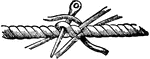
"Knots and splices include all the various methods of tying, fastening, and joining ropes or cords. 'Splicing' is the process employed to join two ropes when it is not advisable to use a knot. The three chief varieties of the splice are the short splice, the long splice, and the eye splice. The short splice is made by unlaying the ends of two ropes for a short distance and fitting them closer together; then, by the help of a marlinspike, the ends are laced over and under the strands of the opposite rope, as shown in figure 18. When each strand has been passed through once, half of it is cut away and the remainder passed through again; half of the remainder being also cut away, it is passed a third time, and, when all the strands are so treated, they are hauled taut and cut close. This reducing the thickness of the strands tapers off the splice."&mdash;(Charles Leonard-Stuart, 1911)

Knots and Splices

"Knots and splices include all the various methods of tying, fastening, and joining ropes or cords.…
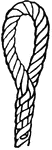
"Knots and splices include all the various methods of tying, fastening, and joining ropes or cords. 'Splicing' is the process employed to join two ropes when it is not advisable to use a knot. The three chief varieties of the splice are the short splice, the long splice, and the eye splice. The eye splice is, as the term implies, used to form an eye, or round a dead eye, and is shown finished in figure 19."&mdash;(Charles Leonard-Stuart, 1911)

Knots and Splices

"Knots and splices include all the various methods of tying, fastening, and joining ropes or cords.…
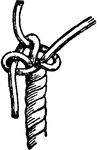
"Knots and splices include all the various methods of tying, fastening, and joining ropes or cords. To prevent a rope fraying at the ends a variety of methods are employed, the simplest being to serve or whip the end with a small cord. Other methods are by interlacing the ends, one of which, the single wall, is shown at figure 20, the ends afterward being drawn taut and cut short."&mdash;(Charles Leonard-Stuart, 1911)

Knots and Splices

"Knots and splices include all the various methods of tying, fastening, and joining ropes or cords.…
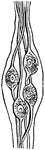
"Nerve tissue is really made up of a great number of distinctive units called <em>nerve cells</em>. Each cell usually contains a large nucleus and gives off one or more tiny branches, or processes. Thse cells vary more in shape and size than any other cell in the body. Each nerve cell has a number of short branches, and many have also one long branch which can be traced for some distance from the cell body." — Blaisedell, 1904

Nerve Cells

"Nerve tissue is really made up of a great number of distinctive units called nerve cells.…
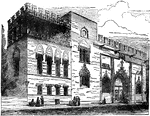
"Lombardic Architecture is the style of architecture that prevailed in Lombardy and part of Upper Italy, and which for a long time was recognized as a distinct Lombard style, presenting essential points of difference from the other later Romanesque styles. In the Lombard churches the type of early Christian architecture was abandoned, and the vaulted basilica was introduced in its stead."&mdash;(Charles Leonard-Stuart, 1911)

Lonja Palace, Valencia

"Lombardic Architecture is the style of architecture that prevailed in Lombardy and part of Upper Italy,…
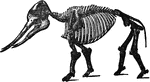
"Mastodon is an extinct genus of proboscideans, closely allied to the true elephants. The genus ranged in time from the middle of the Miocene period to the end of the Pliocene in the Old World, when they became extinct. In America several species survived to a late leistocene period. "&mdash;(Charles Leonard-Stuart, 1911)

Mastodon

"Mastodon is an extinct genus of proboscideans, closely allied to the true elephants. The genus ranged…
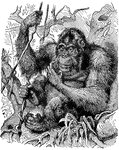
"The Orang Outang is the Mias of the Dyaks; also known as the 'wild man of the wood.' It is a dull, slothful animal, but possessed of great strength. These animals are now confined to the swampy forests of Sumatra and Borneo. Their height has been variously stated, but we have not the least reliable evidence of the existence of orangs in Borneo more than four feet two inches high. The legs are very short, the arms are disproportionately long, reaching to the ankle when the animal is placed in an erect position. The males have a longish beard, and they sometimes develop warty protuberances on each side of the face. The resemblance to man in appearance is greatest in the females and in young animals. The head of a baby orang is not very different from that of an average child; but in the adult the muzzle is as well-marked a feature as in the Carnivora. It never walks erect, unless when supporting itself by branches."&mdash;(Charles Leonard-Stuart, 1911)

Orang Outang

"The Orang Outang is the Mias of the Dyaks; also known as the 'wild man of the wood.' It is a dull,…
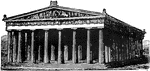
"The Parthenon is a celebrated temple at Athens, consecrated to Athena or Minerva, the protectress of the city, built on an elevated rock near the Acropolis, and has always been regarded as the most exquisite and perfect example of Grecian architecture. The Parthenon was erected about 448 B. C., in the time of Pericles, Phidias being the chief sculptor. It had a length of 228 feet, by a breadth of 100; it had eight columns beneath each pediment, and 15 on each side, exclusive of those at each end of the pediments, with which they formed 16 intercolumns, of 46 columns in all, exclusive of those within the building. This magnificent fane had resisted the ravages of time down to the 17th century, being by turns a pagan temple, a Christian church, and also a Turkish mosque, till at the siege of Athens by the Venetians, in 1687, a shell fell on the roof of the Acropolis or citadel, which, firing the magazine beneath, shattered that building and the Parthenon into blackened ruins."&mdash;(Charles Leonard-Stuart, 1911)

Parthenon

"The Parthenon is a celebrated temple at Athens, consecrated to Athena or Minerva, the protectress of…
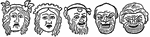
"While Greek tragedt grew farther and farther away from the humor and burlesque so characteristic of the old satyr dances and songs, comedy arose to incorporate within itself much of this early spirit. The comedies supplied entertainments, pure and simple, yet at the same time did much to mold public opinion." &mdash; The Delphian Society, 1913

Comedy masks

"While Greek tragedt grew farther and farther away from the humor and burlesque so characteristic of…
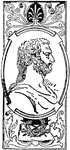
"So long as Pericles stood at the head of Athens in time of peace, he governed it with moderation and maintained it in safety, and under him it rose to its highest power. And when the war broke out he proved that he had well calculated the resources of the State." &mdash; The Delphian Society, 1913

Pericles

"So long as Pericles stood at the head of Athens in time of peace, he governed it with moderation and…
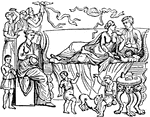
"The act of reclining at meals. The Greeks and Romans were accustomed, in later times, to recline at their meals; but this practice could not have been od great antiquity in Greece, since Homer always describes persons as sitting at their meals; and Isidore of Seville, an ancient grammarian, also attributes the same custom to the ancient Romans. Even in the time of the early Roman emperors, children in families of the highest rank used to sit together, while their fathers and elders reclined on couches at the upper part of the room. Roman ladies continued the practice of sitting at table, even after the recumbent position had become common with the other sex. It appears to have been considered more decent, and more agreeable to the severity and purity of ancient manners for women to sit, more especially if many persons were present. But, on the other hand, we find cases of women reclining, where there was conceived to be nothing bold or indelicate in their posture. Such is the case in the following woodcut, which seems intended to represent a scene of matrimonial felicity. The husband and wife recline on a sofa; their two sons are in front of them; and several females and a boy are performing a piece of music for the entertainment of the married pair." — Smith, 1873

Accubatio

"The act of reclining at meals. The Greeks and Romans were accustomed, in later times, to recline at…
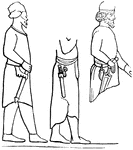
"A Persian sword, whence Horace speaks of the <em>Medus acinaces.</em> The acinaces was a short and straight weapon; and thus differed from the Roman <em>sica,</em> which was curved. It was worn on the right side of the body, whereas the Greeks and Romans usually had their swords suspended on the left side. The form of the acinaces, with the mode of wearing it, is illustrated by the by the following Persepolitan figures." &mdash; Smith, 1873

Acinaces

"A Persian sword, whence Horace speaks of the Medus acinaces. The acinaces was a short and…
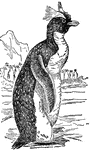
"The Penguins are aquatic birds confined to the high S. latitudes or both hemispheres, where they congregate in large flocks. The body is generally elliptical; neck of moderate length; bill moderately long, straight, compressed; tail short. They have no quills in their wings, which are as rigid as the flippers of a cetacean, and utterly useless for flight, though they move freely at the shoulder joint, forming most efficient paddles, and are usually worked alternately with a rotatory motion. In standing, the penguin preserves an upright position, generally resting on the tarsus, which is widened like the foot of a quadruped; but in progressing this is kept nearly vertical, and the weight supported on the toes alone."&mdash;(Charles Leonard-Stuart, 1911)

Penguin

"The Penguins are aquatic birds confined to the high S. latitudes or both hemispheres, where they congregate…