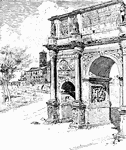
"This arch is the most modern and the best preseved of all the buildings which remain of the Imperial period. Probably it owes its preservation to the Christianity of its hero." — Young, 1901

Arch of Constantine

"This arch is the most modern and the best preseved of all the buildings which remain of the Imperial…
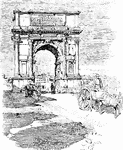
"In the time of Trajan, the Arch of titus and the Colossus of Nero (a gilt bronze statue 120 feet high), stood near the site now occupied by the church of S. Francesca Romana. They were removed by Hadrian to make room for the Temple of Venus and Rome, the arch being placed in its present position, and the colossus on the large square pedestal near the Colosseum, of which some remains may be still identified." — Young, 1901

Arch of Titus

"In the time of Trajan, the Arch of titus and the Colossus of Nero (a gilt bronze statue 120 feet high),…
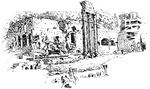
"Columns of Temple of Castor, Temple of Augustus, and Palatine Hill." — Young, 1901

Columns of Temple of Castor

"Columns of Temple of Castor, Temple of Augustus, and Palatine Hill." — Young, 1901
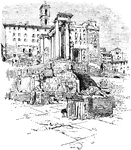
"Temple of Saturn, Tabularium and Tower of Capitol." — Young, 1901

Temple of Saturn

"Temple of Saturn, Tabularium and Tower of Capitol." — Young, 1901

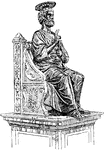
"Statue of St Peter in the Bascilica." — Young, 1901

Statue of St Peter

"Statue of St Peter in the Bascilica." — Young, 1901

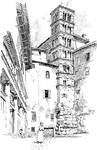
"Campanile and Facade of SS Giovanni E Paolo." — Young, 1901

Campanile

"Campanile and Facade of SS Giovanni E Paolo." — Young, 1901

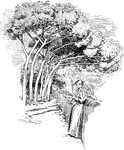
"On the walls near the lantern." — Young, 1901

Woman Leaning on Wall

"On the walls near the lantern." — Young, 1901

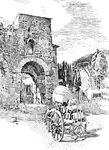
"Porta San Paolo" — Young, 1901

Porta San Paolo

"Porta San Paolo" — Young, 1901

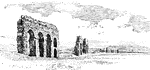
"The ruined aqueducts in the Campagna." — Young, 1901

Ruined aqueducts

"The ruined aqueducts in the Campagna." — Young, 1901

"S. Francesca Romana from the Palatine." — Young, 1901

S. Francesca Romana

"S. Francesca Romana from the Palatine." — Young, 1901

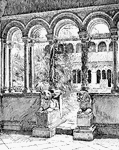
"The Benedictine system enjoined three virtues as essential; solitude, humility, and obedience." — Young, 1901

Cloister of the Lateran

"The Benedictine system enjoined three virtues as essential; solitude, humility, and obedience." —…
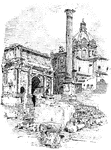
"Arch of Severus, Column of Phocas, and S. Martina." — Young, 1901

Arch of Severus

"Arch of Severus, Column of Phocas, and S. Martina." — Young, 1901

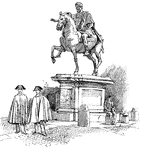
"Equestrian state of Marcus Aurelius." — Young, 1901

Statue of Marcus Aurelius

"Equestrian state of Marcus Aurelius." — Young, 1901

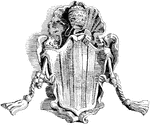
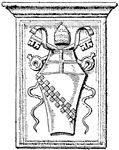
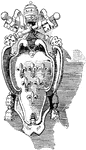
"Arms of Benedict XIV (Lambertini)." — Young, 1901

Benedict XIV

"Arms of Benedict XIV (Lambertini)." — Young, 1901

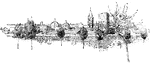
"A Skyline from the Sette Salle." — Young, 1901

Roman skyline

"A Skyline from the Sette Salle." — Young, 1901

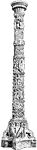
"Candelabrum in S. Paolo Fuori." — Young, 1901

Candelabrum

"Candelabrum in S. Paolo Fuori." — Young, 1901

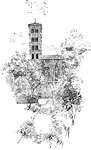
"S. Sominic's Orange Tree, with Campanile of S. Alessio." — Young, 1901

Campanile

"S. Sominic's Orange Tree, with Campanile of S. Alessio." — Young, 1901

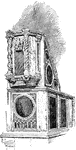
"Ambo in the Ara Coeli." — Young, 1901

Ambo in the Ara Coeli

"Ambo in the Ara Coeli." — Young, 1901

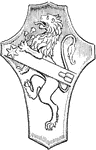
"Arms of Martin V." — Young, 1901

Arms of Martin V

"Arms of Martin V." — Young, 1901

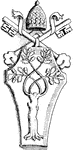
"Arms of Innocent VIII. (Cibo)" — Young, 1901

Innocent VIII

"Arms of Innocent VIII. (Cibo)" — Young, 1901

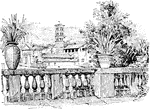
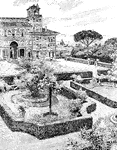
"The Villa Medici, from the Terrace." — Young, 1901

Villa Medici

"The Villa Medici, from the Terrace." — Young, 1901

"Arms of Sixtus IV. and Julius II. (Della Rovere)" — Young, 1901

Sixtus IV

"Arms of Sixtus IV. and Julius II. (Della Rovere)" — Young, 1901

"Arms of Paul III. (Farnese)" — Young, 1901

Paul III

"Arms of Paul III. (Farnese)" — Young, 1901

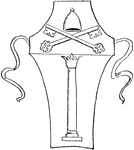
"Arms of Sixtus V (Peretti)." — Young, 1901

Sixtus V

"Arms of Sixtus V (Peretti)." — Young, 1901

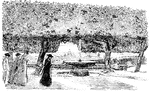
"From the Villa Medici." — Young, 1901

Fountain and People

"From the Villa Medici." — Young, 1901

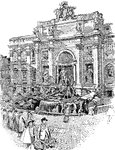
"The Fountain Trevi." — Young, 1901

Trevi Fountain

"The Fountain Trevi." — Young, 1901

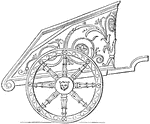
"Arms and a chariot are here assigned to June through not properly a warlike goddess. The idea itself, of giving such appendages to Diety, seems borrowed from the habits of the heroic age. The following delineation of a chariot is from an ancient one preserved in the Vatican; <em>Hoc regnum dea</em> etc." &mdash; Anthon, 1891

Chariot

"Arms and a chariot are here assigned to June through not properly a warlike goddess. The idea itself,…
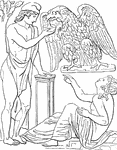
"From an ancient sarcophagus, represents Ganymede giving drink to the eagle, or bird of Jobe, and Hebe in disgrace, lying upon the ground." &mdash; Anthon, 1891

Ganymede and Eagle

"From an ancient sarcophagus, represents Ganymede giving drink to the eagle, or bird of Jobe, and Hebe…
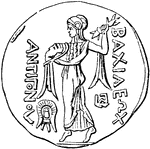
"Minerva is often represented on gems and coins, hurling the thunderbolts of Jove. The following cut, so representing her, is from a silver coin of Antigonus Gona as itself copied from an ancient statue." &mdash; Anthon, 1891

Coin of Minerva

"Minerva is often represented on gems and coins, hurling the thunderbolts of Jove. The following cut,…
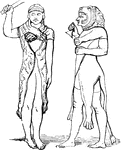
"'Exulting in the tawny covering of a she-wolf, such as his foster-parent was.' Alluding to the custom on the part of the ancient heroes of arraying themselves in the skins of wild animals, in order to strike more terror into the foe and of either making a part of the hide answer the purposes of a helmet, or decking the helmet with it, <em>Genetricis</em>." — Anthon, 1891

Greek soldiers

"'Exulting in the tawny covering of a she-wolf, such as his foster-parent was.' Alluding to the custom…
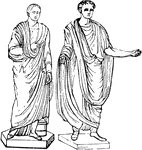
"The following cuts represent, the first more ancient, and the second the later mode of wearing the toga." &mdash; Anthon, 1891

Roman Togas

"The following cuts represent, the first more ancient, and the second the later mode of wearing the…
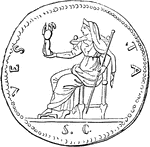
"Represents Vesta seated on a throne, with the Palladium of Rome in her hand." &mdash; Anthon, 1891

Coin of Vesta

"Represents Vesta seated on a throne, with the Palladium of Rome in her hand." — Anthon, 1891
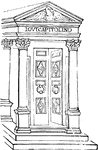
"The door in front of a temple, as it reeached nearly to the ceiling allowed the worshippers to view from without the entire statue of the divinity, and to observe the rites performed before it. The whole light of the building, moreover, was commonly admitted through the same aperture. These circumstances are illustrated in the following cut, showing the front of a small temple of Jupiter taken from an ancient bas-relief." &mdash; Anthon, 1891

Temple of Jupiter

"The door in front of a temple, as it reeached nearly to the ceiling allowed the worshippers to view…

"The Temple of Janus is represented as closed." &mdash; Anthon, 1891

Coin of Temple of Janus

"The Temple of Janus is represented as closed." — Anthon, 1891

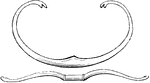
"Represents two forms of the bow; the upper, the Scythian or Parthian bow enstrung, agreeing with the form of that now used by the Tartars, the lower, the ordinary bow, like the one mentioned in the text." &mdash; Anthon, 1891

Ancient bows

"Represents two forms of the bow; the upper, the Scythian or Parthian bow enstrung, agreeing with the…
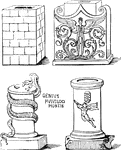
"Altars were either square or round. Specimens of both kinds are here given from ancient sculptures." — Anthon, 1891

Altars

"Altars were either square or round. Specimens of both kinds are here given from ancient sculptures."…
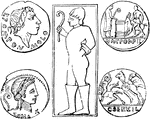
"The figure in the middle of the following illustration is from a most ancient specimen of Etruscan sculpture, and represents an augur with his <em>lituus</em>, or staff. The others are Roman denarii." &mdash; Anthon, 1891

Sculpture and coins

"The figure in the middle of the following illustration is from a most ancient specimen of Etruscan…
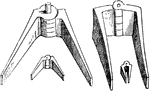
"The Greeks and Romans used hinges exactly like those now in common use. The following cut exhibits four Roman hinges of bronze, now preserved in the British Museum." &mdash; Anthon, 1891

Roman hinges

"The Greeks and Romans used hinges exactly like those now in common use. The following cut exhibits…
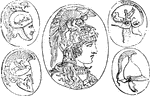
""The crested Achilles was pressing on in his chariot." Some idea of the ancient crests may be formed from the following woodcuts, selected from ancient gems." &mdash; Anthon, 1891

Crested helmets

""The crested Achilles was pressing on in his chariot." Some idea of the ancient crests may be formed…
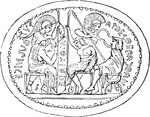
"The <em>palla</em>, as well as the <em>pallium</em> and <em>palliolum</em>, was always a rectangular piece of cloth, exactly, or, at least, nearly square. It was, indeed, used in the very form in which it was taken from the loom, being made entirely by the weaver. Among the Greeks and Romans the most common material for the <em>palla</em> was wool. It was often folded about the body simply with a view to defend it from cold, and without any regard to gracefulness of appearance, as in the following cut, taken from an ancient intaglio." &mdash; Anthon, 1891

Palla

"The palla, as well as the pallium and palliolum, was always a rectangular…

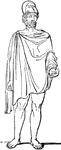
"A more graceful mode of wearing the <em>palla</em> was to attach it by means of a brooch, and allow it to hang down from the shoulders, as in the following cut, representing the statue of Phocion in the Vatican." &mdash; Anthon, 1891

Statue of Phocion

"A more graceful mode of wearing the palla was to attach it by means of a brooch, and allow…
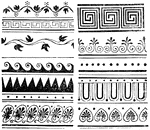
"The following cut shows specimens of ancient borders to veils and other articles of female attire." &mdash; Anthon, 1891

Assorted ornaments

"The following cut shows specimens of ancient borders to veils and other articles of female attire."…
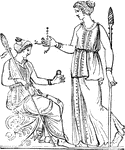
"It is a very common error to translate <em>monile baccatum</em>, "a pearl necklace". The ornament of which we are here speaking is frequently shown in ancient paintings, as in the two following cuts." &mdash; Anthon, 1891

Women with necklaces

"It is a very common error to translate monile baccatum, "a pearl necklace". The ornament of…
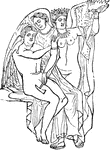
"It is a very common error to translate <em>monile baccatum</em>, "a pearl necklace". The ornament of which we are here speaking is frequently shown in ancient paintings, &c., as in the two following cuts." &mdash; Anthon, 1891

Women with necklaces

"It is a very common error to translate monile baccatum, "a pearl necklace". The ornament of…
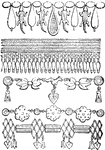
"The following, also, are specimens of other ancient necklances. The first, small golden lizards alternate with drops. The second one was found at St. Agatha, near Naples, in the sepulchre of a Greek lady. It has 71 pendants. The third, fourth, and fifth, were found in Etrurian tombs." &mdash; Anthon, 1891

Ancient necklaces

"The following, also, are specimens of other ancient necklances. The first, small golden lizards alternate…
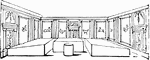
"The Roman people reclined at their meals. On each couch there were commonly three persons. They lay with the upper part of the body reclined on the left arm, the head a little raised, the back supported by cushions and the limbs stretched out at full length, or a little bent; the feet of the first behind the back of the second, and his feet behind the back of the third, with a pillow between each. When they ate, they raised themselves on their elbow, and made use of the right hand. A banqueting-room generally contained three couches, holding nine guests, and, from the number of couches, was called <em>riclinium</em>. The following representation of such a room is from one at Pomopeii. In the centre is a pedestal to receive the table." &mdash; Anthon, 1891

Banqueting room

"The Roman people reclined at their meals. On each couch there were commonly three persons. They lay…
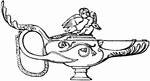
"An oil lamp. The Greeks and Romans originally used candles; but in later times candles were chiefly confined to the houses of the lower classes. A great number of ancient lamps has come down to us; the greater part of which are made of terra cotta, but also a considerable number of bronze. Most of the lamps are of an oval form, and flat upon the top, on which there are frequently figures in relief. In the lamps there are one or more ellychnia burnt into it. The following is an example of a dumyxos lucerna, upon which there is a winged boy with a goose." — Smith, 1873

Lucerna

"An oil lamp. The Greeks and Romans originally used candles; but in later times candles were chiefly…
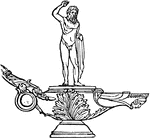
"An oil lamp. The Greeks and Romans originally used candles; but in later times candles were chiefly confined to the houses of the lower classes. A great number of ancient lamps has come down to us; the greater part of which are made of terra cotta, but also a considerable number of bronze. Most of the lamps are of an oval form, and flat upon the top, on which there are frequently figures in relief. In the lamps there are one or more ellychnia burnt into it. The following is an example of a dumyxos lucerna, upon which there is a winged boy with a goose." — Smith, 1873

Lucerna

"An oil lamp. The Greeks and Romans originally used candles; but in later times candles were chiefly…
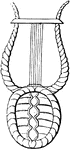
"A lyre, one of the most ancient musical instruments of the stringed kind. The Greeks attributed the invention of the lyre to Mercury, who is said to have formed the instrument of a tortoiseshell, over which he placed gut-strings." &mdash; Smith, 1873

Lyra

"A lyre, one of the most ancient musical instruments of the stringed kind. The Greeks attributed the…
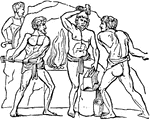
"A hammer, a mallet. In the hands of the farmer the mallet of wood served to break down the clods and to pulverize them. The butcher used it in slaying cattle, by striking the head, and we often read of it as used by the smith upon the anvil. When several men were employed at te same anvil it was a matter of necessity that they should strike in time, and Virgil, accordingly says of the Cyclopes, "inter se brachia tollunt in numerum." The scene which he describes is represented in the annexed woodcut, taken from an ancient bas-relief, in which Vulcan, Brontes, and Steropes, are seen forging the metal, while the third Cyclops, Pyracmon, blows the bellows. Beside the anvil is seen the vessel of water in which the hot iron or bronze was immersed. But besides the employment of the hammer upon the anvil for making all ordinary utensils, the smith wrought with this instrument figures which were either small and fine, some of their parts being beaten as thin as paper, and being in very high relief, as in the bronzes of Siris, or of colossal proportions, being composed of seperate plates riveted together." &mdash; Smith, 1873

Malleus

"A hammer, a mallet. In the hands of the farmer the mallet of wood served to break down the clods and…
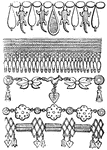
"A necklace. Necklaces were worn by both sexes among the most polished of those nations which the Greeks called barbarous, expecially the Indians, the Egyptians, and the Persians. Greek and Roman females adopted them more particularly as a bridal ornament. They were of various forms, as may be seen by the following specimens." — Smith, 1873

Monilia

"A necklace. Necklaces were worn by both sexes among the most polished of those nations which the Greeks…

"A greave, a leggin. A pair of greaves was one of the six articles of armour which formed the complete equipment of a Greek warrior, and likewise of a Roman soldier as fixed by Servius Tullius. They were made of various metals, with a lining probably of leather, felt, or cloth. Their form is shown in the accompanying cut. The figure is that of a fallen warrior, and is consequence of the bending of the knees, the greaves are seen to project a little above them. This statue also shows the ankle-rings, which were used to fasten the greaves immediately above the feet. The woodcut that follows shows the interior of a bronze shield, and a pair of bronze greaves found in the tomb of an Etruscan Museum. The greaves are made right and left." &mdash; Smith, 1873

Ocrea

"A greave, a leggin. A pair of greaves was one of the six articles of armour which formed the complete…
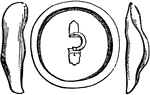
"A greave, a leggin. A pair of greaves was one of the six articles of armour which formed the complete equipment of a Greek warrior, and likewise of a Roman soldier as fixed by Servius Tullius. They were made of various metals, with a lining probably of leather, felt, or cloth. Their form is shown in the accompanying cut. The figure is that of a fallen warrior, and is consequence of the bending of the knees, the greaves are seen to project a little above them. This statue also shows the ankle-rings, which were used to fasten the greaves immediately above the feet. The woodcut that follows shows the interior of a bronze shield, and a pair of bronze greaves found in the tomb of an Etruscan Museum. The greaves are made right and left." &mdash; Smith, 1873

Ocrea

"A greave, a leggin. A pair of greaves was one of the six articles of armour which formed the complete…
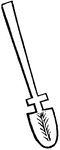
"The spade was but little used in ancient husbandry, the ground having been broken and turned over by the plough, and also by the use of large hoes and rakes. The preceding woodcut, taken a deceased countryman with his falx and bidens, and also with a pala, modified by the addition of a strong cross-bar, by the use of which he was enabled to drive it nearly twice as deep into the ground, as he could have done without it." &mdash; Smith, 1873

Pala

"The spade was but little used in ancient husbandry, the ground having been broken and turned over by…
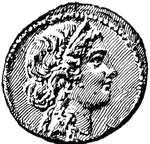
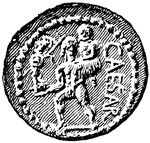
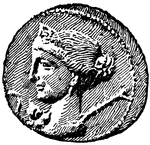
Coin commissioned with the image of Caius Julius Caesar. Front.

Coin of Caesar

Coin commissioned with the image of Caius Julius Caesar. Front.

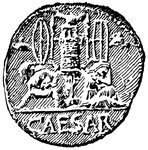
Coin commissioned with the image of Caius Julius Caesar. Back.

Coin of Caesar

Coin commissioned with the image of Caius Julius Caesar. Back.

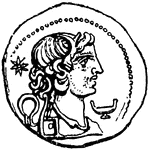
Coin commissioned with the image of Caius Julius Caesar. Front.

A Coin of Caesar

Coin commissioned with the image of Caius Julius Caesar. Front.

Coin commissioned with the image of Caius Julius Caesar. Back.

A Coin of Caesar

Coin commissioned with the image of Caius Julius Caesar. Back.

Coin of Piso with bust on front and wreath on back. Front.

Coin of Piso

Coin of Piso with bust on front and wreath on back. Front.

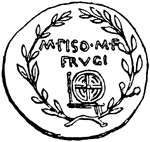
Coin of Piso with bust on front and wreath on back. Back.

Coin of Piso

Coin of Piso with bust on front and wreath on back. Back.