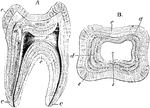
Longitudinal section (A) and transverse section (B) of a human molar tooth. Labels: c, cement; d, dentine; e, enamel; v, pulp cavity

Structure of a Molar

Longitudinal section (A) and transverse section (B) of a human molar tooth. Labels: c, cement; d, dentine;…
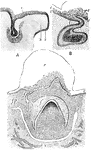
The first step in the development of teeth consists in a downward growth from the Rete Malpighi or the deeper layer of stratified epithelium of the mucous membrane of the mouth, which first becomes thickened in the neighborhood of the maxillae now in the course of formation. This development is shown in a section of the upper jaw of a fetal sheep. A- 1, common enamel germ dipping down into the mucous membrane; 2, palantine process of jaw; 3, Reta Malpighi. B- Section similar to A, but passing through one of the special enamel germs here becoming flask-shaped; c, d, epithelium of mouth; f, neck; f', body of special enamel organ; p, papilla; s, dental sac forming; f p, the enamel germ of permanent tooth; m, bone of jaw; v, vessel cut across.

Development of Teeth

The first step in the development of teeth consists in a downward growth from the Rete Malpighi or the…
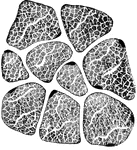
Transverse section through muscular fibers of human tongue. The muscle corpuscles are indicated by their deeply stained nuclei situated at the inside of the sarcolemma. Each muscle fiber shows "Cohnheim's fields," that is, the sarcous elements in transverse section separated by clear (apparently linear) interstitial substance.

Muscular Fibers of the Human Tongue

Transverse section through muscular fibers of human tongue. The muscle corpuscles are indicated by their…
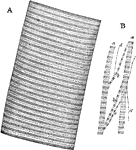
A. Portion of a medium sized human muscular fiber. B. Separated bundles of fibrils equally magnified. Labels: a, larger, and b, smaller collections; c, still smaller; d, smallest which could be detached, possibly representing a single series of sarcous element.

Muscular Fiber

A. Portion of a medium sized human muscular fiber. B. Separated bundles of fibrils equally magnified.…
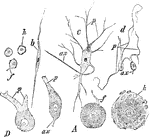
Different forms of ganglion cells. A, a, round ball-shaped unipolar cell from the human Gasserian ganglion. Two cells only show the process f; b, spindle shaped; c, multipolar ganglion cell from he spinal cord of the ox. d, D, Purkinjee ganglion cells from human cerebellum; ax, axis cylinder process; p, protoplasmic process; h, h, two cells surrounded with a nucleated sheath.

Different Forms of Ganglion Cells

Different forms of ganglion cells. A, a, round ball-shaped unipolar cell from the human Gasserian ganglion.…
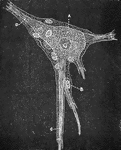
An isolated ganglion cell of a human, showing sheath with nucleated cell lining, B. A Ganglion cell, with nucleus and nucleolus. C, Branched process. D. Unbranched process.

Ganglion Cell, Structure of

An isolated ganglion cell of a human, showing sheath with nucleated cell lining, B. A Ganglion cell,…
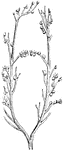
The Pacinian bodies or corpuscles are elongated oval bodies situated on some of the cerebrospinal and sympathetic nerves, especially the cutaneous nerves of the hands and feet; and on branches of the large sympathetic plexus about the abdominal aorta. Shown are the extremities of a nerve of the finger with Pacinian corpuscles attached.

Pacinian Corpuscles in a Human

The Pacinian bodies or corpuscles are elongated oval bodies situated on some of the cerebrospinal and…
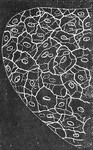
The Pacinian bodies or corpuscles are elongated oval bodies situated on some of the cerebrospinal and sympathetic nerves, especially the cutaneous nerves of the hands and feet; and on branches of the large sympathetic plexus about the abdominal aorta. Shown is the summit of a Pacinian corpuscle of a human finger, showing the endothelial membranes linking the capsules.

Pacinian Corpuscle of a Human

The Pacinian bodies or corpuscles are elongated oval bodies situated on some of the cerebrospinal and…
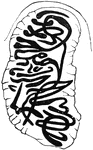
Touch corpuscles are found in the papillae of the skin of the fingers and toes, or among its epithelium; they may be simple or compound; when simple, they are large and slightly flattened transparent nucleated ganglion cells, enclosed in a capsule; when compound the capsule contains several smalls cells. Show is a touch corpuscle of Meissner, from the skin of the human hand.

Touch Corpuscle of Meissner

Touch corpuscles are found in the papillae of the skin of the fingers and toes, or among its epithelium;…
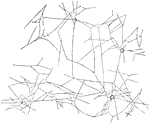
The clotting of the blood is due to the development in it of a substance called fibrin which appears as a meshwork of fine fibrils. Reticulum of fibrin, from a drop of human blood, after treatment rosanilin.

Reticulum of Fibrin

The clotting of the blood is due to the development in it of a substance called fibrin which appears…
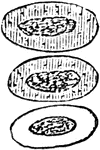
Acetic acid (dilute) causes the nucleus of the red blood cells in the frog to become more clearly defined; if the action is prolonged, the nucleus becomes strongly granulated, and all the coloring matter seems to be concentrated in it, the surrounding cell substance and outline of the cell becoming almost invisible; after a time the cells lose their color altogether. The cells shown represent the successive stages of change. A similar loss of color occurs in the red cells of human blood, which , however, from the absence of nuclei, seem to disappear entirely.

Effect of Acetic Acid on Red Blood Cells

Acetic acid (dilute) causes the nucleus of the red blood cells in the frog to become more clearly defined;…
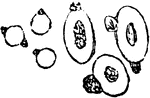
When a 2 percent fresh solution of tannic acid is applied to frog's blood it causes the appearance of a sharply defined little knob, projecting from the free surface (Robert's macula): the coloring matter becomes at the same concentrated in the nucleus, which grows more distinct. A somewhat similar effect is produced on the human blood corpuscle.

Effect of Tannin on Red Blood Cells

When a 2 percent fresh solution of tannic acid is applied to frog's blood it causes the appearance of…
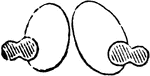
A 2 percent solution of boric acid applied to nucleated red blood cells of a frog will cause the concentration of all he coloring matter in the nucleus; the colored body thus formed gradually quits its central position , and comes to be partly, sometime entirely, protruded from the surface of the now colorless cell. When applied to non-nucleated mammalian corpuscle its effect merely resembles that of other dilute acids.

Effect of Boric Acid on Red Blood Cells

A 2 percent solution of boric acid applied to nucleated red blood cells of a frog will cause the concentration…
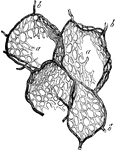
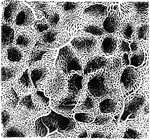
The form of the capillary network presents considerable variety in the different textures of the body: the varieties consists principally of modifications of two chief kind of mesh, the rounded and the elongated. The kind in which the meshes or interspaces have a roundish form is the most common, and prevails in those parts which the capillary network is most dense, such as the lungs. Shown is the network of capillary vessels of the air cells of the horse's lung magnified. Labels: a, capillaries proceeding from b, terminal branched of the pulmonary artery.

Capillary Vessels of Air Cells

The form of the capillary network presents considerable variety in the different textures of the body:…
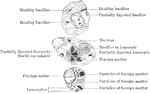
Human colorless blood corpuscle, showing its successive changes of outline within ten minutes when kept moist on a warm stage.

The Change of Colorless Blood Corpuscles

Human colorless blood corpuscle, showing its successive changes of outline within ten minutes when kept…
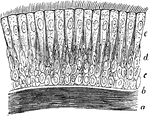
Ciliary epithelium of the human trachea. Labels: a, layer of longitudinally arranged elastic fibers; b, basement membrane; c, deepest cells, circular in form; d, intermediate elongated cells; e, outermost layer of cells fully developed and bearing cilia.

Ciliary Epithelium

Ciliary epithelium of the human trachea. Labels: a, layer of longitudinally arranged elastic fibers;…
The capillary network of the pulmonary blood vessels in the human lung.

Capillary Network in Lung

The capillary network of the pulmonary blood vessels in the human lung.

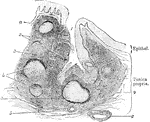
A tonsil consists of an elevation of the mucous membrane presenting 12 to 15 orifices which lead into crypts or recesses, in the walls of which are placed nodules of adenoid or lymphoid tissue. Shown is a vertical section through a crypt of the human tonsil. Labels: 1, entrance to the crypt; 2 and 3, the framework or adenoid tissue; 4, the enclosing fibrous tissue; a and b, lymphatic follicles; 5 and 6, blood vessels.

Crypt of Tonsil

A tonsil consists of an elevation of the mucous membrane presenting 12 to 15 orifices which lead into…
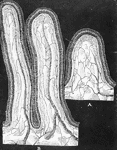
A, Villus of sheep. B, Villi of human.

Villus of Humans and Sheep

A, Villus of sheep. B, Villi of human.

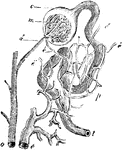
Relation of the Malpighian body to the uriniferous ducts and blood vessels. Labels: a, one of the interlobular arteries; a', afferent artery passing into the glomerulus; c, capsule of the Malpighian body, forming the termination of and continuous with t, the uriniferous tube; e', efferent vessels which subdivide in the plexus; p, surrounding the tube, and finally terminate in the branch of the renal vein, e.

Malpighian Body

Relation of the Malpighian body to the uriniferous ducts and blood vessels. Labels: a, one of the interlobular…
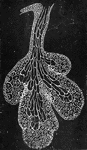
Sebaceous gland from the human skin.

Sebaceous Gland from Human Skin

Sebaceous gland from the human skin.

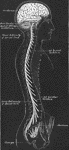
View of the cerebrospinal axis of the nervous system. The right half of the cranium and trunk of the body have been removed by a vertical section; the membranes of the brain and spinal cord have also been removed, and the roots and first part of the fifth and ninth cranial, and of all the spinal nerves of the right side, have been dissected out and laid separately on the wall of the skull and on the several vertebrae opposite to the place of their natural exit from the craniospinal cavity.

Central Nervous System

View of the cerebrospinal axis of the nervous system. The right half of the cranium and trunk of the…
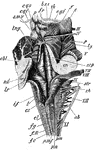
Dorsal or posterior view of the medulla, fourth ventricle, and mesencephalon. Labels: p.n., line of the posterior roots of the spinal nerves; p.m.f., posterior median fissure; f.g., funiculus gracilis; cl., its clava; f.c., funiculus cuneatus; f.R., funiculus of Rolando; r.b., restiform body; c.s., calamus scriptorius; l, section of ligula or taenia; part of choroid plexus is seen beneath t; l.r., lateral recess of the ventricle; str., striae acusticae; i.f., inferior fossa; s.f., posterior fossa; between it and the median sulcus is the fasciculus teres; cbl., cut surface of the cerebellar hemisphere; nd., central or gray matter; s.m.v., superior medullary velum; lng., ligula; s.c.p., superior cerebellar peduncle cut longitudinally; cr., combined section of the three cerebellar peduncles; c.q.s., c.q.i., corpora quadrigemina (superior and inferior); fr., fraenulum; f; f., fibers of the fillet seen on the surface of the tegmentum; c, crusti; l.g., lateral groove; c.g.i, corpus geniculum internus; th., posterior part of the thalamus; p., pineal body. The Roman numbers indicate the corresponding cranial nerves.

Medulla

Dorsal or posterior view of the medulla, fourth ventricle, and mesencephalon. Labels: p.n., line of…
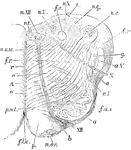
Section of the medulla oblongata at about the middle of the olivary body. f.l.a., anterior median fissure; n.ar., nucleus arciformis; p., pyramid; XII., bundle of hypoglossal nerve emerging from the surface; at b, it is seen coursing between the pyramid and the olivary nucleus, o.; f.a.e., external arciform fibers; n.l., nucleus lateralis; a., arciform fibers passing towards restiform body, partly through the substantia gelatinosa, g., partly superficial to the ascending root of the fifth nerve, a.V.; X., bundle of vagus root emerging; f.r., formatio reticularis; c.r., corpus restiform, beginning to be formed, chiefly by arciform fibers, superficial and deep; n.c., nucleus of the funiculus teres; n.am., nucleus ambiguus; r., raphe; A., continuation of the anterior column of cord; o', o", accessory olivary nucleus; p.o., pedunculus olivae.

Medulla Oblongata

Section of the medulla oblongata at about the middle of the olivary body. f.l.a., anterior median fissure;…
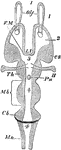
Diagrammatic horizontal section of a vertebrate brain. Mb, midbrain: what lies in front of this is the fore-, and what lies behind, the hindbrain; Lt, lamina terminalis; Olf, olfactory lobes; Hmp, hemispheres; Th. E, thalamencephalon; Pn, pineal gland; Py, pituitary body; F. M., foramen of Munro; cs, corpus striatum; Th, optic thalamus; CC, crura cerebri; the mass lying above the canal represents the corpora quadrigemina; Cb, cerebellum; I-IX, the nine pairs of cranial nerves; 1, olfactory ventricle; 2, lateral ventricle; 3, third ventricle; 4, fourth ventricle; +, iter a tertio ad quartum ventriculum.

Horizontal Section of a Vertebrate Brain

Diagrammatic horizontal section of a vertebrate brain. Mb, midbrain: what lies in front of this is the…
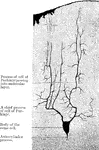
Section through the gray matter of the human cerebellum.

Gray Matter of Cerebellum

Section through the gray matter of the human cerebellum.

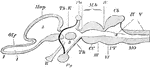
Longitudinal and vertical diagrammatic section of a vertebrate brain. Mb, midbrain: what lies in front of this is the fore-, and what lies behind, the hindbrain; Lt, lamina terminalis; Olf, olfactory lobes; Hmp, hemispheres; Th. E, thalamencephalon; Pn, pineal gland; Py, pituitary body; F. M., foramen of Munro; cs, corpus striatum; Th, optic thalamus; CC, crura cerebri; the mass lying above the canal represents the corpora quadrigemina; Cb, cerebellum; I-IX, the nine pairs of cranial nerves; 1, olfactory ventricle; 2, lateral ventricle; 3, third ventricle; 4, fourth ventricle; +, iter a tertio ad quartum ventriculum. Lamina terminalis is represented by the strong black line joining Pn and Py.

Vertical Section of a Vertebrate Brain

Longitudinal and vertical diagrammatic section of a vertebrate brain. Mb, midbrain: what lies in front…
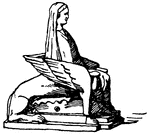
The Antique Terracotta arm-chair was in the form of a hollowed-out body of a sphinx.

Antique Terracotta Arm-chair

The Antique Terracotta arm-chair was in the form of a hollowed-out body of a sphinx.
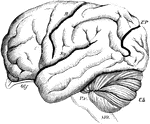
Brain of the Orangoutang, showing arrangement of the convolutions. Sy, fissure of Sylvius; R, fissure of Rolando; E P, external perpendicular fissure; Olf, olfactory lobe; Cb, cerebellum; PV, pons Varolii; MO, medulla oblongata. As contrasted with the human brain, the frontal lobe is short and small relatively, the fissure of Sylvius is oblique, the temporo-sphenoidal lobe very prominent, and the external perpendicular fissure very well marked.

Brain of the Orangutan

Brain of the Orangoutang, showing arrangement of the convolutions. Sy, fissure of Sylvius; R, fissure…
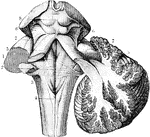
The cerebellum in section and fourth ventricle, with the neighboring parts. Labels: 1, median groove of fourth ventricle, ending below in the calamus scriptorius, with the longitudinal eminence formed by the fasciculi teretes, one on each side; 2, the same groove, at the place where the white streaks of th auditory nerve emerge from it to cross the floor of the ventricle; 3, in inferior crus or peduncle of the cerebellum, formed by the restiform body; 4, posterior pyramid; above this is the calamus scriptorius; 5, superior crus of cerebellum, or processus e cerebello ad cerebrum( or ad testes); 6, fillet to the side of the crura cerebri; 7, lateral grooves of the crura cerebri; 8, corpora quadrigemina.

The Cerebrum and Fourth Ventricle of the Brain

The cerebellum in section and fourth ventricle, with the neighboring parts. Labels: 1, median groove…
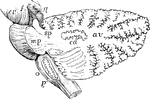
Outline sketch of a section of the cerebellum, showing the corpus dentatum. The section has been carried through the left lateral part of the pons, so as to divide the superior peduncle and pass nearly through the middle of the left cerebellar hemisphere. The olivary body has also been divided longitudinally so as to expose in section its corpus dentatum. c r, crus cerebri; f, fillet; q, corpora quadrigemina; s p, superior peduncle of the cerebellum divided; m p, middle peduncle or lateral part of the pons Varolii, with fibers passing from it into the white stem; a v, continuation of the white stem radiating towards the arbor vitae of the folia; c d, corpus dentatum; o, olivary body with its corpus dentatum; p, anterior pyramid.

The Cerebellum of the Brain

Outline sketch of a section of the cerebellum, showing the corpus dentatum. The section has been carried…
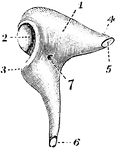
The incus, or anvil-bone. Labels: 1, body; 2, ridged articulation from the malleus; 4, processus brevis, with 5, rough articular surface from ligament of incus; 6, processus magnus, with articulating surface for stapes; 7, nutrient foramen.

Incus

The incus, or anvil-bone. Labels: 1, body; 2, ridged articulation from the malleus; 4, processus brevis,…
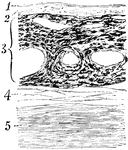
Section through the choroid coat of the human eye. Labels: 1, elastic membrane, structureless or finely fibrillated; 2, chorio-capillaris or tunica Ruyschiana; 3, Proper substance of the choroid with large vessels cut through; 4, suprachoroidea; 5, sclerotic.

Section Through the Choroid Coat

Section through the choroid coat of the human eye. Labels: 1, elastic membrane, structureless or finely…
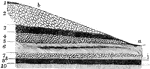
Section through the macula lutea and fovea centralis of the human retina. Labels: a, fovea; b, descent of the macula towards fovea. The numbers indicate the layers of the retina: 1, membrana limitans interna; 2, optic nerve fibers; 3, layer of ganglionic corpuscles; 4, inner molecular layer; 5, inner nuclear layer; 6, intergranular, internuclear, or outer molecular layer. 7, external nuclear layer; 8, membrana limitans externa; 9, layer of rods and cones; 10, pigment-cell layer.

Layers of the Retina

Section through the macula lutea and fovea centralis of the human retina. Labels: a, fovea; b, descent…
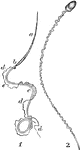
Spermatozoa of the salamander (1) and human (2). Labels: a, long pointed head; b, elliptical structure ; c, filiform body; d, fine filament; e, homogeneous membrane.

Spermatozoa of a Salamander and Human

Spermatozoa of the salamander (1) and human (2). Labels: a, long pointed head; b, elliptical structure…
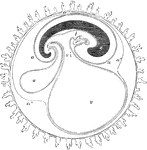
Diagrammatic section showing the relation in a mammal between the primitive alimentary canal and the membranes of the ovum. The stage represented in this diagram corresponds to that of the fifteenth or seventeenth day in the human embryo, previous to the expansion of the allantois; c, the villous chorion; a, the amnion; a', the place of convergence of the amnion and reflexion of the false amnion a", or outer or corneous layer; e, the head and trunk of the embryo, comprising the primitive vertebrae and cerebrospinal axis; i, the simple alimentary canal in its upper and lower portions. Immediately beneath the right hand i is seen the fetal heart, lying in the anterior part of the pleuroperitoneal cavity; v, the yolk sac or umbilical vesicle; vi, the vitellointestinal opening; u, the allantois connected by a pedicle with the anal portion of the alimentary canal.

Membranes of the Ovum

Diagrammatic section showing the relation in a mammal between the primitive alimentary canal and the…
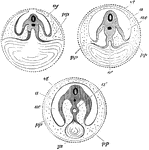
Diagram showing the three successive stages of development. Transverse vertical sections. The yolk sac, ys, is seen progressively diminishing in size. In the embryo itself the medullary canal and notochord are seen in section. a', in middle figure, the alimentary canal, becoming pinched off, as it were, from the yolk sac; a', in right hand figure, alimentary canal completely closed; a, in last two figures amnion; ac', cavity of amnion filled with amniotic fluid; p, space between amnion and chorion continuous with the pleuroperitoneal cavity inside the body; vt, vitelline membrane; ys, yolk sac, or umbilical vesicle.

Development of the Yolk Sac

Diagram showing the three successive stages of development. Transverse vertical sections. The yolk sac,…
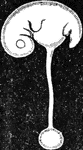
Human embryo of fifth week with umbilical vesicle. The human umbilical vesicle never exceeds the size of a small pea.

Embryo of Fifth Week

Human embryo of fifth week with umbilical vesicle. The human umbilical vesicle never exceeds the size…
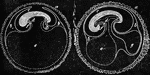
Very soon after the entrance of the ovum into the uterus, in the human subject, the outer surface of the chorion is found beset with fine processes, the so-called chorion villi, which give it a rough and shaggy appearance. a, chorion with villi. The villi are shown to be best developed in the part of the chorion to which the allantois is extending, this portion ultimately becomes the placenta. ; b, space between the two layers of the amnion; c, amniotic cavity; d, situation of the intestine, showing its connection with the umbilical vesicle; e, umbilical vesicle; f, situation of heart and vessels; g, allantois.

Chorion Villi

Very soon after the entrance of the ovum into the uterus, in the human subject, the outer surface of…
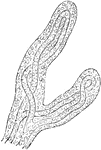
Very soon after the entrance of the ovum into the uterus, in the human subject, the outer surface of the chorion is found beset with fine processes, the so-called chorion villi, which give it a rough and shaggy appearance. Shown is a magnified view of chorion villi.

Magnified View of Chorion Villi

Very soon after the entrance of the ovum into the uterus, in the human subject, the outer surface of…
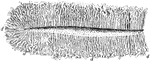
Section of the lining membrane of a human uterus at the period of commencing pregnancy showing the arrangement and other peculiarities of the glands, d, with their orfices, a, on the internal surface of the organ.

Lining Membrane of the Uterus

Section of the lining membrane of a human uterus at the period of commencing pregnancy showing the arrangement…
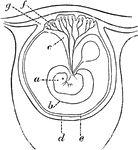
Diagram of an early stage of the formation of the human placenta. Labels: a, embryo; b, amnion; c, placental vessels; d, decidua reflexa; e, allantois; f, placental villi; g, mucous membrane.

Early Formation of the Placenta

Diagram of an early stage of the formation of the human placenta. Labels: a, embryo; b, amnion; c, placental…
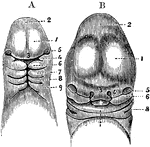
A, Magnified view of the head and neck of a human embryo of three weeks. Labels: 1, anterior cerebral vesicle or cerebrum; 2, middle cerebral vesicle; 3, middle or frontonasal process; 4, superior maxillary process, or first visceral arch, and below it the first cleft; 7, 8, 9, second, third, and fourth arches and clefts. B, Anterior view of the head of a human fetus of about the fifth week. 1, 2, 3, 5, the same parts as in A; 4, the external nasal or lateral frontal process: 6, the superior maxillary process; 7, the lower jaw; X, the tongue; 8, first branchial cleft becoming the meatus auditorius externus.

Head of an Embryo

A, Magnified view of the head and neck of a human embryo of three weeks. Labels: 1, anterior cerebral…
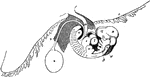
A human embryo of the fourth week. I, the chorion; 3, part of the amnion; 4, umbilical vesicle with its long pedicle passing into the abdomen; 7, the heart; 8, the liver; 9, the visceral arch destined to form the lower jaw, beneath which are two other visceral arches separated by the branchial clefts; 10, rudiment of the upper extremity, 11, that of the lower extremity; 12, the umbilical cord; 15, the eye; 16, the ear; 17, cerebral hemispheres; 18, optic lobes, corpora quadrigemina.

Embryo at Fourth Week

A human embryo of the fourth week. I, the chorion; 3, part of the amnion; 4, umbilical vesicle with…
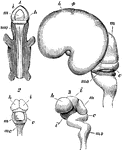
Early stages in development of human brain. 1, 2, 3, are from an embryo about seven weeks old; 4, about three months old. m, middle cerebral vesicle (mesencephalon); c, cerebellum; m o, medulla oblongata; i, thalamencephalon; h, hemispheres; i', infundibulum; Fig. 3 shows the several curves which occur in the course of development; Fig. 4 is a lateral view, showing the great enlargement of the cerebral hemispheres which have covered in the thalami, leaving the optic lobes, m, uncovered.

Development of the Brain

Early stages in development of human brain. 1, 2, 3, are from an embryo about seven weeks old; 4, about…
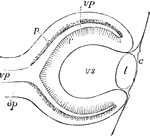
Diagrammatic sketch of a vertical longitudinal section through the eyeball of a human fetus of four weeks. The section is a little to the side, so as to avoid passing through the ocular cleft; c, the cuticle where it becomes later the corneal epithelium; l, the lens; op, optic nerve formed by the pedicle of the primary optic vesicle; vp, primary medullary cavity or optic vesicle; p, the pigment layer of the retina; r, the inner wall forming the retina proper; vs, secondary optic vesicle containing the rudiment of the vitreous humour.

Eye of Fetus of Four Weeks

Diagrammatic sketch of a vertical longitudinal section through the eyeball of a human fetus of four…
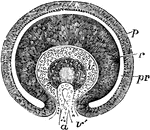
Transverse vertical section of the eyeball of a human embryo of four weeks. The anterior half of the section is represented: pr, the remains of the cavity of the primary optic vesicle; p, the inner part of the outer layer forming the retinal pigment; r, the thickened inner part giving rise to the columnar and other structures of the retina; v, the commencing vitreous humour within the secondary optic vesicle; v', the ocular cleft through which the loop of the central blood vessel, a, projects from below; l, the lends with a central cavity.

Eye of Fetus of Four Weeks

Transverse vertical section of the eyeball of a human embryo of four weeks. The anterior half of the…
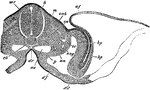
Transverse section of an embryo chick (third day). Labels: mr, rudimentary spinal cord; the primitive central canal has become constricted in the middle; ch, notochords; layer of mesoblast lining groove, which is not yet closed in to form the intestines; a o, one of the primitive aorta, u n, Wolffian body; ung; Wolffian duct; vc, vena cardinalis; h, epiblast; hp, somatopleure and its reflection to form af, amniotic fold; p, pleuroperitoneal cavity.

Transverse Section of an Embryo Chick

Transverse section of an embryo chick (third day). Labels: mr, rudimentary spinal cord; the primitive…
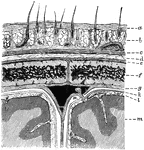
Diagram showing the layers of the scalp and membranes of the brain in section. Labels: a, skin; b, subcutaneous tissue with hair roots and vessels; c, epicranius; d, subepicranial layer; e, pericranium; fm parietal bone; g, dura mater; k, arachnoid; l, pia mater; m, cortex; n, in subdural space near a Pacchionian body projecting within the superior longitudinal sinus.

Layers of the Scalp and Membrane of the Brain

Diagram showing the layers of the scalp and membranes of the brain in section. Labels: a, skin; b, subcutaneous…
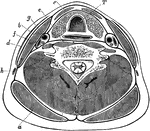
Transverse section through the lower part of the neck, to show the arrangement of the cervical fascia. Labels: a, Trapezius; b, sternomastoid; c, depressors of hyoid bone; d, platysma; e, anterior spinal muscles; f, scalenus anticus; g, carotid artery; h, external jugular vein; i, posterior spinal muscles; T, trachea, with gullet behind and thyroid body in front.

Transverse Section of the Neck

Transverse section through the lower part of the neck, to show the arrangement of the cervical fascia.…
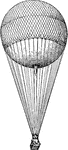
"A body whose average density is so much less than that of air that the body will rise, lifting not only itself, but a considerable load."

Spherical Balloon

"A body whose average density is so much less than that of air that the body will rise, lifting not…
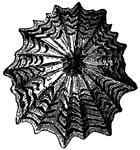
"Ruby-eyed Limpet, from the Antilles. If the common Limpet is alarmed, no human force, pulling in a direct line, can remove it."

Patella Granatina (Linnaeus)

"Ruby-eyed Limpet, from the Antilles. If the common Limpet is alarmed, no human force, pulling in a…
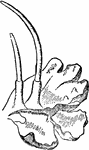
A genus of the plants known as liverworts. The body is a simple flat thallus and produces a slender spore-case.

Anthoceros Showing Thallus with Two Capsules

A genus of the plants known as liverworts. The body is a simple flat thallus and produces a slender…
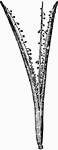
A genus of the plants known as liverworts. The body is a simple flat thallus and produces a slender spore-case.

Anthoceros, Mature Capsule Splitting

A genus of the plants known as liverworts. The body is a simple flat thallus and produces a slender…
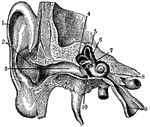
"Section through right ear. 1, helix; 2, concha; 3, outer passage; 4, 5, 6, semi-circular canals; 7, oval window; 8, cochlea; 9, Eustachian tube; 10, eardrum." -Foster, 1921

Ear

"Section through right ear. 1, helix; 2, concha; 3, outer passage; 4, 5, 6, semi-circular canals; 7,…
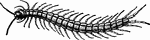
The common hundred-legged worm. Its body is divided into a number of similar joints, and each joint is provided with a pair of legs.

Centiped

The common hundred-legged worm. Its body is divided into a number of similar joints, and each joint…
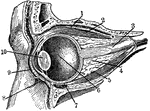
"Section through the left eye, closed. 1, lifting muscle; 2, upper straight muscle; 3, optic nerve; 4, fatty cushion; 5, lower straight muscle; 6, vitreous humor; 7, lower cross muscle; 8, lower eyelid; 9, upper eyelid; 10, crystalline lens." -Foster, 1921

Eye Section

"Section through the left eye, closed. 1, lifting muscle; 2, upper straight muscle; 3, optic nerve;…
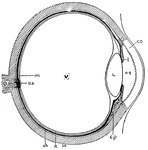
"Cross-section of the eye. Parts: co, cornea; I, iris; aq, anterior chamber of aqueous humor; L, lens; cp, ciliary process; sc, sclerotic coat; R, retina; ch, choroid; V, vitreous body; m, yellow spot; bs, blind spot; O, optic nerve." -Foster, 1921

Eye Cross-Section

"Cross-section of the eye. Parts: co, cornea; I, iris; aq, anterior chamber of aqueous humor; L, lens;…
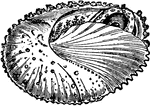
"The argonaut can blush, turn pale, and show through its transparent shell its body changing in sudden shades."

Argonauta Papyracea in its Shell

"The argonaut can blush, turn pale, and show through its transparent shell its body changing in sudden…
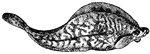
A common fish known for its flat appearance and both eyes being on the upper, darker side of its body.

Flounder

A common fish known for its flat appearance and both eyes being on the upper, darker side of its body.