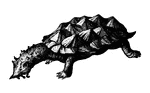
Land tortoises have short, oval and convex bodies, covered by carapace and plastron. They have no teeth.
Tortoise

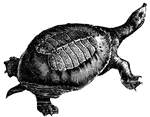
Land tortoises have short, oval and convex bodies, covered by carapace and plastron. They have no teeth.
Land tortoises have short, oval and convex bodies, covered by carapace and plastron. They have no teeth.

Tortoise

Land tortoises have short, oval and convex bodies, covered by carapace and plastron. They have no teeth.

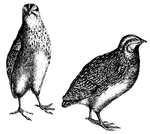
The quail has a small beak, a short back toe inserted high up, tarsi furnished with a rudimentary spur in the shape of a horny tubercle.

Quail

The quail has a small beak, a short back toe inserted high up, tarsi furnished with a rudimentary spur…
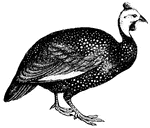
Guinea fowls have small heads for their size; beak and neck short; the tail equally short and drooping.
Guinea Fowl

Guinea fowls have small heads for their size; beak and neck short; the tail equally short and drooping.

Like Woodpeckers, they can hang upon trees, and sustain themselves in a vertical position for a long time; but they are incapable of climbing (Figuier, 1869).

Wryneck

Like Woodpeckers, they can hang upon trees, and sustain themselves in a vertical position for a long…
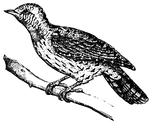
Like Woodpeckers, they can hang upon trees, and sustain themselves in a vertical position for a long time; but they are incapable of climbing (Figuier, 1869).

Wryneck

Like Woodpeckers, they can hang upon trees, and sustain themselves in a vertical position for a long…
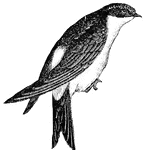
The swallows are recognized by their long, pointed wings, forked tail and excessively short tarsi. (Figuier, 1869).

Swallow

The swallows are recognized by their long, pointed wings, forked tail and excessively short tarsi. (Figuier,…
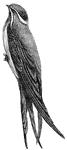
The swallows are recognized by their long, pointed wings, forked tail and excessively short tarsi. (Figuier, 1869).

Cliff Swallow

The swallows are recognized by their long, pointed wings, forked tail and excessively short tarsi. (Figuier,…
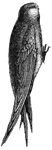
Swifts are related to swallows. The Swallows are recognized by their long, pointed wings, forked tail and excessively short tarsi. (Figuier, 1869).

Swift

Swifts are related to swallows. The Swallows are recognized by their long, pointed wings, forked tail…
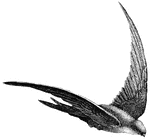
The Swallows are recognized by their long, pointed wings, forked tail and excessively short tarsi. (Figuier, 1869).

Salangane Swallow

The Swallows are recognized by their long, pointed wings, forked tail and excessively short tarsi. (Figuier,…
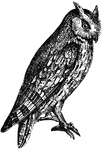
The scops-eared owl is diminutive in size, not exceeding that of the thrush, (Figuier, 1869).

Scops-Eared Owl

The scops-eared owl is diminutive in size, not exceeding that of the thrush, (Figuier, 1869).
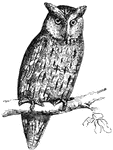
The scops-eared owl is diminutive in size, not exceeding that of the thrush, (Figuier, 1869).

Scops-Eared Owl

The scops-eared owl is diminutive in size, not exceeding that of the thrush, (Figuier, 1869).
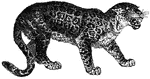
The jaguar can spend a great deal of time in trees, but are known to also hunt fish. They range from S.W. US to Argentina.

Jaguar

The jaguar can spend a great deal of time in trees, but are known to also hunt fish. They range from…
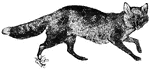
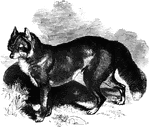
The fox is characterized chiefly by its pointed muzzle, short legs and its bushy tail.

Fox

The fox is characterized chiefly by its pointed muzzle, short legs and its bushy tail.

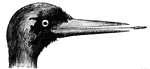
While a woodpecker is drilling, the two parts of the bill are closed together, making a wedge-pointed drill, and at the same time a snug case for the insect-catcher.

Woodpecker

While a woodpecker is drilling, the two parts of the bill are closed together, making a wedge-pointed…
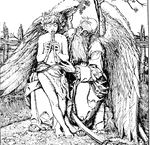
Father Time reading

Pictorial banner

Father Time reading

Father Time and young boy playing double flute.

Father Time

Father Time and young boy playing double flute.

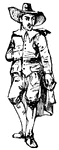
Gentleman of the time of Charles I.

Gentleman of the Time of Charles I

Gentleman of the time of Charles I.

Intermediate between the oboe and the cor anglais, the oboe d'amore, an instrument now fallen into neglect, was very much used in the time of Sebastian Bach.

Oboe D'amore

Intermediate between the oboe and the cor anglais, the oboe d'amore, an instrument now fallen into neglect,…
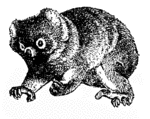
The koala spends the majority of its time in trees.

Koala

The koala spends the majority of its time in trees.

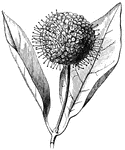
A head is a flower cluster with a short body, and without pedicles to the blossoms.

Head

A head is a flower cluster with a short body, and without pedicles to the blossoms.

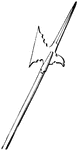
Halberd, from the time of Henry VIII.

Halberd (Time of Henry VIII)

Halberd, from the time of Henry VIII.

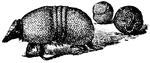
The limbs are short and strong, as are also the claws , and the animals have a great aptitude for digging and burrowing.

Armadillo

The limbs are short and strong, as are also the claws , and the animals have a great aptitude for digging…
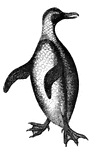
Penguins are adopted for a completely aquatic life. The body is boat-shaped, the neck long, and legs short and placed behind the point of equilibrium of the body.

Penguin

Penguins are adopted for a completely aquatic life. The body is boat-shaped, the neck long, and legs…
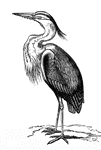
These wading birds mostly spend their time wading about in shallow water, feeding upon small fishes, shell-fish, worms and insects.

Heron

These wading birds mostly spend their time wading about in shallow water, feeding upon small fishes,…

Escapement is a mechanical device intervening between the power and the time-measurer of a clock or watch, and whose purpose is to secure uniformity in the rate of movement.

Escapement

Escapement is a mechanical device intervening between the power and the time-measurer of a clock or…
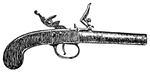
A revolutionary flint-lock pistol with a short, thick barrel. Requires reloaded after each shot.

Revoltionary Flint-Lock Pistol

A revolutionary flint-lock pistol with a short, thick barrel. Requires reloaded after each shot.
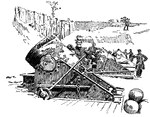
A short barreled, high angled, short ranged cannon.

Mortar

A short barreled, high angled, short ranged cannon.

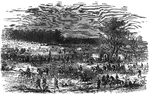
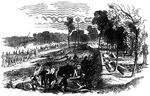
When General McClellan reached Locst Hill, on april 2nd, 1862, he found fifty-eight thousand men and much of his artillery there. The following day he moved his whole army toward Yorktown, in order to prevent, if possible, Johnston's re-enforcement of General Magruder, expecting to receive in time for the co-operation of the naval force in Hampton Roads, which he thought would reduce the Confederate batteries both on the James and York Rivers.

Advance of the Federal Army towards Yorktown

When General McClellan reached Locst Hill, on april 2nd, 1862, he found fifty-eight thousand men and…
Gulliver's watch is being taken away. From <em>Gulliver's Travels</em> by Dean Swift.

Gulliver's Watch

Gulliver's watch is being taken away. From Gulliver's Travels by Dean Swift.

Evacuation of Corinth, Mississippi- Confederate fortifications, from the northern angle, looking south- pursuit of the retreating Confederates by the Federal Cavalry under General Smith. The details of the evacuation of Corinth, by Beauregard, beyond those contained in the official reports of General Halleck, were that Beauregard's force did not exceed 60,000 men. Nobody was left in town except women and children and old men; everything was taken away except a few provisions, which were burned. They did not leave a single gun, and had been moving their stores for two weeks, and their troops for six days. Their fortifications were five miles long, extending from the Memphis and Charleston to the Mobile and Ohio Roads. But they were much weaker than supposed. They could have been carried by storm at any time.

Evacuation of Corinth

Evacuation of Corinth, Mississippi- Confederate fortifications, from the northern angle, looking south-…
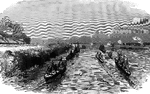
First day's bombardment, Federal Schooners off Forts Jackson and St. Philip, commanding the passage of the river. The Federal offensive force consisted of six sloops of war, sixteen gunboats and twenty-one mortar vessels. These were accompanied by a large number of storeships, tenders, etc. On the 18th of April, they anchored three miles below Forts Jackson and St. Philip, and prepared for active operations. Captain Porter, commanding the mortar flotilla, wishing to ascertain their range before his actual attack, stationed the <em>Arietta, John Griffiths<em> and <em>Orvetta<em> about two and a half miles from the forts. The <em>Arietta<em> fired the first shot, to which Fort Jackson replied. The Confederate shots fell short more than fifty yards every time, while the effect of our shells on the fort was such that after two explosions the enemy retired from their barbette guns, and afterward only used those in the casemates.

The Great Naval Battle on the Mississippi

First day's bombardment, Federal Schooners off Forts Jackson and St. Philip, commanding the passage…
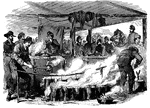
The kitchen of the Fremont Dragoons at Tipton, Missouri. Tipton, which is 38 miles from Jefferson City, 26 from Sedalia and 13 from California City, is situated on the Pacific Railway, which passes through Jefferson City, and has its terminus in Sedalia. At all these cities large bodies of troops were places by General Fremont, so as to enable him to concentrate, at a very short time, an overwhelming force to bear upon the Confederates. This is the kitchen when the army of cooks was in full preparation for the daily dinner.

Cooking in Camp

The kitchen of the Fremont Dragoons at Tipton, Missouri. Tipton, which is 38 miles from Jefferson City,…
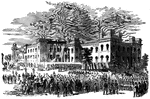
At the time this picture was drawn the handsome arsenal of the government of Charleston, South Carolina, was an object of great interest. An immense amount of ammunition was stored there, and raids upon it were expected at any moment. It was watched and guarded with great care by detachments of the Washington Light Infantry. It was afterward seized by the State authorities on December 28, 1860.

United States Arsenal at Charleston

At the time this picture was drawn the handsome arsenal of the government of Charleston, South Carolina,…
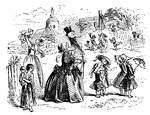
Old Mother Duck has hatched a brood of ducklings, small and callow. Their wings are short, their down is mottled grey and yellow.

Dame Duck

Old Mother Duck has hatched a brood of ducklings, small and callow. Their wings are short, their down…
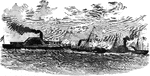
"Desperate engagement, april 24th, 1862, between the United States gunboat "Varuna," Commander Boggs, and the Confederate steam ram "J. C. Breckinridge," and the gunboat "Governor Moore." Captain Boggs of the "Varuna," finding that the Confederate ram "J. C. Breckinridge" was about to run into him, put the vessel in such a position that in being damaged he could repay it with interest. On came the ram, all clad with iron about the bow, and hit the "Varuna" in the port waist, cutting and crushing in her side. she dropped alongside and cleared out to butt again. She hit the "Varuna" a second time, and while in a sinking condition the "Varuna" poured her 8-inch shells into her so fast that the Confederate was set on fire and driven on shore." &mdash; Frank Leslie, 1896

Gunboat collision

"Desperate engagement, april 24th, 1862, between the United States gunboat "Varuna," Commander Boggs,…
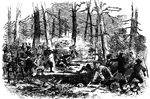
"Gallant attack by 150 of the Pennsylvania Bucktails, led by Colonel Kane, upon a portion of General Stonewall Jackson's Confederate Army, stronly posted in the woods, near Harrisonburg, Friday, June 6th, 1862. We illustrate one of the most heroic actions of the war, the attack of the famous Bucktails, under their gallant leader, Colonel Krane, upon a large portion of Stonewall Jackson's army, consisting of infantry, cavalry and artillery. The spot where this deadly conflict took place was about a mile and a half beyond Harrisonburg, on the road to Port Republic, toward which place the Confederates were in full retreat, closely but warily pursued by Generals Fremont and Shields. On Friday, June 6th, Colonel Sir Percy Wyndham, of the First New Jersey Cavalry, having been sent by General Bayard to reconnoitre, was led into an ambuscade, where his regiment was fearfully cut up, and himself wounded and taken prisoner. It will be seen that the humanity of Colonel Krane led him into a similar trap. News of what had occurred was rapidly transmitted to headquarters, and General Bayard was ordered out with fresh cavalry and a battalion of Pennsylvania Bucktails. But the Sixtieth Ohio had already beaten back the bold Confederates. The evening was waxing late; General Fremont did not wish to bring on a general engagement at this hour, and the troops were ordered back. "But do not leave poor Wyndham on the field, and all the wounded," remonstrated brave Colonel Krane of the Bucktails. "Let me at 'em, general, with my Bucktails." "Just forty minutes I'll give you, colonel," said General Bayard, pulling out his watch. "Peep through the woods on our left, see what is in there, and out again when the time is up." In go the 150 at an opening in the pines; they were soon surrounded by a cordon of fire flashing from the muzzles of more than a thousand muskets; but not a sign, nor the shadow of a sign, of yielding. Their fire met the enemy's straight and unyielding as the blade of a matador. Oh for re-enforcements! But none came. The brave Bucktails were forcd to retreat across the fields of waving green, firing as they did so- but not the 150 that went in. The rest lie under the arching dome of the treacherous forest." — Frank Leslie, 1896

Attack at Harrisonburg

"Gallant attack by 150 of the Pennsylvania Bucktails, led by Colonel Kane, upon a portion of General…
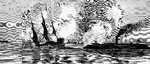
"First naval battle in Hampton Roads between the Confederate iron-plated steamers <em>Merrimac, Yorktown</em>, and <em>Jamestown</em>, and the Federal wooden sailing frigates <em>Cumberland</em> and <em>Congress</em>- sinking of the <em>Cumberland</em> by a blow from the <em>Merrimac</em>, March 8th, 1862- sketched by our special artist. About noon on the 8th, a suspicious-looking vessel, looking like a submerged house, with the roof only above water, was discovered, moving down from Norfolk, by the channel in front of Sewall's Point batteries. There was nothing protruding above the water but a flagstaff flying the Confederate flag and a short smokestack. She moved along slowly, and turned into the channel leading to Newport News, and steamed direct for the wooden sailing frigates <em>Cumberland</em> and <em>Congress</em>, which were lying at the mouth of James River. As soon as she came within range of the <em>Cumberland</em>, the latter opened on her with her heavy guns; but the balls struck and glanced off without effect. In the meantime, as the <em>Merrimac</em> was approaching the two frigates on one side, the Confederate ironclad steamers <em>Yorktown</em> and <em>Jamestown</em> came down James River, and engaged the frigates on the other side. The batteries at Newport News also opened on the <em>Yorktown</em> and <em>Jamestown</em>, and did all in their power to assist the <em>Cumberland</em> and <em>Congress</em>, which, being sailing vessels, were at the mercy of the approaching steamers. The <em>Merrimac</em>, in the meantime, kept steadily on her course, and slowly approached the <em>Cumberland</em>, when she and the <em>Congress</em>, at a distance of one hundred yards, rained full broadsides on the ironclad monters without effect. After receiving the first broadside of the two frigates, she ran on to the <em>Cumberland</em>, striking her about midship, and literally laying open her bow, left her to sink, while she engaged the <em>Congress</em>, which lay about a quarter of a mile distant. The <em>Congress</em>, having no regular crew on board of her, and seeing the hopelessness of resisting the ironclad steamer, at once struck her colors." &mdash; Frank Leslie, 1896

First naval battle

"First naval battle in Hampton Roads between the Confederate iron-plated steamers Merrimac, Yorktown,…
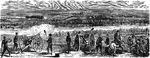
"Engagement between the Federal troops and the Confederates on the Virginia side of the Potomac, opposite Edward's Ferry, October 22nd, 1861- battery of Parrott Guns on the Maryland shore. Early in the evening the news of the death of Colonel Baker, and of the presence of an overwhelming Confederate force on the opposite bank, reached Edward's Ferry, and at once orders were given for bringing back to the Maryland shore the troops which had been passed in the scows, etc., during the day. This was effected by the same means, occupying until midnight. At this time word was received at Edward's Ferry that General Banks was approaching with his column to support the movement of the day, and immediately the same troops, which had crossed and recrossed, were again sent across the river in the same scows. Give hundred feet of fortifications were thrown up to support the lodgment, with only a slight brush with a detachment of Confederates, in which General Lander was wounded. During the night, Tuesday, October 22nd, the full epressing news of Baker's disaster became known, and the whistle of the Leesburg railway, bringing up Confederate re-enforcements from Manassas, sounded constantly in the ears of the Federals. On Tuesday morning, however, General McClellan had arrived at Edward's Ferry, and both with reference to further advance or a retreat, as circumstances might justify or require, ordered a bridge of boats to be thrown across the river. He, however, received such intelligence on Wednesday of the number and designs of the Confederates, that he resolved to withdraw the Federal forces from the Virginia side, which was effected silently and safely on the same night. Our engraving illustrates the position of the Federal troops on the Virginia shore, on Tuesday, during the attack in which General Lander was wounded." — Frank Leslie, 1896

Battle at Potomac

"Engagement between the Federal troops and the Confederates on the Virginia side of the Potomac, opposite…
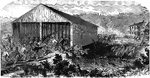
"Engagement at Romney, VA., twenty miles from New Creek, Tuesday, June 11th, 1861- the Eleventh Indiana Zouaves crossing the bridge over the Potomac, at double quick time, to attack the Confederate forces. On Tuesday, June 11th, 1861, Colonel Lewis Wallace, in command of the Eleventh Regiment, Indiana Volunteer Zouaves, stationed at Cumberland, Md., received orders to attack the Confederates assembled at Romney, the capital of Hampshire County, Va. He took six hundred men and left the same evening, reaching New Creek Bridge, twenty-eight miles by rail from Cumberland, at eleven o'clock P.M. Colonel Wallace reached the neighborhood of Romney about eight o'clock A.M., and was not surprised to find that the enemy had got the alarm, there having been time enough for horsemen to give warning. Picket guards had been placed on the eights commanding the road, at a distance of about one mile and a half from the town. These fired their pieces at the advance of the Zouaves, and as the fire was promptly and effectually returned, they immediately withdrew. The Zouaves entered Romney at half-past eight o'clock A.M., in time to partake of the breakfast which had been prepared for the "evacuates."" — Frank Leslie, 1896

Engagement at Romney

"Engagement at Romney, VA., twenty miles from New Creek, Tuesday, June 11th, 1861- the Eleventh Indiana…
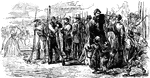
"The military authorities at Washington, D. C., examining passes in 1861. This scene was of frequent occurrence. A gallant volunteer wishes to take a short furlough in order to show his fiancee the wonders of the capital city. The provost marshal is scrutinizing the document with considerable interest, as though he has some latent doubts of its genuineness." &mdash; Frank Leslie, 1896

Military authorities

"The military authorities at Washington, D. C., examining passes in 1861. This scene was of frequent…
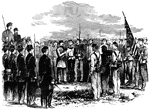
"Taking away the colors of the Seventy-ninth New York Regiment for insubordination and mutiny, Washington, D. C., August 14th, 1861. The scene during the reading of the order of General McClellan was exceedingly impressive. The sun was just going down, and in hazy mountain twilight the features and forms of officers and men could scarcely be distinguished. Immediately behind his aid was General Porter, firm and self-possessed. Colonel Stevens was in front of the regiment, endeavoring to quiet his rather nervous horse. In the rear of the regulars, and a little distance apart, General Sickles sat carelessly on horseback, cooly smoking a cigar and conversing with some friends. At one time during the reading a murmur passed through the lines of the mutineers; and when the portion of the order directing the regiment to surrentder its colors was read a private in one of the rear lines cried out, in broad Scotch tones, "Let's keep the colors, boys!" No response was made by the remainder of the regiment. Major Sykes at once rode up the line to where the voice was heard. It would have been more than the soldier's life was worth had he been discovered at the moment in pistol range by any of the officers." &mdash; Frank Leslie, 1896

Seventy-ninth Regiment

"Taking away the colors of the Seventy-ninth New York Regiment for insubordination and mutiny, Washington,…
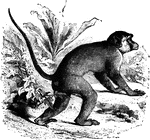
"<em>M. cynomolgus</em>. The hair of this mammal is short, of a brown olive, spotted with black on the body, and a gray on the lower part." &mdash;Goodrich, 1885

Buffon Macacus

"M. cynomolgus. The hair of this mammal is short, of a brown olive, spotted with black on the…
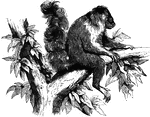
"The monkeys of this genus are marked by a short head, an angular muzzle, and a non-prehensile tail. They are gentle, intelligent, slender in form, and partially nocturnal in their habbits. The genus is divided into two branches, the <em>Brachyures</em>, which have very short tails, and the <em>Sakis proper</em> which have long, large tails." &mdash;Goodrich, 1885

Monk Saki

"The monkeys of this genus are marked by a short head, an angular muzzle, and a non-prehensile tail.…
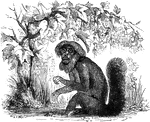
"The monkeys of this genus are marked by a short head, an angular muzzle, and a non-prehensile tail. They are gentle, intelligent, slender in form, and partially nocturnal in their habbits. The genus is divided into two branches, the <em>Brachyures</em>, which have very short tails, and the <em>Sakis proper</em> which have long, large tails." &mdash;Goodrich, 1885

Satanic Saki

"The monkeys of this genus are marked by a short head, an angular muzzle, and a non-prehensile tail.…
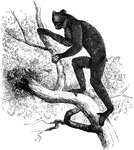
"Genus Indri: Indris. - This genus includes only a single species, the Short-Tailed Indri of Madagascar, <em>I. brevicaudatus.</em> It is the largest of the lemuridae, being three foot high when standing on its hind legs. It is covered with soft, thick fur, mostly black, but whitish on the face, and reddish white on its sides." —Goodrich, 1885

Indri

"Genus Indri: Indris. - This genus includes only a single species, the Short-Tailed Indri of Madagascar,…

"These animals have round heads, like the cats, the short snout, the lips garnished with mustaches, the ears small and oval, the eyes large, staring, and close together. The tail is long and thickly furred, and is frequently carried coiled around the body of the animal." &mdash;Goodrich, 1885

Cheirogale

"These animals have round heads, like the cats, the short snout, the lips garnished with mustaches,…
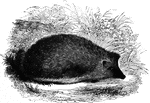
"The body is short, thick, and stout; the nose pointed, the tail short or entirely wanting, and the upper surface more or less covered with short spines, which when the snimal roll themseles up into a ball, as they always do when alarmed or threatened, present an almsost insuperable obstacle to any predaceous animal that might attack them." &mdash;Goodrich, 1885

Hedgehog

"The body is short, thick, and stout; the nose pointed, the tail short or entirely wanting, and the…
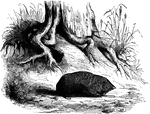
"These curious animals about three inches long, are exclusively African. They have a chunky body, small eyes, no enternal tail, ears nearly rubimentary, short legs, a strong fore-feet, fitted for burrowing. The hind-feet have four claws, and the fore ones but three." &mdash;Goodrich, 1885

Chrysochloris Aurea

"These curious animals about three inches long, are exclusively African. They have a chunky body, small…
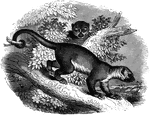
"Of this genus there is a single species. A graceful animal, somewhat smaller than a cat, found in Guiana, Brazil, and Peru, which has the local name of Cuchumon. Its body is long, the legs short, the feet plantigrade, the tail prehensile, the fur thick, woolly, and of a grayish or russet brown." &mdash;Goodrich, 1885

Kinkajou

"Of this genus there is a single species. A graceful animal, somewhat smaller than a cat, found in Guiana,…
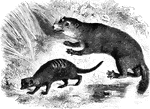
"Of this there is but a single species, the <em>Cynogale Benneti</em>. Its body is about eighteen inches long, and of a slender form; the legs are short; the fur thick and soft; resembling that of the otter. The color is borwn, tinged with gray." &mdash;Goodrich, 1885

Cynogale

"Of this there is but a single species, the Cynogale Benneti. Its body is about eighteen inches…
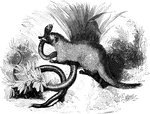
Species of the genus <em>Mangouste</em>. This animal bears a close resemblance to the weasel tribe, both in form and habits. At the base, the tail is very thick, tapering gradually toward the point, which is slightly tufted. It has a long, active body, short legs, lively and piercing eyes, and a pointed nose." &mdash;Goodrich, 1885

Eqyptian Ichneumon

Species of the genus Mangouste. This animal bears a close resemblance to the weasel tribe,…
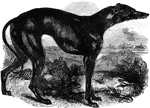
A slender dog with short fur. Used mostly for their superior speed.

Greyhound

A slender dog with short fur. Used mostly for their superior speed.

"This remarkable bred has the head elongated, the forehead flat, and the ears short and erect, or with a slight direction forward. The body is thickly covered with hair of two kinds, - the one woolly and gray, the other sillk and of a deep yellow or fawn color. he limbs are muscular, and, in their form and proportions, resemble those of a common sheperd's dog." &mdash;Goodrich, 1885

Dingo

"This remarkable bred has the head elongated, the forehead flat, and the ears short and erect, or with…
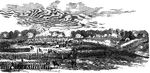
"Battle of Gaines's Mill, Friday, June 27th, 1862. At eleven o'clock each division, brigade, regiment and gun was in place. Some were in the broad, open field and others under the cover of the woods. The day was intensely warm, and many of the men, worn out with their previous day's fighting, lack of sleep and toilsome march, had already thrown themselves upon the ground and were indulging in a short slumber, when a sharp volley and then the roar of artillery announced that the Confederates had opened the fight. Their shells burst in front of the farmhouse which General Morell had made his headquarters. The Federal batteries, after some little delay, replied and for an hour this artillery duel and shelling the woods continued. It was not till near three o'clock in the afternoon that the engagement became general, and then the battle raged for four hours with unexampled fury. As though by common consent, there was a pause now; but it did not last long, for the enemy had evidently received large re-enforcements, as the whole Federal line was attacked, with a vigor which showed that those who made it were fresh men. To prevent defeat, General Porter sent for re-enforcements, for under the additional pressure the Federal troops were giving way. Fortunately, General Slocum's division came to the rescue, and with it Generals Palmer, French and Meagher with their brigades and two bodies of cavalry. This changed the character of the struggle. Meagher's gallant gellows, coats off and sleeves rolled up, charged the enemy and drove them back. General Palmer's men and Duryee's Zouaves also went in with valor, and finally the Confederates rolled back like a retreating wave. This was the close of the day's fight. Toward the end the Federals had fifty-four regiments on the field, numbering about 36,000 men." &mdash;Leslie, 1896

Battle of Gaines's Mill

"Battle of Gaines's Mill, Friday, June 27th, 1862. At eleven o'clock each division, brigade, regiment…
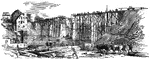
"Rebuilding of the railroad bridge over the Rappahannock to Fredericksburg, burnt by the Confederates in their retreat from Falmouth, April 19th, 1862. On April 17th, 1862, General McDowell, with his division of the Federal army, arrived on the banks of the Rappahannock, the Confederates retreating and burning the bridge which connected Falmouth with Fredericksburg. The city capitulated the next day. Our artist wrote, "I send you a sketch of the rebuilding of the railroad bridge across the Rappahannock. The rapidity with which our Northern men rebuilt the burnt bridge, and the strength and excellence of the work, caused the astonishment of the inhabitants of the city. The supports are made of pine logs cut from the adjacent forest, and the time occupied in putting the structure over was about six days."" —Leslie, 1896

Rappahannock Bridge

"Rebuilding of the railroad bridge over the Rappahannock to Fredericksburg, burnt by the Confederates…
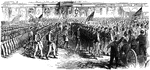
"The departure of Colonel Ellsworth's Zouaves from New york, escorted by the fire department- the regiment and escort passing the corner of Broadway and Canal Street, April 29th, 1861. The Fire Zouaves, under command of Colonel Ellsworth, mustering over eleven hundred strong, embarked on board the <em>Baltic</em>, on Monday, April 29th, 1861, amid a most enthusiastic ovation. Chosen from so popular a corps as the firemen of New York, they could not fail to arouse public sympathy to a large extent. As it was generally known that three separate stands of colors would be presented to them- one at their barracks, another by Mrs. Astor, and the third at the Astor House by Mr. Stetson- an immense crowd attended every movement of this gallant regiment. The first flag was presented by Mr. Wickham, on behalf of the Fire Department and Common Council. The Hon. J. A. Dix then, in behalf of Mrs. Augusta Astor, presented them with another stand of colors, with a very handsome letter from the fair donor. The regiment then marched through Bond Street, the Bowery and Chatham Street to the Astor House, where Mr. Stetson presented them with a third flag in the name of the ladies of the house. After a short soldierly response from the colonel, the regiment with their noble escort, marched to the foot of Canal Street, where they embarked on board the <em>Baltic</em>, which steamed down the river on her way to Annapolis." —Leslie, 1896

Ellsworth's Zouaves

"The departure of Colonel Ellsworth's Zouaves from New york, escorted by the fire department- the regiment…
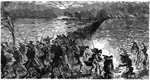
"Successful retreat of the Federal troops from the Virginia shore across a canal-boat bridge at Edward's Ferry, on the night of October 23rd, 1861. Of the 1,900 Federals who crossed the river in the morning but a sad remnant reached the island and opposite shore on that awful night. Upward of 500 were taken prisoners; more than 100 were drowned; nearly the same number were killed on the field or shot in the retreat, and upward of 200 were wounded. We shrink from detailing all the incidents of horror which marked this most disastrous action and retreat. It was a fearful blunder from beginning to end. Our illustration represents the successful retreat to the Maryland shore on the night of Wednesday, October 23rd, by moonlight, during a high, cold windstorm." —Leslie, 1896

Edward's Ferry

"Successful retreat of the Federal troops from the Virginia shore across a canal-boat bridge at Edward's…
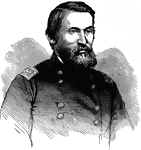
"General Crook, born near Dayton, O., September 8th, 1828, died in Chicago, Ill., March 21st, 1890, was graduated at the United States Military Academy in 1852, and was on duty with the Fourth Infantry in California in 1852-'61. He had risen to a captaincy, when, at the beginning of the Civil War, he returned to the East and became colonel of the Thirty-sixth Ohio Infantry. He afterward served in the Western Virginia campaign, in command of the Third Provisional Brigade, from May 1st to August 15th, 1862, and was wounded in the action at Lewisburg. He served in Tennessee in 1863, and on July 1st he was transferred to the command of the Second Cavalry Division. After various actions, ending in the battle of Chickamauga, he pursued Wheeler's Confederate cavalry and defeated it. He entered upon the command of the Kanawha District, in Western Virginia, in February, 1864; made constant raids and was in numerous actions. He took part in Sheridan's Shenandoah campaign, and received the brevet of brigadier general and major general in the United States Army, March 13th, 1865. General Crook had command of the cavalry of the Army of the Potomac from March 26th to April 9th, during which time he was engaged at Dinwiddie Courthouse, Sailor's Creek and Farmville, till the surrender at Appomattox." &mdash;Leslie, 1896

General George Crook

"General Crook, born near Dayton, O., September 8th, 1828, died in Chicago, Ill., March 21st, 1890,…
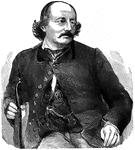
"General Butler was born in Deerfield, N. H., November 6th, 1818. At the time of President Lincoln's call for troops in April, 1861, he held the commission of brigadier general of militia. On the 17th of that month he marched to Annapolis with the Eighth Massachusetts Regiment, and was placed in command of the District of Annapolis, in which the city of Baltimore was included. On May 13th, 1861, he entered Baltimore at the head of 900 men, occupied the city without opposition, and on May 16th was made a major general and assigned to the command of Fortress Monroe and the Department of Eastern Virginia. In August he captured Forts Hatteras and Clark. He then returned to Massachusetts to recruit an expedition for the Gulf of Mexico and the Mississippi. On March 23rd, 1862, the expedition reached Ship Island, and on April 17th went up the Mississippi. The fleet under Farragut having passed the forts, April 24th, and virtually capture New Orleans, General Butler took possession of the city on May 1st. Near the close of 1863 he was placed in command of the Army of the James. In December, 1864, he conducted an ineffectual expedition against Fort Fisher, and soon afterward was removed from command by General Grant. He died in Washington, D. C., January 11th, 1893." &mdash;Leslie, 1896

General Benjamin F. Butler

"General Butler was born in Deerfield, N. H., November 6th, 1818. At the time of President Lincoln's…