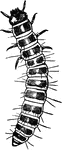

Silvanus Surinamensis, larva.

Saw-Toothed Grain Beetle

Silvanus Surinamensis, larva.

The wheat-head army-worm; eating out a head of grain.

Armyworm

The wheat-head army-worm; eating out a head of grain.

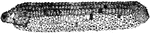
An ear of corn showing injury done by the Angoumois grain moth.

Corn

An ear of corn showing injury done by the Angoumois grain moth.

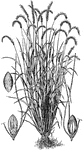
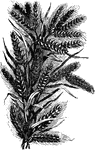
An image of a crop of grain.

Grain

An image of a crop of grain.

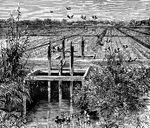
Field of grain.

Grain

Field of grain.

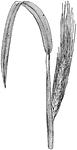
"A variety of the common wheat, originally cultivated by the Romans."—Finley, 1917

Spelt

"A variety of the common wheat, originally cultivated by the Romans."—Finley, 1917

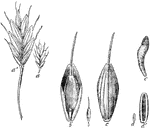
Spicula of a spelt plant.

Spelt spicula

Spicula of a spelt plant.

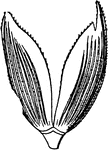
"Calyx of a spelt plant."—Finley, 1917

Spelt calyx

"Calyx of a spelt plant."—Finley, 1917

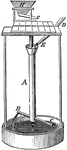
"Grain enters the mill at H down into D and into tube A. The grain passes down through the holes B and C causing A to rotate. This rotation powers the millstone S at the top which grinds the grain before it reaches the dispersal tube A." —Quackenbos 1859

Barker's Mill

"Grain enters the mill at H down into D and into tube A. The grain passes down through the holes B and…
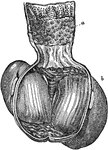
The stomach of a grain-eating bird, which has a gizzard that functions to crush the seeds to pieces since birds have no teeth to crush their food. It has on its inside two hard surfaces which rub and press against each other by muscles to grind food. At <em>b</em> is the gizzard cut open, showing two hard grinding surfaces, and at <em> a </em> above is the part from which oozes the gastric juice.

Stomach of a Bird

The stomach of a grain-eating bird, which has a gizzard that functions to crush the seeds to pieces…

Cent (1 cent) United States coin from 1856. Obverse has a left-flying eagle and is inscribed - UNITED STATES OF AMERICA 1856. Reverse shows the value surrounded by a cotton, tobacco and grain wreath.

Copper-Nickel Cent Coin, 1856

Cent (1 cent) United States coin from 1856. Obverse has a left-flying eagle and is inscribed - UNITED…
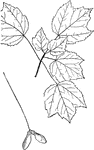
Leaves - simple; opposite; edge lobed, with the lobes irregularly sharp-toothed and notched. Outline - roundish, with three to five lobes (the lowest pair, if present, the smallest); and with the hollows between the lobes pointed and usually extending less than half-way to the base of the leaf. Apex - of the lobes, pointed. Base - heart-shaped (or sometimes rounded.) Leaf/Stem - long and round. Leaf - (very variable in size and in the toothing and shape of its lobes); whitish beneath. Bark - smoothish; gray, becoming dark and rough with age. Flowers - rich crimson, on short stems in drooping clusters. March, April. Fruit - bright red, smooth, with stems two to three inches long. The wings are about one inch long. At first they approach each other, but afterward are somewhat spreading. September.Found - widely distributed in swamps and along streams especially in all wet forests eastward from the Mississippi to the Atlantic, and from Southern Canada to Florida and Texas. General Information - A tree thirty to sixty feet high, with wood of considerable value, especially when it shows a "curly grain." It is one of the very earliest trees to blossom in the spring, and to show its autumn coloring in the fall.

Genus Acer, L. (Maple)

Leaves - simple; opposite; edge lobed, with the lobes irregularly sharp-toothed and notched. Outline…
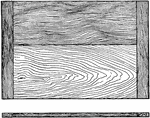
A drawing board is usually made of well-seasoned and straight-grained soft pine, the grain running lengthwise of the board.

Drawing Board

A drawing board is usually made of well-seasoned and straight-grained soft pine, the grain running lengthwise…
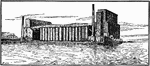
The grain elevator of Port Arthur in Canada.

Port Arthur

The grain elevator of Port Arthur in Canada.

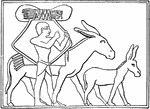
"Donkey carrying a load of grain sheaves in the Pyramid Age." -Breasted, 1914.

Donkeys

"Donkey carrying a load of grain sheaves in the Pyramid Age." -Breasted, 1914.

The Korean foxtail variety of millet, a grain.

Korean Foxtail Millet

The Korean foxtail variety of millet, a grain.

"Fruit of upright chess (Bromus racemosus): a, a', spikelet; b, b', single fruit, inner face, showing pedicel, palet, and concave face of glume with awn; c, outer face of glume; d, d', caryopsis or grain; e, pedicel." -Department of Agriculture, 1899

Grass Seed

"Fruit of upright chess (Bromus racemosus): a, a', spikelet; b, b', single fruit, inner face, showing…
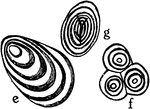
"Showing concentric and eccentric striations of starch grains. e, potato starch eccentrically striated; f, compound starch grain from potato; g, bean starch concentrically striated." -Stevens, 1916

Starch Grain Striations

"Showing concentric and eccentric striations of starch grains. e, potato starch eccentrically striated;…
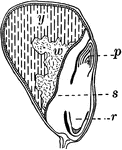
"Lengthwise section of grain of corn. y, yellow, oily part of endosperm; w, white, starchy part of endosperm; p, plumule; s, the shield (cotyledon), in contact with the endosperm for absorption of food from it; r, the primary root." -Bergen, 1896

Corn Grain

"Lengthwise section of grain of corn. y, yellow, oily part of endosperm; w, white, starchy part of endosperm;…
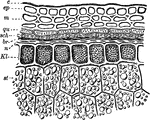
"Section through exterior part of a grain of wheat. c, cuticle or outer layer of bran; ep, epidermis; m, layer beneath epidermis; qu, sch, layers of hull next to seed-coats; br, n, seed-coats; Kl, layer containing proteid grains; st, cells of the endosperm filled with starch." -Bergen, 1896

Wheat Grain

"Section through exterior part of a grain of wheat. c, cuticle or outer layer of bran; ep, epidermis;…
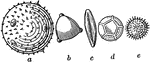
"Pollen grains. a, pumpkin; b, enchanter's nightshade; c, Albuca; d, pink; e, hibiscus." -Bergen, 1896
Pollen Grains

"Pollen grains. a, pumpkin; b, enchanter's nightshade; c, Albuca; d, pink; e, hibiscus." -Bergen, 1896

"To find the number of bushels of grain in a bin or box, multiply the length in feet by the height in feet, then by the width in feet and then by 8. For instance. In a bin 10 feet long, 6 feet high and 8 feet wide, 10 x 8 x 6 x 8 = 384." -Foster, 1921

Capacity

"To find the number of bushels of grain in a bin or box, multiply the length in feet by the height in…
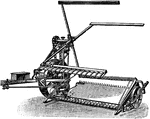
A machine for cutting down standing grain, usually worked by a pair of horses, the cutting machinery being driven by being connected with the wheels on which the machine is drawn over the field.

Reaping Machine

A machine for cutting down standing grain, usually worked by a pair of horses, the cutting machinery…
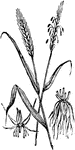
A species of grain of which there are several varieties It is an esculent grain bearing naked seeds on a flat ear, furnished with awns like barley.

Rye Grain

A species of grain of which there are several varieties It is an esculent grain bearing naked seeds…
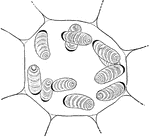
"Cell of Pellionia Daveauana, showing starch-grains. The black, crescent-shaped body on the end of each grain is the amyloplast." -Gager, 1916

Pellionia Plant Cell

"Cell of Pellionia Daveauana, showing starch-grains. The black, crescent-shaped body on the end of each…
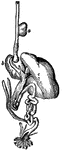
The swelling under the throat is called the crop, or first stomach. It is largely developed in some of the granivorous or grain-eating birds.

Crop and Digestive Organs

The swelling under the throat is called the crop, or first stomach. It is largely developed in some…
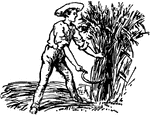
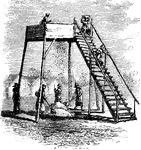
A man reaping grain with a sickle.

Reaping

A man reaping grain with a sickle.

An illustration of a rice winnower.

Winnowing Rice

An illustration of a rice winnower.

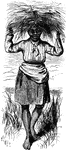
An illustration of a adult female farm hand transporting grain on her head.

Farm hand

An illustration of a adult female farm hand transporting grain on her head.

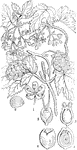
"Humulus Lupulus. 1. male flower; 2. female; 3. section of ovary; 4. ripe fruit; 5. section of it, showing embryo; 6. a grain of lupuline." -Lindley, 1853

Common Hop

"Humulus Lupulus. 1. male flower; 2. female; 3. section of ovary; 4. ripe fruit; 5. section of it, showing…
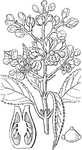
"Ochranthe arguta. 1. grain of pollen; 2. perpendicular section of its pistil." -Lindley, 1853

Ochranthe

"Ochranthe arguta. 1. grain of pollen; 2. perpendicular section of its pistil." -Lindley, 1853
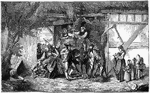
An illustration of a family standing in front a barn filled from harvest.

Family & Barn

An illustration of a family standing in front a barn filled from harvest.

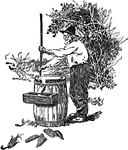
A man milling corn by hand with a gristmill.

Gristmill

A man milling corn by hand with a gristmill.

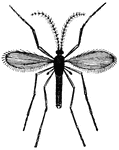
The hessian fly or barley midge, Mayetiola destructor, is a species of fly that is a significant pest of cereal crops including wheat, barley and rye. Though a native of Asia it was transported into Europe and later into North America, supposedly in the straw bedding of Hessian troops during the American Revolution (1775&ndash;83). There are usually two generations a year but may be up to five. In the spring the dark-coloured female lays about 250 to 300 reddish eggs on plants, usually where the stems are covered by leaves; the larvae feed on the sap and weaken the plants so that they cannot bear grain.

Hessian Fly

The hessian fly or barley midge, Mayetiola destructor, is a species of fly that is a significant pest…
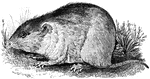
The Meadow Vole (Microtus pennsylvanicus), sometimes called the Field Mouse or Meadow Mouse, is a small North American vole found across Canada, Alaska and the northern United States. Its range extends further south along the Atlantic coast. One subspecies, the Florida Salt Marsh Vole, is found in Florida, and is classified as endangered. The Meadow Vole is active year-round, usually at night. It also digs underground burrows where it stores food for the winter and females give birth to their young. Although these animals tend to live close together, they are aggressive towards one other. This is particularly evident in males during the breeding season. It can cause damage to fruit trees, garden plants and commercial grain crops.

Field Mouse

The Meadow Vole (Microtus pennsylvanicus), sometimes called the Field Mouse or Meadow Mouse, is a small…

The Great Seal of Vermont. The seal depicts a pine tree in the center with grain sheaves and a cow at its side. Below holds the state motto "Freedom and Unity."

Seal of Vermont

The Great Seal of Vermont. The seal depicts a pine tree in the center with grain sheaves and a cow at…

The Great Seal of the State of Wyoming. The seal shows two men symbolizing livestock and mining next to a draped statue with the banner "Equal Rights." The ribbon around the columns reads "Oil, Mines, Livestock, Grain."

Seal of Wyoming

The Great Seal of the State of Wyoming. The seal shows two men symbolizing livestock and mining next…
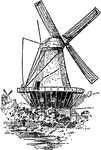
A windmill is a machine that is powered by the energy of the wind. It is designed to convert the energy of the wind into more useful forms using rotating blades or sails. The term also refers to the structure it is commonly built on. In much of Europe, windmills served originally to grind grain, though later applications included pumping water and, more recently, generation of electricity.

Windmill

A windmill is a machine that is powered by the energy of the wind. It is designed to convert the energy…
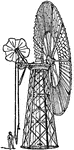
A windmill is a machine that is powered by the energy of the wind. It is designed to convert the energy of the wind into more useful forms using rotating blades or sails. The term also refers to the structure it is commonly built on. In much of Europe, windmills served originally to grind grain, though later applications included pumping water and, more recently, generation of electricity.

Windmill

A windmill is a machine that is powered by the energy of the wind. It is designed to convert the energy…
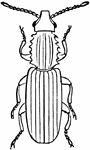
The Saw-Toothed Grain Beetle (Oryzaephilus surinamensis) is a beetle of the Silvanidae family and is named after the saw teeth on the sides of its prothorax.

Saw-Toothed Grain Beetle

The Saw-Toothed Grain Beetle (Oryzaephilus surinamensis) is a beetle of the Silvanidae family and is…
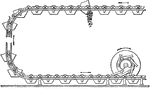
A bucket elevator, also called a grain leg, is a mechanism for hauling flowable bulk materials (most often grain or fertilizer) vertically.

Bucket Elevator

A bucket elevator, also called a grain leg, is a mechanism for hauling flowable bulk materials (most…
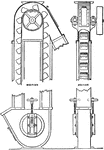
An illustration of sections of a grain elevator.

Grain Elevator

An illustration of sections of a grain elevator.

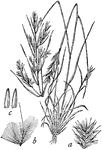
"Broom-sedge (Andropogon Virginicus). a, spike; b, spikelet; c, glumes." -Whitney, 1911

Broomsedge

"Broom-sedge (Andropogon Virginicus). a, spike; b, spikelet; c, glumes." -Whitney, 1911

"Side-oats (Atheropogon curtipendulus). a, spike; b, spikelet; c, spikelet with glumes removed." -Whitney, 1911

Side Oats

"Side-oats (Atheropogon curtipendulus). a, spike; b, spikelet; c, spikelet with glumes removed." -Whitney,…
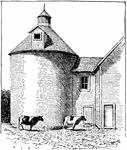
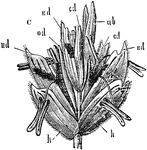
A structure usually next to a barn, for the storage of grain or feed.

Silo

A structure usually next to a barn, for the storage of grain or feed.

An illustration of a wheat spikelet.

Spikelet of Wheat

An illustration of a wheat spikelet.

"Esparto-Grasses. 1, 4, stalk and fruit of Macrochloa tenacissima. 2, 3, 5, stalk, flowering stem, and fruit of Lygeum Spartum." -Whitney, 1911

Esparto Grass

"Esparto-Grasses. 1, 4, stalk and fruit of Macrochloa tenacissima. 2, 3, 5, stalk, flowering stem, and…
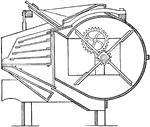
"A pressure-blower used to send a blast through screens upon which grain is falling to clean it from the chaff and dust; a winnowing-machine. It usually forms a part of a threshing-machine, or is used in connection with grain-elevators." -Whitney, 1911

Fanning Mill

"A pressure-blower used to send a blast through screens upon which grain is falling to clean it from…
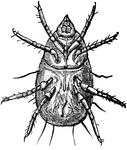
The Flour Mite (Acarus siro) is an arachnid that is a pest of stored grain and flour.

Flour Mite

The Flour Mite (Acarus siro) is an arachnid that is a pest of stored grain and flour.

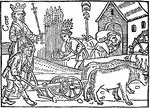
An illustration of a group of peasants working the field; one plowing the field, one hauling grain, and one harvesting wheat.

Peasants Working

An illustration of a group of peasants working the field; one plowing the field, one hauling grain,…

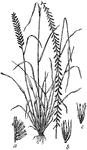
The Bearded Darnel (Lolium temulentum) is sometimes found in grain-fields, with its glume equalling the five to seven flowered spikelets, an awn longer than the flower. Its grain is poisonous, the only instance known among the grasses.

Bearded Darnel

The Bearded Darnel (Lolium temulentum) is sometimes found in grain-fields, with its glume equalling…
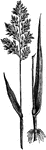
The Reed Canary Grass (Phalaris arundinacea) has a panicle that is slightly branched, clustered, and somewhat spreading when old. The glumes are wingless and rudimentary florets are hairy. The stem is round, smooth, erect and form two to seven feet high. There are five to six broad, lightish-green,acute, harsh, flat-ribbed leaves. The central rib the most prominent and roughish on both surfaces. It grows on wet grounds by the sides of rivers and standing pools. It may be gathered and sown with winter grain. Flowers in July.

Reed Canary Grass

The Reed Canary Grass (Phalaris arundinacea) has a panicle that is slightly branched, clustered, and…
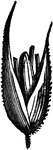
The Reed Canary Grass (Phalaris arundinacea) has a panicle that is slightly branched, clustered, and somewhat spreading when old. The glumes are wingless and rudimentary florets are hairy. The stem is round, smooth, erect and form two to seven feet high. There are five to six broad, lightish-green,acute, harsh, flat-ribbed leaves. The central rib the most prominent and roughish on both surfaces. It grows on wet grounds by the sides of rivers and standing pools. It may be gathered and sown with winter grain. The flower is shown here.

Reed Canary Grass

The Reed Canary Grass (Phalaris arundinacea) has a panicle that is slightly branched, clustered, and…

Rice (Oryza sativa) is a long panicled grass, having, when ripe, some resemblance to oats, the seed growing in a separate pedicel starting from the main stalk. Each kernel terminates in an awn, and is enclosed in a rough husk, or scale, of a yellowish color. The stem or stalk of rice is similiar to that of wheat, except that the joints are more numerous. It is annual, and rises to the height of from two to six feet, according to the variety, soil, and culture. The rice seed is surrounded with a husk, which is so closely attached to it as being difficult of seperation. It is cleaned by passing through mill-stones, set far enough apart to prevent crushing the grain, but sufficiently near to remove the husks or chaff by friction.

Rice

Rice (Oryza sativa) is a long panicled grass, having, when ripe, some resemblance to oats, the seed…

Wheat (Triticum vulgare) is an annual herbaceous plant. The seed is oblong, or a compressed oval, surrounded by scales or chaff, which are easily removed. The side of the kernal or fruit which is next to the rachis in growing is marked by a deep groove separating the mealy parts in the middle . On the other side of the kernal a small oval is seen. The oval is the seat of the embryo, or place where the germ of the new plant is to take its start. The grain is composed to a great extent of starch, with a large percentage of gluten and other nitrogen bodies. Shown is a variation of winter wheat.

Wheat

Wheat (Triticum vulgare) is an annual herbaceous plant. The seed is oblong, or a compressed oval, surrounded…

Wheat (Triticum vulgare) is an annual herbaceous plant. The seed is oblong, or a compressed oval, surrounded by scales or chaff, which are easily removed. The side of the kernal or fruit which is next to the rachis in growing is marked by a deep groove separating the mealy parts in the middle. On the other side of the kernal a small oval is seen. The oval is the seat of the embryo, or place where the germ of the new plant is to take its start. The grain is composed to a great extent of starch, with a large percentage of gluten and other nitrogen bodies. Shown is a variation of winter wheat.

Wheat

Wheat (Triticum vulgare) is an annual herbaceous plant. The seed is oblong, or a compressed oval, surrounded…

Wheat (Triticum spelta) is an annual herbaceous plant. The seed is oblong, or a compressed oval, surrounded by scales or chaff, which are easily removed. The side of the kernal or fruit which is next to the rachis in growing is marked by a deep groove separating the mealy parts in the middle. On the other side of the kernal a small oval is seen. The oval is the seat of the embryo, or place where the germ of the new plant is to take its start. The grain is composed to a great extent of starch, with a large percentage of gluten and other nitrogen bodies. Shown is a sample of spelta wheat.

Wheat

Wheat (Triticum spelta) is an annual herbaceous plant. The seed is oblong, or a compressed oval, surrounded…

Wheat (Triticum spelta) is an annual herbaceous plant. The seed is oblong, or a compressed oval, surrounded by scales or chaff, which are easily removed. The side of the kernal or fruit which is next to the rachis in growing is marked by a deep groove separating the mealy parts in the middle. On the other side of the kernal a small oval is seen. The oval is the seat of the embryo, or place where the germ of the new plant is to take its start. The grain is composed to a great extent of starch, with a large percentage of gluten and other nitrogen bodies. Shown is a sample of a summer variety.

Wheat

Wheat (Triticum spelta) is an annual herbaceous plant. The seed is oblong, or a compressed oval, surrounded…
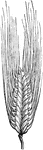
Egyptian wheat (Sorghum bicolor) has long slender stalks growing seven to ten feet. It matures late and is inferior as a grain for cattle.

Wheat

Egyptian wheat (Sorghum bicolor) has long slender stalks growing seven to ten feet. It matures late…

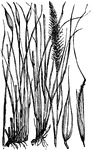
Barley is a cereal grain derived from the annual grass Hordeum vulgare, a common barley. It serves as a major animal feed crop, with smaller amounts used for malting and in health food, as well as the making of the alcoholic beverages beer. This is a spring species. The seed is more slender than wheat with a firmer and rougher covering of husk or chaff.

Barley

Barley is a cereal grain derived from the annual grass Hordeum vulgare, a common barley. It serves as…