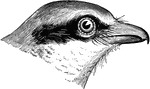
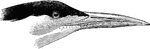
"Lanius borealis. Great Northern Shrike. Butcher-bird. Great Grey Shrike. Above, clear bluish-ash, blanching on rump and scapulars; below, white, always vermiculated transversely with fine wavy blackish lines; a broad black bar along side of head, not meeting its fellow across forehead, interrupted by a white crescent on under eyelid, and bordered above by hoary white that also occupies the extreme forehead; wings and tail black, the former with a large white spot near base of the primaries, and white tips of most of the quills, the latter with the outer web of the outer feather edged, and all the feathers excepting the middle pair broadly tipped, with white, and with concealed white bases; bill and feet bluish-black; eyes blackish. Elliot Coues, 1884

Butcher-bird Head

"Lanius borealis. Great Northern Shrike. Butcher-bird. Great Grey Shrike. Above, clear bluish-ash, blanching…
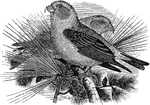
"Loxai curvirostra. American Red Crossbill. Red; wings and tail blackish, without white markings. Middle of back darker, more brownish-red than elsewhere, the feathers with dusky centres. In the highest feather, even, the red is scarcely continuous except on head and rump, where brightest; lower belly and crissum usually gray or pale. Though the shade of red is never rosy or carmine as in the last, it varies interminably. It is usually tilered or cinnabar, heightening in some cases to vermilion, in others shading to brownish-red, and often mixed not only with gray, but with olivaceous or saffron-yellowish tints. Orange, chrome or gamboge are sometimes seen." Elliot Coues, 1884

American Red Crossbill

"Loxai curvirostra. American Red Crossbill. Red; wings and tail blackish, without white markings. Middle…
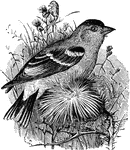
"Astragalinus tristis. American Goldfinch. Yellow-bird. Thistle-bird. In summer: Rich yellow, changing to whitish on the tail-coverts; a black patch on the crown; wings black, ore or less edged with white; lesser wing-coverts white or yellow; greater coverts tipped with white; tail black, every feather with a white spot; bill and feet flesh-colored. In September, the black cap disappears; the general plumage changes to a pale flaxen-brown above and whitey-brown below, with traces of the yellow, especially about the head; wings and tail much as in summer; sexes then much alike: this continues until the following April or May." Elliot Coues, 1884

American Goldfinch

"Astragalinus tristis. American Goldfinch. Yellow-bird. Thistle-bird. In summer: Rich yellow, changing…
"Pooecetes gramineus. Grass Finch. Bay-winged Bunting. Vesper-bird. Above, grayish-brown, closely and uniformly marked with dusky-centered brown-edged streaks, and further variegated by pale gray edging of the feathers. Crown quite like back, though the marking is in smaller pattern; superciliary line and eye-ring whitish. Under parts dull white, usually noticeably buff-tinged in the streaked areas, thickly streaked across breast and along sides with dusky-centered brown-edged streaks, anteriorly tending to concentrate in lateral chains bounding the white throat; above this chain a maxillary brown stripe; auriculars varied with light and dark brown. Quills fuscous, the longer ones with grayish-white edging, the secondaries and greater and median coverts with broad firm brown and white edges and tips; lesser coverts bright chestnut, whence the name "bay-winged". Outer-feather largely or wholly white, next pair or two airs largely white in decreasing amount. Upper mandible brown; lower, and the feet, flash-colored or yellowish." Elliot Coues, 1884

Bay-winged Bunting

"Pooecetes gramineus. Grass Finch. Bay-winged Bunting. Vesper-bird. Above, grayish-brown, closely and…
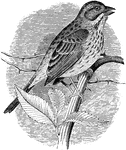
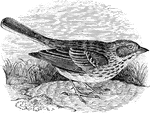
"Melospiza fasciata. Song Sparrow. Silver-tongue. Below, white, slightly shaded with brownish on the flanks and crissum; with numerous black-centred, brown-edged streaks cross breast and along sides, usually forming a pectoral blotch and coalescing into maxillary stripes bounding the white throat; crown dull bay, with fine black streaks, divided in the middle and bounded on either side by ashy-whitish lines; vague brown or dusky and whitish markings on sides of the head; a brown post-ocular stripe over the gray auriculars, and another, not so well defined, from angle of mouth below the auriculars; the interscapular streaks black, with bay and ashy-white edgings; rump and cervix grayish-brown, with merely a few bay marks; wings with dull bay edgings, the coverts and inner quills marked like the interscapulars; tail plain brown, with darker shaft lines, on the middle feathers at least, and often with obsolete transverse wavy markings. Very constant in plumage, the chief difference being in the sharpness and breadth of the markings, due in part to the wear of the feathers. In worn midsummer plumage, the streaking is very sharp, narrow, and black, from wearing of the rufous and whitish, especially observable below where the streaks contrast with white, and giving the impression of heavier streaking than in fall and winter, when in fresher feather, the markings are softer and more suffuse. The aggregation of spots into a blotch on the middle of the breast is usual. Bill dark brown, paler below; feet pale brow." Elliot Coues, 1884

Song Sparrow

"Melospiza fasciata. Song Sparrow. Silver-tongue. Below, white, slightly shaded with brownish on the…
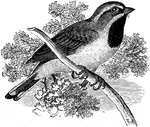
"Amphispiza bilineata. Black-throated Sparrow. Black-faced Sage Sparrow. face, chin, and throat sharply jet-black; a strong white superciliary line, and another bounding the black of the throat; under eyelid white; auriculars dark slate. No yellow anywhere. Below, pure white; the sides, flanks, and crissum shaded with ashy or fulvous-brownish, but no streaks. Above, uniform grayish-brown; clearer ash in high plumage, otherwise browner, generally more shy anteriorly than behind, and shading insensibly into the black of the face. wings dusky; coverts and inner quills edged with the color of the back. Tail black, with narrow grayish edgings; the outer feather sharply edged and tipped with white, and several others similarly tipped. Bill and feet plumbeous-black." Elliot Coues, 1884

Black-throated Sparrow

"Amphispiza bilineata. Black-throated Sparrow. Black-faced Sage Sparrow. face, chin, and throat sharply…
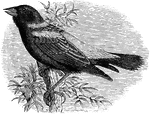
"Dolichonyx oryzivorus. Bobolink. Meadow-wink. Skunk Blackbird (Northern States), Reed-bird (Middle States), Rice-bird (Southern States). Male, in breeding plumage: Black; cervix buff; scapulars, rump and upper tail-coverts ashy-white; interscapulars streaked with black, buff, and ashy; outer quills edged with yellowish; bill blackish-horn; feet brown. The faultless full dress of black, white, and buff is worn only for a brief period; and even in spring and summer, most males are found to have yellowish touches in the black, especially of the under parts. The "delirious song" is only heard while the males re trooping their way to their breeding-grounds, and before the midsummer change of feather." Elliot Coues, 1884

Bobolink

"Dolichonyx oryzivorus. Bobolink. Meadow-wink. Skunk Blackbird (Northern States), Reed-bird (Middle…
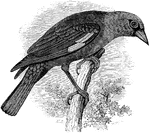
"Xanthocephalus icterocephalus. Yellow-headed Blackbird. Male: Black, including lores and small space around eye and bill; whole head otherwise, with the neck and breast, rich yellow, orange in high feather, the color extending interruptedly to or towards the belly; some feathers around vent, and the tibiae, usually yellow also. A large white patch on the wing, formed by the primary and many of the greater secondary coverts, interrupted by black of the bastard quills. Bill and feet black." Elliot Coues, 1884

Yellow-headed Blackbird

"Xanthocephalus icterocephalus. Yellow-headed Blackbird. Male: Black, including lores and small space…
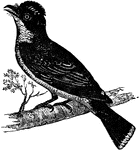
Tyrannus carolinensis. King-bird. Bee-martin. No olive nor decided yellow. Only outer primaries obviously emarginate. Tail nearly even - if anything a little rounded. Blackish-ash, still darker or quite black on head, crown with a flaming spot. Below, pure white, the breast shaded with plumbeous. Wings dusky, with much whitish edging. Tail black, broadly and sharply tipped with white, the outer feather sometimes edged with the same. Bill and feet black." Elliot Coues, 1884

King-bird

Tyrannus carolinensis. King-bird. Bee-martin. No olive nor decided yellow. Only outer primaries obviously…
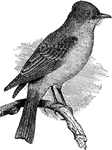
"Sayiornis fusca. Pewit Flycatcher. Water Pewee. Pewit. Phaebe. Dull olivaceous-brown, the head much darker fuscous-brown, almost blackish, usually in marked contrast with the back; below, solid whitish, or palest possible yellow, particularly on the belly; the sides, and the breast nearly or quite across, shaded with grayish -brown; wings and tail dusky, the outer tail-feather, inner secondaries, and usually the wing-coverts, edged with whitish; a whitish ring round the eye; bill and feet black. Varies greatly in shade; the foregoing is the average spring condition. As summer passes, the plumage becomes much-duller and and darker brown, from wearing of the feather; then, after the moult, fall specimens are much brighter than in spring, the under parts being decidedly yellow, at least on the belly." Elliot Coues, 1884

Pewit Flycatcher

"Sayiornis fusca. Pewit Flycatcher. Water Pewee. Pewit. Phaebe. Dull olivaceous-brown, the head much…
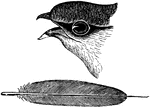
"Chaetura pelasgica. Chimney Swift. Chimney "Swallow". Sooty-brown, with a faint greenish gloss above; below paler, becoming gray on the throat; wings black; a velvety black space about eyes." Elliot Coues, 1884

Chimney Swift Head and Feather

"Chaetura pelasgica. Chimney Swift. Chimney "Swallow". Sooty-brown, with a faint greenish gloss above;…
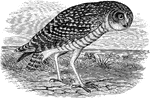
"Speotyto cunicularia hypogae'a. Burrowing Owl. Adult: Above, dull grayish-brown, profusely spotted with whitish; the markings mostly rounded and paired on each feather, but anteriorly lengthened. Quills with 4-6 whitish bars, entire or broken into cross-rows of spots; tail-feathers similarly marked. There is much individual variation in the tone of the ground-color, and size and number of the spots, which may also be rather ochrey than whitish. Superciliary line, chin, and throat, white, the two latter separated by a dark brown jugular collar; auruculars brown; facial bristles black-shafted. Under parts white or pale ochrey, the breast, belly, and sides barred with traverse spots of brown, in a pretty regular manner; legs and under tail-coverts unmarked. Lining of wings tawny-white, dusky-spotted on the primary coverts." Elliot Coues, 1884

Burrowing Owl

"Speotyto cunicularia hypogae'a. Burrowing Owl. Adult: Above, dull grayish-brown, profusely spotted…
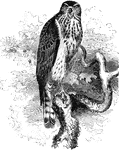
"Astur atricapillus. American Goshawk. Blue Hen Hawk (adult). Chicken Hawk (young). Adult: Above, dark bluish-slate color, each feather black-shafted; top of head blackish, conspicuously different from other upper parts, the feathers there with fleecy white bases; a long white superciliary or rather post-ocular stripe; auriculars blackish. Ground color of under parts, including lining of wings, white, closely barred or vermiculated in narrow zigzag lines with slaty-brown, except on throat and crissum, and everywhere sharply pencilled with blackish shaft-lines, one on each feather. The barring is largest and most regular on the belly, flanks, and tibiae, but is for the most part much dissipated in a fine mottling. It varies greatly in coarseness in different specimens, some of which approach A. palumbarius in this respect. Tail like back, banded with four or five blackish bars, the terminal one much the broadest. Bill dark bluish; iris yellowish; feet yellow, claws black." Elliot Coues, 1884

American Goshawk

"Astur atricapillus. American Goshawk. Blue Hen Hawk (adult). Chicken Hawk (young). Adult: Above, dark…
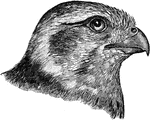
"Falco mexicanus. American Lanner Falcon. Prairie Flacon. A medium-sized species, distinguished from any gyrfalcon by the smaller size, different feathering of the tarsus etc., from the duck hawk by the general much lighter color, which is dull brownish above instead of dark slate, etc. Adult: Upper parts brownish-drab, each feather with a paler border of brown, grayish, or whitish; the top of the head more uniform, the occiput and nape showing more whitish. Under parts white, everywhere excepting on the throat marked with firm spots of dark brown, most linear on the breast, then more broadly oval on the belly, enlarging and tending to merge into bars on the flanks, very sparse or obsolete on the crissum, on the maxiliary region forming a broad firm moustache; these marking corresponding with the ground color of the upper parts. Primaries ashy-brown, with narrow but firm pale edging of outer webs and ends, the inner webs regularly marked with white in form of barred indents or circumscribed spots, most numerous and regular on the outer primaries; the white tinged with fulvous, next to the shafts; the outer web of the first primary either plain, or with whitish indents as in F. lanarius; outer webs of secondaries more or less marked with fulvous; axillars plain dark brown; lining of wings otherwise white, spotted with dark brown. Tail pale brownish-gray, nearly uniform, but with white tip, and more or less distinct barring or indenting with whitish, especially on the lateral feathers, producing a pattern not unlike that of the primaries. Bill mostly dark bluish horn-color, but its base, and much of under mandible, yellow; feet yellow." Elliot Coues, 1884

Prairie Falcon Head

"Falco mexicanus. American Lanner Falcon. Prairie Flacon. A medium-sized species, distinguished from…
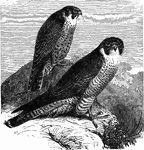
"Falco mexicanus. American Lanner Falcon. Prairie Flacon. A medium-sized species, distinguished from any gyrfalcon by the smaller size, different feathering of the tarsus etc., from the duck hawk by the general much lighter color, which is dull brownish above instead of dark slate, etc. Adult: Upper parts brownish-drab, each feather with a paler border of brown, grayish, or whitish; the top of the head more uniform, the occiput and nape showing more whitish. Under parts white, everywhere excepting on the throat marked with firm spots of dark brown, most linear on the breast, then more broadly oval on the belly, enlarging and tending to merge into bars on the flanks, very sparse or obsolete on the crissum, on the maxiliary region forming a broad firm moustache; these marking corresponding with the ground color of the upper parts. Primaries ashy-brown, with narrow but firm pale edging of outer webs and ends, the inner webs regularly marked with white in form of barred indents or circumscribed spots, most numerous and regular on the outer primaries; the white tinged with fulvous, next to the shafts; the outer web of the first primary either plain, or with whitish indents as in F. lanarius; outer webs of secondaries more or less marked with fulvous; axillars plain dark brown; lining of wings otherwise white, spotted with dark brown. Tail pale brownish-gray, nearly uniform, but with white tip, and more or less distinct barring or indenting with whitish, especially on the lateral feathers, producing a pattern not unlike that of the primaries. Bill mostly dark bluish horn-color, but its base, and much of under mandible, yellow; feet yellow." Elliot Coues, 1884

Two Lanner Falcon

"Falco mexicanus. American Lanner Falcon. Prairie Flacon. A medium-sized species, distinguished from…
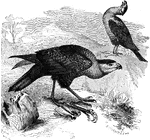
"Polyborus auduboni. Common Caracara. General color blackish, the throat, neck all around, and more or less of fore back and breast whitish, spotted and chiefly barred with blackish; upper and under tail-coverts and most of the tail white, the latter very numerously barred with blackish, of which color is the broad terminal zone; the shafts white along the white portion of each feather. Basal portion of primaries likewise barred with whitish. Bill variously pale colored; cere carmine; iris brown; feet yellow; claws black; soft parts drying to a dingy indefinable color." Elliot Coues, 1884

Caracaras

"Polyborus auduboni. Common Caracara. General color blackish, the throat, neck all around, and more…
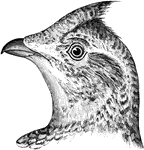
"Pediaecetes phasianellus Columbianus. Common Sharp-tailed Grouse. Upper parts closely and pretty evenly variegated with blackish-brown, reddish-brown, and grayish-brown, the pattern smallest on the rump and lower back, where the blackish is mostly in sharp-angled stars; the reddish most conspicuous on the upper back, and both the lighter colors everywhere finely sprinkled with blackish. Wing-coverts like the upper back, but with numerous conspicuous rounded white spots, one on the end of each feather. Crown and back of neck nearly like the back, but in smaller pattern, and the markings mostly transverse. An illy-defined white area on each side of the neck, over the tympanum, and slight whitish stripe behind the eye. Throat fine light buff, usually immaculate, but sometimes finely speckled quite across. Under parts white, more or less tinted with buff towards the throat; the breast with numerous regular dark-brown U-shaped spots, one on each feather; similar but smaller, sharper, and fewer such spots thence scattered over most of the under parts, only the middle of the belly being left unmarked. Long feathers of the sides under the wings matching the upper wing-coverts nearly; under wing-coverts and axillaries pure white, not marked; flanks with bars or U-spots of dark brown. Legs grayish-white, unmarked. Quills of the wings fuscous; outer webs of the secondaries with equidistant, squarish, white or tawny spots, the secondaries tipped and imperfectly twice or thrice barred with white, gradually becoming sprinkled with the varied colors of the back, so that the innermost of them are almost precisely like the greater coverts. Four middle tail-feathers variegated, much like the back; others white, or grayish-white, on the inner webs, the outer webs being mottled; a few under tail-coverts spotted, the rest white; upper tail-coverts nearly like the rump. Iris light brown; bill dark horn-color; part of under mandible flesh-colored; claws like bill; toes on top light horn-color, the soles darker." Elliot Coues, 1884

Sharp-tailed Grouse

"Pediaecetes phasianellus Columbianus. Common Sharp-tailed Grouse. Upper parts closely and pretty evenly…
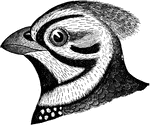
"Cyrtonyx massena. Massena Partridge. Male: Upper parts intimately waved with black and reddish-brown and tawny-brown, and marked with sharp buff or whitish shaft-lines; on the wings the irregular black variegation changing to black bars and round spots, in regular paired series on each feather. Outer quills fuscous, their outer webs spotted with white or buff. Under parts crowded with innumerable round white spots on a dark ground, several pairs on each feather; the middle line of the breast and belly mahogany-colored, the flanks, vent, and crissum velvety-black. Top of head black in front, with slight white touches, changing on the crest to brown. Sides of the head and throat fantastically striped with black and white; a broad black throat-patch; another on the cheeks, across lored alongside of crown; a third on the ear-coverts; a fourth bordering the white all around behind." Elliot Coues, 1884

Massena Quail

"Cyrtonyx massena. Massena Partridge. Male: Upper parts intimately waved with black and reddish-brown…
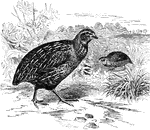
"Coturnix dactylisonans. Messina Quail. Migratory Quail. Common Quail of Europe. Upper parts variegated with buff or whitish and black upon a mixed reddish-brown and gray ground, the most conspicuous markings being sharp lance-lineal lengthwise stripes of buff or whitish over most of the upper parts, these dashes mostly edged with black; other less prominent buff or whitish cross-bars, several to a feather, likewise framed in black. Crown mixed brown and black, with sharp median and lateral buff stripes. Throat white, bounded before by a dark bar curving down behind the auriculars; behind, by a necklace of ruddy-brown, blackish, or whitish spots; chin varied with dark marks n advance of the auricular bar. Under parts fading to whitish from the buff or pale yellowish-brown breast, without any dark crossbars, but the long feathers of the sides and flanks with large and conspicuous white shaft-stripes and otherwise variegated with black, brown, and buff. Primaries fuscous, spotted with light brown on outer webs; secondaries similar, but the markings becoming bars on both webs. Tail-feathers brownish-black, much varied with shaft-lines, cross-bars, and edgings of buff; crissum immaculate, like the abdomen. Bill dark; feet pale; iris dark brown." Elliot Coues, 1884

Common Quail of Europe

"Coturnix dactylisonans. Messina Quail. Migratory Quail. Common Quail of Europe. Upper parts variegated…
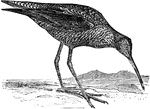
"Micropalama himantopus. Stilt Sandpiper. In summer: blackish, each feather edged and tipped with white and tawny or bay, which on the scapulars becomes scalloped. Auriculars chestnut; a dusky line from bill to eye, and a light reddish superciliary one; upper tail-coverts white with dusky bars. Primaries dusky with blackish tips; tail-feathers 12 ashy-gray, their edges and a central field white; under parts mixed reddish, black, and whitish, in streaks on the jugulum, elsewhere in bars; bill and feet greenish-black." Elliot Coues, 1884

Stilt Sandpiper

"Micropalama himantopus. Stilt Sandpiper. In summer: blackish, each feather edged and tipped with white…
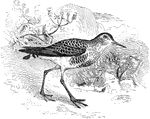
"Calidris arenaria. Sanderling. Ruddy "Plover". Adult in summer: Entire upper parts and neck all round variegated with black, light ashy and bright reddish; on the back and scapulars each feather having a central black field, and being broadly margined and tipped with ashy or reddish. Under parts white, immaculate. Outer webs an tips of primaries deep brownish-black, inner light ashy. A white spot at base of inner primaries. Secondaries mostly pure white; the outer vanes and part of inner on the latter half dusky. Greater coverts dusky, broadly tipped and narrowly edged with pure white. Rump, upper tail-coverts and central tail-feathers dusky, tipped and narrowly edged with ashy-white; lateral tail=-feathers very light ash, nearly white. Bill and feet black." Elliot Coues, 1884

Sanderling

"Calidris arenaria. Sanderling. Ruddy "Plover". Adult in summer: Entire upper parts and neck all round…
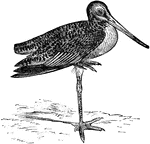
"Limosa fedoa. Great Marbled Godwit. Marlin. Feathers not extending on side of lower mandible to a point far beyond those on upper. no white anywhere; rump, tail, and its coverts barred throughout with blackish and the body-color. Lining of wings chestnut; axillars the same, more or less barred with black. General color rufous or light dull cinnamon-red, uniform and nearly uninterrupted on all the under parts, richer and more chestnut on the lining of the wings and axillars; somewhat marked with dusky on the sides of the breast and body; on the whole upper parts variegated with the brownish-black central field of each feather, the blackish predominating, leaving the rufous chiefly as scallops and tips of the feathers. This rufous very variable in intensity; usually paler on upper than on under parts, and strongest under the wings. Primaries rufous, successively darkening from the last to first, the outer webs and ends of the few outer ones blackish, the shaft of the first white. Bill livid flesh-colored, blackish on about terminal third; legs ashy-blackish." Elliot Coues, 1884

Marbled Godwit

"Limosa fedoa. Great Marbled Godwit. Marlin. Feathers not extending on side of lower mandible to a point…
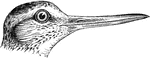
"Symphemia semipalmata. Semipalmated Tattler. Willet. Adult in summer: Upper parts ashy, confoundedly speckled to greater or less extent with blackish; this sometimes giving the prevailing tone, but in lighter colored cases the blackish restricted to an irregular central field on each feather, throwing out angular processes and tending to become traverse bars. When such dark fields prevail, the upper parts become quite blackish, speckled with ashy-white, like Totanus melanoleucus, for example. Furthermore, there is often a slight rufescence. Under parts white, sometimes with a rufous or brownish tinge, the jugulum and breast spotted and streaked, the sides barred or arrow-headed, with brownish-black. Axillars and lining of wing, edge of wing and primary coverts, sooty-blackish. Primaries blackish, with a great space white at base, partly overlaid and concealed by the primary coverts, partly showing conspicuously as a speculum; shafts white along this space. Most secondaries white most upper tail-coverts white, the shorter ones dark like rump, the longer ones barred like tail. Tail ashy, incompletely barred with blackish; lateral feathers pale, or marbled with white. Bill dark; legs bluish." Elliot Coues, 1884

Willet Head

"Symphemia semipalmata. Semipalmated Tattler. Willet. Adult in summer: Upper parts ashy, confoundedly…
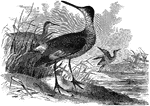
"Symphemia semipalmata. Semipalmated Tattler. Willet. Adult in summer: Upper parts ashy, confoundedly speckled to greater or less extent with blackish; this sometimes giving the prevailing tone, but in lighter colored cases the blackish restricted to an irregular central field on each feather, throwing out angular processes and tending to become traverse bars. When such dark fields prevail, the upper parts become quite blackish, speckled with ashy-white, like Totanus melanoleucus, for example. Furthermore, there is often a slight rufescence. Under parts white, sometimes with a rufous or brownish tinge, the jugulum and breast spotted and streaked, the sides barred or arrow-headed, with brownish-black. Axillars and lining of wing, edge of wing and primary coverts, sooty-blackish. Primaries blackish, with a great space white at base, partly overlaid and concealed by the primary coverts, partly showing conspicuously as a speculum; shafts white along this space. Most secondaries white most upper tail-coverts white, the shorter ones dark like rump, the longer ones barred like tail. Tail ashy, incompletely barred with blackish; lateral feathers pale, or marbled with white. Bill dark; legs bluish." Elliot Coues, 1884

Willets

"Symphemia semipalmata. Semipalmated Tattler. Willet. Adult in summer: Upper parts ashy, confoundedly…
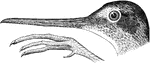
"Totanus melanoleucus. Greater Tell-tale. Greater Yellow-shanks. Long-legged Tattler. Stone-snipe. Bill straight or slightly inclined upwards, not with regular curve, but as if bent near the middle, black or greenish-black. Legs very long and slender, chrome-yellow. Above, blackish, more or less ashy according to season, everywhere speckled with whitish, in a series on indentations along edge of each feather; the markings spottle on the back and wings, streaky on the head and neck. A slight white superciliary line. Upper tail-coverts mostly white. Under parts white, the jugulum and fore-breast streaked, the sides and flanks, lining of wings and axillars barred and arrow-headed with the color of the back. Tail like back,with numerous white bars, generally broken on the middle feathers. Primaries blackish, with black shafts, mostly with white tips; secondaries and their coverts the same, but their edges marbled, spotted, or broken-barred with white. The seasonal changes of plumage are inconsiderable, consisting chiefly in the tone of the upper parts, more blackish and white in summer, more gray and ashy in winter and in the young; and in the emphasis of the dark markings of the under parts." Elliot Coues, 1884

Greater Yello-shanks

"Totanus melanoleucus. Greater Tell-tale. Greater Yellow-shanks. Long-legged Tattler. Stone-snipe. Bill…
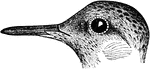
"Tryngites rufescens. Buff-breasted Sandpiper. Above, brownish-black with a greenish gloss, every feather broadly margined with tawny or yellowish-brown, the latter the prevailing tone. Under parts buff or fawn-colored, without markings except a few small blackish spots on sides of breast. Central tail-feathers greenish-brown, blackening at ends; others paler, often rufescent, with white or tawny tips and subterminal black bar; and usually, also, some black marbling or streaking/ Primaries and secondaries ashy-brown blackening at end, the extreme tip white - most of the inner webs of the primaries, and both webs of the secondaries pearly white, speckled and marbled with black. This curious tracery, best seen from below, is diagnostic; though the precise pattern varies interminably. The patch of under coverts at the bases of the primaries have the same character. Axillars white, lining of wings white or rufescent. Iris brown. Bill brownish-black; legs greenish or yellowish." Elliot Coues, 1884

Buff-breasted Sandpiper

"Tryngites rufescens. Buff-breasted Sandpiper. Above, brownish-black with a greenish gloss, every feather…
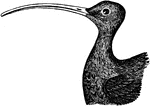
"Numenius longirostris. Long-billed Curlew. Sickle-bill. Plumage very similar to that of the Godwit, Limosa faeda: prevailing tone rufous, of varying intensity in different specimens, usually deepest on the lining of the wings, which are little varied with other color. Primaries varied with rufous. Top of head variegated with blackish and rufous or whitish, without distinct pale median and lateral lines. Upper parts brownish-black, speckled with tawny or cinnamon-brown, each feather having several indentations or broken bars of this color; rufous prevailing on wing-coverts. Tail-feathers and secondaries cinnamon-brown, with pretty regular dark bars throughout. Under parts rufous or cinnamon of varying intensity, usually deepening to chestnut under the wings, fading to whitish on throat; the jugulum and fore-breast with dusky streaks which tend on the sides of breast and body to arrowheads or more or less complete bars; lining of wings, axillars, and crissum, mostly unmarked, though some spots may appear. No white on rump, tail, or wings. Bill black, much of under mandible pale-flesh-color or yellowish; legs dark. Little variation in plumage with sex, age, and season. Chicks hatch in whitish down, thickly blotched above with brownish-black; the bill straight, an inch long." Elliot Coues, 1884

long-billed Curlew

"Numenius longirostris. Long-billed Curlew. Sickle-bill. Plumage very similar to that of the Godwit,…
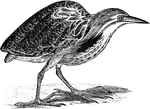
"Botaurus mugitans. American Bittern. Indian Hen. Stake-driver. Bog-Bull. Plumage of the upper parts singularly freckled with brown of various shades, blackish, tawny, and whitish; neck and under parts ochrey or tawny-white, each feather marked with a brown dark-edged stripe, the throat-line white, with brown streaks. A velvety-black patch on each side of the neck above. Crown dull brown, with buff superciliary stripe. Tail brown. Quills greenish-black, with a glaucous shade, brown-tipped. Iris yellow. Bill on the ridge brownish-black, the rest pale yellowish; a dark brown loral strip. Legs dull yellowish-green; claws brown.

American Bittern

"Botaurus mugitans. American Bittern. Indian Hen. Stake-driver. Bog-Bull. Plumage of the upper parts…
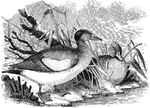
"Mareca americana. American Wigeon. Bald-pate. Bill grayish-blue, with black tip and extreme base; feet similar, duller, with dusky webs and claws; iris brown. Top of head white, or nearly so; sides the same, or more buffy, speckled with dusky-green, purer green forming a broad patch from and below eye to hind head; chin dusky. Fore neck and breast light brownish-red, or very pale purplish-cinnamon, each feather with paler grayish edge; along the sides of the body the same, finely waved with dusky; the breast and belly pure white, the crissum abruptly black. Lower hind neck and fore back and scapulars finely waved with the same reddish color and with dusky; lower back and rump similarly waved with dusky and whitish. Lesser wing-coverts plain gray; middle and greater coverts pure white, forming a large area, the greater black-tipped, forming the fore border of the speculum, which is glossy green, bordered behind by velvety black, internally by the black and white stripes on the inner secondaries. Tail brownish-gray, the lateral upper coverts black; axillary feathers white. Only old drakes have the crown immaculate white, the chin dusky, the auricular definitely green; generally the whole head and upper neck are pale brownish-yellow or reddish-white, speckled with greenish-Dusky." Elliot Coues, 1884

American Wigeon

"Mareca americana. American Wigeon. Bald-pate. Bill grayish-blue, with black tip and extreme base; feet…
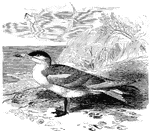
"Sterna (T.) caspia. Caspian Tern. Imperial Tern. Bill dark vermilion red, growing and somewhat "diaphanous" toward the tip. Pileum and occipital crest glossy greenish-black, extending to below the lower level of the eyes, and occupying the termination of the feathers on the side of the mandible to the exclusion of the white; lower eyelid white, forming a noticeable spot on the greenish; a white streak along sides of upper mandible, not extending to the end of the feathers. mantle pearl-blue, the line of demarcation between it and the white rather indefinite, both on nape and rump; most of the tail-feathers, and especially the central ones, retaining a more or less pearly tint. Shafts of the primaries yellowish-white; primaries grayish-black, but, when new, so heavily silvered over as to appear of a light hoary gray, especially on their superior aspects. On the inner web of all there is a central light field; this is very narrow, even on the first primary, although it runs considerable distance, and on the others it rapidly grows less; and it has no trenchant line of division of the primaries from the darker portions of the feather. whole inner web of secondaries pure white, outer pearl-blue. Legs and feet black." Elliot Coues, 1884

Caspian Tern

"Sterna (T.) caspia. Caspian Tern. Imperial Tern. Bill dark vermilion red, growing and somewhat "diaphanous"…
"Sterna (T.) maxima. Cayenne Tern. Royal Tern. Adult in summer: Pileum glossy greenish-black, not extending below eyes, so narrow on side of upper mandible that a broad white streak extends to extreme tip of the feathers. Mantle exceedingly light pearl-blue, fading imperceptibly into white on the rump and towards the extremities of the tertials. Tail white, with a faint tinge of pearly, especially on the central feathers and inner webs of the other. Secondaries pure white for their whole length except a small space on the outer web near the tip, which is grayish-blue, deeper than the mantle. Outer web of first primary grayish-black; in the inner web of the same has a space of black extending the whole length of the feather, very narrow at the base, widening as it runs toward the tip. within 1 & 1/2 inches of which it occupies the whole web; the rest of the web white. separated from the black by a straight distinct line of division. The second, third, fourth, and fifth primaries have the same general characteristics, but the white space grows narrow and shorter, and round up further in the centre than along the edge of the web, so that for a little way from its end it has a border of blackish along its outer margin; other primaries wholly pearl-blue, their inner webs margined with white. Bill coral and orange-red, with a slightly lighter tip; feet blackish, their soles dull yellowish." Elliot Coues, 1884

Royal Tern

"Sterna (T.) maxima. Cayenne Tern. Royal Tern. Adult in summer: Pileum glossy greenish-black, not extending…
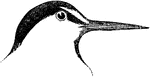
"Sterna aleutica. Aleutian Tern. Bill of ordinary shape, as in hirundo, macrura, etc., entirely black. Feet small, as in the species just named, but the webs more deeply incised; emargination not so great, however, as in Hydrochelidon; much as in Haliplana. Tibia bare to the usual extent. Wings and tail exactly as in Sterna proper, the latter, in its length and depth of fork, recalling macrura and forsteri. Crown and nape black; a large white frontal crescent, the horns of which reach to the posterior border of the eyes, the convexity of which extends into the nasal fossae, the concavity of which is opposite the anterior border of the eyes; thus broader than in most species similarly marked. The black vertex sends through the eye a band that crosses the cheeks and reaches the bill just posterior to the point of greatest extension of the feathers on the latter. The chin, auriculars, and other parts of the head bordering this vitta below, and pure white, presently deepening insensibly into the hue of the under parts. Tail wholly pure white; no pearly wash on either vane of any of the feathers. Upper parts at large dark pearl-gray, with a dull leaden hue, different from the clear pearly of macrura, etc., yet not of the smoky cast of panayensis, etc.; it is a tint intermediate between these, that I find difficult to name satisfactorily. The whole under parts, from the white of the chin, just noticed, to the under tail-coverts, paler and more decidedly pearly, more nearly as in full-plumaged macrura, yet more grayish. Both under and upper tail-coverts, like the tail, white. The color of the back mounts on the neck behind to the black of the nape without intervention of the white. Under wing-coverts and edge of wing pure white; as are all the shafts of the primaries. Primaries blackish lead-color, with silvery hoariness, and each with a large white space on inner web; this white space on the first primary occupies at the base the whole width of the inner web, but grows narrower toward the tip of the feather, ending about an inch from the tip, which is wholly blackish lead-color, this color running down as a narrow margining of the inner vane for two inches or more." Elliot Coues, 1884

Aleutian Tern

"Sterna aleutica. Aleutian Tern. Bill of ordinary shape, as in hirundo, macrura, etc., entirely black.…

This feather hat is an early 20th century design. It has a feather design that flares open like a peacock in the front of the hat.

Feather Hat

This feather hat is an early 20th century design. It has a feather design that flares open like a peacock…
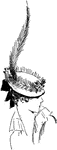
This feather hat is an early 20th century design. It has a feather that wraps around the top of the hat and then points upwards from the back.

Feather Hat

This feather hat is an early 20th century design. It has a feather that wraps around the top of the…
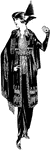
This early 20th century lady's outfit is made out of a shiny black material. It consists of a long knee length jacket that has an oriental design. It also includes a high wasted belt and a hat with a feather.

Early 20th Century Lady's Outfit

This early 20th century lady's outfit is made out of a shiny black material. It consists of a long knee…
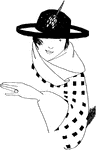
This is a drawing of a lady wearing a hat with a feather in the front. She is also wearing a jacket that has a square pattern.

Lady Wearing a Hat

This is a drawing of a lady wearing a hat with a feather in the front. She is also wearing a jacket…

This is a 1912 fashion silhouette. It shows a women outlined in black,wearing a long dress, and a hat with a feather in the front. She is has a little dog on a leash.

1912 Fashion Silhouette

This is a 1912 fashion silhouette. It shows a women outlined in black,wearing a long dress, and a hat…

This 1350 Silhouette of man is a black outline that shows the fashion of men during that period. The man is wearing a short sleeve shirt, tight fitting pants, and a pointed hat with a feather.

1350 Silhouette of Man

This 1350 Silhouette of man is a black outline that shows the fashion of men during that period. The…
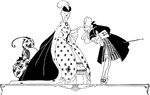
This is a Man and Woman dressed in 18th Century Costumes. The woman is dressed in a full dress that is wide, a cape, and a large feather hat. The man is dressed in a waist coat, breeches and a wig typically worn in those times by men.

Man and Woman 18th Century Costumes

This is a Man and Woman dressed in 18th Century Costumes. The woman is dressed in a full dress that…
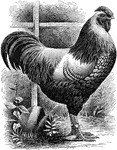
The silver-laced wyandotte is the base for all other colors of wyandotte, of which there are 17. It has white feathers with black edges on each feather, with a black tail and yellow legs.

Silver-Laced Wyandotte Cockerel

The silver-laced wyandotte is the base for all other colors of wyandotte, of which there are 17. It…
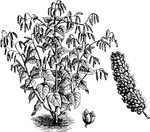
Also known as Polygonum orientale. A flower that is commonly found in southeastern Asia and Australia. It consists of red drooping flowers and ovate leaves.

Prince's Feather

Also known as Polygonum orientale. A flower that is commonly found in southeastern Asia and Australia.…
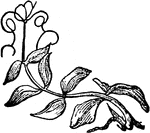
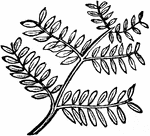
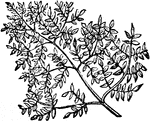
A feather-like leaf with multi-divided features.

Pinnate Leaf

A feather-like leaf with multi-divided features.

A leaf with double the amount of feather-like leaves.

Bipinnate Leaf

A leaf with double the amount of feather-like leaves.

A leaf with triple the amount of feather-like leaves.

Tripinnate Leaf

A leaf with triple the amount of feather-like leaves.

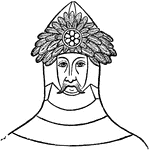
The feathered crest of Sir Thomas de Saint Quintin.

Crest of Sir Thomas de Saint Quintin

The feathered crest of Sir Thomas de Saint Quintin.

A decorative capital letter O with two peacock feathers in the background.

Capital Letter O

A decorative capital letter O with two peacock feathers in the background.

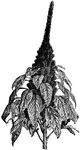
The Amaranthus Hypochondriacus is commonly known as Prince's Feather. The flowers are deep crimson and are on densely compacted spikes. The underside of the leaves are purplish in color.

Amaranthus Hypochondriacus

The Amaranthus Hypochondriacus is commonly known as Prince's Feather. The flowers are deep crimson and…
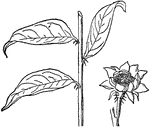
The leaves of pereskia aculeata are large and perfectly developed, with feather veins. Pereskia belongs to the cactus family.

Pereskia Aculeata

The leaves of pereskia aculeata are large and perfectly developed, with feather veins. Pereskia belongs…
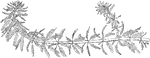
Parrot's feather is the common name of <i>myriophyllum proserpinacoides</i>. It is native to Chile. It is a water plant used in aquaria, fountains, and pools.

Parrot's Feather

Parrot's feather is the common name of myriophyllum proserpinacoides. It is native to Chile. It is a…
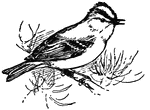
Also known as the Kinglet, the Golden-Crested Wren (Regulus cristatus) is the smallest of European birds. In America, only the hummingbird is less in size. It is one of the warblers (Sylviidæ). The length of the body is from three to six inches, there is a bright yellow crest, the back is yellowish olive green, the wings and tail ash brown with black and white markings. The Golden-Crested Wren is generally distributed over Europe. In spring it utters a sweet and surprisingly loud song.

Golden-Crested Wren

Also known as the Kinglet, the Golden-Crested Wren (Regulus cristatus) is the smallest of European birds.…
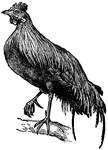
Jungle-fowl is a general name given to the members of the genus Gallus. The red jungle-fowl, G. jerrugineus, is the origin of the domesticated breeds of poultry. It inhabits India, Farther India, Sumatra, the Philippines, Celebes, and Timor, and strongly resembles the 'black-breasted game' variety of domesticated birds, with its fine orange or purplish-red upper surface, and greenish-black wings, tail, and under surface. Though excessively pugnacious in the wild state, polygamy is stated to be then rare. Three other species of jungle-fowl are known: the gray jungle-fowl of S. Central, and W. India (G. Sonnerati), G. Lafayettii of Ceylon, and G. varius of Java, Lombok, and Flores; but all these are stated to be sterile when mated with the common fowl.

Jungle-fowl

Jungle-fowl is a general name given to the members of the genus Gallus. The red jungle-fowl, G. jerrugineus,…
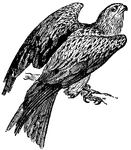
European Kites are very miscellaneous feeders, but depend largely on offal, and in the eastern tropics they are valuable as scavengers. The nest is usually placed in a tree, and consists of a mass of sticks lined with rags and paper; the eggs are three to four in number. The name kite is strictly applicable to the rare European Red Kite.

European Kite

European Kites are very miscellaneous feeders, but depend largely on offal, and in the eastern tropics…
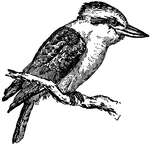
The Settler's Clock <i>('Dacelo gigs')</i>, is a very large kingfisher found in Australia, where it receives its popular name from the peculiar gurgling cry uttered with great regularity at dawn and dusk. It is one of the wood kingfishers, the food consisting of of reptiles, birds, insects, and even small mammals. The name is also applied to other species of the same genus found in Australia and New Guinea, and possessing similar habits. The coloring is not brilliant, consisting of a mixture of brown, black, and white, but the male has the lower part of the back of a greenish-blue color.

Kingfisher, Dacelo gigas

The Settler's Clock ('Dacelo gigs'), is a very large kingfisher found in Australia, where it receives…
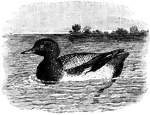
"A duck, <i>Fuligula</i> or <i>Fulix marila</i> and related species. The common scaup inhabits Europe, Asia, and North America. It is from 18 to 20 inches long, and from 30 to 35 in extent of wings." &mdash;Whitney, 1889
<p>In this illustration the duck is sitting on placid water, its feet tucked up underneath its body. Its head and upper body is dark, while its belly is white. There is a tree line in the distance.

Scaup, a Common Duck

"A duck, Fuligula or Fulix marila and related species. The common scaup inhabits Europe, Asia, and North…
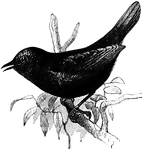
<i>Scytalopus magellanicus</i>. "A genus of South American formicarioid passerine birds, of the family <i>Pteroptochidae</i>. <i>S. magellanicus</i> is curiously similar to wrens in general appearance and habits, though belonging to a different suborder of birds." —Whitney, 1889
<p>This illustration features a darkly colored bird sitting on a branch with small leaves.

Magellanic Tapaculo

Scytalopus magellanicus. "A genus of South American formicarioid passerine birds, of the family Pteroptochidae.…
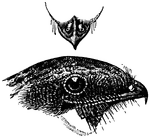
<i>Siphonorhis americana</i>. "A genus of American <i>Caprimulgidae</i> or goatsuckers, having tubular nostrils. The only species, <i>S. americana</i> inhabits Jamaica." &mdash;Whitney, 1889

Nightjar Profile and Tubular Nostrils

Siphonorhis americana. "A genus of American Caprimulgidae or goatsuckers, having tubular nostrils. The…
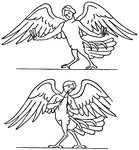
"In Greek mythology, one of two, or three, or an indeterminate number of sea-nymphs who by their singing fascinated those who sailed by their island, and destroyed them. In works of art they are represented as having the head, arms, and generally the bust of a young woman, the wings and lower part of the body, or sometimes only the feet, of a bird." &mdash;Whitney, 1889.
<p>This illustration is of two of the sirens depicted on a funeral marble in Chios. The top siren appears to be dancing. The one on the bottom is playing an instrument.

Sirens on a Greek Funeral Marble

"In Greek mythology, one of two, or three, or an indeterminate number of sea-nymphs who by their singing…
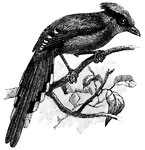
"The so-called green jackdaw of Asia, <i>Cissa sinensis</i>. The sirgang inhabits the southeastern Himalayan region, and thence through Burma to Tasserim, and has occasioned much literature." &mdash;Whitney, 1889
<p>The bird is perched on a branch with a few leaves.

Sirgang

"The so-called green jackdaw of Asia, Cissa sinensis. The sirgang inhabits the southeastern Himalayan…
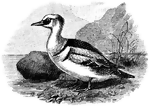
<i>Mergellus albellus</i>. "A small merganser or fishing duck...The male in adult plumage is a very beautiful bird, of a pure white, varied with black and gray, and tinged with green on the crested head; the length is about 17 inches. The female is smaller, with reddish-brown and gray plumage, and is called the red-headed smew." &mdash;Whitney, 1889

Smew - A Merganser or Fishing Duck

Mergellus albellus. "A small merganser or fishing duck...The male in adult plumage is a very beautiful…
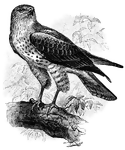
<i>Circaetus gallicus</i> is a "bird of prey inhabiting all the countries bordering the Mediterranean, and thence eastward to the whole of the Indian peninsula and part of the Malay archipelago. The male is 26 inches long; the female, 30 inches; the pointed wings are more than half as long again as the tail; the tarsi are mostly naked; the nostrils are oval perpendicularly; the head is crested with lanceolate feathers; and in the adult the breast is white, streaked with brown." &mdash;Whitney, 1889

Snake Buzzard, Also Called a Short-Toed Eagle

Circaetus gallicus is a "bird of prey inhabiting all the countries bordering the Mediterranean, and…