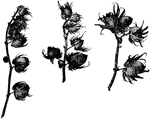
A short fruit limb of cotton bolls.

Short Fruit Limb of Cotton Bolls

A short fruit limb of cotton bolls.

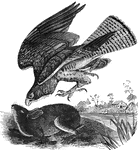
"<em>B. vulgaris</em> is twenty-two inches long, the head is large and the body heavy. Above, the color is chocolate-brown; grayish-white beneath. Its flight is low, and much of its time is spent in sitting on trees, in wooded districts, awaiting its prey, which consists of small quadrupeds, birds, reptiles, insects, and earthworms." &mdash Goodrich, 1859

Common Buzzard of Europe

"B. vulgaris is twenty-two inches long, the head is large and the body heavy. Above, the color…
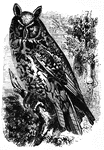
Genus <em>ascalaphia</em>, a large owl, native to southern Europe and northern parts of Egypt.

Great Short-Eared Owl

Genus ascalaphia, a large owl, native to southern Europe and northern parts of Egypt.
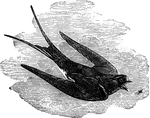
The common European swallow, which averages approximately six inches in length. This migratory bird divides its time between Europe, Asia, and Africa.

Common European Swallow

The common European swallow, which averages approximately six inches in length. This migratory bird…
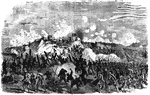
"First assault upon Fort Fisher, Sunday, January 15th, 1865. The One Hundred and Seventeenth New York troops, followed by the Third, planting the flag on the northern traverse of the fort. On the 13th of January the Federal fleet commenced the bombardment, which was continued with unabated vigor throughout the day. On the 15th it was resolved to take the place by storm. The boats containing the naval force intended to co-operate effected a landing on a shelving piece of beach about a mile and a half from the fort. At two o'clock, and when within eight hundred yards of the fort, the order to charge was given. The First Brigade of the Second Division of the Twenty-fourth Corps, headed by General Curtis, scaled the northeast salient of the fort, and forced a rapid entrance. Inch by inch they fought their way along the northeast face, the gallant First Brigade in the advance. It was a hand-to-hand struggle; bayonets were in general use; muskets were clubbed; and man stood up to man in deadly conflict. Night fell, and yet the fierce struggle raged unremittingly within the fort. About ten o'clock the final struggle took place, and, after a short but desperate hand-to-hand encounter, the Federals remained masters of the hitherto impregnable Fort Fisher."— Frank Leslie, 1896

Fort Fisher

"First assault upon Fort Fisher, Sunday, January 15th, 1865. The One Hundred and Seventeenth New York…
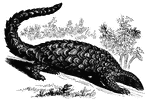
"Its head is small, pointed, and conic; muzzle elongated and narrow; body rather stout; tail short and very broad at its base; dorsal scales disposed in longitudinal rows to the number of eleven; under part of the body, head, and feet naked; some long fair-colored hairs spring from under the scales; the middle claw of the fore-feet exceeds the others in its proportions." &mdash; S. G. Goodrich, 1885

Indian Pangolin

"Its head is small, pointed, and conic; muzzle elongated and narrow; body rather stout; tail short and…
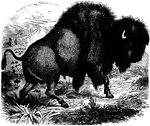
"The head is very large and carried low; the eyes are small, black, and piercing; the horns are short, small, sharp, set far apart, and directed outward and backward, so as to be erect, with a slight curve toward the outward pointing tips." &mdash; S. G. Goodrich, 1885

American Bison

"The head is very large and carried low; the eyes are small, black, and piercing; the horns are short,…
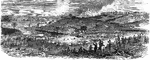
"The battle of the Wilderness, between General Grant and General Lee, May 5th and 6th, 1864. Our sketch of the first of the great battles of General Grant in Virginia will give a striking idea of the battleground, to be henceforth forever famous, like Manassas, Gettysburg, Pittsburg Landing or Fair Oaks. The eye can take in the five-mile line of battle, which for two days advanced and met hostile advances, gaining ground to be lost in a moment, but holding steadily to their lines till the furious Confederate charge on the Sixth Corps swept away Seymour's and Shaler's brigade of the Third Division and had well-nigh won the day. Sedgwick, soon to fall, saved the right; but the Federal loss in two days was not far from 15,000. Our correspondent gives this interesting account of General Grant during the battle: 'General Grant's headquarters were located in a field between the plank road and a small road leading to a little hamlet known as Parker's Store. During the fight, however, he was principally with General Meade, whose headquarters were on a piny knoll in the rear of Warren's corps. I had seen Grant at Vicksburg and in Tennessee, and his appearance was familiar; but as I strolled through the group of officers reclining under the trees at headquarters, I looked for him some time in vain, such was his insignificant, unpretending aspect and conduct while the battle was raging in all its fury. A stranger to the insignia of military rank would have little dreamed that the plain, quiet man who sat with his back against a tree, apparently heedless and unmoved, was the one upon whom the fortunes of the day, if not of the age and country, were hanging. It was only when some aid or orderly rode up in hot haste with a communication from some portion of the battlefield that his eyes upturnd to seek in those of the messenger the purport of the message. The consultation with General Meade, or the direct suggestion or command, all took place with the same imperturbability of countenance for which he has always been remarkable. No movement of the enemy seemed to puzzle or disconcert him. Fertile in resources, the petition for re-enforcement was speedily answered. And while all this transpired he stood calmly in the group, at times smoking his favorite cigar, a more vigorous or a more frequent puffing only indicating the inward working of his mind.'"— Frank Leslie, 1896

Battle of the Wilderness

"The battle of the Wilderness, between General Grant and General Lee, May 5th and 6th, 1864. Our sketch…
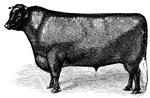
"The head is small and finely formed, the eye bright and clear, the horn light in substance and waxy in color; the chest dep, broad, and full, the brisket set prominently forward, the crops or spaces behind the shoulders full, hips wide, lions broad, the hair soft, the skin mellow and elastic; the colors full red, full white, or any combination of these." &mdash; S. G. Goodrich, 1885

Short Horn Cattle

"The head is small and finely formed, the eye bright and clear, the horn light in substance and waxy…
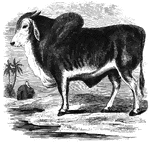
"It has a long head, short, blunt horns, drooping ears, and a hump on its sholders sometimes weighing fifty pounds. Its temper is gently, and in its qualities resembles the common ox." &mdash; S. G. Goodrich, 1885

Indian Ox

"It has a long head, short, blunt horns, drooping ears, and a hump on its sholders sometimes weighing…
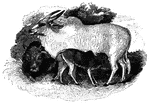
"It has a long head, short, blunt horns, drooping ears, and a hump on its sholders sometimes weighing fifty pounds. Its temper is gently, and in its qualities resembles the common ox." &mdash; S. G. Goodrich, 1885

Indian Ox

"It has a long head, short, blunt horns, drooping ears, and a hump on its sholders sometimes weighing…
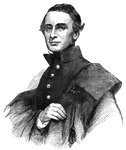
"Major Robert Anderson, the commander of Fort Sumter at the time of its fall, was born in Kentucky in the year 1805, and graduated at West Point in 1825. He was actively engaged through the Mexican War, and was severely wounded at Molino del Rey. In recognition of his services of his services at Fort Sumter he was appointed brigadier general by President Lincoln. He was relieved from duty in October, 1861, on account of failing health. He died in France in 1871."&mdash; Frank Leslie, 1896

Major Robert Anderson

"Major Robert Anderson, the commander of Fort Sumter at the time of its fall, was born in Kentucky in…
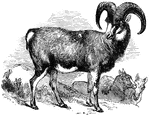
"The animals of this genus are distinguished by short tails, rogh hair; and enormous horns; they live on the mountains, and though their numbers are small, they are found widely in Europe, Asia, Africa, and America." &mdash; S. G. Goodrich, 1885

Mouflon

"The animals of this genus are distinguished by short tails, rogh hair; and enormous horns; they live…
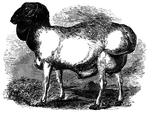
"Has drooping ears, a convex forehead, short hair, a brisket and dewlap like those of an ox, and two lobes consisting of hard, curdy fat beneath the throat, appearing like goitres." &mdash; S. G. Goodrich, 1885

Goitred Sheep

"Has drooping ears, a convex forehead, short hair, a brisket and dewlap like those of an ox, and two…
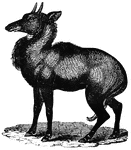
"Also known as the <em>Blue Antilope</em>. The face is long and narrow, the hair short, and the color a salty-blue." &mdash; S. G. Goodrich, 1885

Nil-Ghau

"Also known as the Blue Antilope. The face is long and narrow, the hair short, and the color…

"Morning mustering of the 'Contrabands' at Fortress Monroe, on their way to their day's work. As a living illustration of one of the aspects of the Civil War, a sketch is given above of the contrabands, [African Americans], going to their daily work at Fortress Monroe. The variety of the Ethiopian countenance is capitally given, and while some remind us of the merry phiz of George Christy in his sable mood, others wear the ponderous gravity of a New Jersey justice. The [African American] men had a comparatively pleasant time under their state of contraband existence."— Frank Leslie, 1896

Morning Mustering

"Morning mustering of the 'Contrabands' at Fortress Monroe, on their way to their day's work. As a living…
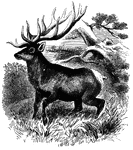
"is a large and noble species, resembling the red deer of europe; is has tall, round, branching horns, some times six feet high; the color is yellowish brown; hte tail short, the form stately, the air maestic. its length is seven to eight feet, its height four and a half to five. Its horns are shed in February or March." &mdash; S. G. Goodrich, 1885

American Elk

"is a large and noble species, resembling the red deer of europe; is has tall, round, branching horns,…
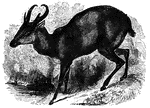
"Is of a grayish brown color, with short, pale, ringed hair." &mdash; S. G. Goodrich, 1885

Muntjac

"Is of a grayish brown color, with short, pale, ringed hair." — S. G. Goodrich, 1885

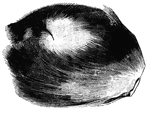
"A small kidney shaped, pendulous bag of the size of a hen's egg, situated below the abdomen and peculiar to the male. It is brown and unctuous, and may be pressed out through two apertures. It is the strongest and most pungent of perfumes; the mere skin of the animal is sufficient to fill the place where it has been kept with a strong odor for a long time.In medicine it is used as an antispammodic. " &mdash; S. G. Goodrich, 1885

Musk bag

"A small kidney shaped, pendulous bag of the size of a hen's egg, situated below the abdomen and peculiar…
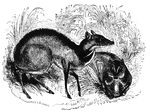
"Is two feet long and nine inches high; the eyes large and brilliant; the tail short; the general color brownish gray. It frequents the thickets near the sea-shore, and feeds principally upon berries." &mdash; S. G. Goodrich, 1885

Napu Musk Deer

"Is two feet long and nine inches high; the eyes large and brilliant; the tail short; the general color…
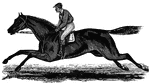
"The fastest race horse in the world. His best time, May 24, 1877, was 1.39 for one mile." — S. G. Goodrich, 1885

Ten Broeck

"The fastest race horse in the world. His best time, May 24, 1877, was 1.39 for one mile." — S. G.…
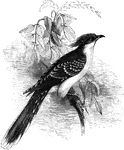
The great spotted cuckoo divides its time between North Africa and Southern Europe, laying its eggs in the nests of other birds for them to rear its offspring as their own.

Great spotted cuckoo

The great spotted cuckoo divides its time between North Africa and Southern Europe, laying its eggs…
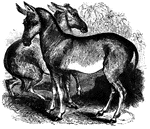
"In this the fur is short, smooth, and bright red bay; the legs are straw color; there is a broad, longitudinal dorsal streaks, broadest over the small of the back, without any cross band on the shoulders." &mdash; S. G. Goodrich, 1885

Hemiones

"In this the fur is short, smooth, and bright red bay; the legs are straw color; there is a broad, longitudinal…
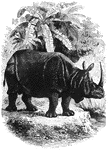
"The head and neck are rather short; the eye is small and lateral, and the snimal cannot see in front, more particularly when the horn is full grown, as it stands in the way of vision. The body is about nine feet long and give feet high; in its structure it is perculiarly massive, heavy, and hog-like, and often weighing six thousand pounds." &mdash; S. G. Goodrich, 1885

Indian Rhinoceros

"The head and neck are rather short; the eye is small and lateral, and the snimal cannot see in front,…
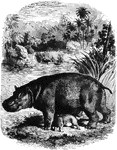
"Of this the muzzle is exceedingly thick and blunt, the head is very large, but the greater part of its bulk is made up of the facial bones, which are of enormous size when compared to the cranium. The legs are short and stount, and the feet have four toes, each terminated by a hoof. The eyes and ears are small." &mdash; S. G. Goodrich, 1885

Hippopotamus

"Of this the muzzle is exceedingly thick and blunt, the head is very large, but the greater part of…
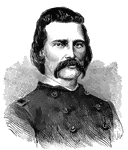
"General Logan, born in Jackson County, Ill., February 9th, 1826, died in Washington, D. C., December 26th, 1886. In July, 1861, he fought in the ranks of Colonel Richardson's regiment in the battle of Bull Run. In August he organized the Thirty-first Illinois Infantry, and was appointed its colonel, September 13th. He led his regiment in the attack on Fort Henry and at Fort Donelson, where he received a wound that incapacitated him for active service for some time. He was made brigadier general of volunteers, March 5th, 1862; during Grant's Northern Mississippi campaign General Logan commanded the Third Division of the Seventeenth Army Corps under General McPherson, and was promoted major general of volunteers."&mdash; Frank Leslie, 1896

General John A. Logan

"General Logan, born in Jackson County, Ill., February 9th, 1826, died in Washington, D. C., December…
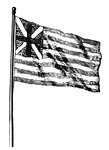
"Union Flag. The first recognized Continental Standard, raised for the first time January 2, 1776."—E. Benjamin Andrews, 1895

Union Flag

"Union Flag. The first recognized Continental Standard, raised for the first time January 2, 1776."—E.…
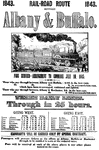
"Railroad route from an old time-table."&mdash;E. Benjamin Andrews, 1895

Rail-road Route

"Railroad route from an old time-table."—E. Benjamin Andrews, 1895

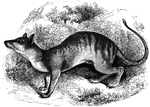
"It is the size of a small wolf, with short, smooth, hair of dusky yellowish-brown color, barred on the lower part of the back with sexteen black transverse stripes. It is the largest and most powerful carnivorous animal in Australia, is nocturnal in its habits, lives in retired caves, devours kangaroos and other small mammalia." — S. G. Goodrich, 1885

Tasmanian Wolf

"It is the size of a small wolf, with short, smooth, hair of dusky yellowish-brown color, barred on…
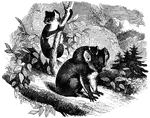
"Large as a moderate sized dog. It has long, thick and rather course fur, of an ashy-gray color; its moves with the gait of a young bear, lives in dens and holes dug with its feet, but spends much time in the trees." — S. G. Goodrich, 1885

Koala

"Large as a moderate sized dog. It has long, thick and rather course fur, of an ashy-gray color; its…
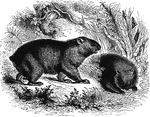
"A short-legged, thickset animal, the body two feet long, the tail half an inch long. It lives in burrows and feeds on vegetables. It is covered with coarse hair of a sandy brown color; its eyes are small and lively. Its pace is shuffling and hobbling, like that of a bear. it has little intelligence, but its disposition is mild." &mdash; S. G. Goodrich, 1885

Wombat

"A short-legged, thickset animal, the body two feet long, the tail half an inch long. It lives in burrows…
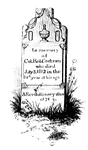
Grave of Colonel Robert Cochran, who commanded a detachment of militia at Fort Edward at the time of Burgoyne's surrender.

Cochran Grave

Grave of Colonel Robert Cochran, who commanded a detachment of militia at Fort Edward at the time of…
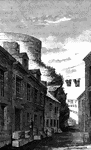
Place where Arnold was wounded. This view is in a narrow alley near the north end of <em>Sault au Matelot</em> Street, in the rear of St. Paul's Street. At the time in question St. Paul's Street did not exist, and the water, at high tide, came nearly up to the precipice. The first barrier and battery extended from the jutting rock seen in the picture, to the water. The present alley was then the beach. The circular wall on top of the rock is a part of the grand battery, one of the most formidable and commanding defenses in the world.

Arnold Wounded

Place where Arnold was wounded. This view is in a narrow alley near the north end of Sault au Matelot

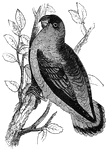
A love-bird (one of the genus <em>psittacula</em>), noted for its short, square tail.

Love-bird

A love-bird (one of the genus psittacula), noted for its short, square tail.

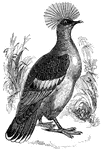
A goura crowned pigeon, which prefers to spend most of its time on the ground.

Goura Crowned Pigeon

A goura crowned pigeon, which prefers to spend most of its time on the ground.

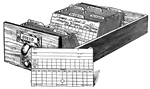
Index cards for the state of Ohio.

Index Card

Index cards for the state of Ohio.

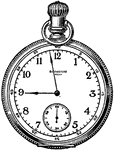
A typical pocket stop watch used for timing.

Stop Watch

A typical pocket stop watch used for timing.

A dense cluster of sessile or almost sessile flowers borne on a very short axis.

Head

A dense cluster of sessile or almost sessile flowers borne on a very short axis.

Covered with hairs, often short and downy.

Pubescent

Covered with hairs, often short and downy.

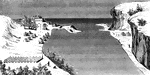
Oswego in 1755. This view is looking north toward the lake. It is a reduced copy of the frontispiece to <em>Smith's History of New York</em>, first ediction, London, 1757, and represents the encampment of Shirley there at that time.

Oswego

Oswego in 1755. This view is looking north toward the lake. It is a reduced copy of the frontispiece…
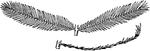
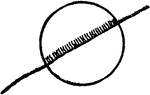
A shrub with leaves that are short needles, arranged in two ranks along twig, or sometimes appressed to twig; not in fascicles.

Needles

A shrub with leaves that are short needles, arranged in two ranks along twig, or sometimes appressed…

Distant view of Cherry Valley. Cherry Valley derived is name, according to Campbell, from the following circumstance: "Mr. Dunlop [the venerable pastor whose family suffered at the time of the massacre in 1778], engaged in writing some letters, inquired of Mr. Lindesay [the original proprietor of the soil] where he should date them, who proposed the name of a town in Scotland. Mr. Dunlop, pointing to the fine wild cherry-trees and to the valley, replied, 'Let us give our place an appropriate name, and call it Cherry Valley,' which was readily agreed to."

Cherry Valley

Distant view of Cherry Valley. Cherry Valley derived is name, according to Campbell, from the following…
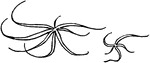
Plants floating just below water surfacel plant body made up of a clump of short filaments.

Wolffiella

Plants floating just below water surfacel plant body made up of a clump of short filaments.
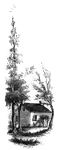
Mrs. Mathews' house. This sketch was made from the left bank of the Rahway, at the site of the old bridge. This is now the rear of the house, but, at the time of the battle, the road was upon this side of it, which formed the front. Remains of the abutments of the old bridge, where the British crossed, may still be seen.

Mrs. Mathews' house

Mrs. Mathews' house. This sketch was made from the left bank of the Rahway, at the site of the old bridge.…
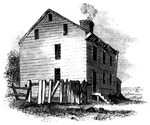
Old Tavern at Elizabethport. This view is looking eastward. In the distance, on the right, is seen a vessel, at the entrance of Newark Bay, and the land beyond is the high ground intervening between it and Jersey City. In one of the rooms of the old tavern is a Franklin stove, which has probably been a tenant there ever since it came from the foundery. I give a sketch of it, not only because it is a relic of the time, but because it doubtless shows the form of the stove as invented by Dr. Franklin in 1742, beore an "improvement" was made. On its front, in raised letters, are the words "Ross and Bird's Hibernia Foundry, 1782." Ross had a foundery at Elizabethtown in 1774, as appears by the inscription upon the dinner-bell of Sir William Johnson, now in the belfry of the old Caughnawaga Chuch at Fonda.

Tavern at Elizabethport

Old Tavern at Elizabethport. This view is looking eastward. In the distance, on the right, is seen a…
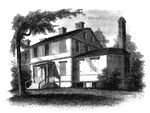
Liberty Hall. Some time after the death of Governor Livingston this property was purchased by Lord Blingbroke, who, under the assumed name of John Belesis, ran away from England with a daughter of Baron Hompasch, a German general. She was at a boarding school there, and Bolingbroke had a wife living. He married the girl here. She died in England in 1848. The grandmother of the present proprietor, Susan, the daughter of Peter Van Burgh Livingston, bought the farm of Lord Bolingbroke, and it has been in possession of the family ever since. Her first husband was John Kean, a member of Congress from South Carolina from 1785 to 1787, and was first cashier of the first United States Bank, chartered by an act of Congress passed February 8th, 1791. Her second husband was Count Niemcewicz, a Polish nobleman.

Liberty Hall

Liberty Hall. Some time after the death of Governor Livingston this property was purchased by Lord Blingbroke,…
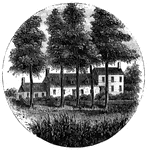
Steuben's head-quarters. This view is from the field in front of the house, looking north. The dwelling is at the end of a lane several rods from the main road leading to Middlebrook from New Brunswick. It is on the western side of the Raritan, and about a mile from the bridge near Middlebrook. Only the center building was in existence at the time in question, and that seems to have been enlarged. Each wing has since been added. The interior of the old part is kept in the same condition as it was when Steuben occupied it, being, like most of the better dwellings of that time, neatly wainscoted with pine, wrought into moldings and panels.

Steuben's Head-Quarters

Steuben's head-quarters. This view is from the field in front of the house, looking north. The dwelling…
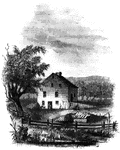
Site of Wintermoot's Fort. This view is from the ancient bed of the Susquehanna, looking west. The building, formerly the property of Colonel Jenkins, and now owned by Mr. David Goodwin, is upon the site of old Fort Wintermoot, which was destroyed at the time of the invasion in 1778. It is upon the ancient bank of the river, here from fifteen to twenty feeth high, and about sixty rods from the stream in its present channel.

Wintermoot's Fort

Site of Wintermoot's Fort. This view is from the ancient bed of the Susquehanna, looking west. The building,…
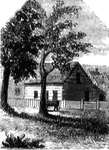
The Red House. The "Red House" is situated upon the street in Wilkesbarre next the river, and about seventy-five rods below the bridge. It is the place where John Franklin was arrested. On his return from a political tour down the valley, he came up by the way of Hanover to Wilkesbarre. While standing near the ferry, an acquaintance came up to him and said, "A friend at the Red House wishes to speak to you." Franklin walked to the house, where a person caught him from behind, and attempted to pinion his hands. He was a powerful man, and shook off his captors; but, a noose being thrown over his head, he was secured. They then attempted to get him on horseback, when he cried out, "Help, help! William Slocum! where is William Slocum?" and, drawing his pistols, discharged one, but without effect. He was felled by a blow, and laid almost senseless. It was seeding time, and nearly all the men were in the fields. But the Yankee blood of Mrs. Slocum (the mother of the "lost sister") was up, and, seizing a gun, she ran to the door, exclaiming, "William! Who will call William? Is there no man here? Will nobody rescue him?" Colonel Pickering's dwelling was near the "Red House." It is still standing, but so modernized that its original character is lost.

Red House

The Red House. The "Red House" is situated upon the street in Wilkesbarre next the river, and about…
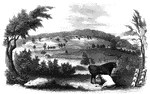
The Bennington battle-ground. This view is from the hill on the southwest bank of the Walloomscoick, a little west of the road from the bridge to Starkville, looking northeast. The road over this hill existed at the time of the battle. The river, which here makes a sudden bend, is seen at two points- near the cattle, and at the bridge, in the distance, on the right. The house on the left, near the bridge, is Mr. Barnet's, and the road that crosses the center of the picture from right to left is the road from Bennington to Van Schaick's or North Hoosick. It passes along the river flat, at the foot of the hills where the battle occurred. The highest point on the distant hills, covered with woods, is the place where the Hessians were intrenched. From that point, along the hills to the left, for about two miles, the conflict was carried on; and upon the slopes, now cultivated, musket-balls and other relics of the battle have been plowed up.

Bennington Battle-ground

The Bennington battle-ground. This view is from the hill on the southwest bank of the Walloomscoick,…
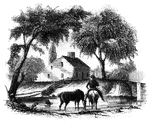
Head-quarters of Agnew and Erskine. This house is on the south bank of Still River, at the north end of the main street. It was built by Benjamind Knapp, in 1770, and was owned by him at the time of the invasion. His birth-place is also standing, on the north side of the river. They were among the few houses not burned. At the bridge seen on the right the British planted a cannon, and kept a strong guard there until their departure. This house is now (1848) owned by Noah Knapp.

Agnew and Erskine

Head-quarters of Agnew and Erskine. This house is on the south bank of Still River, at the north end…

Campbell's Monument. This rude memorial was erected in 1831, by J. W. Barber, Esq., of New Haven, the historian of that city, and author of the <em>Historical Collections of Connecticut</em>, as a tribute of respect for a meritorious officer. It is about a foot and a half high. The site of Campbell's grave was pointed out to Mr. Barber by the late Chauncy Alling, who saw him buried. Several Americans, who were killed at the same time, were buried near. Their remains were afterward removed. Those of Adjutant Campbell rest undisturbed.

Campbell's Monument

Campbell's Monument. This rude memorial was erected in 1831, by J. W. Barber, Esq., of New Haven, the…
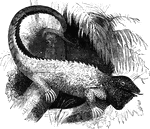
A large lizard, the common iguana is common to the tropical regions of the Americas. It spends much of its time in trees.

Common iguana

A large lizard, the common iguana is common to the tropical regions of the Americas. It spends much…
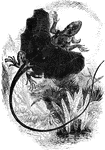
The flying dragon gets its name from its ability to glide for short distance using a thin membrane.
Flying dragon

The flying dragon gets its name from its ability to glide for short distance using a thin membrane.

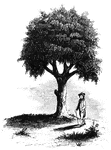
"Liberty Tree. I am indebted to the Hon. David Sears, of Boston, for this sketch of the 'Liberty Tree,' as it appeared just previous to its destruction by the British troops and Tories, during the siege of Boston in August, 1775. Mr. Sears has erected a row of fine buildings upon the site of the old grove of elms, of which this tree was one; and within a niche, on the front of one of them, and exactly over the spot where the <em>Liberty Tree</em> stood, he has placed a sculptured representation of it, as seen in the picture. From the time of the Stamp Act excitement until the armed possession of Boston by General Gage and his troops in 1774, that tree had been the rallying-place for the patriots, and had fallen, in consequence, much in disfavor with the friends of government. It was inscribed 'Liberty Tree,' and the ground under it was called 'Liberty Hall.' The Essex Gazette of August 31st, 1775, in describing the destruction of the tree, says, 'They made a furious attack upon it. After a long spell of laughing and grinning, sweating, swearing, and foaming with malice diabolical, they cut down the tree because it bore the name of liberty. A soldier was killed by falling from one of its branches during the operation.'"&mdash;Lossing, 1851

Liberty Tree

"Liberty Tree. I am indebted to the Hon. David Sears, of Boston, for this sketch of the 'Liberty Tree,'…
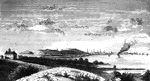
"View of Boston from Dorchester Heights in 1774. This picture is from an English print of the time. Then the principal portion of the town was upon the eastern slope and flats. There were a few houses upon the higher ground in the vicinity of Beacon Hill, around the Common, among which was that of John Hancock. In this picture, Beacon Hill is designated by the pole, which, with its barrel, is noticed in a preceding chapter. The peninsula originally contained about seven hundred acres. The hills have been razed and the earth carried into the water, by which means the peninsula is so enlarged that it now comprises about fourteen hundred acres."&mdash;Lossing, 1851

Boston

"View of Boston from Dorchester Heights in 1774. This picture is from an English print of the time.…
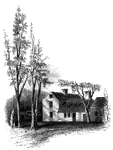
"Clark's House, Lexington. This building was standing when I visited Lexington in 1848. It was built by Thomas Hancock, Esq., of Boston, as a parsonage for his father, the Reverend John Hancock, of Lexington, about 130 years ago. Mr. Hancock was a minister at Lexington fifty-two years, and was succeeded by the Reverend Jonas Clark, the occupant of the house at the time of the skirmish at Lexington. Mr. Clark lived in the house fifty-two years. The room in which the two patriots, Samuel Adams and John Hancock, were sleeping on the night before the skirmish at Lexington, is retained in its original condition. The wainscoting is of Carolina pine, and the sides of the room are covered with a heavy paper, with dark figures, pasted upon the boards in rectangular pieces about fourteen inches square. In an adjoining room is one of those ancient fire-places, ornamented with pictorial tiles, so rarely found in New England."&mdash;Lossing, 1851

Clark's House

"Clark's House, Lexington. This building was standing when I visited Lexington in 1848. It was built…
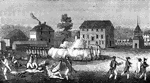
"Skirmish at Lexington. The largest building in the picture is the meeting-house, and the officer on horseback in front of it is Major Pitcairn. The figures in the foreground are the provincial militia. The dwelling with the two chimneys on the left (which is still standing), was Buckman's Tavern. The position of the monument since erected upon Lexington Green, is about where the provincials on the left are seen dispersing. The merit of this picture consists in its truthfulness in depicting the appearance of the spot at the time of the engagement."&mdash;Lossing, 1851

Skirmish at Lexington

"Skirmish at Lexington. The largest building in the picture is the meeting-house, and the officer on…
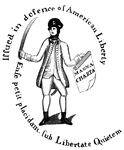
"Reverse of a Massachusetts Treasury note. This is a fac simile of the device on the back of one of the first of the Massachusetts treasury notes or bills of credit. The literal translation of the Latin inscription is 'He seeks by the sword calm repose under the auspices of Freedom.' In othe words, to use a phrase of the present time, they were determined 'to conquer a peace.' The face of the bill has a neatly-engraved border of scroll-work; and on the left of the brace where the names of the committee are signed, is a circle with a ship within it."—Lossing, 1851

Treasury Note

"Reverse of a Massachusetts Treasury note. This is a fac simile of the device on the back of one of…
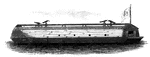
"American Floating Battery. I am indebted to the kindness of Peter Force, Esq., of Washington city (editor of 'The American Archives'), for this drawing of one of the American floating batteries used in the siege of Boston. It is copied from an English mauscript in his possession, and is now published for the first time. I have never met with a description of those batteries, and can judge of their construction only from the drawing. They appear to have been made of strong planks, pierced, near the water-line, for cars; along the sides, higher up, for the light and musketry. A heavy gun was placed in each end, and upon the top were four swivels."&mdash;Lossing, 1851

Floating Battery

"American Floating Battery. I am indebted to the kindness of Peter Force, Esq., of Washington city (editor…