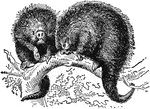
"The Porcupine is a rodent quadruped. The North American porcupine is about two feet long, and of sluggish habits. The quills are short, and concealed among the fur, and the tail is short. The 'tree porcupine' of South America has a prehensile tail, about 10 inches long. The porcupine of Southern Europe and Africa is about 28 inches long, exclusive of the tail. The head, fore quarters, and under surface are clothed with short spines, intermixed with hairs, crest on head and neck, hind quarters covered with long sharp spines, ringed with black and white, and erectile at will. They are but loosely attached to the skin and readily fall out, a circumstance which probably gave rise to the belief that the animal was able to project them at an enemy."—(Charles Leonard-Stuart, 1911)

Prehensile Tailed Porcupine

"The Porcupine is a rodent quadruped. The North American porcupine is about two feet long, and of sluggish…
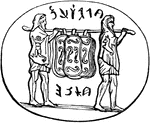
"Ancilia carried by Salii. The sacred shield carried by the Salii, and made of bronze. The original ancile was found, according to tradition, in the palace of Numa; and, as no numan hand has brought it there, it was concluded that it had been sent from heaven. At the same time, the haruspices declared that the Roman state would endure so long as this shield remained in Rome. To secure its preservation in the city, Numa ordered eleven other shields, exactly like it, to be made by the armourer, Mamurius Veturius, and twelve ancilia. They were kept in the temple of that divinity, on the Palatine mount, and were taken from it only once a year, on the calends of March. The feast of the god was then observed during several daysl when the Salaii carried their shields about the city, singing songs in praise of Mars, Numa, and Mamurius Veturius, and at the same time performing a dance, which probably in some degree resembled our morris with rods, so as to keep time with their voices, and with the movements of their dance. The preceding cut shows one of these rods, as represented on the tomb of pontifex salius, or chief of the Salii" — Smith, 1873

Ancile

"Ancilia carried by Salii. The sacred shield carried by the Salii, and made of bronze. The original…
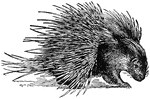
"The Porcupine is a rodent quadruped. The North American porcupine is about two feet long, and of sluggish habits. The quills are short, and concealed among the fur, and the tail is short. The 'tree porcupine' of South America has a prehensile tail, about 10 inches long. The porcupine of Southern Europe and Africa is about 28 inches long, exclusive of the tail. The head, fore quarters, and under surface are clothed with short spines, intermixed with hairs, crest on head and neck, hind quarters covered with long sharp spines, ringed with black and white, and erectile at will. They are but loosely attached to the skin and readily fall out, a circumstance which probably gave rise to the belief that the animal was able to project them at an enemy."—(Charles Leonard-Stuart, 1911)

Hystrix Crystata Porcupine

"The Porcupine is a rodent quadruped. The North American porcupine is about two feet long, and of sluggish…
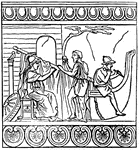
"Antefixa representing Minerva superintending the construction of the Ship Argo. Antefixa are terra-cottas, which exhibited various ornamental designs, and were used in architecture to cover the frieze of the entablature. These terra-cottas do not appear to have been used among the Greeks, but were probabl Etruscan in their origin, and were thence taken for the decoration of Roman buildings. The name antefixa is evidently derived from the circumstance that they were fixed before the buildings which they adorned. Cato, the censor, complained that the Romans of his time began to despise ornaments of this description, and to prefer the marble friezes of Athens and Corinth. The rising taste which Cato deplored may account for the superior beauty of the antefixa preserved in the British Museum, which were discovered at Rome." — Smith, 1873

Antefixa

"Antefixa representing Minerva superintending the construction of the Ship Argo. Antefixa are terra-cottas,…
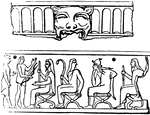
"The two imperfect antefixa, are amoung those found at Velletri, and described by Carloni. Antefixa are terra-cottas, which exhibited various ornamental designs, and were used in architecture to cover the frieze of the entablature. These terra-cottas do not appear to have been used among the Greeks, but were probabl Etruscan in their origin, and were thence taken for the decoration of Roman buildings. The name antefixa is evidently derived from the circumstance that they were fixed before the buildings which they adorned. Cato, the censor, complained that the Romans of his time began to despise ornaments of this description, and to prefer the marble friezes of Athens and Corinth. The rising taste which Cato deplored may account for the superior beauty of the antefixa preserved in the British Museum, which were discovered at Rome." — Smith, 1873

Antefixa

"The two imperfect antefixa, are amoung those found at Velletri, and described by Carloni. Antefixa…
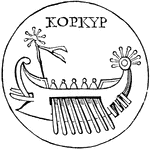
"Called also navis aperta, a ship which had no deck but was merely covered with planks in the front and hinder part, as is represented in the following cut. The ships which had decks were called cataphracti. At the time of the Trojan war the Greek ships had no decks, but were only covered over in the prow and stern." — Smith, 1873

Aphractus

"Called also navis aperta, a ship which had no deck but was merely covered with planks in the front…
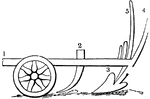
"A plough. Among the Greek and Romans the three most essential parts of the plough were-the plough tail, the share-beam, that is, the piece of wood to which the share is fixed, and the pole. In the time and country of Virgil it was the custom to force a tree into the crooked form of the buris, or plough-tail. The upper end of the buris being held by the ploughman, the lower part, below its junction with the pole, was used to hold the dentale or share-beam, which was either sheathed with metal, or driven bare into the ground, according to circumstances. The term vomer was sometimes applied to the end of the dentale. The image distinctly shows the pole (1), the coulter (2), the dentale (3), the buris (4), and the handle (5)." — Smith, 1873

Aratrum

"A plough. Among the Greek and Romans the three most essential parts of the plough were-the plough tail,…
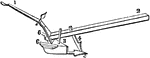
"A plough. Among the Greek and Romans the three most essential parts of the plough were-the plough tail, the share-beam, that is, the piece of wood to which the share is fixed, and the pole. In the time and country of Virgil it was the custom to force a tree into the crooked form of the buris, or plough-tail. The upper end of the buris being held by the ploughman, the lower part, below its junction with the pole, was used to hold the dentale or share-beam, which was either sheathed with metal, or driven bare into the ground, according to circumstances. The term vomer was sometimes applied to the end of the dentale. The image distinctly shows the buris (1), the temo (2), the dentale (3), the culter (4), the vomer (5), and the aures (6)." — Smith, 1873

Aratrum

"A plough. Among the Greek and Romans the three most essential parts of the plough were-the plough tail,…
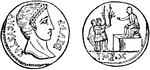
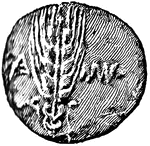
"Gold appears not to have been coined at Athens till the time of the Macedonian empire, with the exception a solitary issue of a debased coinage in 407. But from a very early period the Asian nations, and he Greek cities of Asia Minor and the adjacent islands, possessed a gold coinage, which was more or less current in Greece. Herodotus says that the Lydians were the first who coined gold; and the stater of Croesus appears to have been the earliest gold coin known to the Greeks. The dario was a Persian coin. Staters of Cyzicus and Phocaea had a considerable currency in Greece. There was a gold coinage in Samos as early as the time of Polycrates." — Smith, 1873

Aurum

"Gold appears not to have been coined at Athens till the time of the Macedonian empire, with the exception…
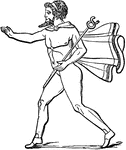
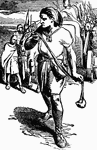
"The staff or mace carried by heralds and ambassadors in time of war. This name is also given to the staff with which Hermes or Mercury is usually represented, as is shown in he following figure of that god. From caduceus was formed the word cadu ceator, which signified a person sent to treaty of peace. The persons of the caduceatores were considered sacred." — Smith, 1873

Caduceus

"The staff or mace carried by heralds and ambassadors in time of war. This name is also given to the…
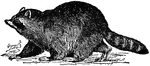
"The Raccoon, or Racoon, is a handsome animal, about the size of a large cat, brown furry hair, tail bushy and ringed; body large and unwieldy, legs short, feet with strong fossorial claws. It is omnivorous and ranges over a large part of North America, where it is hunted for its fur. The crab-eating raccoon of South America, ranging as far N. as Panama, differs chiefly from the former in the shortness of its fur, and consequent slender shape."—(Charles Leonard-Stuart, 1911)

Procyon Lotor Raccoon

"The Raccoon, or Racoon, is a handsome animal, about the size of a large cat, brown furry hair, tail…
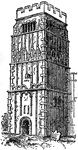
"Saxon Architecture was the style of architecture in use in England from the time of its conversion till the Conquest. It is easily recognized by its massive columns and semicircular arches, which usually spring from capitals without the intervention of the entablature."—(Charles Leonard-Stuart, 1911)

Tower in Northamptonshire, England

"Saxon Architecture was the style of architecture in use in England from the time of its conversion…
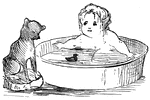
Baby swimming with the dog

Baby and Dog

Baby swimming with the dog

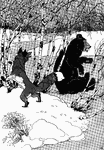
Scene from "Why the Bear's Tail is Short."

Fox and Mother Bear

Scene from "Why the Bear's Tail is Short."

"A Sling is a short leather strap having a string secured to each end, by which a stone is hurled."—(Charles Leonard-Stuart, 1911)

Sling and Slinger

"A Sling is a short leather strap having a string secured to each end, by which a stone is hurled."—(Charles…
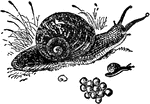
"Snail is the common name of gasteropodous mollusks. They feed chiefly on vegetable substances, though they are very indiscriminate in their appetite and even devour the dead of their own kind. The mischief which they do to garden crops is well known. Snails delight in warm, moist weather; in dry weather, their chief time of activity is during the night, and they hide themselves by day; but after rain they come forth at any hour in quest of food. At the approach of winter or in very dry weather they close the mouth of the shell with a membrane (epiphragm), formed by the drying of the mucous substance which they secrete, and become inactive and torpid."—(Charles Leonard-Stuart, 1911)

Snail

"Snail is the common name of gasteropodous mollusks. They feed chiefly on vegetable substances, though…
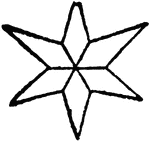
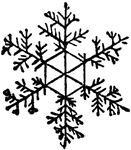
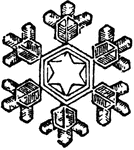
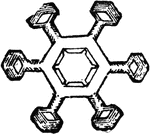
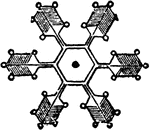
"Snow is water solidified in stellate crystals, variously modified, and floating in the atmosphere. These crystals arise from the congelation of the minute vesicles which constitute the clouds, when the temperature of the latter is below zero. They are more regular when formed in a calm atmosphere. Their form may be investigated by collecting them on a black surface, and viewing them through a strong lens. The regularity, and at the same time variety, of their forms, are truly beautiful."—(Charles Leonard-Stuart, 1911)

Snow Crystals

"Snow is water solidified in stellate crystals, variously modified, and floating in the atmosphere.…
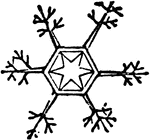
"Snow is water solidified in stellate crystals, variously modified, and floating in the atmosphere. These crystals arise from the congelation of the minute vesicles which constitute the clouds, when the temperature of the latter is below zero. They are more regular when formed in a calm atmosphere. Their form may be investigated by collecting them on a black surface, and viewing them through a strong lens. The regularity, and at the same time variety, of their forms, are truly beautiful."—(Charles Leonard-Stuart, 1911)

Snow Crystals

"Snow is water solidified in stellate crystals, variously modified, and floating in the atmosphere.…
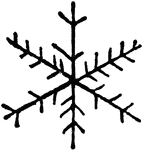
"Snow is water solidified in stellate crystals, variously modified, and floating in the atmosphere. These crystals arise from the congelation of the minute vesicles which constitute the clouds, when the temperature of the latter is below zero. They are more regular when formed in a calm atmosphere. Their form may be investigated by collecting them on a black surface, and viewing them through a strong lens. The regularity, and at the same time variety, of their forms, are truly beautiful."—(Charles Leonard-Stuart, 1911)

Snow Crystals

"Snow is water solidified in stellate crystals, variously modified, and floating in the atmosphere.…
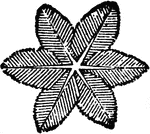
"Snow is water solidified in stellate crystals, variously modified, and floating in the atmosphere. These crystals arise from the congelation of the minute vesicles which constitute the clouds, when the temperature of the latter is below zero. They are more regular when formed in a calm atmosphere. Their form may be investigated by collecting them on a black surface, and viewing them through a strong lens. The regularity, and at the same time variety, of their forms, are truly beautiful."—(Charles Leonard-Stuart, 1911)

Snow Crystals

"Snow is water solidified in stellate crystals, variously modified, and floating in the atmosphere.…
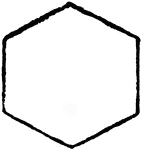
"Snow is water solidified in stellate crystals, variously modified, and floating in the atmosphere. These crystals arise from the congelation of the minute vesicles which constitute the clouds, when the temperature of the latter is below zero. They are more regular when formed in a calm atmosphere. Their form may be investigated by collecting them on a black surface, and viewing them through a strong lens. The regularity, and at the same time variety, of their forms, are truly beautiful."—(Charles Leonard-Stuart, 1911)

Snow Crystals

"Snow is water solidified in stellate crystals, variously modified, and floating in the atmosphere.…
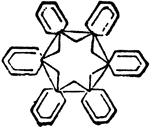
"Snow is water solidified in stellate crystals, variously modified, and floating in the atmosphere. These crystals arise from the congelation of the minute vesicles which constitute the clouds, when the temperature of the latter is below zero. They are more regular when formed in a calm atmosphere. Their form may be investigated by collecting them on a black surface, and viewing them through a strong lens. The regularity, and at the same time variety, of their forms, are truly beautiful."—(Charles Leonard-Stuart, 1911)

Snow Crystals

"Snow is water solidified in stellate crystals, variously modified, and floating in the atmosphere.…
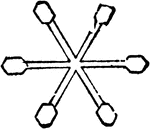
"Snow is water solidified in stellate crystals, variously modified, and floating in the atmosphere. These crystals arise from the congelation of the minute vesicles which constitute the clouds, when the temperature of the latter is below zero. They are more regular when formed in a calm atmosphere. Their form may be investigated by collecting them on a black surface, and viewing them through a strong lens. The regularity, and at the same time variety, of their forms, are truly beautiful."—(Charles Leonard-Stuart, 1911)

Snow Crystals

"Snow is water solidified in stellate crystals, variously modified, and floating in the atmosphere.…
"Snow is water solidified in stellate crystals, variously modified, and floating in the atmosphere. These crystals arise from the congelation of the minute vesicles which constitute the clouds, when the temperature of the latter is below zero. They are more regular when formed in a calm atmosphere. Their form may be investigated by collecting them on a black surface, and viewing them through a strong lens. The regularity, and at the same time variety, of their forms, are truly beautiful."—(Charles Leonard-Stuart, 1911)

Snow Crystals

"Snow is water solidified in stellate crystals, variously modified, and floating in the atmosphere.…
"Snow is water solidified in stellate crystals, variously modified, and floating in the atmosphere. These crystals arise from the congelation of the minute vesicles which constitute the clouds, when the temperature of the latter is below zero. They are more regular when formed in a calm atmosphere. Their form may be investigated by collecting them on a black surface, and viewing them through a strong lens. The regularity, and at the same time variety, of their forms, are truly beautiful."—(Charles Leonard-Stuart, 1911)

Snow Crystals

"Snow is water solidified in stellate crystals, variously modified, and floating in the atmosphere.…
"Snow is water solidified in stellate crystals, variously modified, and floating in the atmosphere. These crystals arise from the congelation of the minute vesicles which constitute the clouds, when the temperature of the latter is below zero. They are more regular when formed in a calm atmosphere. Their form may be investigated by collecting them on a black surface, and viewing them through a strong lens. The regularity, and at the same time variety, of their forms, are truly beautiful."—(Charles Leonard-Stuart, 1911)

Snow Crystals

"Snow is water solidified in stellate crystals, variously modified, and floating in the atmosphere.…
"Snow is water solidified in stellate crystals, variously modified, and floating in the atmosphere. These crystals arise from the congelation of the minute vesicles which constitute the clouds, when the temperature of the latter is below zero. They are more regular when formed in a calm atmosphere. Their form may be investigated by collecting them on a black surface, and viewing them through a strong lens. The regularity, and at the same time variety, of their forms, are truly beautiful."—(Charles Leonard-Stuart, 1911)

Snow Crystals

"Snow is water solidified in stellate crystals, variously modified, and floating in the atmosphere.…
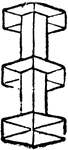
"Snow is water solidified in stellate crystals, variously modified, and floating in the atmosphere. These crystals arise from the congelation of the minute vesicles which constitute the clouds, when the temperature of the latter is below zero. They are more regular when formed in a calm atmosphere. Their form may be investigated by collecting them on a black surface, and viewing them through a strong lens. The regularity, and at the same time variety, of their forms, are truly beautiful."—(Charles Leonard-Stuart, 1911)

Snow Crystals

"Snow is water solidified in stellate crystals, variously modified, and floating in the atmosphere.…
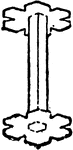
"Snow is water solidified in stellate crystals, variously modified, and floating in the atmosphere. These crystals arise from the congelation of the minute vesicles which constitute the clouds, when the temperature of the latter is below zero. They are more regular when formed in a calm atmosphere. Their form may be investigated by collecting them on a black surface, and viewing them through a strong lens. The regularity, and at the same time variety, of their forms, are truly beautiful."—(Charles Leonard-Stuart, 1911)

Snow Crystals

"Snow is water solidified in stellate crystals, variously modified, and floating in the atmosphere.…
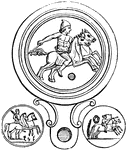
"A rider in the Roman games, who generally rode two horses at the same time, sitting on them without a saddle, and vaulting upon either of them at is pleasure. The annexed woodcut shows three figures of desultores." — Smith, 1873.

Desultor

"A rider in the Roman games, who generally rode two horses at the same time, sitting on them without…
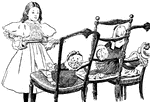
A girl playing tea time with her dolls

Tea Time

A girl playing tea time with her dolls

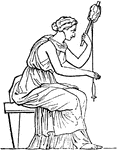
"The spindle, was always, when in use, accompanied by the distaff, as an indispensable part of the same apparatus. The wool, flax, or other material, haing been prepared for spinning, was rolled into a ball, which was however, sufficiently loose to allow the fibres to be easily drawn out by the hand of the spinner. The upper part of the distaff was then inserted into this mass of flax or wool, and the lower part was held under the left arm in such a position as was most convenient for conducting the operation. The fibres were drawn out, and at the same time spirally twisted, chiefly by the use of the fore-finger and thumb of the right hand; and the thread so produced was wound upon the spindle until the quantity was as great as it would carry." — Smith, 1873.

Fusus

"The spindle, was always, when in use, accompanied by the distaff, as an indispensable part of the same…
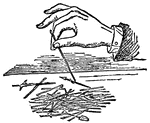
"This is a game of pure manual dexterity, and is rare practice for cultivating steadiness of hand and delicacy of touch. Its worst fault is that in the very nature of the game a constant series of deadlocks are inevitable, only to be overcome by the self-sacrifice of one or other of the players. Jackstraws are a number of thing narrow slips of wood, bone or ivory, each more or less notched, sometimes cut into fantastic shapes, and numbered. These being held together in a bundle, are allowed to fall on the table, and the players, two or more in number, each in turn pull them out one by one with a small hook. As long as a player can go on abstracting from the heap, without in any way shaking or disturbing more than one jackstraw at the time, his turn continues, and all he thus secures he keeps; at the least shake his turn ceases, and the next player goes on. When all the jackstraws have been thus abstracted, each player counts his heap, each jackstraw being valued at the number inscribed on it, and he who has most wins."— Thomas Sheppard Meek

Jackstraws

"This is a game of pure manual dexterity, and is rare practice for cultivating steadiness of hand and…
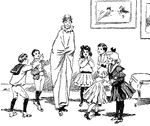
"This may be done in two ways: first and most difficult, by one boy standing on another's shoulders, and then putting over both a long loose garment, long enough to reach to the knees of the lower one. This method, however, may be made much more easy by the upper player putting his feet in a kind of stirrup fastened to straps passing over the under one's shoulder's, and hanging just down to the hips. Height, of course, is sacrificed, but greater safety is secured; the giant, too, can exhibit thus for a longer time, as the attitude is not so fatiguing. The other and simpler method is to place a huge mask, which should represent a head and neck, on the top of a pole about five feet long, with a cross-piece to represent arms, and then tying a long cloak- it should be made for the purpose: any common material will do- round the neck of the mask and get bodily inside. Now, by raising or depressing the pole, the giant may be made to attain an extra ordinary stature or to shrink down again to ordinary dimensions as well. The lower end of the cloak, about two feet from the bottom, must be fastened to the performer's waist, so that when the head is depressed the cloak may fall in folds, and not sweep the ground as it otherwise would. There is a very entertaining illusion of this sort exhibited under the name of 'The Nondescripts.' Two figures with enormous heads, alternately giants and dwarfs, run about the circus and indulge in the most surprising vagaries, being able apparently to contort themselves in every imaginable direction. Their final coup is to put their heads deliberately through their legs, and make their exit with their eyes thus looking over their own shoulders."— Thomas Sheppard Meek

The Giant

"This may be done in two ways: first and most difficult, by one boy standing on another's shoulders,…
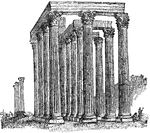
"Athens is said to have derrived its name from the prominence given to its worship of Athena by its king erechtheus. The inhabitants were previously called Crannai and Cecropidae, from Cecrops, who, according to tradition, was the original founder of the city. This at first occupied the hill or rock which afterwards became the <em>Acropolis</em>, but gradually the buildings began to spread over the ground at the southern foot of this hill. It was not till the time of Pisitratus and his sons (B.C. 560-514) that the city began to assume any degree of splendour. The most remarkable of these building deposits was the gigantic temple of the Olympian Zeus, which, however, was not finished till many centuries later."&mdash; Smith, 1882

Temple of the Olympian Zeus

"Athens is said to have derrived its name from the prominence given to its worship of Athena by its…
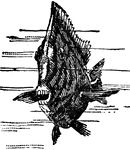
"Surgeon-fish is a popular name for any species of the genus Acanthurus, from the sharp, erectile, lancet-shaped spine with which each side of the tail is armed. In the early stages of their growth these fish are so different from the fully-developed individuals, that for some time the young fish were placed in a separate genus."&mdash;(Charles Leonard-Stuart, 1911)

Surgeon Fish

"Surgeon-fish is a popular name for any species of the genus Acanthurus, from the sharp, erectile, lancet-shaped…
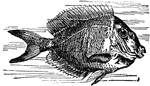
"Surgeon-fish is a popular name for any species of the genus Acanthurus, from the sharp, erectile, lancet-shaped spine with which each side of the tail is armed. In the early stages of their growth these fish are so different from the fully-developed individuals, that for some time the young fish were placed in a separate genus."&mdash;(Charles Leonard-Stuart, 1911)

Surgeon Fish

"Surgeon-fish is a popular name for any species of the genus Acanthurus, from the sharp, erectile, lancet-shaped…
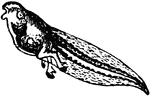
"The Tadpole is the larva of the anurous amphibia, sometimes so far extended as to include larva&aelig; of the urodela, which undergo a much less complete metamorphosis. At first the young have no respiratory organs or limbs. They are all head and tail with simple entire gills which soon disappear, to be followed by others of more complicated structure, situated within the cavity of the body as in fishes. After a certain length of time the hind legs begin to appear, the head becomes more developed, and the body assumes a more compact form. Still later the forelegs are found to exist fully formed beneath the skin and ready ultimately to burst forth. The tadpole at first seems to derive its subsistence from the fluid absorbed within its body and on the surface, but soon begins to seek its food amidst softened or decomposing vegetable matter. From that period the tadpole begins to assume more and more the appearance of a frog. Toes appear on its hind legs, the tail very rapidly disappears by absorption, and finally the fore-legs become fully developed and the metamorphosis of the tadpole is completed."&mdash;(Charles Leonard-Stuart, 1911)

Tadpole

"The Tadpole is the larva of the anurous amphibia, sometimes so far extended as to include larvaæ…
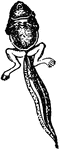
"The Tadpole is the larva of the anurous amphibia, sometimes so far extended as to include larva&aelig; of the urodela, which undergo a much less complete metamorphosis. At first the young have no respiratory organs or limbs. They are all head and tail with simple entire gills which soon disappear, to be followed by others of more complicated structure, situated within the cavity of the body as in fishes. After a certain length of time the hind legs begin to appear, the head becomes more developed, and the body assumes a more compact form. Still later the forelegs are found to exist fully formed beneath the skin and ready ultimately to burst forth. The tadpole at first seems to derive its subsistence from the fluid absorbed within its body and on the surface, but soon begins to seek its food amidst softened or decomposing vegetable matter. From that period the tadpole begins to assume more and more the appearance of a frog. Toes appear on its hind legs, the tail very rapidly disappears by absorption, and finally the fore-legs become fully developed and the metamorphosis of the tadpole is completed."&mdash;(Charles Leonard-Stuart, 1911)

Tadpole

"The Tadpole is the larva of the anurous amphibia, sometimes so far extended as to include larvaæ…
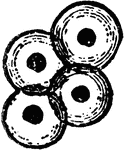
"The Tadpole is the larva of the anurous amphibia, sometimes so far extended as to include larva&aelig; of the urodela, which undergo a much less complete metamorphosis. At first the young have no respiratory organs or limbs. They are all head and tail with simple entire gills which soon disappear, to be followed by others of more complicated structure, situated within the cavity of the body as in fishes. After a certain length of time the hind legs begin to appear, the head becomes more developed, and the body assumes a more compact form. Still later the forelegs are found to exist fully formed beneath the skin and ready ultimately to burst forth. The tadpole at first seems to derive its subsistence from the fluid absorbed within its body and on the surface, but soon begins to seek its food amidst softened or decomposing vegetable matter. From that period the tadpole begins to assume more and more the appearance of a frog. Toes appear on its hind legs, the tail very rapidly disappears by absorption, and finally the fore-legs become fully developed and the metamorphosis of the tadpole is completed."&mdash;(Charles Leonard-Stuart, 1911)

Frog Eggs

"The Tadpole is the larva of the anurous amphibia, sometimes so far extended as to include larvaæ…

"The Tadpole is the larva of the anurous amphibia, sometimes so far extended as to include larva&aelig; of the urodela, which undergo a much less complete metamorphosis. At first the young have no respiratory organs or limbs. They are all head and tail with simple entire gills which soon disappear, to be followed by others of more complicated structure, situated within the cavity of the body as in fishes. After a certain length of time the hind legs begin to appear, the head becomes more developed, and the body assumes a more compact form. Still later the forelegs are found to exist fully formed beneath the skin and ready ultimately to burst forth. The tadpole at first seems to derive its subsistence from the fluid absorbed within its body and on the surface, but soon begins to seek its food amidst softened or decomposing vegetable matter. From that period the tadpole begins to assume more and more the appearance of a frog. Toes appear on its hind legs, the tail very rapidly disappears by absorption, and finally the fore-legs become fully developed and the metamorphosis of the tadpole is completed."&mdash;(Charles Leonard-Stuart, 1911)

Frog Egg

"The Tadpole is the larva of the anurous amphibia, sometimes so far extended as to include larvaæ…
"A Tail-piece is a piece at the end, as of a series of engravings; an appendage. Also a piece of ebony or other material appended to the end of a violin or other similar instrument, to which the strings are fastened. In printing, tail-pieces are ornaments in wood or metal placed in short pages, partly to fill up the vacancy."&mdash;(Charles Leonard-Stuart, 1911)

Tail-piece

"A Tail-piece is a piece at the end, as of a series of engravings; an appendage. Also a piece of ebony…
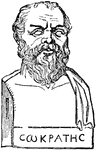
"This celebrated philosopher was born inthe year 468 B.C., in the immediate neighborhood of Athens. His father, Sophroniscus, was a sculptor, and Socrates was brought up to, and for some time practiced the same profession. He was married to Xanthippe, by whom he had three sons, but her bad temper has rendered her name proverbial for a conjugal scold. His physical constitution was healthy, robust, and wonderfully enduring." &mdash; Smith, 1882

Bust of Socrates

"This celebrated philosopher was born inthe year 468 B.C., in the immediate neighborhood of Athens.…
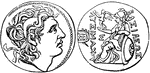
"Coin of Alexander the Great. Alexander, at the time of his father's death, was in his twentieth year, having been born in B.C. 356." &mdash; Smith, 1882

Coin of Alexander the Great

"Coin of Alexander the Great. Alexander, at the time of his father's death, was in his twentieth year,…
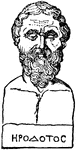
"The first writer who deserves the name of a historian is Herodotus, hence called the Father of History. Herodotus was born in the Dorian colony of Halicarnassus in Caria, in the year 484 B.C., and accordingly about the time of the Persian expeditions to Greece." &mdash; Smith, 1882

Bust of Herodotus

"The first writer who deserves the name of a historian is Herodotus, hence called the Father of History.…
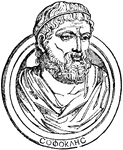
"Sophocles, the younger rival and immediate successor of Aeschylus in the tragic art, was born at Colonus, a village about a mile from Athens, in b.C. 495. We have already adverted to his wrestling the tragic prize from Aeschylus in 468, from which time he seems to have retained the almost undisputed posession of the Athenian stage, until a young but formidable rival arose in the person of Euripides." &mdash; Smith, 1882

Sophocles

"Sophocles, the younger rival and immediate successor of Aeschylus in the tragic art, was born at Colonus,…
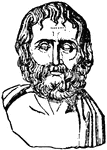
"Euripides was born in the island of Salamis, in B.C. 480, his parents having been among those who fled thither at the time of the invasion of Attica by Xerxes. He studied rhetoric under Prodicus, and physics under Anaxagoras." &mdash; Smith, 1882

Euripides

"Euripides was born in the island of Salamis, in B.C. 480, his parents having been among those who fled…
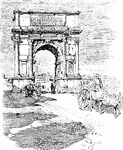
"In the time of Trajan, the Arch of titus and the Colossus of Nero (a gilt bronze statue 120 feet high), stood near the site now occupied by the church of S. Francesca Romana. They were removed by Hadrian to make room for the Temple of Venus and Rome, the arch being placed in its present position, and the colossus on the large square pedestal near the Colosseum, of which some remains may be still identified." — Young, 1901

Arch of Titus

"In the time of Trajan, the Arch of titus and the Colossus of Nero (a gilt bronze statue 120 feet high),…
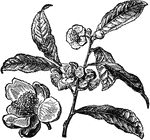
"Tea is the dried leaf of an evergreen shrub of the natural order Ternstœmiaceæ. It includes the China plant, and the indigenous Assam plant. At one time it was supposed that two Chinese species were grown of which one furnished the black tea and the other the green tea of commerce, but further research has shown that these species cannot be maintained. Whether the tea shrub is indigenous in China and Japan is a doubtful question. The fact has been historically established that the culture of tea existed in China in the 4th century, and in Japan in the 9th century, and from these countries it was exclusively obtained for any other part of the globe till the time of the present generation. The discovery of the indigenous plant in the forest country of Upper Assam was made in 1834, and since 1840 its cultivation there has taken very firm root."—(Charles Leonard-Stuart, 1911)

Tea Plant

"Tea is the dried leaf of an evergreen shrub of the natural order Ternstœmiaceæ. It includes the China…
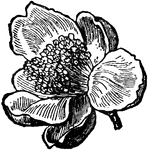
"Tea is the dried leaf of an evergreen shrub of the natural order Ternst&oelig;miace&aelig;. It includes the China plant, and the indigenous Assam plant. At one time it was supposed that two Chinese species were grown of which one furnished the black tea and the other the green tea of commerce, but further research has shown that these species cannot be maintained. Whether the tea shrub is indigenous in China and Japan is a doubtful question. The fact has been historically established that the culture of tea existed in China in the 4th century, and in Japan in the 9th century, and from these countries it was exclusively obtained for any other part of the globe till the time of the present generation. The discovery of the indigenous plant in the forest country of Upper Assam was made in 1834, and since 1840 its cultivation there has taken very firm root."&mdash;(Charles Leonard-Stuart, 1911)

Tea Flower

"Tea is the dried leaf of an evergreen shrub of the natural order Ternstœmiaceæ. It includes…
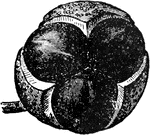
"Tea is the dried leaf of an evergreen shrub of the natural order Ternst&oelig;miace&aelig;. It includes the China plant, and the indigenous Assam plant. At one time it was supposed that two Chinese species were grown of which one furnished the black tea and the other the green tea of commerce, but further research has shown that these species cannot be maintained. Whether the tea shrub is indigenous in China and Japan is a doubtful question. The fact has been historically established that the culture of tea existed in China in the 4th century, and in Japan in the 9th century, and from these countries it was exclusively obtained for any other part of the globe till the time of the present generation. The discovery of the indigenous plant in the forest country of Upper Assam was made in 1834, and since 1840 its cultivation there has taken very firm root."&mdash;(Charles Leonard-Stuart, 1911)

Tea Fruit

"Tea is the dried leaf of an evergreen shrub of the natural order Ternstœmiaceæ. It includes…
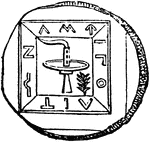
"Lampadedromia, torch-race, and often simply, Lampas, was a game common throughout Greece. At Athens we know of five celebrations of this game: one to Prometheus at the Prometheia, a second to Minerva at the Panametheia, a third to Vulcan at the Hephaesteia, a fourth to Pan, and a fifth to the Thracian Diana or Bendis. The three former are of unknown antiquity; the fourth was introduced soon after the battle of Marathon; the last in the time of Socrates. The race was usually run on foot, horses being first used in the time of Socrates: sometimes also at night. The preparation for it was a principal branch of the Gymnasiarchia, so much so indeed in later times, that Lampadarchia, seems to have been pretty much equivalent to the Gymnasiarchia. The gymnasiarch had to provide the lampas, which was a candlestick with a kind of shield set at the bottom of the socket, so as to shelter the flame of the candle; as is seen in the following woodcut, taken from a coin, He had also to provide for the training of the runners, which was of no slight consequence, for the race was evidently a severe one, with other expenses, which on the whole were very heave, so that Isaeus classes this office with the choregia and trierarchia, and reckons that it had cost him 12 minae." &mdash; Smith, 1873

Lampadephoria

"Lampadedromia, torch-race, and often simply, Lampas, was a game common throughout Greece. At Athens…
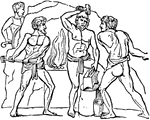
"A hammer, a mallet. In the hands of the farmer the mallet of wood served to break down the clods and to pulverize them. The butcher used it in slaying cattle, by striking the head, and we often read of it as used by the smith upon the anvil. When several men were employed at te same anvil it was a matter of necessity that they should strike in time, and Virgil, accordingly says of the Cyclopes, "inter se brachia tollunt in numerum." The scene which he describes is represented in the annexed woodcut, taken from an ancient bas-relief, in which Vulcan, Brontes, and Steropes, are seen forging the metal, while the third Cyclops, Pyracmon, blows the bellows. Beside the anvil is seen the vessel of water in which the hot iron or bronze was immersed. But besides the employment of the hammer upon the anvil for making all ordinary utensils, the smith wrought with this instrument figures which were either small and fine, some of their parts being beaten as thin as paper, and being in very high relief, as in the bronzes of Siris, or of colossal proportions, being composed of seperate plates riveted together." &mdash; Smith, 1873

Malleus

"A hammer, a mallet. In the hands of the farmer the mallet of wood served to break down the clods and…
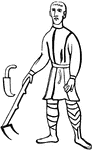
"An outer garment. The English cloak, though commonly adopted as the translation of these terms, conveys no accurate conception of the form, material, or use of that which they denoted. The article designated by them was always a rectangular piece of cloth, exactly, or at least nearly square. It was indeed used in the very form in which it was taken from the loom, being made entirely by the weaver, without and aid from the tailor except to repair the injuries which it sustained by time. Whatever additional richness and beauty it received from the art of the dyer, " &mdash; Smith, 1873

Pallium

"An outer garment. The English cloak, though commonly adopted as the translation of these terms, conveys…
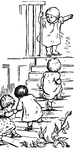
Children going to bed.

Bed-Time

Children going to bed.

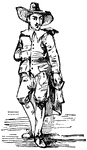
A citizen in the time of Charles I; dressed in clothing of the time.

Citizen

A citizen in the time of Charles I; dressed in clothing of the time.

British coin of the time period of the Roman invasion in the Gallic War, B.C. 54. Front.

British Coin

British coin of the time period of the Roman invasion in the Gallic War, B.C. 54. Front.
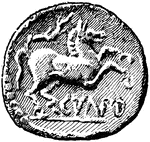
British coin of the time period of the Roman invasion in the Gallic War, B.C. 54. Back.

British Coin

British coin of the time period of the Roman invasion in the Gallic War, B.C. 54. Back.
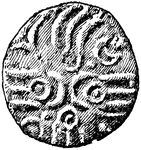
British coin of the time period of the Roman invasion in the Gallic War, B.C. 54. Front.

British Coin

British coin of the time period of the Roman invasion in the Gallic War, B.C. 54. Front.
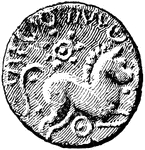
British coin of the time period of the Roman invasion in the Gallic War, B.C. 54. Back.

British Coin

British coin of the time period of the Roman invasion in the Gallic War, B.C. 54. Back.