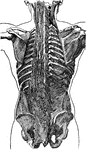
Back view of the trunk of body, showing spinal deep muscles.

Deep Muscles of the Trunk of the Body

Back view of the trunk of body, showing spinal deep muscles.

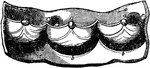
Semilunar valves of the heart. The blood received by the left ventricle through the auriculo-ventricular orifice is discharged into the main artery of the body, the aorta, through an opening which is guarded by these valves.

Semilunar Valves

Semilunar valves of the heart. The blood received by the left ventricle through the auriculo-ventricular…
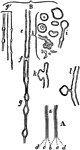
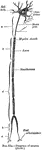
A diagram of nerve tubules A nerve tube consists of a white portion which is fatty, and which protects the central portion, or axis cylinder. Surrounding these is a tubular membrane composed of epithelial cells. The nerve of the body are made up of bundles of these tubes, bound together by connective tissue and enclosed in a sheath of the same. Labels: a, axis cylinder; b, inner border of white substance; c, c, outer border of same; d, ,d, tubular membrane; B, tubular fibers; e, in natural state; f, under pressure; g, g', varicose fibers.

Nerve Tubules

A diagram of nerve tubules A nerve tube consists of a white portion which is fatty, and which protects…
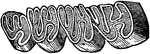
Teeth of an herbivore, showing the rough surface of some of these teeth. Herbivores have no tearing teeth. Instead they have two kinds of teeth, cutting teeth in the front and grinding teeth in the back. This figure shows a peculiar arrangement of the enamel, which admirably fits them to grind up the fibers of the grass in the back grinding teeth of an herbivore. The enamel is not only on the outside as it is in human teeth, rather there are ridges on it standing up in the middle of each tooth.

Teeth of an Herbivore

Teeth of an herbivore, showing the rough surface of some of these teeth. Herbivores have no tearing…
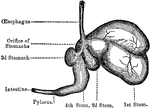
The four stomachs of the sheep, a grass-eating animal. The beginning of the intestines are also shown, which reach in their full length to 28 times the size of the sheep's body.

Sheep, Stomachs of

The four stomachs of the sheep, a grass-eating animal. The beginning of the intestines are also shown,…
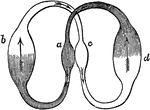
Diagram showing the circulation of blood in the heart. Let <em>a</em> represent the right side of the heart, <em>c</em>the left side, <em>b</em> the lungs, and <em>d</em> the general system of the body. The arrows point in the direction in which the blood flows. In all the shaded part the blood is dark (oxygen-poor), and in the part that is not shaded it is red (oxygen-rich).

Blood Circulation in the Heart

Diagram showing the circulation of blood in the heart. Let a represent the right side of the…
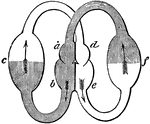
Diagram showing the compartments of the heart. The smaller compartments are the auricles (also known as atria) and the larger compartments are the ventricles. The middle part of the figure represents the heart with its two sides; <em>a</em> being the right auricle, <em>b</em> the right ventricle, <em>d</em> the left auricle, and <em>e</em> the left ventricle. The blood is received in the right auricle, <em>a</em>, from the general system, <em>f</em>. It then passes into the right ventricle, <em>b</em>, and is forced by the contraction of it through arteries to the lungs, <em>c</em>. From the lungs it comes back to the heart, to the left side, and enters the left auricle, <em>d</em>. From this it passes into the left ventricle, <em>e</em>, from which it is sent all over the body, represented by <em>f</em>.

Heart, Compartments of

Diagram showing the compartments of the heart. The smaller compartments are the auricles (also known…
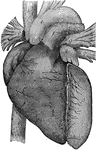
A representation of the heart as it really appears showing the front view. At <em>a</em> is the right auricle that receives blood from all pats of the body by two large veins h and i. At <em>b</em> is the right ventricle, which receives the blood from the auricle and sends it to the lungs by the pulmonary artery <em>f</em>. At <em>c</em> is the left auricle, which receives the blood from the lungs by the pulmonary veins <em>g, g, g</em>. At <em>d</em> is the left ventricle which receives blood from the auricle and forces it all over the body through the aorta <em>e</em>.

Heart, Front View of

A representation of the heart as it really appears showing the front view. At a is the right…
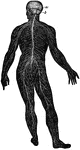
Diagram of the human nervous system showing the brain, spinal cord, and nerves.

Nervous System

Diagram of the human nervous system showing the brain, spinal cord, and nerves.

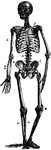
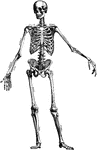
The human skeleton.

Human Skeleton

The human skeleton.

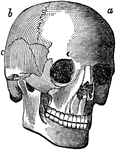
The human skull, showing the bones of the head. <em>a</em>is the large bone of the forehead known as the frontal bone; <em>b</em> is known as the parietal bone, and <em>c</em> is the temporal bone.

Skull

The human skull, showing the bones of the head. ais the large bone of the forehead known as…

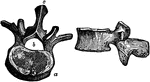
Two views of vertebra. 24 vertebrae make up the spinal column. On the left figure, <em>a</em> is the body of the bone; <em>b</em> is the hole through the vertebra which forms its part of the canal for the spinal marrow; and <em>c</em> is the spinous process. On the right is a side view of the same vertebra.

Two Views of a Vertebra

Two views of vertebra. 24 vertebrae make up the spinal column. On the left figure, a is the…
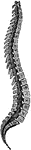
View of the entire spinal column. The bodies of the vertebrae are in the front with the spinous processes on the other side. Between the row of the bodies of the vertebrae and the row of spinous processes you can see the canal in which lies the spinal marrow.

The Spinal Column

View of the entire spinal column. The bodies of the vertebrae are in the front with the spinous processes…
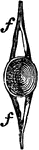
The vertebra of a fish, which is very different from that of a human. It has but two processes, <em> f f </em>. In humans there is a single short spinous process behind, while the vertebra is round in front. But in the fish there are two quite long spinous processes, one in front and the other in the rear (which is above and below, respectively, when the fish is in water).

Vertebra of a Fish

The vertebra of a fish, which is very different from that of a human. It has but two processes,

The lower part of the large muscle that raises the heel during walking. P, the muscle, makes up most of the bulk of the calf of the leg. The weight of the body rests upon the bone W. In walking, as we raise the body in taking a step, we do it first by raising the heel with the muscle P, the pressure being on the ball of the foot, F. This muscle does here with the weight of the body what the muscles of your arms do to the load in a wheel barrow when you raise it by the handles.

Heel Muscle

The lower part of the large muscle that raises the heel during walking. P, the muscle, makes up most…
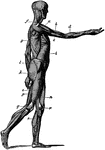
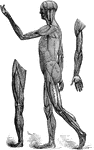
Side view of the muscles of the body, showing those that lie directly under the skin. Other deeper muscles are not visible. Muscles vary widely in their shape and size depending on their function.

Side View of the Muscles of the Body

Side view of the muscles of the body, showing those that lie directly under the skin. Other deeper muscles…
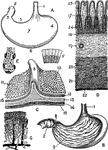
Views of the stomach. Labels: A. stomach (human). B. Same, anterior wall removed. C. Portion of stomach, pylorus and duodenum. D. Section through coats of stomach. E. Fundus of a cardiac gland. F. Epithelium from surface of stomach. G. Arterie sand veins of mucous membrane. w. Esophagus. 2. Duodenum. 3. Pylorus. $. Cardia. 5. Lesser curvature. 6. Greater curvature. 7. Anterior surface. 8. Pyloric valve. 9. Mucous membrane, with rugae. 10. Inner surface of gastric mucous membrane. 11. Mucous membrane of duodenum with villi. 12. Pyloric gastric glands. 13. Circular or deep muscular fibers. 17. Mucous membrane. 18. Muscularis mucosae. 19. Submucous coat. 20. Circular muscular layer. 21. Longitudinal muscular layer. 22. Serous coat. 23. Orifice of gland. 24. Fundus of gland.

Views of the Stomach

Views of the stomach. Labels: A. stomach (human). B. Same, anterior wall removed. C. Portion of stomach,…
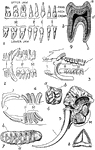
1. Dentition (teeth) of man. 2. Dentition of hyena. 3. Dentition of pig. 4. Dentition of Patagonian cavy (type of rodent). 5. Section of skull of Indian elephant, showing dentition of right side. 6. Crown of upper molar of horse, showing enamal folds. 7. Grinding surface of molar of African elephant, with enamal folds. 8. Single tooth of blue shark. 9. Longitudinal section of human tooth. 1. Incisors (human); C, canines; P, premolars; M, molars. a, enamel; b, dentine; c, cement (crusta petrosa); d, pulp cavity.

Teeth of Man and Several Animal Species

1. Dentition (teeth) of man. 2. Dentition of hyena. 3. Dentition of pig. 4. Dentition of Patagonian…
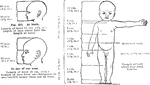
Proportions of a health child's body and head size at birth and at one year of age.

Proportions of a Healthy Child's Body at Birth and Birth and One Year

Proportions of a health child's body and head size at birth and at one year of age.
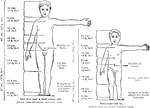
Proportions of a health child's body and head size at 2 and 5.5 years of age.

Proportions of a Healthy Child's Body at 2 and 5 Years of Age

Proportions of a health child's body and head size at 2 and 5.5 years of age.
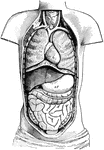
Diagram of the Body opened from the front to show the contents of the ventral cavity. Labels: d, diaphragm; h, heart; lu, lungs; st, stomach; li, liver; si, small intestines; c, large intestine

Ventral Cavity of the Body

Diagram of the Body opened from the front to show the contents of the ventral cavity. Labels: d, diaphragm;…
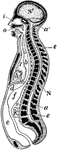
Diagrammatic longitudinal section of the Body. Labels: a, the neural tube, with its upper enlargement in the skull cavity at a'; N, the spinal cord; N', the brain; ee, vertebrae forming the solid partition between the dorsal and ventral cavities; b, the pleural, and c, the abdominal division of the ventral cavity, separated from one another by the diaphragm, d; i, the nasal, and o, the mouth chamber, opening behind into the pharynx, from which one tube leads to the lungs, l, and the heart; k, a kidney; s, the sympathetic nervous chain. From the stomach, f, the intestinal tube leads through the abdominal cavity to the posterior opening of the alimentary canal.

Longitudinal Section of the Body

Diagrammatic longitudinal section of the Body. Labels: a, the neural tube, with its upper enlargement…
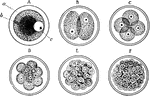
Every human body begin as a single nucleated cell. This cell, known as the ovum, divides or segments and gives rise to a mass consisting of a number of similar units known as the morula. At this stage there are no distinguishable tissues.

Cell Development

Every human body begin as a single nucleated cell. This cell, known as the ovum, divides or segments…
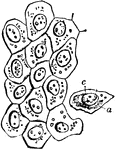
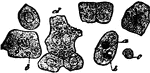
Flat epithelium cells from the surface of the peritoneum. Labels: a, cell body; c, nucleus.

Flat Epithelium Cells

Flat epithelium cells from the surface of the peritoneum. Labels: a, cell body; c, nucleus.

Two thoracic vertebrae seen from behind, i.e., the end turned from the head. Labels: C, the body; A, neural arch; Ps, spinous process; Pas, anterior articular process; Pai, posterior articular process; Pt, transverse process; Ft, facet for articulation with the tubercle of a rib; Fcs, Fci, articular surface on the centrum for articulation with a rib.

Thoracic Vertebrae

Two thoracic vertebrae seen from behind, i.e., the end turned from the head. Labels: C, the body; A,…
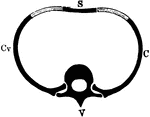
Diagrammatic representation of a segment of the axial skeleton V, a vertebra; C, Cv, ribs articulating above with the body and transverse process of the vertebra; S, the breastbone. The lighter-shaded part between S and C is the costal cartilage.

Segment of the Axial Skeleton

Diagrammatic representation of a segment of the axial skeleton V, a vertebra; C, Cv, ribs articulating…
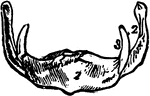
The hyoid bone. Labels: 1, body; 2, great cornua; 3, small cornua.

Hyoid Bone

The hyoid bone. Labels: 1, body; 2, great cornua; 3, small cornua.

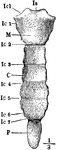
Ventral view of the sternum. Labels: M, manubrium; C, body; P, ensiform cartilage; Icl, notch for the collarbone; Ic 1-7, notches for the rib-cartilages.

Ventral View of the Sternum

Ventral view of the sternum. Labels: M, manubrium; C, body; P, ensiform cartilage; Icl, notch for the…
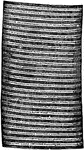
Portion of a human muscle fiber.

Portion of a Muscle Fiber

Portion of a human muscle fiber.

The human skeleton.

The Human Skeleton

The human skeleton.

The muscles of the human body.

Muscles of the Human Body

The muscles of the human body.

Diagram of a neuron.

The Nervous System

Diagram of a neuron.

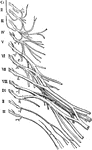
The cervical and brachial nerve plexuses of the left side of the body.

Cervical and Brachial Nerve Plexuses

The cervical and brachial nerve plexuses of the left side of the body.
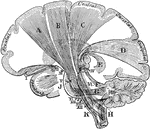
Diagram of the projection fibers of the cerebrum. Labels: B, motor (pyramidal) tract; C, body-sense tract; D, visual tract; E, auditory tract; F, G and H, upper, middle and lower peduncles of cerebellum; K, decussation of pyramids. Numerals refer to cranial nerves.

Projection Fibers of the Cerebrum

Diagram of the projection fibers of the cerebrum. Labels: B, motor (pyramidal) tract; C, body-sense…
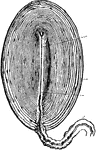
A Pacinian corpuscle, magnified. Pacinian corpuscles are pain receptors located in the interior of the body, especially in the connective tissue which supports the abdominal viscera.

Pacinian Corpuscles

A Pacinian corpuscle, magnified. Pacinian corpuscles are pain receptors located in the interior of the…
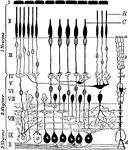
Diagram of the structure of the human retina. Labels: I, pigment layer; II, rod and cone layer; R, rods; C, cones; III-IX, intraretinal nerve-elements; X, axons which pass to optic nerve.

Retinal Structure

Diagram of the structure of the human retina. Labels: I, pigment layer; II, rod and cone layer; R, rods;…
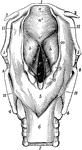
The larynx viewed from its pharyngeal opening. The back wall of the pharynx has been divided and its edges (11) turned aside. Labels 1, body of hyoid; 2, its small, and 3, its great, horns; 4, upper and lower horns of thyroid cartilages; 5, mucous membrane of front of pharynx, covering the back of the cricoid cartilage; 6, upper end of gullet; 7, windpipe, lying in front of the gullet; 8, eminence caused by cartilage of Santorini; 9, eminence caused by cartilage of Wrisberg; both lie in, 10, the artytenoepiglottic fold of mucous membrane, surrounding the opening (aditus laryngis) from pharynx to larynx; a, projecting tip of epiglottis; c, the glottis, the lines leading from the latter point to the free vibratory edges of the vocal cords; b', the ventricles of the larynx; their upper edges, marking them off from the eminences b, are the false vocal cords.

Larynx

The larynx viewed from its pharyngeal opening. The back wall of the pharynx has been divided and its…
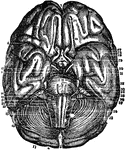
Base of the Brain. Labels: 1,2, longitudinal fissure; 3, anterior lobes cerebrum; 4, middle lobe; 5, fissure Sylvius; 6, posterior lobe; 7, infundibulum; 8, its body; 9, corporo albicantia; 10, cineritious matter; 11, crura cerebri; 12, pons Varolii; 13, medulla oblongata; 14, posterior prolongation of pons; 15, middle of cerebellum; 16, anterior part of cerebellum; 17, its posterior part and fissure; 18, medulla spinalis; 19, middle fissure medulla; 20, pyramidal body; 21, retiform body; 22, olivary body; 23, olfactory nerve; 24, its bulb; 25, its external root; 26, middle root; 27, internal root; 28, 29, optic nerve; 30, third nerve; 31, fourth nerve; 32, fifth nerve; 33, sixth nerve; 34, facial nerve; 35, auditory nerve; 36, 37, 38, eighth nerve.

Base of the Brain

Base of the Brain. Labels: 1,2, longitudinal fissure; 3, anterior lobes cerebrum; 4, middle lobe; 5,…
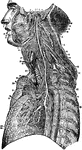
The ninth, tenth, and eleventh cranial nerves. Labels: 1, Gasserian ganglion; 2, internal carotid; 3, pharyngeal branch of pneumogastric; 4, glosso-pharyngeal; 5, lingual; 6, spinal accessory; 7, middle constrictor of pharynx; 8, internal jugular vein; 9, superior laryngeal nerve; 10, ganglion of pneumogastric, 11, hypoglossal; 12, ditto communicating with eighth and first cervical; 13, external laryngeal; 14, second cervical; 15, pharyngeal plexus; 16, superior cervical ganglion; 17, superior cardiac nerve; 18, third cervical; 19, thyroid body; 20, fourth cervical; 21, recurrent laryngeal; 22, spinal accessory; 23, trachea 24, middle cervical ganglion; 25, middle cardiac nerve; 26, phrenic; 27, left carotid; 28, bronchial plexus; 29, phrenic; 30, inferior cervical ganglion; 31, pulmonary plexus; 32, aorta; 33, esophageal plexus; 34, vena axygos superior; 35, vena azygos minor; 36, gangliated cord of sympathetic.

The Ninths, Tenth, and Eleventh Cranial Nerves

The ninth, tenth, and eleventh cranial nerves. Labels: 1, Gasserian ganglion; 2, internal carotid; 3,…
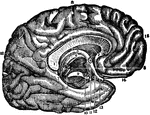
Middle vertical section of the callous body (corpus callosum). The inner left side of the brain is also seen.

Corpus Callosum

Middle vertical section of the callous body (corpus callosum). The inner left side of the brain is also…
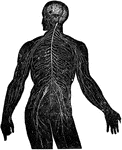
View of the nervous system in man, showing the nervous centers (the brain and the spinal near row) where the other nerves begin which provide the whole body.

Nervous System

View of the nervous system in man, showing the nervous centers (the brain and the spinal near row) where…
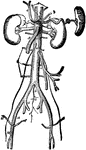
Major arteries of the body. The kidneys and spleen are also shown with their respective arteries. Labels: 1, cheek arteries; 2, coeliac axis; 3, gastric artery; 4, hepatic artery; 5, spleenic artery; 6, supra-renal artery on right side; 7, right renal artery; 8, lumbar arteries; 9, upper mesenteric artery; 10, the two spermatic arteries; 11, the lower mesenteric; 12, the middle sacras; 13, the common iliac; 14, internal iliac of the right side; 15, external iliac; 16, episgastric artery; 17, circumflex iliac artery; 18, femoral artery.

Major Arteries

Major arteries of the body. The kidneys and spleen are also shown with their respective arteries. Labels:…
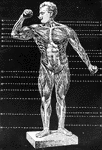
General view of the human body - front view.

The Human Body - Front View

General view of the human body - front view.

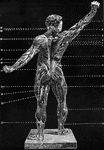
General view of the human body - back view.

The Human Body - Back View

General view of the human body - back view.

Human liver cells.

Liver Cells

Human liver cells.

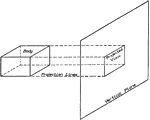
A body is shown as projecting from its surface projection lines, and these lines are cut by a plane. By connecting the points on the plane made by the projection lines the projection of the body is formed, and it corresponds in shape with the body itself.

Projected Geometric View

A body is shown as projecting from its surface projection lines, and these lines are cut by a plane.…
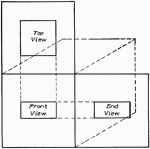
It can readily be seen that one view only with not give a complete picture of a solid object. Usually two or more views are necessary, according to the complication of the object or body.

Top, Front, and End Projections

It can readily be seen that one view only with not give a complete picture of a solid object. Usually…
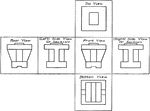
All six views in a projection.

Six views of Object

All six views in a projection.

A serious membrane. These line all closed cavities, or sac, of the body, and are reflected over the organs contained in them. They form a shut sac, completely excluding the air.

Serous Membrane

A serious membrane. These line all closed cavities, or sac, of the body, and are reflected over the…
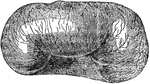
A portion of the stomach, showing its internal surface or mucous coat. Mucous membranes line various cavities of the body, which are exposed to the air.

Mucous Membrane

A portion of the stomach, showing its internal surface or mucous coat. Mucous membranes line various…
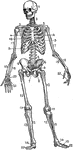
The human skeleton.

Human Skeleton

The human skeleton.

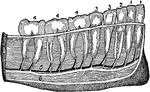
Image of teeth in a human jaw. "1, incisors; 2, canine; 3, bicuspids; 4, molars (the molar at the left is the "wisdom tooth); 5, a blood vessel; 6, a nerve." -Foster, 1921

Teeth

Image of teeth in a human jaw. "1, incisors; 2, canine; 3, bicuspids; 4, molars (the molar at the left…
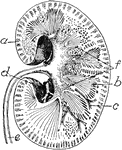
Transverse section of the human kidney: "(a) cortex; (b) medulla; (c) small branch of the renal artery; (d) renal artery; (e) ureter; (f) pelvis." -Foster, 1921

Kidney

Transverse section of the human kidney: "(a) cortex; (b) medulla; (c) small branch of the renal artery;…

A device propelled through water with a ship as its target. "(a) Head; (b) air cylinder; (c) after body; (e) propellers; (f) war nose." -Foster, 1921

Torpedo

A device propelled through water with a ship as its target. "(a) Head; (b) air cylinder; (c) after body;…
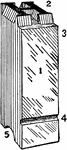
A piece of wood or metal to stamp a letter or character. "(1) the body, (2) the face, (3) the shoulder, (4) the nick and (5) the groove." -Foster, 1921

Type

A piece of wood or metal to stamp a letter or character. "(1) the body, (2) the face, (3) the shoulder,…
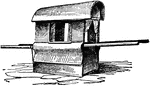
A covered human-powered wagon used in Eastern countries where passengers were inside while two men would carry the poles of the palanquin on their shoulders.

Palanquin

A covered human-powered wagon used in Eastern countries where passengers were inside while two men would…
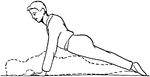
"Place the hands on the floor, the body outstretched, face downward. Raise and lower the body from the floor, dipping the body until the nose touches the floor." -Foster, 1921

Exercise

"Place the hands on the floor, the body outstretched, face downward. Raise and lower the body from the…
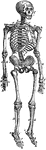
Front view of the human skeleton.

Skeleton, Front View

Front view of the human skeleton.

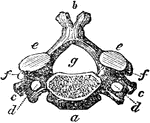
A vertebra of the neck. Labels: a, body of the bone; b, the spinal process; c, d, the transverse processes double, showing circular holes for the passage of the vertebral artery; e,e,. the superior; f,f, the articular of oblique processes; g, the spinal hole for the spinal marrow. The roots of the articular processes are hallowed out above and below into notches; and these, when the bones are fitted together, form apertures on each side of the spine, through which the nerves pass out from the spinal canal.

Vertebra of the Neck

A vertebra of the neck. Labels: a, body of the bone; b, the spinal process; c, d, the transverse processes…
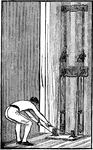
A man exercising with chest weights. In this position, he bends over and straightens his body with his hands over his head.

Chest Weights

A man exercising with chest weights. In this position, he bends over and straightens his body with his…