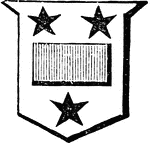
"Argent, a fess humetty gules, between three mullets sable. HUMETTY. A term used to denote an ordinary, parts of which are couped or cut off, so that it does not touch the edges of the shield." -Hall, 1862

Fess Humetty

"Argent, a fess humetty gules, between three mullets sable. HUMETTY. A term used to denote an ordinary,…
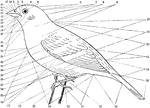
"fig. 25 - Topography of a Bird. 1, forehead (frons). 2, lore. 3, circumocular region. 4, crown (vertex). 5, eye. 6, hind head (occiput). 7, nape (nucha). 8, hind neck (cervix). 9, side of neck. 10, interscapular region. 11, dorsum, or back proper, including 10. 12, notaeum, or upper part of body proper, including 10, 11, and 13. 13, rump (uropygium). 14, upper tail-coverts. 15, tail. 16, under tail-coverts (crissum). 17, tarsus. 18, abdomen. 19, hind toe (hallux). 20, gastraeum, including 18 and 24. 21, outer and fourth toe. 22, middle and third toe. 23, side of the body. 24, breast (pectus). 25, primaries. 26, secondaries. 27, tertiaries; nos. 25, 26, 27 are all coverts. 28, primary coverts. 29, alula, or bastard wing. 30, greater coverts. 31, median coverts. 32, lesser coverts. 33, the "throat," including 34, 37, 38. 34, jugulum or lower throat. 35, auriculars. 36, malar region. 37, gula, or middle throat. 38, mentum, or chin. 39, angle of commissure, or corner of mouth. 40, ramus of under mandible. 41, side of under mandible. 42, gonys. 43, apex, or tip of bill. 44, tomia, or cutting edges of the bill. 45, culmen, or ridge of upper mandible, corresponding to gonys. 46, side of upper mandible. 47, nostril. 48, passes across the bill a little in front of it base." Elliot Coues, 1884

Topography of a Bird

"fig. 25 - Topography of a Bird. 1, forehead (frons). 2, lore. 3, circumocular region. 4, crown (vertex).…
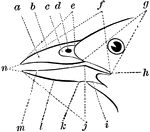
"Fig. 26 - Parts of a Bill. a, side of upper mandible; b, culmen; c, nasal fossa; d, nostril; e(see below); f, gape, or whole commissural line; g, rictus; h, commissural point or angle of the mouth; i, ramus of under jaw; j, tomia of under mandible (the reference lines e should have been drawn to indicate the correct tomia of upper mandible):k, angle of gonys; l, gonys; m, side of under mandible; n, tips of mandibles." Elliot Coues, 1884

The Parts of a Bird Bill

"Fig. 26 - Parts of a Bill. a, side of upper mandible; b, culmen; c, nasal fossa; d, nostril; e(see…
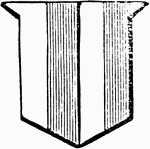
"Paly of four, argent and gules. PALY. A field divided by perpendicular lines into several equal parts of metal and tincture interchangeably disposed." -Hall, 1862

Paly

"Paly of four, argent and gules. PALY. A field divided by perpendicular lines into several equal parts…
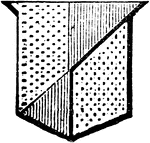
"PARTED PER PALE AND PER BEND SINISTER Counterchanged, or and gules. PARTY or PARTED signifies divided, and applies to the several parts of an escutcheon parted by a line, which always runs in the direction of one or more of the honourable ordinaries." -Hall, 1862

Parted Per Pale and Per Bend Sinister

"PARTED PER PALE AND PER BEND SINISTER Counterchanged, or and gules. PARTY or PARTED signifies divided,…
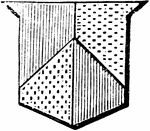
"PARTED PER PALE AND PER CHEVRON Gules and or, counter changed. PARTY or PARTED signifies divided, and applies to the several parts of an escutcheon parted by a line, which always runs in the direction of one or more of the honourable ordinaries." -Hall, 1862

Parted Per Pale and Per Chevron

"PARTED PER PALE AND PER CHEVRON Gules and or, counter changed. PARTY or PARTED signifies divided, and…
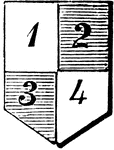
"QUARTERED. A shield divided into four equal parts by a cross is said to be quartered. The quarter occupying the dexter chief is marked 1, or the first quarter; that occupying the sinister chief, 2; the dexter base, 3; the sinister base, 4; as in the annexed example." -Hall, 1862

Quartered

"QUARTERED. A shield divided into four equal parts by a cross is said to be quartered. The quarter occupying…
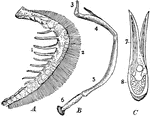
"Gill of Fish. A, first branchial arch of left side of black-bass: 1, gill-rakers; 2, branchial lamellae. C, same, in cross-section: 7, branchial lamellae; 8, a gill-raker. B, same arch of striped-bass, with appendages removed: 3, 4, 5, and 6, pharyngobranchial, epibranchial, ceratobranchial, and hypobranchial segments." -Whitney, 1911

Parts of Fish Gills

"Gill of Fish. A, first branchial arch of left side of black-bass: 1, gill-rakers; 2, branchial lamellae.…
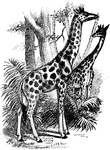
"The camelopard, Giraffa camelopardalis or Camelopardalis giraffa, a ruminant animal inhabiting various parts of Africa, and constituting the only species of its genus and family." -Whitney, 1911

Giraffe

"The camelopard, Giraffa camelopardalis or Camelopardalis giraffa, a ruminant animal inhabiting various…
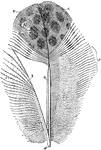
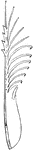
"Fig. 19 - A partly pennaceous, partly plumulaceous feather, from Argus pheasant; after Nitzsch. ad, main stem; d, calamus; a, rhachis; c, c, c, vanes, cut away on left side in order not to interfere with b, the after-shaft, the whole of the right vane of which is likewise cut away." Elliot Coues, 1884

Feather from a Argus Pheasant

"Fig. 19 - A partly pennaceous, partly plumulaceous feather, from Argus pheasant; after Nitzsch. ad,…
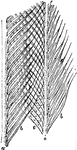
"Fig. - 20 - Two barbs, a, a, of a vane, bearing anterior, b, b, and posterior, c, barbules; enlarged; after Nitzsch." Elliot Coues, 1884

Structure of a Feather

"Fig. - 20 - Two barbs, a, a, of a vane, bearing anterior, b, b, and posterior, c, barbules; enlarged;…
"Fig. 21. -A single barbule, baring barbicels and hooklets; magnified; after Nitzsch. ...barbicels (another dimin. of barba), also called cilia, or lashes (fig. 21); and hamuli, or hooklets (Lat. hamulus, a little hook; fig 21). These are simply a sort of fringe to the barbules, just as if the lower edge of the barbules were frayed out, and only differ from each other in that barbicels are plain hair like processes, while hamuli are hooked at the end; they are not found on all feathers, nor on all parts of some feathers." Elliot Coues, 1884

Single Barbule

"Fig. 21. -A single barbule, baring barbicels and hooklets; magnified; after Nitzsch. ...barbicels (another…
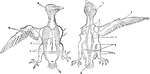
"Fig. 24. - Pterylosis of Cyoselus apus, drawn by Coues after Nitzsch; right hand upper, left hand lower, surface. 1 spinal tract; 2. humeral; 3. femoral; 4. capital; 5. alar; 6. caudal; 7. crural; 8. ventral." Elliot Coues, 1884

Pterylosis of Cypselus Apus

"Fig. 24. - Pterylosis of Cyoselus apus, drawn by Coues after Nitzsch; right hand upper, left hand lower,…
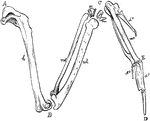
"Fig 27. - Bones of the right wing of a duck, Clangula islandica, A, shoulder, omos; B, elbow, ancon; C, wrist, carpus; D, end of principal finger; E, end of hand proper, metacarpus. AB, upper arm, brachium; BC, fore-arm, antibrachium; CD, whole hand or pinion, manus; composed of CE, hand proper or metacarpus, excepting d2; ED, or d2, d3, d4, fingers, digits, digiti, h, humerus; rd, radius; ul, ulna; sc, outer carpal, scapholunare or radiale; cu, inner carpal, cuneiforme or ulnare; these two composing wrist or carpus. mc, the compound hand-bone or metcarpus, composed of three metacarpal bones, bearing as many digits - the outer digit seated upon a protuberance at the head of the metacarpal, the other two situated at the end of the bone. d2, the outer or radial digit, commonly called the thumb or pollex, composed or two phalanges; d3, the middle digit, of two phalanges; d4, the inner or ulnar digit, of one phalanx d2 is the seat of the feathers of the bastard wing or alula. D to C (whole pinion), seat of the flight feathers called primaries; C to B (fore-arm), seat of the secondaries; at B and above it in direction of A, seat of tertiaries proper; below A, in direction of B, seat of scapularies (upon pteryla humeralis), often called tertiaries. The wing shown half-spread: complete extension would bring A B C D into a right line; in complete folding C goes to A, and D to B; all these motions nearly in the plane of the paper. The elbow-joint and wrist are such perfect hinges, that, in opening or closing the wing, C cannot sink below the paper, nor D fly up above the paper, as would otherwise be the effect of the pressure of the air upon the flight-feathers. Observe also rd and ul are two rods connecting B and C; the construction of their joining at B and C, and with each other, is such, that they can slide lengthwise a little upon each other. Now when the point C, revolving about B, approaches A in the arc of a circle, rd pushes on sc, while ul pulls back cu; the motion is transmitted to D, and makes this point approach B. conversely, in opening the wing, rd pulls back sc, and ul pushes on cu, making D recede from B. In other words, the angle A B C cannot be increased or diminished without similarly increasing or diminishing the angle B C D; so that no part of the wing can be opened or shut without automatically opening or shutting the rest..." Elliot Coues, 1884

The Bones of the Right Wing of a Duck

"Fig 27. - Bones of the right wing of a duck, Clangula islandica, A, shoulder, omos; B, elbow, ancon;…
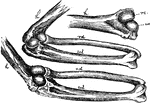
"Fig. 28. - Mechanism of elbow-joint. ..., where rc and uc show respectively the size, shape, and position of the radial condyle and ulnar condyle of the humerus. It is evident that in the flexed state of the elbow, as shown in the middle figure, the radius, rd, is do pushed upon that its end projects beyond ul, the ulna; while in the opposite condition of extension, shown in the lower figure, rd is pulled back to a corresponding extent." Elliot Coues, 1884

Mechanism of the Elbow-Joint

"Fig. 28. - Mechanism of elbow-joint. ..., where rc and uc show respectively the size, shape, and position…
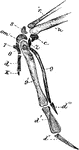
"Fig. 29., from a young grouse (Centrocercus urophasianus, six months old), is designed to show the composition of the carpus and metacarpus before the elements of these bones fuse together: r, radius; u, ulna; s, scapholunar or radiale; c, cuneiform or ulnare; om, a carpal bone believed to be os magnum, later fusing with the metacarpus; z, a carpal bone, supposed to be unciform, later fusing with metacarpus; 8, an unidentified fifth carpal bone, which may be called pentosteon, later fusing with the metacarpus; 7, radial or outer metacarpal bone, bearing the pollex or outer digit, consisting of two phalanges, d and k; 9', principal (median) metacarpal bone, bearing the middle finger, consisting of the two phalanges, d', d"; 9, inner or ulnar metacarpal, bearing a digit of one phalanx, d'". The pieces marked om, z, 7, 8, 9,. all fuse with 9'. (From nature by Dr. R. W. Shufeldt, U.S.A.)."Elliot Coues, 1884

The Wing Bones of a Young Grouse

"Fig. 29., from a young grouse (Centrocercus urophasianus, six months old), is designed to show the…
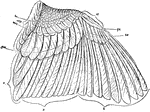
"Fig. 30., Feathers of a sparrow's wing. pc, covers of the primaries; msc, median upper secondary coverts; bc, tectrices minores; b, primaries; s, secondaries; t, tertiaries." Elliot Coues, 1884

Feathers of a Sparrow's Wing

"Fig. 30., Feathers of a sparrow's wing. pc, covers of the primaries; msc, median upper secondary coverts;…

"Fig. 31. - Ulna of Colaptes mexicanus, showing points of attachment of the secondaries. (Dr. R. W. Shufeldt, U. S. A.)." Elliot Coues, 1884

Red Shafted Woodpecker Ulna

"Fig. 31. - Ulna of Colaptes mexicanus, showing points of attachment of the secondaries. (Dr. R. W.…
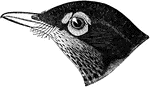
"Robin: Upper parts slate-color, with a shade of olive. Head black, the eyelids and a spot before the eye white, and the throat streaked with white. Quills of the wings dusky, edged with hoary ash, and with the color of the back. Tail blackish, the outer feather usually tipped with white. Underparts, to the vent, including the under wing-coverts and tibiae white, showing more or less plumbeous. Bill yellow, often with a dusky tip. Mouth yellow. Eyes dark brown. Feet blackish, the soles yellowish." Elliot Coues, 1884

Robin

"Robin: Upper parts slate-color, with a shade of olive. Head black, the eyelids and a spot before the…
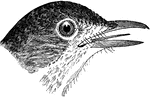
"Wood Thrush. Upper parts, including the surface of the closed wings, tawny-brown, purest and deepest on the head, shading insensibly into olivaceous on the rump and tail. Below, pure white, faintly tinged on the breast with buff, and everywhere, rounded or subtriangular blackish spots. Inner webs and ends of quills fuscous, with a white or buffy edging toward the base. Greater under wing-coverts mostly white. Auriculars sharply streaked with dusky and white. Bill blackish-brown, with flesh-colored or yellowish base. Feet like this part of the bill." Elliot Coues, 1884

Wood Thrush

"Wood Thrush. Upper parts, including the surface of the closed wings, tawny-brown, purest and deepest…
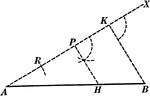
Illustration used to show how to divide a given straight line into any number of equal parts.

Line Divided Into Equal Parts

Illustration used to show how to divide a given straight line into any number of equal parts.
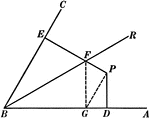
Illustration used to show "The two perpendiculars to the sides of an angle from any point not in its bisector are unequal."

Perpendiculars To The Sides Of An Angle

Illustration used to show "The two perpendiculars to the sides of an angle from any point not in its…
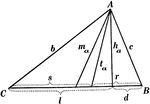
Illustration used to show the various parts of a triangle: sides, angles, medians, altitudes, bisectors, and segments.

Parts Of A Triangle

Illustration used to show the various parts of a triangle: sides, angles, medians, altitudes, bisectors,…
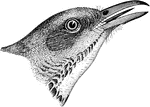
"Upper parts uniform rust-red, with a bronzy lustre. Concealed portions of quills fuscous. Greater the median wing-coverts blackish near the end, then conspicuously tipped with white. Bastard quills like the coverts. Tail like the back, the lateral feathers with paler ends. Under pars white, more or less strongly tinged, especially on the breast, flanks, and crissum, with tawney or pale cinnamon-brown, the breast and sides marked with a profusion of well-defined spots of dark brown, oval in front, becoming more linear posteriorly. Throat immaculate, bordered with a necklace or spots; middle of belly and under tail-coverts likewise unspotted. Bill quite straight, black, with yellow base of the lower mandible; feet pale; iris yellow or orange." Elliot Coues, 1884

Brown Thrasher

"Upper parts uniform rust-red, with a bronzy lustre. Concealed portions of quills fuscous. Greater the…
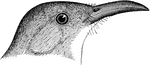
"Above, grayish-brown, nearly uniform; wing- coverts and quills with slight whitish edging, the edge of the wing itself white; tail feathers with slight whitish tips; below; a paler shade of the color of the upper parts, the throat quite whitish, the crissum slightly rufescent, the breast and belly with obscure dark gray spots on the grayish-white ground; no obvious maxillary streaks, but vague speckling on the cheeks; bill black; feet blackish-brown." Elliot Coues, 1884

Bow-Billed Thrasher

"Above, grayish-brown, nearly uniform; wing- coverts and quills with slight whitish edging, the edge…
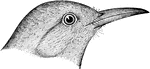
"Bill shorter than head, comparatively stout at base, very acute at tip, the culmen quite convex, the gonys just appreciably concave, Tarsus a little longer that the middle tow an claw. 3d and 4th primaries about equal and longest, 5th and 6th successively slightly shorter, 2 d equal to 7th, 1st equal to penultimae secondary in the closed wing. Entire upper parts, including surfaces of wings and tail, uniform dull pale grayish-brown, with narrow, faintly-rusty edge of the wing-coverts and inner quills, and equally obscure whitish tipping of the tail-feathers. No maxillary nor auricular streaks; no markings about the head except slight speckling on the cheeks. Under parts brownish-white, palest (nearly white) on the belly and throat, more numerous small arrow-head spots on the color of the back. Bill light-colored at base below." Elliot Coues, 1884

Arizona Thrasher

"Bill shorter than head, comparatively stout at base, very acute at tip, the culmen quite convex, the…
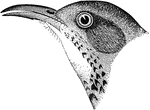
"Upper parts uniform ashy-brown; wings and tail similar, but rather purer and darker brown, the former crossed with two white bars formed by the tips of the coverts, the latter tipped with white. Below dull white, often tinged with rusty, especially behind, and thickly marked with small, sharp, triangular spots of dark brown or blackish. These spots are all perfectly distinct, covering the lower parts excepting the throat, lower belly, and crissum; becoming smaller anteriorly, they run up each side of the throat in a maxillary series bounding the immaculate area. Sides of the head finely speckled, and auriculars streaked; bill black, lightening at base below, little longer than that of H. rufas, though decidedly curved." Elliot Coues, 1884

St. Lucas Thrasher

"Upper parts uniform ashy-brown; wings and tail similar, but rather purer and darker brown, the former…
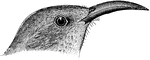
"No spots anywhere; wings and tail without decided barring or tipping. Bill as long as the head or longer, bow-shaped, black. Wings very much shorter that the tail. Above, dark oily olive-brown, the wings and tail similar, but rather purer brown. Below, a paler shade of the color of the upper parts, the belly and crissum strongly rusty-brown, the throat definitely whitish in marked contrast, and not bordered by decided maxillary streaks. Cheeks and auriculars blackish-brown with sharp whitish shaft streaks." Elliot Coues, 1884

California Thrasher

"No spots anywhere; wings and tail without decided barring or tipping. Bill as long as the head or longer,…
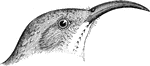
"Brownish-ash, with a faith olive shade, the wings and tail purer and darker fuscous, without white edging or tipping. Below, a paler shade of the color of the upper pats. Throat and side of the lower jaw white, with sharp black maxillary streaks. Cheeks and auriculars speckled with whitish. Under tail-coverts rich chestnut, in marked contrast with the surrounding parts. Bill black, at the maximum of length, slenderness, and curvature; feet blackish." Elliot Coues, 1884

Crissal Thrasher

"Brownish-ash, with a faith olive shade, the wings and tail purer and darker fuscous, without white…
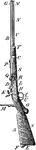
"Gun. A, breech; B, barrel; C, band; D, breech-block; E, butt; F, butt- or heel-plate; G, front sight or bead; H, guard- or trigger-plate; I, guard-bow; K, hammer; L, lock; M, peep-sight; N, N, pipes; O, pistol-grip; P, rear sight; Q, receiver; R, side-screws or -nails; S, S, stock; T, tip; U, trigger; V, wiping-rod." -Whitney, 1911

Parts of the Gun

"Gun. A, breech; B, barrel; C, band; D, breech-block; E, butt; F, butt- or heel-plate; G, front sight…
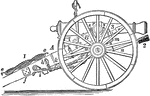
"Field-gun Carriage. A, stock. B, cheek. a, lunette; b, trail-plate; c, c, pointing-rings; d, handle; e, e, prolonge-hooks; f, wheel-guard plate; g, lock-chain bolt, nut, and washer; h, turn buckle, chain, and hasp for sponge and rammer; i, stop for rammer-head; k, ear-plate for worm; l, elevating-screw; m, under-strap; n, implement-hook; o, D-ring for hand-spike; q, trunnion-plate; r, cap-square; s, s, cap-square chains and keys; 1, prolonge; 2, sponge and rammer; 3, hand-spike." -Whitney, 1911

Field Gun Carriage

"Field-gun Carriage. A, stock. B, cheek. a, lunette; b, trail-plate; c, c, pointing-rings; d, handle;…
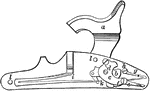
"Gun-lock. a, hammer or cock; b, tumbler; c, bridle; d, bridle-screw; e, sear; f, sear-screw; g, sear-spring; h, sear spring screw; i, main-spring; k, swivel; l, l, side-screws." -Whitney, 1911

Gun Lock

"Gun-lock. a, hammer or cock; b, tumbler; c, bridle; d, bridle-screw; e, sear; f, sear-screw; g, sear-spring;…
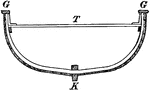
"G, G, gunwale; K, keel; T, thwart. GUNWALE, GUNNEL. Naut., the upper edge of a ship's side; the uppermost wale of a ship, or that piece of timber which reaches on either side from the quarter-deck to the forecastle, being the uppermost bend which finishes the upper works of the hull." -Whitney, 1911

Gunwale

"G, G, gunwale; K, keel; T, thwart. GUNWALE, GUNNEL. Naut., the upper edge of a ship's side; the uppermost…
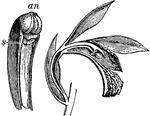
"Gynandria. A, section of flower of Bletia' B, separated column of same, composed of the united style and filaments, bearing the stigma (s) and anthers (an)." -Whitney, 1911

Gynandria of Bletia

"Gynandria. A, section of flower of Bletia' B, separated column of same, composed of the united style…
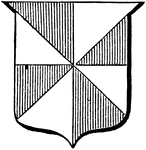
"Gyronny of eight, gules and argent. GYRONNY. In heraldry, dividend into a number of triangular parts of two different tinctures." -Whitney, 1911

Gyronny

"Gyronny of eight, gules and argent. GYRONNY. In heraldry, dividend into a number of triangular parts…
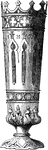

This vase is an a Gothic style. It has stained glass in the center of the perforated parts.

Vase

This vase is an a Gothic style. It has stained glass in the center of the perforated parts.

Color flag of Cape Verde. Five unequal horizontal bands; the top-most band of blue - equal to one half the width of the flag - is followed by three bands of white, red, and white, each equal to 1/12 of the width, and a bottom stripe of blue equal to one quarter of the flag width; a circle of 10, yellow, five-pointed stars, each representing one of the islands, is centered on the red stripe and positioned 3/8 of the length of the flag from the hoist side.
<p>Historically, the name "Cape Verde" has been used in English for the archipelago and, since independence in 1975, for the country. In 2013, the Cape Verdean government determined that the Portuguese designation "Cabo Verde" would henceforth be used for official purposes, such as at the United Nations, even in English contexts.

Flag of Cape Verde, 2009

Color flag of Cape Verde. Five unequal horizontal bands; the top-most band of blue - equal to one half…
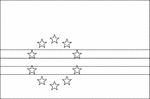
Black and white outline flag of Cape Verde. Five unequal horizontal bands; the top-most band of blue - equal to one half the width of the flag - is followed by three bands of white, red, and white, each equal to 1/12 of the width, and a bottom stripe of blue equal to one quarter of the flag width; a circle of 10, yellow, five-pointed stars, each representing one of the islands, is centered on the red stripe and positioned 3/8 of the length of the flag from the hoist side.
<p>Historically, the name "Cape Verde" has been used in English for the archipelago and, since independence in 1975, for the country. In 2013, the Cape Verdean government determined that the Portuguese designation "Cabo Verde" would henceforth be used for official purposes, such as at the United Nations, even in English contexts.

Flag of Cape Verde, 2009

Black and white outline flag of Cape Verde. Five unequal horizontal bands; the top-most band of blue…
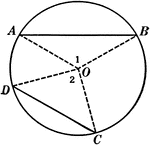
Illustration used to show that "In equal circles, or in the same circle, if two chords are unequal, the greater chord subtends the greater minor arc; conversely, if two minor arcs are unequal, the chord that subtends the greater arc is the greater."

Unequal Chords in Circles Theorem

Illustration used to show that "In equal circles, or in the same circle, if two chords are unequal,…
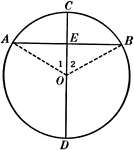
Illustration used to show that "The diameter perpendicular to a chord bisects the chord and also its subtended arc."

Diameter Perpendicular to a Chord in a Circle

Illustration used to show that "The diameter perpendicular to a chord bisects the chord and also its…
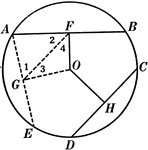
Illustration used to show that "In equal circles, or in the same circle, if two chords are unequal, the greater chord is at the less distance from the center."

Unequal Chords in Equal Circles Theorem

Illustration used to show that "In equal circles, or in the same circle, if two chords are unequal,…
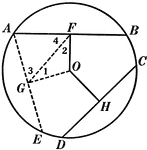
Illustration used to show that "In equal circles, or in the same circle, if two chords are unequal, the greater chord is at the less distance from the center."

Unequal Chords in Equal Circles Theorem

Illustration used to show that "In equal circles, or in the same circle, if two chords are unequal,…
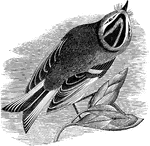
"Upper parts olive-green, more or less bright, sometimes rather olive-ashy, always brightest on the rump; under parts dull ashy-white or yellowish-white. Wings and tail dusky, strongly edged with yellowish, the inner wing-quills with whitish. On the secondaries, this yellowish edging stops abruptly in advance of the ends of the coverts, leaving a pure blackish interval in advance of the white tips of the greater coverts: this, and the similar tips of the median coverts, form two white bars across the wings; inner webs of the quills and tail feathers edged with white. Supercilary line and extreme forehead hoary-whitish. Crown black, enclosing a large space, the middle of which is flame colored, bordered with pure yellow. The black reaches across the forehead; but behind, the yellow flame-color reach the general olive of the upper parts. Or, the top of the head may be described as a central bed of flame-color, bounded in front and on the sides with clear yellow, this similarly bounded by black, this again in the same manner by hoary-whitish. Smaller than R. calendula; overlying nasal plumes larger." Elliot Coues, 1884

Golden Crested Kinglet

"Upper parts olive-green, more or less bright, sometimes rather olive-ashy, always brightest on the…
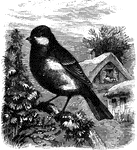
"Head not crested. Wings and tail rounded, of approximately equal lengths, and about as long as the body. Bill typically parine." Elliot Coues, 1884. Head and neck are black; cheeks and ear coverts are white; male has a thick black strip going through its yellow breast; upper parts are olive; and outer tail feathers and wing bars are white

European Greater Titmouse

"Head not crested. Wings and tail rounded, of approximately equal lengths, and about as long as the…
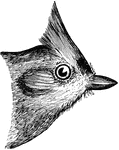
"Entire upper parts ashy, the back usually with a slight olivaceous shade, the wings and tail rather purer and darker plumberous, the latter sometimes showing obsolete transverse bars. Sides of the head and entire under parts dull whitish, washed with chestnut-brown on the sides. A black frontlet at the base of the crest. Bill plumbeous-blackish; feet plumbeous." Elliot Coues, 1884

Tufted Titmouse

"Entire upper parts ashy, the back usually with a slight olivaceous shade, the wings and tail rather…
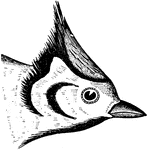
"Upper parts olivaceous-ash, wings and tail darker, edged with the color of the back, or even a brighter tint, sometimes nearly as yellowish as in Regulus. Under parts sordid ashy-white. Crest-black, with a central field like the back. Whole throat black, as in species of parus. A black line runs behind the eye and curves down over the auriculars, distinguished from the black of the crest and throat by the white of the side of the head and white superciliary stripe; a half-collar of black on the nape, descending on the sides of the neck, there separated from the black crescent of the auriculars by a white crescent, which latter is continuous with the white on the superciliary line; considerable whitish speckling in the black of the forehead and lores. Bill blackish-plumbeous; feet plumbeous." Elliot Coues, 1884

Bridled Titmouse

"Upper parts olivaceous-ash, wings and tail darker, edged with the color of the back, or even a brighter…
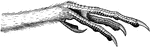
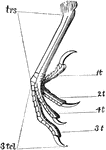
"Feathered tarsus of a Grouse, Cupidonia cupido" Elliot Coues, 1884

Feathered Tarsus of a Grouse

"Feathered tarsus of a Grouse, Cupidonia cupido" Elliot Coues, 1884

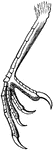
"Booted laminiplanter tarsus of a Robin" Elliot Coues, 1884

Booted Laminiplanter Tarsus of a Robin

"Booted laminiplanter tarsus of a Robin" Elliot Coues, 1884

"Figure shows Scutellate laminiplanter tarsus of a cat-bird. A tarsus so disposed as to its podotheca is said to be scutellate - scutellate before (fig 37), or behind, or both, as the case may be. ." Elliot Coues, 1884

Scutellate Laminiplanter Tarsus of a Cat-bird

"Figure shows Scutellate laminiplanter tarsus of a cat-bird. A tarsus so disposed as to its podotheca…
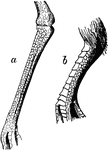
"Fig 38 a, Reticulate tarsus of a Plover. b, Scutellate and reticulate tarsus of a pigeon." Elliot Coues, 1884

Reticulate Tarsus of a Plover

"Fig 38 a, Reticulate tarsus of a Plover. b, Scutellate and reticulate tarsus of a pigeon." Elliot Coues,…
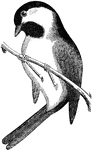
"Crown and nape, with chin and throat, black, separated by white sides of the head. Upper parts brownish-ash, with slight olive tinge, and a rusty wash on rump. Under parts more or less purely white or whitish, shaded on the sides with a brownish or rusty wash. Wings and tail like upper parts, the feathers moderately edged with hoary-white." Elliot Coues, 1884

Black-capped Chickadee

"Crown and nape, with chin and throat, black, separated by white sides of the head. Upper parts brownish-ash,…
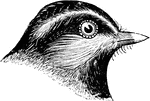
"Upper part ashy-gray, with scarcely a shade, and only on the rump, under parts similarly grayish-white, without a rusty tinge, the middle of the belly, the rest more heavily shaded. Wings and tail with comparatively little whitish edging - tail at least with no more than that of P. carolonensis. Sides of the head and neck white; top of the head, and the throat, black. A conspicuous white superciliary stripe in the black cap, usually meeting its fellow across the forehead." Elliot Coues, 1884

Mountain Chickadee

"Upper part ashy-gray, with scarcely a shade, and only on the rump, under parts similarly grayish-white,…
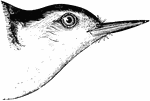
"Upper parts, central tail-feathers, and much edging of the wings, clear ashy-blue; whole crown, nape, and back of the neck, glossy black. Under parts, including sides of neck and head to above eyes, dull white, more or less marked on the flanks and crissum with rusty-brown. Wings and their coverts blackish, much edged as already said, and with an oblique bar of white on the outer webs of the primaries white; under wing-coverts mostly blackish; bold bluish and black variegation of the inner secondaries. Tail, excepting the two middle feathers, black, each feather marked with white in increasing amount, the outer web of the lateral feather being mostly white. Bill blackish-plumbeous, pale at the base below. Feet dark brown. Iris brown." Elliot Coues, 1884

White-Breasted Nuthatch

"Upper parts, central tail-feathers, and much edging of the wings, clear ashy-blue; whole crown, nape,…
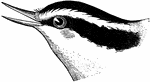
"Upper parts leaden-blue the central tail-feathers the same; wings fuscous, with slight ashy edgings and concealed white bases of the primaries. Entire under parts rusty-brown, very variable in shade, from rich fulvous to brownish-white, usually palest on the throat, deepest on the sides and crissum; tail-feathers, except the middle pair, black, the lateral marked with white. Whole top and side of head and neck glossy black, that of the side appearing as a broad bar through the eye from bill to side of neck, cut off from that of the crown by a long white superciliary stripe, which meets its fellow across the forehead. Bill dark plumbeous, paler below; feet plumbeous-brown." Elliot Coues, 1884

Red-breasted Nuthatch

"Upper parts leaden-blue the central tail-feathers the same; wings fuscous, with slight ashy edgings…
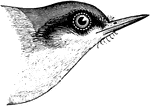
"No black cap or white stripe on head. Upper parts dull ashy-blue; under parts sordid or muddy whitish. Cap clear hair-brown. A decided spot white on the middle of the nape, in the brown cap, which on the sides of the head includes the eyes, and is bordered with dusky. Middle tail-feathers like back, without black, and with little or no white." Elliot Coues, 1884

Brown-headed Nuthatch

"No black cap or white stripe on head. Upper parts dull ashy-blue; under parts sordid or muddy whitish.…
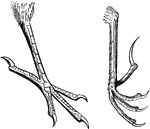
"Fig. Typical passerine feet. The right hand fig. is plectrophanes lapponicus." Elliot Coues, 1884
Typical Passerine Bird Feet

"Fig. Typical passerine feet. The right hand fig. is plectrophanes lapponicus." Elliot Coues, 1884

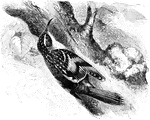
"Common Brown Creeper. Upper parts dark brown, changing to rusty-brown on the rump, everywhere streaked with ashy-white. An obscure whitish superciliary stripe. Under parts dull whitish, sometimes tinged with rusty on the flanks and crissum. Wing-coverts and quills tipped with white, the inner secondaries also with white shaft-lines, which, with the tips, contrast the blackish of their outer webs. Wings also crossed with white or tawny-white, the anterior bar broad and occupying both webs of the feathers, the other only on the outer webs near their ends. Tail grayish-brown, darker along the shaft and at the ends of the feathers, sometimes showing obsolete transverse bars. Bill blackish above, mostly flesh-colored or yellowish below; feet brown; iris dark brown." Elliot Coues, 1884

Common Brown Creeper

"Common Brown Creeper. Upper parts dark brown, changing to rusty-brown on the rump, everywhere streaked…
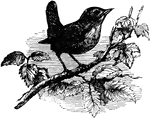
"European Wren. Feet strictly laminiplanter, as usual in Oscines. Tail thin, with narrow parallel-edged feathers. Wings and tail more or less completely barred cross-wise. Large. Upper parts uniform in color, without streaks or bars; rump with concealed white spots. Belly unmarked; a conspicuous superciliary stripe." Elliot Coues, 1884

European Wren

"European Wren. Feet strictly laminiplanter, as usual in Oscines. Tail thin, with narrow parallel-edged…
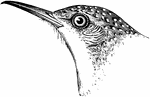
"Upper parts pale brownish-gray, minutely dotted with blackish and whitish points together, and usually showing obsolete wavy bars of dusky. Rump cinnamon-brown; a whitish superciliary line. Beneath, soiled white, shading behind into pale cinnamon, the throat and breast obsoletely streaked, and the under tail-covers barred, with dusky. Quills of the wings rather darker than the back, with similar markings on the outer webs. Middle tail-feathers like the back, with many dark bars of equal width with the lighter ones; lateral tail-feathers similarly marked on the outer webs, plain on the inner webs, with a broad subterminal black bar on both webs, and cinnamon-brown tips, the latter usually marbled with dusky; outer feathers with several blackish and cinnamon bars on both webs. Bill and feet dark horn color, the former paler at base below." Elliot Coues, 1884

Rock Wren

"Upper parts pale brownish-gray, minutely dotted with blackish and whitish points together, and usually…
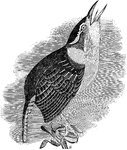
"Carolina Wren. Upper parts uniform reddish-brown, brightest on the rump, where are concealed whitish spots; a long whitish superciliary line, usually bordered with dusky streaks; upper surfaces of wings and tail like back, barred with dusky, the outer edges of the primaries and lateral tail-feathers showing whitish spots. Below, rusty or muddy whitish, clearest anteriorly, deepening behind, the under tail-coverts reddish-brown barred with blackish. Wing-coverts usually with dusky and whitish tips. Feet livid flesh-colored." Elliot Coues, 1884

Carolina Wren

"Carolina Wren. Upper parts uniform reddish-brown, brightest on the rump, where are concealed whitish…