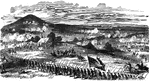
"Battle of Cedar Mountain, fought Saturday, August 9th, 1862, between the Federal troops commanded by General Banks and the Confederate Army led by Generals Jackson, Ewell, Winder, etc.- final repulse of the Confederates. General Pope's report of the battle is as follows: "On Saturday, August 9th, 1862, the enemy advanced rapidly to Cedar Mountain, the sides of which they occupied in heavy force. General Banks was instructed to take up his position on the ground occupied by Crawford's brigade, of his command, which had been thrown out the day previous to observe the enemy's movements. He was directed not to advance beyond that point, and if attacked by the enemy to defend his position and send back timely notice. The artillery of the enemy was opened early in the afternoon, but he made no advance until nearly five o'clock, at which time a few skirmishers were thrown forward on each side under cover of the heavy wood in which his force was concealed. The enemy pushed forward a strong force in the rear of his skirmishers, and General Banks advanced to the attack. The engagement did not fairly open until after six o'clock, and for an hour and a half was furious and unceasing. I arrived personally on the field at 7 P.M., and found the action raging furiously. The infantry fire was incessant and severe. I found General Banks holding the position he took up early in the morning. His losses were heavy. Ricketts's division was immediately pushed forward and occupied the right of General Banks, the brigades of Crawford and Gordon being directed to change their position from the right and mass themselves in the centre. Before this change could be effected it was quite dark, though the artillery fire continued at short range without intermission. The artillery fire, at night, by the Second and Fifth Maine batteries in Ricketts's division of General McDowell's corps was most destructive, as was readily observable the next morning in the dead men and horses and broken gun carriages of the enemy's batteries which had been advanced against it. Our troops rested on their arms during the night in line of battle, the heavy shelling being kept up on both sides until midnight. At daylight the next morning the enemy fell back two miles from our front, and still higher up the mountain."" —Leslie, 1896

Battle of Cedar Mountain

"Battle of Cedar Mountain, fought Saturday, August 9th, 1862, between the Federal troops commanded by…
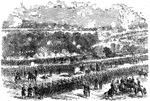
"Battle of Malvern Hill, near Turkey Bend, James River, Va., fought Tuesday, July 1st, 1862. The battle of Malvern Hill commenced with the advance of a large body of Confederates, extending quite across the country, with cavalry on each flank. The Federals at once jumped up wearily, and waited their appraoch, while all the signal officers, on their several stations, waved their cabalistic muslin. The Federal column was formed with General Couch, of General Keyes's corps, on the extreme left; Franklin and Heintzelman took up the centre, and on the right were the remnants of Porter and Sumner. Burns's brigade, being ordered to charge, advanced with the sixty-ninth Pennsylvania Regiment (Irish), Colonel Owen, and being gallantly seconded by Dana's, Meagher's and French's brigades, they dashed within fifty yards of the enemy and opened a splendid fire of musketry. The left of the line was now advanced, and the troops of General Couch really behaved wonderfully, facing the enemy wherever he appeared, and pouring volleys into him all the time. After fighting two hours, with a loss of about 400, the night fell, and having moved across Turkey Island Creek, they broke up the bridge, and soon the whole army closed up at and near Harrison's Bar, twenty-seven miles from Richmond." —Leslie, 1896

Battle of Malvern Hill

"Battle of Malvern Hill, near Turkey Bend, James River, Va., fought Tuesday, July 1st, 1862. The battle…
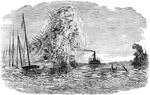
"Removing sunken schooners from Core Sound, N. C., placed to obstruct the passage of the Federal gunboats, under the superintendence of Captain Hayden, of the New York Submarine Engineering Company. The perverse ingenuity which the Confederates showed in obstructing the channels which led to their strongholds was only exceeded by the persistent ingenuity with which the Federal officers removed them. The Confederates obstructed the channel of Core Sound by sinking schooners; but under the superintendence of Captain Hayden, of the New York Submarine Engineering Company, they were removed by blasting. The shock was perceptibly felt a considerable distance, and it was some time before the water resumed its usual appearance." —Leslie, 1896

Schooners

"Removing sunken schooners from Core Sound, N. C., placed to obstruct the passage of the Federal gunboats,…
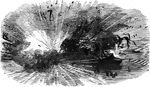
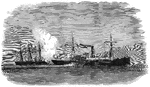
"Destruction of the Confederate ironclad steamer <em>Merrimac</em>, blown up by its commander, on the morning of May 11th, 1862. The abandonment of Norfolk compelled the evacuation of the Confederate positions at Sewell's Point and at Crany Island, and on May 11th, 1862, the <em>Merrimac</em> was blown up to prevent her falling into the hands of the Federals. The Federal officers who witnessed the burning and blowing up of the <em>Merrimac</em> described the scene as one of the grandest imaginable. For nearly an hour before the explosion the roof was red hot, and at short intervals the guns would discharge themselves, solemnly breking in upon the stillness of the night. Just at the first dawn of daylight the whole black mass heaved upward, then came the report, so terrific as to shake houses at a distance of eight miles. With a flash, an unearthly hissing sound, and the great monster, the <em>Merrimac</em>, ceased to exist." &mdash;Leslie, 1896

Destruction of Merrimac

"Destruction of the Confederate ironclad steamer Merrimac, blown up by its commander, on the…
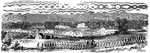
"Battle of Cross Keys, Sunday June 8th, 1862- centre and front of the Federal army in the engagement. We illustrated the opening of this battle on page 159, and now add a sketch of the centre and front of the Federal army in the engagement, described by our correspondent, as follows: "General Melroy had the centre, and pressed steadily forward from the ground where he first took position, planting his guns each time nearer the enemy's batteries. His artillery delivered its fire with a precision truly remarkable. The ground where the enemy's guns were planted was furrowed with our shot and shell as with a plow, and where one battery stood I counted twelve dead horses. General Melroy's infantry deployed through the woods, taking advantage of a deep gully to cross a wheatfield, where they were exposed, and charged gallantly up the hill, where one of the opposing batteries was planted, cutting down the gunners with their fire. Had they been supported they would have captured a battery. They made the crest of the hill too hot to hold on the part of the enemy, and held their position until recalled." &mdash;Leslie, 1896

Battle of Cross Keys

"Battle of Cross Keys, Sunday June 8th, 1862- centre and front of the Federal army in the engagement.…
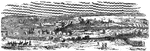
"The Confederate forces under General Jackson advancing upon the Rapphannock Station at the river. Federal batteries replying to the Confederate artillery, August 23rd, 1862, being the commencement of the battles ending at Bull Run, August 30th. Our correspondent reported as follows: "The fight was opened by our batteries in front of the hill and woods on the centre and left. It was immediately replid to by the enemy's batteries in the orchard and along the crest of the hill, about three-quarters of a mile distant. After the artillery fighting had lasted some time, our infantry attacked the enemy's left flank. The fighting, however, was very severe. Huge columns of yellow smoke rolled up from the roads. The faint rattle and roll of distant musketry came across the open fields, interrupted occasionally by the boom of a heavy gun. Meanwhile, the enemy was making a very serious attempt to turn our left. Part of General McDowell's corps was sent to drive them back. They moved in solid column across the field from the right, while the enemy in overpowering force was pushing our small number back. The fighting was terriblly fierce at this point, the enemy throwing all their force on this flank. Our men retired across the field in the foreground and into the woods. On the right the enemy was driven from its position." —Leslie, 1896

Commencement of Bull Run

"The Confederate forces under General Jackson advancing upon the Rapphannock Station at the river. Federal…
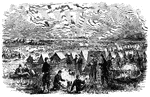
"Camp Zagonyi, encampment of Fremont's army on the prairie, near Wheatland, Mo., October 14th, 1861. This spot, where Fremont's army rested after their first day's march from Tipton, is on the vast prairies of Missouri, about fifteen miles from Tipton and two miles from Wheatland. The Grand Army of the West here pitched their tents on the afternoon of the 14th of October, 1861. A brilliant sunset fell over the whole, which looked more like a monster picnic than the advanced corps of an army bent on the destruction of traitorous brothers. The rapidity with which the evening's meal for a marching regiment is prepared has something of the marvelous in it. Appetite quickens practice, and the air is soon filled with the savory aromas of culinary processes. Then comes the hearty enjoyment of food which at another time would be passed by, but which now, under the appetizing provocative of hunger, is thankfully received. Not the least of a soldier's trials is the inroad a long march and privation makes upon that fastidiousness which plenty to eat engenders in the human diaphragm. The camp was called after the colonel of General Fremont's bodyguard, whose gallant achievements at Springfield on the 25th of October we have recorded." &mdash;Leslie, 1896

Camp Zagonyi

"Camp Zagonyi, encampment of Fremont's army on the prairie, near Wheatland, Mo., October 14th, 1861.…
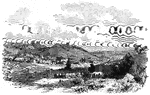
"Village of Clarksburg, Western Virginia, headquarters of General Rosecrans. Clarksburg, a post village, capital of Harrison County, is situated on the west fork of the Monongahela River, at the mouth of Elk Creek, about two hundred and twenty miles northwest of Richmond. It is built on a high tableland environed by hills. It had in 1861 several churches, academies, two printing offices and many fine stores. Stove coal abounded in its vicinity. The Northwestern Railroad, a branch of the Baltimore and Ohio, passed through it. It has about two thousand inhabitants. For a short time Clarksburg was the headquarters of General Rosecrans. The situation was briefly this: The Cheat Mountain Gaps, the key to the whole country, were held by a strong force, a portion of General Reynolds's brigade, the remainder of which was stationed at Bevery, Huttonsville, and in that vicinity. Other portions of General Rosecrans's command were scattered over almost the whole northwestern part of Virginia, guarding the railroad lines from Wheeling and Parkersburg down to Grafton, and then eastward through the Cheat River country, Oakland, Altamont, and almost to Cumberland, occupying the Kanawha Valley by General Cox's brigade, and holding towns like Weston, Buckhannon, Summerville, Philippi and Bealington." —Leslie, 1896

Village of Clarksburg

"Village of Clarksburg, Western Virginia, headquarters of General Rosecrans. Clarksburg, a post village,…
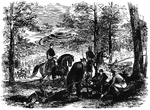
"Battle of Carrick's Ford, Western Virginia- discovery of the body of General Garnett, by Major Gordon and Colonel Dumont, after the battle. After the Confederates had crossed the fourth ford General Garnett again endeavored to rally his men, standing waving his hand on an exposed point near the river bank, by his side only one young man (Chaplet), wearing the uniform of the Georgia Sharpshooters. Three of Dumont's men fired at the same time, and Garnett and his companion fell at the first round. The men rushed across, and on turning the body discovered that the Confederate leader of Western Virginia had paid the penalty; he was shot through the heart. Major Gordon, U.S.A., closed his eyes reverently, and Colonel Dumont, coming up, had him carried into a grove close by, where they laid him down, taking care of his sword and watch, to be sent with his body to his family." —Leslie, 1896

Battle of Corrick's Ford

"Battle of Carrick's Ford, Western Virginia- discovery of the body of General Garnett, by Major Gordon…
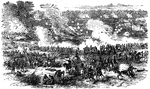
"Battle of White Oak Swamp Bridge, Monday June 30th, 1862- Ayres's, Mott's and Randall's batteries checking the advance of the Confederates. After the battle of Savage's Station the Federals continued on their retreat, and by eight o'clock on the morning of June 30th, 1862, they had crossed White Oak Swamp and Creek, after destroying the bridge over the latter and warding off the repeated attacks to which they were subjected throughout the night. After crossing White Oak Creek the Federals had quickly formed a new line of battle at Willis Church, General Hancock's forces being on the extreme right, while Porter's occupied the left, and Heintzelman's and Sumner's the intervening space. Jackson's advance was checked by the destruction of the bridge, and when he reached the creek, at about noon, he found the approaches well defended by artillery. Jackson opened upon Hancock's troops, and made repeated efforts to rebuild the bridge under cover of his heavy artillery, but he was every time repulsed. While this was going on Longstreet and Hill had come upon a Federal force at a place two miles away, called Frazier's Farm. Here stood Sumner and Hooker, on the extreme right, McCall somewhat in advance toward the centre and Kearny on the extreme left. When Longstreet found this force arrayed against him he waited for re-enforcements to come up, and it was four o'clock when he commenced the attack. McCall's left was first assailed by Kenper's brigade, which was met by the Pennsylvania Reserves under Colonel Simmons, who, after a bitter conflict, drove the Confederates into the woods with a loss of 250 killed and wounded and about 200 prisoners. Fresh troops then enabled the Confederates to drive back the Federals, who in turn lost heavily. Longstreet and Hill now pressed on, and the conflict became a severe one along the entire front. One point, then another, was vainly tried in the determined effort to break the Federal line. At length Wilcox's Alabama Brigade rushed across an open field upon McCall's left, directly against Randall's battery, which centered upon the Confederates a most galling fire. Nothing daunted, they moved on, and finally engaging in a desperate hand-to-hand fight, first captured Cooper's battery, and afterward Randall's battery, which had been doing such terrible execution. A charge was then ordered for the recapture of the guns. The Confederates bravely met the severe attacks that followed. A still more desperate hand-to-hand struggle took place for the possession of the lost batteries, which were finally recaptured. By dark the Confederates had retired into the woods, and the Federals remained on that portion of the field which they had lost earlier in the action. The Federal loss was about 1,800 killed and wounded, whilst that of the Confederates was over 2,000. Colonel Simmons and General Meade were both severely wounded, while General McCall was a made prisoner." —Leslie, 1896

Battle of White Oak Swamp Bridge

"Battle of White Oak Swamp Bridge, Monday June 30th, 1862- Ayres's, Mott's and Randall's batteries checking…
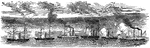
"Engagement between the United States gunboats, commanded by Commodore Davis, and the Confederate Mosquito Fleet, under Commodore Tatnall, near Fort Pulaski, Savannah River, January 28th, 1862. Our artist described this spirited sketch as follows: 'On Monday night Lieutenant Barnes was dispatched in the <em>Ottawa's</em> gig to scout up the creek and report. Passing the piles with ease, he pulled silently up the stream with muffled oars, and with no opposition succeeded in reaching the mouth of the creek where it enters the Savannah River. He came upon the fleet of Tatnall lying there, and approached near enough to see the watch on deck. As he was too near them in case they discovered him, and as he had accomplished the object of reconnoisance, he returned and reported the facts to Captain Davis. On Tuesday forenoon Tatnall's fleet was again discovered standing down the Savannah. We beat to quarters, and when the flagship had got within range we opened on her with an eleven-inch gun from the <em>Ottawa</em>. The signal for action having been given, the gunboats opened fire. The Confederates returned a few shots, which fell short. The engagement lasted nearly two hours, during which time the Confederate Flagship was struck three times, seriously damaging her. One eleven-inch shell struck her on her wheelhouse, and so much disabled her as to compel the commander to signal for assistance, and one steamer turned round and went to her aid. The other three steamed down toward Fort Pulaski faster than they ever went before.'" &mdash;Leslie, 1896

Gunboat engagement

"Engagement between the United States gunboats, commanded by Commodore Davis, and the Confederate Mosquito…
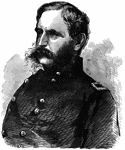
"General Augur, born in New York in 1821, was graduated from the United States Military Academy in 1843. During the Mexican War he served as aid-de-camp to General Hopping, and after his death to General Caleb Cushing. He was promoted captain, August 1st, 1852, and served with distinction in a campaign against the Indians in Oregon in 1856. On May 14th, 1861, he was appointed major in the Thirteenth Infantry, and was for a time commandant of cadets at West Point. In November of that year he was commissioned a brigadier general of volunteers, and joined McDowell's corps. In July, 1862, he was assigned to a division under Banks, and in the battle of Cedar Mountain was severely wounded. He was promoted major general of volunteers, August 9th, 1862, and in November joined his corps and took part in the Louisiana campaign. He was breveted brigadier-general in the United States Army, March 13th, 1865, receiving on the same date the brevet of major-general for services in the field during the rebellion." &mdash;Leslie, 1896

General Christopher C. Augur

"General Augur, born in New York in 1821, was graduated from the United States Military Academy in 1843.…
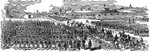
"Advance of the Army of the Potomac. Occupation of Winchester, VA., and the abandoned Confederate Fortifications, by a detachment of General Banks's Deivision of the Federal Army, consisting of the brigades of Generals Hamilton and Williams, March 12th, 1862. Our sketch represents the advance of the Federal troops upon the City of Winchester, and is thus described by our correspondent: 'A portion of General Banks's Division, under General Gorman, occupied the town of Berryville, VA., on the 11th. There were five hundred of the Confederate cavalry in the place, but upon the Third New York Cavalry, properly supported by artillery and infantry, charging them, they fled in confusion toward Winchester. During the night the pickets of General Gorman came in contact with a portion of Colonel Ashby's Confederate cavalry, and were compelled to fall back, but the general made a reconnoissance in force to within two miles of Winchester, and, charging upon the Confederates dispersed them, taking several prisoners, and killing or wounding four of the Confederates. This reconnoissance sealed the fate of Winchester. The enemy were blinded and misled by the movement of our troops, and they commenced the evacuation of the place on the afternoon of the 12th. General Hamilton advanced from Bunker hill, the Michigan Cavalry heading the column. The Confederate Cavalry, one thousand two hundred strong, and supported by a section of artillery, gave battle at five o'clock in the afternoon. Our cavalry was supported by the First maryland Infantry, and a battery of artillery. The fight was a short one. The Confederates fled, leaving their guns behind them, and at daylight on the 12th our troops entered the city as the rear guard of the enemy was flying out of it.'"— Frank Leslie, 1896

Army of the Potomac

"Advance of the Army of the Potomac. Occupation of Winchester, VA., and the abandoned Confederate Fortifications,…
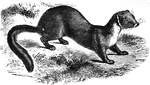
"Its head is somewhat triangular , the muzzle pointed, the eyes prominent and lively; the body much elongated and very flexible; the tail long, thick, and bushy; the toes naked, but at times, probably in winter, covered beneath with think soft hair. The fur is of two corts - the inner extremely soft, short, copious, and of a light, yellowish-gray color; the outer very long, shining, ash-colored at the roots, brown at hte extremity, but of different degrees of intensity at different parts of the body." &mdash; S. G. Goodrich, 1885

Marten

"Its head is somewhat triangular , the muzzle pointed, the eyes prominent and lively; the body much…
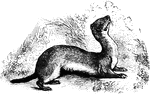
An animal of the genus Mustela, having a long slender body, short legs, long slender tail, and light colored fur.

Weasel

An animal of the genus Mustela, having a long slender body, short legs, long slender tail, and light…
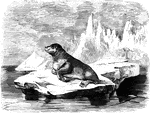
"It is the size of a large bear; girth at the sholder, five feet, near the tail, twenty inches; fur brown. acquiring a grayish tint at the point of the hairs in old age; external ears one inch eight lines long, conical, erect, covered with short hair, and open by an oblong slit, which is shut in the water; nail very slender and minute." &mdash; S. G. Goodrich, 1885

Sea Bear

"It is the size of a large bear; girth at the sholder, five feet, near the tail, twenty inches; fur…
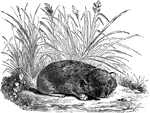
"It has a head loner than usual with hares, and thickly covered with cur, even the tip of the nose; numerous hairs in the wiskers; ears not long but rounded; legs very short; soles furred beneath: its whole coat very soft, long, and smooth, with a thich, long, fine down beneath of a brownish lead-color. " &mdash; S. G. Goodrich, 1885

Calling Hare

"It has a head loner than usual with hares, and thickly covered with cur, even the tip of the nose;…
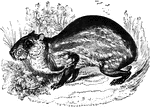
"This animal, which is found in Brazil and the adjacent countries, and which once exsisted in the West Indies, has a thickset, stubby appearance, with a clumbsy gate, though its movements are prompt and sudden. The fur is composed of silky hairs, very short, thin, stiff, of a blackish-brown on all the upper parts of the body, exepting four rows of parallel spots." &mdash; S. G. Goodrich, 1885

Brown Paca

"This animal, which is found in Brazil and the adjacent countries, and which once exsisted in the West…
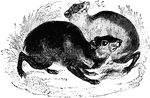
"Is considerably smaller than the common agouti, being about the size of a rabbit, while the species approaches the dimensions of the hare. Its general proportions and form, however, are the same; but the hairs of the back and sides, instead of being annulated with various-colored rings as in that species, are nearly uniform black, while the long hairs of the croup are perfectly so; the belly and legs are equally covered with short dark hair. " &mdash; S. G. Goodrich, 1885

Black Agouti

"Is considerably smaller than the common agouti, being about the size of a rabbit, while the species…
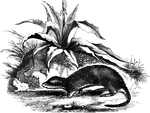
"This is the size of a rabbit, of a brown color, with short legs and a long body, covered with short spines of nearly uniform length. The tail, medium length, is covered with similar spines." &mdash; S. G. Goodrich, 1885

Swinder's Aulacoe

"This is the size of a rabbit, of a brown color, with short legs and a long body, covered with short…
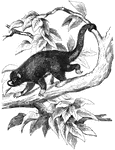
"Of this genus there are several species, all of which are clmbers, with a prehensile tail partly naked. They are covered with short, sharp spines, concealed by the hair." &mdash; S. G. Goodrich, 1885

Couiy

"Of this genus there are several species, all of which are clmbers, with a prehensile tail partly naked.…
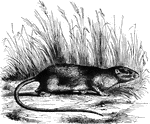
Cayenne Echimys, or spiny rat. Has a stout body, thick muzzle, short ears, long tail, and ample hair.
Spiny Rat

Cayenne Echimys, or spiny rat. Has a stout body, thick muzzle, short ears, long tail, and ample hair.

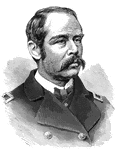
"General Barlow, born in Brooklyn, N. Y., October 18th, 1834, was graduated at Harvard in 1855. In 1861 he enlisted as a private in the Twelfth Regiment, New York State National Guard, and went to the front of the first call for troops to defend the capital. At the end of the three months' term of service he had been promoted lieutenant. He at once re-entered the service as lieutenant colonel of the Sixty-first New York Volunteers, was promoted colonel during the siege of Yorktown, and distinguished himself at the battle of Fair Oaks, May 31st and June 1st, 1862, for which he was severely wounded and taken prisoner; but he was exchanged, and recovered in time to take the field again the following spring. He also participated inthe final campaigns of the Potomac Army under General Grant."&mdash; Frank Leslie, 1896

General Francis C. Barlow

"General Barlow, born in Brooklyn, N. Y., October 18th, 1834, was graduated at Harvard in 1855. In 1861…
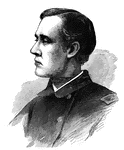
"General Sharpe, born in Kingston, N. Y., February 26th, 1828, was graduated at Rutgers in 1847; studied law at Yale College; was admitted to the bar in 1854, and practiced until he entered the army in 1861 as captain in the Twentieth New York Infantry. He became colonel of the One Hundred and Twentieth New York Infantry in 1862, and took part in all the battles of the Army of the Potomac. He served upon the staffs of Generals Hooker, Meade and Grant, and was brevetted brigadier general in 1864 and major general in 1865. He was attached to the United States Legation at Vienna in 1851, and was a special agent of the State Department in Europe in 1867. In 1870-'73 he was United States Marshal for the Southern District of New York, and took the census that demonstrated the great election frauds of 1868 in New York city, which led to the enforcement of the Federal election laws for the first time in 1871."&mdash; Frank Leslie, 1896

General George H. Sharpe

"General Sharpe, born in Kingston, N. Y., February 26th, 1828, was graduated at Rutgers in 1847; studied…
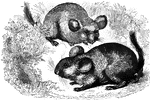
"It is of a grayish color, and sufficiently long for spinning. The little animal which is produces it is size inches long from nose to the root of its tail, with small pointed ears, a short muzzle, teeth like the house-rat, and a tail of moderate length, clothed with delicate fur. It live sin burrows underground and is very fond of being in company with others of its species." &mdash; S. G. Goodrich, 1885

Chinchillas

"It is of a grayish color, and sufficiently long for spinning. The little animal which is produces it…
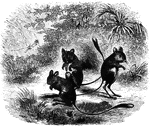
"These animals have the head large and rabbit-like; the ears long and pointed; the eyes full; the tail very long, covered with short hair and tufted at the end, this member being used in leaping and walking; the fur soft and delicate; the fore-feet are very small; the hind legs are long, and the hind feet large and strong, and covered with hair." &mdash; S. G. Goodrich, 1885

Jerboas

"These animals have the head large and rabbit-like; the ears long and pointed; the eyes full; the tail…
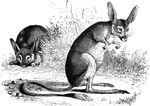
"These animals have the head large and rabbit-like; the ears long and pointed; the eyes full; the tail very long, covered with short hair and tufted at the end, this member being used in leaping and walking; the fur soft and delicate; the fore-feet are very small; the hind legs are long, and the hind feet large and strong, and covered with hair." &mdash; S. G. Goodrich, 1885

Jerboas

"These animals have the head large and rabbit-like; the ears long and pointed; the eyes full; the tail…
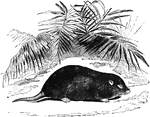
"These animals have a long body, small eyes, and short tails, and resemble mole-rats" &mdash; S. G. Goodrich, 1885

Malacca Rhizomys

"These animals have a long body, small eyes, and short tails, and resemble mole-rats" — S. G.…
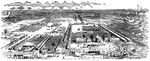
"Bird's-eye view of Camp Douglas, Chicago, Ill., used for the detention of Confederate prisoners in 1862. At the commencement of the Civil War, in 1861, a Camp of Instruction was formed near Chicago, which, in honor of the 'Little Giant,' was called Camp Douglas. Here many of the Western regiments were drilled to that state of efficiency which has borne such glorious fruits as the victories of Fort Donelson and Pittsburg Landing. In the latter part of 1862 it was converted into a prison for Confederate prisoners, over eight thousand having been confined there at one time. They were chiefly Alabamians, Mississippians and Texans. Our sketch shows the vast barracks erected on the drill grounds in 1862."&mdash; Frank Leslie, 1896

Camp Douglas

"Bird's-eye view of Camp Douglas, Chicago, Ill., used for the detention of Confederate prisoners in…
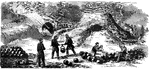
"Interior of the Mortar Battery Stanton, Tybee Island, Ga., showing the operation of 13-inch mortars during the bombardment of Fort Pulaski, April 10th, 1862. The works erected were eleven batteries, with a parapet in front eight feet high, with a bomb-proof traverse between every two guns, the sides of the parapets and traverses being riveted with rods, fascines or hurdle works. The mortars fire over the parapets, and the guns through embrasures cut in the parapets. The batteries nearest to Fort Pulaski were connected with trenches to permit a safe communication between them. All the advanced batteries had splinter-proof shelters, and each one three reliefs, so that two of them were all the time under shelter. These advanced batteries had also a bomb-proof surgery, supplied with a table and all requisites for surgical operations, and each battery had also a well of water. In a word, the admirable manner in which these works were constructed and arranged stamped General Gilmore as one of the greatest engineers of the age Mortar Battery Stanton had three 13-inch mortars, each weighing 17,120 pounds, with a range of 3,476 yards."&mdash; Frank Leslie, 1896

Mortar Battery Stanton

"Interior of the Mortar Battery Stanton, Tybee Island, Ga., showing the operation of 13-inch mortars…
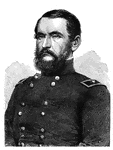
"General Peck, born at Manlius, N. Y., January 4th, 1821, died at Syracuse, n. Y., April 28th, 1978, was graduated from the United States Military Academy in 1843, and commissioned a brevet second lieutenant of artillery. Served in the Mexican War, and distinguished himself at the battles of Palo Alto, Resaca de la Palma, Contreras and Churubusco. On August 9th, 1861, he was made a brigadier general, and at the time of the Virginia Peninsula campaign, in April and May, 1862, was given the command of a brigade in the Fourth Corps under General Couch. He was appointed a major general in July, 1862, and afterward commanded at Suffolk, Va. He stormed Hill's Point, capturing it, and thus ending the siege. Here he was severely wounded. He was mustered out of the service August 24th, 1865."&mdash; Frank Leslie, 1896

General John James Peck

"General Peck, born at Manlius, N. Y., January 4th, 1821, died at Syracuse, n. Y., April 28th, 1978,…

"Battle of New Berne- Lieutenant Hammond capturing Colonel Avery, of South Carolina, while he was endeavoring to rally the flying Confederates. Our illustration represents the moment when Lieutenant Hammond, of the gunboat <em>Hetzel</em>, who served one of the guns of McCook's naval battery at the battle of New Berne, hearing that a Confederate colonel was, flag in hand, endeavoring to rally a South Carolina regiment, resolved to capture him. Riding up to the Confederate, the gallant Hammond, pointing his pistol at his head, demanded his surrender. A glance at the flying Confederates convinced the colonel that the day was lost, and he gave up his sword to the lieutenant. Two flags were also taken- one made of blue and white silk, elegantly fringed, with this inscription, 'Then conquer we must, for our cause is just,' with 'Victory or death.' The name of the Confederate officer taken was Colonel Avery; three hundred of his regiment were also captured at the same time."— Frank Leslie, 1896

Battle of New Berne

"Battle of New Berne- Lieutenant Hammond capturing Colonel Avery, of South Carolina, while he was endeavoring…
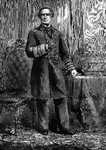
"Admiral Farragut, born at Campbell's Station, near Knoxville, Tenn., July 5th, 1801, died in Portsmouth, N. H., August 14th, 1870. He was appointed to the navy from his native State, and as a midshipman saw active service as early as 1810. In the <em>Essex</em>, under commodore Porter, he took part, in 1812-'13, in her famous cruise against the English commerce in the Pacific. After the capture of the <em>Essex</em> he served on board the line-of-battle ship <em>Independence</em>, and afterward as lieutenant on the <em>Brandywine</em>. In 1847 he was given command of the <em>Saratoga</em>, and in her took part in the naval operations of the Mexican War. When the Civil War broke out Farragut was given command of the Gulf Squadron. The Missippi River below New Orleans was defended with forts, chains stretched across the stream, fire ships, torpedoes, and every kind of appliance. Before commencing actively the attack a council of war was held in the cabin of the admiral's ship, at which all the commanders of the various vessels in the fleet were present. With the exception of two the opinions were unanimously in favor of making the attack; and then was inaugurated the series of naval triumphs which surpassed anything of the kind ever before attempted. The capture of New Orleans was thus secured on April 28th, 1862. The next year Admiral Farragut commanded the attack on Mobile, and in this engagement went into action lashed to the rigging of his ship. He served in the navy more than fifty years, and of this time spent only eleven unemployed on the sea."&mdash; Frank Leslie, 1896

Admiral David G. Farragut

"Admiral Farragut, born at Campbell's Station, near Knoxville, Tenn., July 5th, 1801, died in Portsmouth,…
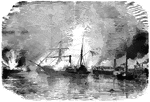
"Daring and desperate attack- surprise and capture of the United States gunboat <em>Harriet Lane</em> by the Confederates under General Magruder, and destruction of the flagship <em>Westfield</em>, in Galveston Harbor, Tex., January 1st, 1863. About two o'clock in the morning of January 1st, 1863, the Federal gunboats were attacked by five Confederate steamers, protected by double rows of bales of cotton, and loaded with troops armed with rifles, muskets, etc. The <em>Harriet Lane</em> was captured by boarding, after about all her officers, including Captain Wainwright and Lieutenant Commander Lee, and a crew of 130, all told, had been killed by muskettry from the Confederate steamers. The gunboats <em>Clifton</em> and <em>Owasco</em> were engaged and escaped, the former losing no men and but one wounded. The <em>Owasco</em> lost one killed and fifteen wounded. Two barks, loaded with coal, fell into the hands of the Confederates. The <em>Westfield</em> (flagship, Commodore Renshaw) was not engaged, being ashore in another channel. Her crew were transferred to transports, and Commodore Renshaw, fearing she would fall into the hands of the Confederates, blew her up. By some mismanagement or accident the exploion took place before a boat containing Commodore Renshaw, First Lieutenant Zimmerman and the boat's crew got away, and they were blown up with the ship. The Confederate force was estimated at 5,000, under the command of General Magruder. The Federal land force, under the command of Colonel Burrill, of Masschusetts, did not exceed 300, the residue not having disembarked at the time of the fight. The Federal loss was 160 killed and 200 taken prisoners. The navy suffered the most. The Confederate loss was much greater, as the Federal guns were firing grape and canister continually in their midst."&mdash; Frank Leslie, 1896

Harriet Lane

"Daring and desperate attack- surprise and capture of the United States gunboat Harriet Lane

"Capture of the United States mail steamer <em>Ariel</em>, Captain Jones, off the east end of Cuba, by the pirate <em>Alabama</em> ('290'), Captain Semmes, December 7th, 1862. Report of the first officer of the <em>Ariel</em>: 'On the 7th of December, at 1:30 P.M., when rounding Cape Maysi, the eastern point of Cuba, we saw a vessel about four miles to the westward, close under the high land, bark-rigged and under canvas. As there was nothing in her appearance indicating her to be a steamer, her smokepipe being down, no suspicions were aroused until in a short time we saw she had furled her sails, raised her smokestack, and was rapidly nearing us under steam, the American flag flying at her peak. Such was her speed in comparison to ours that in about half an hour she had come up within half a mile of us, when she fired a lee gun, hauled down the American ensign and ran up the Confederate flag. No attention was paid to the summons, and the <em>Ariel</em> was pushed to her utmost speed. She then sailed across our wake, took a position on our port quarter, about four hundred yards distant, and fired two guns almost simultaneously, one shot passing over the hurricane deck, and the other hitting the foremast and cutting it half away. A body of United States marines, consisting of 126 men, passengers on board the <em>Ariel</em>, had been drawn up and armed, but the officers in command deemed it worse than folly to resist, as we could plainly see they were training a full broadside to bear upon us, and Captain Jones gave orders to stop the ship and haul down the ensign.'"— Frank Leslie, 1896

Ariel

"Capture of the United States mail steamer Ariel, Captain Jones, off the east end of Cuba,…

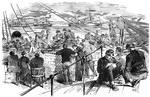
"The Banks Expedition- scene on the hurricane deck of the United States transport <em>North Star</em>- the soldiers of the Forty-first Massachusetts Regiment writing home to their friends, upon their arrival at ship island, Gulf of Mexico. We publish a sketch taken on the evening of the arrival of the Forty-first Massachusetts Regiment at Ship Island. The thoughts of the dear ones at home were uppermost in every soldier's mind, and in a very short time the hurricane deck of the steamer <em>North Star</em> was occupied by a regiment of letterwriters, all hard at work in the service of Cadmus. It is only those separated from all they hold dear who can realize the luxury of that invention which wafts a sigh from Indus to the Pole."&mdash; Frank Leslie, 1896

Banks Expedition

"The Banks Expedition- scene on the hurricane deck of the United States transport North Star-…
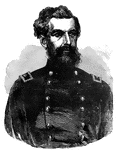
"General Howard, born in Leeds, Me., November 8th, 1830, was graduated at Bowdin in 1850, and at the United States Military Academy in 1854; became first lieutenant and instructor in mathematics in 1854, and resigned in 1861 to take command of the Third Maine Regiment. He commanded a brigade at the first battle of Bull Run, and for gallantry in that engagement was made to brigadier general of volunteers, September 3rd, 1861. He was twice wounded at the battle of Fair Oaks, losing his right arm on June 1st, 1862. In November, 1862, he became major general of volunteers. He commanded the Eleventh Corps during General Hooker's operations in the vicinity of Fredericksburg; served at Gettysburg, Lookout Valley and Missionary Ridge, and was on the expedition for the relief of Knoxville in December, 1863. He was in occupation of Chattanooga from this time till July, 1864, when he was assigned to the Army of the Tennessee in the invasion of Georgia; was at the surrender of Atlanta, and joined in pursuit of the Confederates in Alabama, under Hood, from October 4th till December 13th, 1864. In the march to the sea he commanded the right wing of General Sherman's army. He was in command of the Army of the Tennessee, and engaged in all the important battles from January 4th till April 26th, 1865."&mdash; Frank Leslie, 1896

General Oliver O. Howard

"General Howard, born in Leeds, Me., November 8th, 1830, was graduated at Bowdin in 1850, and at the…
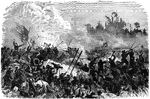
"Siege of Vicksburg, attack on the Confederate Works, May 22nd, 1863. Our sketch represents the terrible but fruitless assault made on Pemberton's last line of defense around the city of Vicksburg. On May 22nd, 1863, a tremendous assault was made on the grass-covered fortifications held by the Confederate army. These works consisted of a chain of forts about eight hundred yards apart, connected by deep intrenchments and extending for seven miles. Lawler's brigade rushed up amid a cross fire, and with heavy loss planted the Stars and Stripes on the edge of a parapet; but the enemy gathered there, and the Federals were overpowered. Landrum's brigade came to the relief, but faltered. McClernand ordered up Benton and Burbridge on the right. Sherman and McPherson also advanced, and at point after point the old flag fluttered for awhile on the works. On the extreme right Steele's division, with Blair on his left, advanced as Pemberton fell back, and, like the others, could only display the bravery of the men. Covered by the ravines which intersected the ground the Federal troops would get near the works and make a gallant rush onward, reach the parapet, yet when the edge of the fort was gained the interior was swept by a line of the rifle pits in the rear and a partition breastwork, so that the Federals, even when in the fort, were almost as far from victory as before. In one case a party of twelve Iowans led by a youth named Griffiths, took and held a fort, but all finally fell under the fire of their assailants except Griffiths, who, with musket and revolver, captured fourteen Confederates when had discharged their pieces, and brought them off. The Confederates used for almost the first time hand grenades, which they rolled down the sides of the works on the assaulting party in the ditch or clinging to the side. This dreadful day swept away thousands of gallant Federals. The siege now began in earnest. No army could stand such losses. Closer were the lines drawn around the enemy. Siege guns were mounted. The mines began their work, and the fortifications were assailed from beneath."&mdash; Frank Leslie, 1896

Attack on Confederate Works

"Siege of Vicksburg, attack on the Confederate Works, May 22nd, 1863. Our sketch represents the terrible…
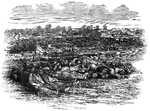
"Battle of Corinth, Miss., October 4th, 1862. Scene in the roundabouts of Fort Robinett after the repulse of the Confederates. We present an exact copy of a photograph showing the scene which presented itself to the Federals at Fort Robinett. As our readers are aware, the battle of Corinth, which took place on the 3rd and 4th of October, was one of the most sanguinary, in proportion to the numbers engaged, that occurred in the West, and it was contested on both sides with great valor and skill. The Federal troops were led by General Rosecrans, and those of the enemy by Van Dorn, Price and Villepigue. The Confederates lost two acting brigadier generals, Johnson and Rogers, who, by a singular coincidence, both fell at the same time and within a few feet of each other. In addition to those officers, they lost Colonels Ross, Morton and McLaine, and Major James. An officer of the Third Michigan Cavalry said: 'Fort Robinett was garrisoned by the First United States Artillery, and here the greatest slaughter took place. In the roundabouts of the fort were found the remains of Generals Johnson and Rogers, and close to them were the bodies of fifty-six of their men, principally of the Second Texas and Fourth Mississippi Regiments. General Rogers was a brave man; he was killed while planting the Confederate flag upon the parapet of the fort, from which the enemy were finally repulsed with great slaughter.'"&mdash; Frank Leslie, 1896

Battle of Corinth

"Battle of Corinth, Miss., October 4th, 1862. Scene in the roundabouts of Fort Robinett after the repulse…
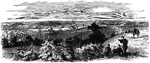
"Fredericksburg, Va., and the Confederate batteries and pickets, as seen from Falmouth Heights, headquarters of General Burnside. Our picture of Fredericksburg gives of course but a very small portion of the famous city, in sight of which our great founder was born, the family homestead being about two miles east of Falmouth where the view was taken. Here stood the famous cherry tree which the infant George cut and confessed to when his indignant father questioned him about it. About a mile to the north of the Rappahannock there is a short range of hills, called Falmouth Heights, which gradually slope to a point where the gully commences, in the centre of which runs the stream, which in dry weather is easy fordable."— Frank Leslie, 1896

Confederate Batteries

"Fredericksburg, Va., and the Confederate batteries and pickets, as seen from Falmouth Heights, headquarters…
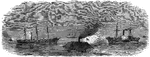
"Confederate rams from Charleston Harbor attacking the Federal blockading squadron, January 31st, 1863. Official report of Rear Admiral Dupont: 'About four o'clock on the morning of the 31st of January, during the obscurity of a thick haze, two ironclad gunboats came out of Charleston by the main ship channel, unperceived by the squadron, and commenced a raid upon the blockading fleet. The <em>Mercedita</em> was the first vessel attacked. Captain Stellwagen had gone to his room for a short time, leaving Lieutenant Commanding Abbott on deck, when one of the ironclads suddenly appeared. Her approach was concealed by the haze and mist of the atmosphere. The vessel was immediately hailed and an order given to fire; but the ironclad being close aboard, and lying low in the water, no guns could be brought to bear. A heavy rifle shell was fired from the enemy, which entered the starboard side of the <em>Mercedita</em>, passed through her condenser, the steam drum of her port boiler, and exploded against her port side, blowing a hole in its exit some four or give feet square, killing the gunner, and, by the escape of steam, a number of the men, and rendering her motive power apparently useless. Unable to use his guns, and being at the mercy of the enemy, which was lying alongside on his starboard quarter, all further resistance was deemed hopeless by Captain Stellwagen, and he surrendered.'"&mdash; Frank Leslie, 1896

Confederate rams

"Confederate rams from Charleston Harbor attacking the Federal blockading squadron, January 31st, 1863.…
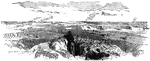
"The Federal siege works on Bogue Island, N. C., erected for the reduction of Fort Macon. Our sketch represents the covering of the working parties while constructing Captain Morris's Parrot-gun siege batteries on Bogue Island. Our correspondent said: 'Colonel White sometimes beguiles his leisure moments by throwing shells promiscuously about the sand spit upon which our works are located, doubtless to ascertain the exact position of the batteries and to annoy the working parties. The proceedings on such occasions are of the serio-comic order. At the word 'drop,' given by the sentinel in the 'rat hole' at the top of the sand hill upon seeing the flash from the gun at the fort, every man makes a bee-line at the double quick for the nearest cover, assuming a position as near the horizontal as possible. This gives comparative immunity from danger, and up to this time nobody has been hurt, except by falling pieces of shells which have exploded overhead.'"— Frank Leslie, 1896

Bogue Island

"The Federal siege works on Bogue Island, N. C., erected for the reduction of Fort Macon. Our sketch…
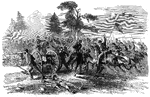
"The War in Virginia. Capture of three Confederate guns, near Culpepper, by General Custer's cavalry brigade, September 14th, 1863. Our sketch represents General Custer's brilliant capture of Confederate cannon near Culpepper. General Pleasonton, on the 14th of September, 1863, drove the Confederates back on Culpepper, and General Custer with his brigade came up with Stuart's horse artillery, which he charged twice, himself at the head, and the second time took guns, limbers, horses and men. His horse was killed by a round shot, which wounded the general in the leg and killed a bugler behind him. Our artist gives a spirited view of this brilliant affair which cannot fail to be of interest."— Frank Leslie, 1896

War in Virginia

"The War in Virginia. Capture of three Confederate guns, near Culpepper, by General Custer's cavalry…
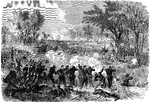
"Battle of Chancellorsville, Sunday, May 3rd, 1863. General Hooker repulsing the attack of the enemy. Early on May 3rd, Stuart renewed the attack upon Hooker's force, with the battle cry, 'Charge and remember Jackson!' and the advance was made with such impetuosity that in a short time he was in possession of the crest from which the Eleventh Corps had been driven the preceding day. No time was lost in crowning that eminence with all the heavy artillery obtainable, and as soon as this could be made to play upon the Federal lines a charge was successively ordered upon the position held by Generals Berry and French, both of whom were supported by the divisions of Williams and Whipple. After a severe struggle the Confederates succeeded in capturing the high ground where the Federals had posted some more heavy artillery, and in turning the latter upon the Federals, who soon had to fall back to their second and third lines of intrenchments. The Confederates followed close upon them, and made charge after charge in order to capture the new positions, but unayailingly and when re-enforcements arrived from Meade's corps they were forced to abadon the attack."— Frank Leslie, 1896

Battle of Chancellorsville

"Battle of Chancellorsville, Sunday, May 3rd, 1863. General Hooker repulsing the attack of the enemy.…
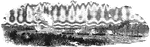
"Reconnoissance in the great Ogeechee River, near Ossabaw Sound, Ga., by the ironclad monitor <em>Montauk</em>, Captain Worden, and other Federal gunboats, January 27th, 1863. A reconnoissance in force was made against Fort McAllister, in the Ogeechee River, on January 27th. The ironclad <em>Montauk</em>, the gunboats <em>Seneca, Dawn, Wissahickon</em>, the tug <em>Daffodil</em>, and mortar schooner <em>C. T. Williams</em> participated in the movement. They found it impossible to get within one thousand seven hundred yards of the work on account of the obstruction in the channel. At this distance, however, a sharp fight of several hours duration was indulged in, when the character of the fort and the nature of the channels having been definitely ascertained and a thick fog coming on, operations were suspended for a time. For McAllister was a casemated work, covered with railroad iron, and mounted thirteen guns."&mdash; Frank Leslie, 1896

Ogeechee River

"Reconnoissance in the great Ogeechee River, near Ossabaw Sound, Ga., by the ironclad monitor Montauk,…
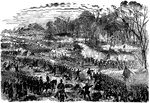
"Battle of Champion Hills, May 16th, 1863- the formidable position of General Pemberton carried by Generals Hovey, Logan and Crocker, of Grant's army. On the morning of the 16th of May, General A. P. Hovey's division, occupying the right of McClernand's corps, encountered the Confederate pickets, but no engagement took place until about eleven o'clock, when the Indiana troops, led by General McGinnis, made a deliberate attack upon the rapidly increasing force which Pemberton had brought together at Champion Hills. Two batteries which had been planted along a high ridge were doing considerable damage, and it was finally determined to assault them. They were both taken by the Eleventh and Forty-sixth Indiana and the Twenty-ninth Wisconsin, after a fierce hand-to-hand fight; but the arrival of fresh Confederate troops and the want of re-enforcements prevented their being held for any length of time. The Federals withdrew, and remained under cover of their artillery till joined by part of Quimby's late dvision, commanded by General Marcellus M. Crocker. Another advance was then ordered, and while Pemberton's right was thus engaged Logan's division attacked his left, and succeeded in flanking and in forcing it back in such manner as to completely isolate for awhile the whole of General Loring's brigade, which occupied the extreme Confederate right. The attack was so fierce that Stevenson's line became completely demoralized, yielded in turn, and by four o'clock the Confederates were in full retreat toward the Big Black River. Just then the other division of McClernand's corps came upon the scene, and a pursuit was ordered by Generals Carr and Osterhaus. This lasted until dark, and resulted in the capture of many prisoners and arms of all descriptions. The total loss in killed and wounded on both sides approximated to 4,000."— Frank Leslie, 1896

Battle of Champion Hills

"Battle of Champion Hills, May 16th, 1863- the formidable position of General Pemberton carried by Generals…
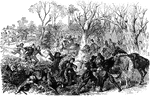
"Federal cavalry covering the escape of Federal prisoners from Libby Prison, Richmond, Va. The feeling of sympathy for the unfortunate Federal officers and men who so long suffered outrage at the hands of the Confederates gave way to a momentary feeling of joy as news came of the escape, at one time, of one hundred and nine officers and men. From time to time a few had escaped, and the narrative of their escapes had been among the most intensely exciting incidents of the war. But when more than a hundred contrived to get out of the Southern dungeon the interest knew no bounds. The method employed was as follows: Having managed to find access to the cellar, they commenced work, relieving one another as opportunity offered. Their instruments were case knives, pocket knives, chisels and files. After getting through the wall they disposed of the excavated soil by drawing it out in a spittoon, which they attached to a cord. This would be filled by the party at work in the tunnel, and pulled out into the cellar by their companions, who disposed of it by spreading it in shallow layers over the floor, concealing it beneath the straw. The tunnel, completed by fifty-one days of patient toil, was about sixty feet long, and opened into an old tobacco shed beyond the line of guards. In order to elude their pursuers, who they knew would soon be on their track, they scattered as much as possible. Many were their hardships and sufferings, and frequent were their narrow escapes from the Confederate cavalry, who the next morning were bushwhacking in every direction for them. The joy which Colonel Streight and four comrades, the pioneers of the band, experienced when they first caught sight of the Federals, sent out to help them and protect them from their pursuers, cannot be expressed."&mdash; Frank Leslie, 1896

Federal Prisoners

"Federal cavalry covering the escape of Federal prisoners from Libby Prison, Richmond, Va. The feeling…
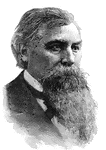
"General Rusk, born in Morgan County, Ohio, June 17th, 1830; died in 1894. He divided his time between farm work and the acquisition of a common-school education till he attained his majority, and in 1853 removed to Wisconsin and engaged in agriculture in Vernon county. He entered the National Army in 1862, was commissioned major of the Twenty-fifth Wisconsin Regiment, rose to the rank of lieutenant colonel, and served with General William T. Sherman from the siege of Vicksburg till the close of the war. In 1865 he received the brevet of brigadier general of volunteers for meritorious services at the battle of Salkehatchie. Beginning with 1881, he was elected Governor of Wisconsin for three successive terms. During the threatened Milwuakee riots in May, 1886, he did good service by his prompt action in ordering the militia to fire on the dangerous mobs when they attempted to destroy life and property. In 1889 President Harrison appointed General Rusk Secretary of Agriculture."— Frank Leslie, 1896

General Jeremiah M. Rusk

"General Rusk, born in Morgan County, Ohio, June 17th, 1830; died in 1894. He divided his time between…
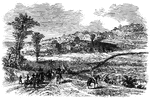
"General McPherson entering Clinton, Miss. To facilitate the movements of the Federal armies near Chattanooga and divert the Confederate forces from hastening to the relief of Bragg. General McPherson marched from Vicksburg on the 15th of October, 1863. On the 17th he came up with the enemy in a strong position on the Canton Road, ten miles beyond Brownsville, and after a short, sharp fight, routed them, the Federals charging gallantly over the bridge and through the tall grass and corn to the enemy's line. The next day he entered Clinton, on the Vicksburg and Jackson Railroad. His gallant troops broke the Sabbath stillness of the place as they marched in, and the Confederates scattered on all sides in flight. General McPherson then proceeded to Canton, and finally returned to Vicksburg after destroying Confederate mills and factories, and alarming all the neighboring stations."— Frank Leslie, 1896

Entering Clinton

"General McPherson entering Clinton, Miss. To facilitate the movements of the Federal armies near Chattanooga…
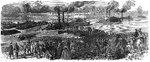
"The war on the Red River. Admiral Porter's fleet passing through Colonel Bailey's Dam, above Alexandria, May, 1864. Admiral David D. Porter's official report: 'The water had fallen so low that I had no hope or expectation of getting the vessels out this season, and, as the army had made arrangements to evacuate the country. I saw nothing before me but the destruction of the best party of the Mississippi squadron. There seems to have been an especial Providence looking out for us in providing a man equal to the emergency. Lieutenant Colonel Bailey, Acting Engineer of the Nineteenth Army Corps, proposed a plan of building a series of dams across the rocks at the falls, and raising the water high enough to let the vessels pass over. This proposition looked like madness, and the best engineers ridiculed it, but Colonel Bailey was so sanguine of success that I requested General Banks to have it done, and he entered heartily in the work. Provisions were short and forage was almost out, and the dam was promised to be finished in ten days, or the army would have to leave us. The work was successfully accomplished and the fleet passed over safely. Words are inadequate to express the admiration I feel for the abilities of Lieutenant Colonel Bailey. This is without doubt the greatest engineering feat ever performed. Under the best circumstances, a private company would not have completed this work under one year, and, to an ordinary mind, the whole thing would have appeared an utter impossibility. Leaving out his abilities as an engineer, he ws rendered a great service to the country, having saved to the Union a valuable fleet worth fully two million dollars.'"&mdash; Frank Leslie, 1896

Red River

"The war on the Red River. Admiral Porter's fleet passing through Colonel Bailey's Dam, above Alexandria,…
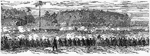
"Grant's Campaign in Virginia. The Battle of Bethesda Church, between Crawford's division, Fifth Corps, and the Confederates, May 30th, 1864. At two P. M. the enemy attacked Crawford's division, and he, in accordance with instructions, fell back, and a line of battle was formed, Griffin on the right, Cutler in the centre, Crawford on the left, General Burnside's corps being to the right of Warren's. At six P. M. the enemy assaulted Griffin on the right. It was a general and sudden attack. They advanced in two lines of battle and heavy skirmish line. Simultaneous with their opening volley of musketry came solid shot and shell from the angry mouths of a score and more of hostile cannon. Firm and unshaken as a wall of brass stood the Federal troops. Schooled to such sudden attacks and ready for it, the Federals coolly waited to return the fire. It was a most murderous volley. The assaulting column were staggered and fell back. Upon General Crawford's division the assaults were more repeated and more fierce. The enemy sought to turn his left, but each time was handsomely repulsed, and more than special glory was won by the men meeting and expelling these assaults.'"— Frank Leslie, 1896

Grant's Campaign

"Grant's Campaign in Virginia. The Battle of Bethesda Church, between Crawford's division, Fifth Corps,…
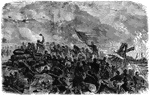
"The war in Tennessee. Hooker's Battle above the clouds, and capture of the Confederate position on Lookout Mountain, November 24th, 1863. The wild mountains of Tennessee, where nature reveals in producing the most fantastic forms, and piling rocks upon rocks, forms one of the mightiest ridges on the land, have been the scene of one of the most extraordinary battles in history; a battle fought with the mists and clouds rolling beneath the combatants, the flash and the roar of the guns appearing to the spectators in the plain below like the lightning and the thunder of heaven. By eight o'clock on Tuesday, November 24th, Hooker's column was moving up Lookout Valley, and, to the surprise of the enemy, disappeared in the woods south of Wauhatchie. But here, filing his troop to the left, General Hooker began the difficult task of the ascent of the mountain. The head of the column, having reached the palisades, went into line of battle facing to the north, and with the right resting against the palisades stretched down the mountain. Geary's division formed the front, with Greene's brigade of New York troops on the right. General Hooker then formed a second line of the two brigades of the Fourth Corps which had been sent him, placing Whittaker on the right and Grose on the left. General Osterhaus formed a third line, and held himself in readiness to aid any part of the line which might need it. Thus arranged, the corps was ordered forward, with a heavy line of skirmishers thrown out, and marching along the slope of the ridge, soon came upon the rear of the enemy, who were taken completely by surprise. Before those at the foot of the hill could comprehend the situation Colonel Ireland's skirmishers had penetrated far toward the point of the mountain, and got in a heavy fire upon the enemy, who were now trying to escape up the hill, while the Federals assaulted them from above. At the same time the Federal batteries on the Moccasin Point and those of the Confederates on Lookout Mountain opened a heavy fire upon each other, and soon the whole mountain was hid from the view in Chattanooga by the cloud of smoke which rose above and around it. The enemy made but little organized resistance, yet their skirmishers for a long time kept up a heavy fire from behind jutting rocks and from trees. Holding Ireland's right well against the palisades, Geary threw Kennedy forward on the left, and he, after being re-enforced by Grose, the enemy on the point of the mountain gradually gave way and fell back in some disorder to the line of breastworks on the east slope of the mountain, at Craven's House. General Geary swung around until his line was parallel with that of the enemy, and again advanced, but being met by organized and well-directed resistance, for a time recoiled. The enemy were now in strong position, Craven's House being the centre of a line of heavy breastworks; but they lacked numbers to man them, having lost severely. They were compelled to expose their right flank. Hooker then sent the Eighty-fourth and Seventy-fifth Illinois to hold the road across the mountain, and advanced on the enemy, with Geary on the right, Osterhaus on the left. Whittaker and Grose in the centre. Geary turned their left, as Osterhaus did the enemy's right, and then, with one charge of the whole line, Hooker carried the position."— Frank Leslie, 1896

Hooker's Battle

"The war in Tennessee. Hooker's Battle above the clouds, and capture of the Confederate position on…
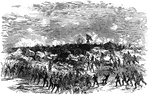
"The Siege of Petersburg, Va. Charge of the second division, Ninth Army Corps, into the crater, July 30th, 1864. The charge made finally by the Second Division of the Ninth Army Corps is shown from the hand of one who witnessed it near by. It was made bravely, but from faults which could not be explained valuable time had been lost, officers were absent, and the result was a sad slaughter of men which the country could not afford to lose. On arriving at the exploded fort the Federals found it a heterogeneous mass of loose earth, guns and gun carriages, dead and wounded gunners, etc. One of the charging officers, noticing the earth move near him as if a mole or gopher were at work under it, commenced digging, and finally extricated a Confederate lieutenant, who actually revived and conversed freely with the officer before being brought from the ground. Several others were exhumed from their living graves and restored to consciousness."&mdash; Frank Leslie, 1896

Siege of Petersburg

"The Siege of Petersburg, Va. Charge of the second division, Ninth Army Corps, into the crater, July…
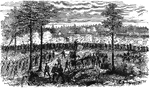
"The Siege of Petersburg. Battle of Ream's Station- the attempt of the enemy to regain the Weldon Railroad on the evening of August 25th, 1864. The enemy having been repulsed, the Federal skirmishers followed, advancing to the position they had formerly held, and capturing a number of prisoners. Shortly after the enemy again advanced, and were again driven back with heavy loss; and their third assault, made about four o'clock P. M., was attended with a like satisfactory result. In the first three charges the enemy used no artillery, but about five o'clock P. M. they opened a heavy, concentrated fire from a number of batteries, pouring a storm of shell and other missiles over the entire ampitheatre included within the Federal lines. After about twenty minutes of this artillery fire the enemy again made their appearance in front of General Miles's division, their assault being directed mainly against his centre. Emerging from the woods, they advanced in two lines of battle. The Federal artillery and musketry greeted them, as before, with a rapid fire, but without checking their progress. On they came, with bayonets fixed and without firing a shot. They approached the Federal lines, gained the outside of their intrenchments, and at some points a hand-to-hand conflict ensued over the top of the breastworks, the Federals beating back the Confederates with their bayonets as they atempted to climb over. But soon it was found that the Federal line was broken near the centre, and the gap once made rapidly grew wider, until nearly the entire line was swept back, leaving the Federal breastworks and artillery in the hands of the enemy. General Miles, with great coolness, set to work to rally the men, and in a short time succeeded in forming a line with its right resting against the breastworks. At the same time General Hancock ordered the Second Division to be faced about, and cheering and urging the men forward, ledthem in person in a charge at double-quick. This charge, which was made under a heavy fire, was gallantly executed, and in conjunction with the line rallied by General Miles instantly checked the enemy and regained the intrenchments for some distance further toward the left. After the enemy had been checked in the centre and along that portion of the line against which they had chiefly directed their attack the graetest part of the Second Division returned to their own intrenchments. By this time it was dark and the fighting ended. Our sketch shows the repulse of the last Confederate assault."&mdash; Frank Leslie, 1896

Battle of Ream's Station

"The Siege of Petersburg. Battle of Ream's Station- the attempt of the enemy to regain the Weldon Railroad…
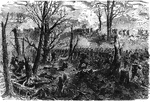
"The war in Tennessee. Capture of Mission Ridge, near Rossville, by General Thomas, November 25th, 1863. Our correspondent thus graphically depicts this scene: 'Simultaneously and instantaneously the two, or rather four, columns rushed forward across the valley of Citco Creek and up to the line of the Confederate rifle pits that lined the base of Mission Ridge. These even did not claim their attention, nor did the two or three discharges of musketry which received them call for a reply. On they pushed with their glittering bayonets, signaling back a reply that startled the already dismayed foe. They abandoned the works and their camps, over and through which our men rushed with headlong speed and a velocity which of itself would have secured them victory. The enemy had opened on these columns a heavy fire from several batteries, which he had massed along his centre, to hide and in some measure remedy his now apparent weakness there. But these were only replied to by the guns of Captain Bridges on Orchard Knob and the deep-mouthed monsters of Fort Wood. The foot of the hill was reached by the advancing column in good order, and now began the difficult ascent. Half-way up, the line became broken and ragged, and it looked much as if a heavy line of skirmishers were mounting the hill. When they reached the top, and the Confederate artillerists were limbering up their pieces, the front line was no longer preserved, but the men pushed forward indiscriminately. The Confederate infantry fled and yielded up the artillery without further struggle. From below we could see the Confederate flag as it entered and passed through Fort Hindman, and gave place to that of the Union. In just three-quarters of an hour after the order was given for the assault General Turchin, of Baird's division, occupied Fort Hindman with two of his regiments, and was rapidly moving the others forward to their support. Generals Willich, Hazen and Waggener were reaping harvest of artillery. The hill was won at four o'clock, the enemy cut in two, and his organization for the time destroyed. As the hill was won, General Grant, following in the wake of the advancing column, appeared in their midst on the summit. The troops saw and recognized him, and at once there went up a shout such as only victorious men can give to a victorious leader.'"— Frank Leslie, 1896

War in Tennessee

"The war in Tennessee. Capture of Mission Ridge, near Rossville, by General Thomas, November 25th, 1863.…

"Siege of Petersburg- the Ninth Corps charging on the enemy's works after the explosion of the mine, July 30th, 1864. Immediately after the explosion of the mine a hundred cannons opened along the Federal front, and at half-past five the Ninth Corps charged, carrying the fort with a part of the line on each side. The Second Division, which was in the centre, advanced and carried the second line a short distance beyond the fort, and rested, holding ground with the utmost determination. It was at the time the [African American] Division, under General White, was pushed forward and ordered to charge and carry the crest of the hill, which would have decided the contest. The troops advanced in good order as far as the first line, where they received a galling fire, which checked them, and although quite a number kept on advancing, the greater number seemed to become utterly demoralized, part taking refuge in the fort, and the remainder running to the rear as fast as possible. They were rallied and again pushed forward, but without success, the greater part of the officers being killed or wounded."&mdash; Frank Leslie, 1896

Siege of Petersburg

"Siege of Petersburg- the Ninth Corps charging on the enemy's works after the explosion of the mine,…
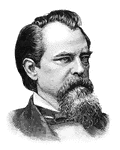
"General Gordon, born in Upson County, Ga., February 6th, 1832. He was educated at the University of Georgia, studied law and was admitted to the bar, but had practiced only a short time when he entered the Confederate army as a captain of infantry. He rose successively to the rank of lieutenant general. He commanded one wing of Lee's army at Appomatox Court House, and was wounded in battle eight times during the war."&mdash; Frank Leslie, 1896

General J. B. Gordon

"General Gordon, born in Upson County, Ga., February 6th, 1832. He was educated at the University of…
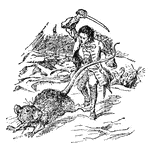
Gulliver draws his sword to defend himself against a giant rat in Brobdngnag.

Gulliver with Large Rat

Gulliver draws his sword to defend himself against a giant rat in Brobdngnag.
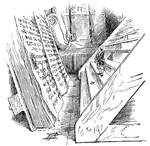
Gulliver on a contrived wooden ladder, built just for him so he could read the giant books of Brobdingnag.
Wooden steps

Gulliver on a contrived wooden ladder, built just for him so he could read the giant books of Brobdingnag.

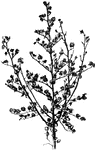
An early, rapid fruiting, productive type of cotton plant, with low fruit limbs, short joints and continuous growing long fruit limbs. Leaves removed.

Fruitful cotton plant

An early, rapid fruiting, productive type of cotton plant, with low fruit limbs, short joints and continuous…