"Camp Wool, two miles from Fort Clark, Hatteras Island, occupied by Hawkins's Zouaves, Ninth Regiment, New York Volunteers, in October, 1861. Camp Wool, which was occupied by the New York Ninth Regiment of Volunteers, was about two miles from Fort Hatteras, and situated on the Pamlico side of the island, in order to be partially sheltered from the Atlantic gales. Besides, as any sudden attack must come from the sound, it put the troops in a better spot to keep a bright look out. The Ninth Zouaves were in an excellent state of discipline, and reflected great credit upon their colonel, Rush Hawkins, who fought his way bravely through the Mexican war. It numbered one thousand and forty-six men. Until the unfortunate capture of the <em>Fanny</em>, it had not lost a single man, although it had been engaged in numerous skirmishes with the Confederates at Newport News." —Leslie, 1896

Camp Wool

"Camp Wool, two miles from Fort Clark, Hatteras Island, occupied by Hawkins's Zouaves, Ninth Regiment,…
"Battle at Dam No. 4, Potomac River, between Butterfield's brigade and a large Confederate force. A desperate and disastrous action occurred on the banks of the Potomac, at Dam No. 4. General Butterfield's brigade, consisting of the Forty-fourth New York, Seventeenth New York, Eighteenth Massachusetts and One Hundred and Eighteenth Pennsylvania, were ordered to make a reconnoissance on the Virginia side. Crossing over at Dam No. 4, which is about six miles northwest in a straight line from Sharpsburg, and eight south from Williamsport, they had hardly landed when a most murderous fire was opened upon them from an entire division of the Confederate army, every volley of which told, as they had the Federals completely under range. The Federals made a desperate resistance, but they were compelled to retire before superior numbers, and retreated in moderate order across the river." —Leslie, 1896

Battle at Dam No. 4

"Battle at Dam No. 4, Potomac River, between Butterfield's brigade and a large Confederate force. A…
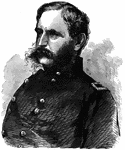
"General Augur, born in New York in 1821, was graduated from the United States Military Academy in 1843. During the Mexican War he served as aid-de-camp to General Hopping, and after his death to General Caleb Cushing. He was promoted captain, August 1st, 1852, and served with distinction in a campaign against the Indians in Oregon in 1856. On May 14th, 1861, he was appointed major in the Thirteenth Infantry, and was for a time commandant of cadets at West Point. In November of that year he was commissioned a brigadier general of volunteers, and joined McDowell's corps. In July, 1862, he was assigned to a division under Banks, and in the battle of Cedar Mountain was severely wounded. He was promoted major general of volunteers, August 9th, 1862, and in November joined his corps and took part in the Louisiana campaign. He was breveted brigadier-general in the United States Army, March 13th, 1865, receiving on the same date the brevet of major-general for services in the field during the rebellion." &mdash;Leslie, 1896

General Christopher C. Augur

"General Augur, born in New York in 1821, was graduated from the United States Military Academy in 1843.…
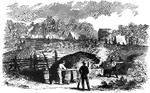
"'Fresh Bread!'- Impromptu oven built by the Nineteenth Regiment, New York Volunteers, in General Banks's division, Western Maryland. The impromptu oven which we illustrate testified to the Federal cleverness, and ministered to the wants of the brave defenders of the Union. The regiment undoubtedly contained men whose means gave them every epicurean indulgence; but we question if any French bread, fresh butter, with all the appliances of Delmonico, ever tasted so sweet as the newly baked bread they got from the primitive oven." — Frank Leslie, 1896

Oven

"'Fresh Bread!'- Impromptu oven built by the Nineteenth Regiment, New York Volunteers, in General Banks's…
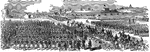
"Advance of the Army of the Potomac. Occupation of Winchester, VA., and the abandoned Confederate Fortifications, by a detachment of General Banks's Deivision of the Federal Army, consisting of the brigades of Generals Hamilton and Williams, March 12th, 1862. Our sketch represents the advance of the Federal troops upon the City of Winchester, and is thus described by our correspondent: 'A portion of General Banks's Division, under General Gorman, occupied the town of Berryville, VA., on the 11th. There were five hundred of the Confederate cavalry in the place, but upon the Third New York Cavalry, properly supported by artillery and infantry, charging them, they fled in confusion toward Winchester. During the night the pickets of General Gorman came in contact with a portion of Colonel Ashby's Confederate cavalry, and were compelled to fall back, but the general made a reconnoissance in force to within two miles of Winchester, and, charging upon the Confederates dispersed them, taking several prisoners, and killing or wounding four of the Confederates. This reconnoissance sealed the fate of Winchester. The enemy were blinded and misled by the movement of our troops, and they commenced the evacuation of the place on the afternoon of the 12th. General Hamilton advanced from Bunker hill, the Michigan Cavalry heading the column. The Confederate Cavalry, one thousand two hundred strong, and supported by a section of artillery, gave battle at five o'clock in the afternoon. Our cavalry was supported by the First maryland Infantry, and a battery of artillery. The fight was a short one. The Confederates fled, leaving their guns behind them, and at daylight on the 12th our troops entered the city as the rear guard of the enemy was flying out of it.'"— Frank Leslie, 1896

Army of the Potomac

"Advance of the Army of the Potomac. Occupation of Winchester, VA., and the abandoned Confederate Fortifications,…
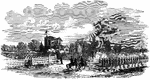
"Encampment of Colonel Max Weber's German Turner Rifle Regiment, Twentieth New York Volunteers, at Hampton Creek, Va.- officers' quarters at the summer residence of Ex-President Tyler."— Frank Leslie, 1896

Encampment of Colonel Max Weber's Rifle Regiment

"Encampment of Colonel Max Weber's German Turner Rifle Regiment, Twentieth New York Volunteers, at Hampton…
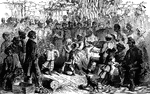
"Extempore musical and terpischorean entertainment at the United States arsenal, Baton Rouge, La., under the patronage of the Forty-First Massachusetts, the one hundred and Thirty-First New York and the Twenty-Fifth Connecticut Volunteers- contraband children dancing the breakdown. If anything were necessary to show the sensuous nature of music, it would be found in the eagerness with which the contraband race pursued it. The Federals, with that love of fun which ever distinguishes the brave soldier off duty, got up, a few evenings after their arrival at Baton Rouge, an extempore musical and terpsichorean entertainment, in which the darky element was largely and loudly represented. The hall was one of the extensive rooms in the United States Arsenal building, and prominent among the promoters were the Forty-first Massachusetts, One Hundred and Thirty-first New York and the Twenty-fifth Cennecticut Volunteers. One of the features was a breakdown, which was dance, or rather jumped, with great vigor by a couple of contraband juveniles."— Frank Leslie, 1896

Civil War Musical Entertainment

"Extempore musical and terpischorean entertainment at the United States arsenal, Baton Rouge, La., under…
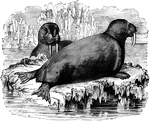
Two Walrus laying on an iceberg.

Walruses

Two Walrus laying on an iceberg.

"The ground-color of the hair or skin, when this animal is alive and dry, is pale whitish-gray, with a very slight tinge of yellow; when just out of the water and wet, the ground-color is ash; after death, and as seen in museums, the ground color is pale yellowish-gray." &mdash; S. G. Goodrich, 1885

Common Seal

"The ground-color of the hair or skin, when this animal is alive and dry, is pale whitish-gray, with…
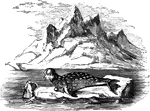
"Also called the Crested Seal, remarkable for possessing, about two inches from te extremity of the upper jaw, on the superior of the surface, a cartilaginous crest, which rises, increasing rapidly in height as it passes backwards, about seven inches high at its posterior or vertical edge, which is separated into two planes by an intervening depression an inch deep." — S. G. Goodrich, 1885

Hooded Seal

"Also called the Crested Seal, remarkable for possessing, about two inches from te extremity of the…
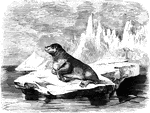
"It is the size of a large bear; girth at the sholder, five feet, near the tail, twenty inches; fur brown. acquiring a grayish tint at the point of the hairs in old age; external ears one inch eight lines long, conical, erect, covered with short hair, and open by an oblong slit, which is shut in the water; nail very slender and minute." &mdash; S. G. Goodrich, 1885

Sea Bear

"It is the size of a large bear; girth at the sholder, five feet, near the tail, twenty inches; fur…
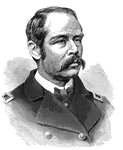
"General Barlow, born in Brooklyn, N. Y., October 18th, 1834, was graduated at Harvard in 1855. In 1861 he enlisted as a private in the Twelfth Regiment, New York State National Guard, and went to the front of the first call for troops to defend the capital. At the end of the three months' term of service he had been promoted lieutenant. He at once re-entered the service as lieutenant colonel of the Sixty-first New York Volunteers, was promoted colonel during the siege of Yorktown, and distinguished himself at the battle of Fair Oaks, May 31st and June 1st, 1862, for which he was severely wounded and taken prisoner; but he was exchanged, and recovered in time to take the field again the following spring. He also participated inthe final campaigns of the Potomac Army under General Grant."&mdash; Frank Leslie, 1896

General Francis C. Barlow

"General Barlow, born in Brooklyn, N. Y., October 18th, 1834, was graduated at Harvard in 1855. In 1861…
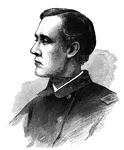
"General Sharpe, born in Kingston, N. Y., February 26th, 1828, was graduated at Rutgers in 1847; studied law at Yale College; was admitted to the bar in 1854, and practiced until he entered the army in 1861 as captain in the Twentieth New York Infantry. He became colonel of the One Hundred and Twentieth New York Infantry in 1862, and took part in all the battles of the Army of the Potomac. He served upon the staffs of Generals Hooker, Meade and Grant, and was brevetted brigadier general in 1864 and major general in 1865. He was attached to the United States Legation at Vienna in 1851, and was a special agent of the State Department in Europe in 1867. In 1870-'73 he was United States Marshal for the Southern District of New York, and took the census that demonstrated the great election frauds of 1868 in New York city, which led to the enforcement of the Federal election laws for the first time in 1871."&mdash; Frank Leslie, 1896

General George H. Sharpe

"General Sharpe, born in Kingston, N. Y., February 26th, 1828, was graduated at Rutgers in 1847; studied…
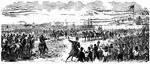
"Reception of Brigadier General Corcoran by Mayor Opdyke and the citizens of New York, at Castle Garden, August 22nd, 1862. Mayor Opdyke escorting the general to his carriage. The 22nd of August, 1862, will be a memorable day for our Irish citizens, for on that day the people of New York turned out to give a hearty welcome to- not a victorious soldier, but to the true and patient man who had for thirteen months endured the worst of captivities to a brave soldier, compulsory inaction, when he knows his gallant companions are fighting for a great cause almost within cannon shot of his dungeon. And the reception was not given alone to the released general, but to everyone of those patient thousands who have suffered an equally cruel ordeal, although their names are unwept, unhonored and unsung. In this view, the oration which greeted the brave Corcoran was a noble and remarkabe one, and worthy of the great city that gave it."— Frank Leslie, 1896

Castle Garden

"Reception of Brigadier General Corcoran by Mayor Opdyke and the citizens of New York, at Castle Garden,…
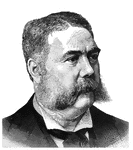
"General Arthur, twenty-first President of the United States, born in Fairfield, Franklin County, Vt., October 5th, 1830; died in New York City, November 18th, 1896."&mdash; Frank Leslie, 1896

General Chester A. Arthur

"General Arthur, twenty-first President of the United States, born in Fairfield, Franklin County, Vt.,…
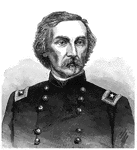
"General Warren, born in Cold Spring, N. Y., January 8th, 1830, died in Newport, R. I., August 8th, 1882, was graduated from the United States Military Academy in 1850, and assigned to the Topographical Engineers as brevet second lieutenant. At the beginning of the Civil War he entered active service as lieutenant colonel of the Fifth New York Volunteers, of which regiment he became colonel on August 31st, 1861. His regiment was ordered to Fortress Monroe, and he took part in the battle of Big Bethel. During the remainder of the year he was stationed at Baltimore, where he constructed the fort on Federal Hill. In the spring of 1862 he joined the Army of the Potomac, serving in the Peninsular campaign and at Yorktown. He was given a brigade in the Fifth Army Corps in May, with which he covered the extreme right of the army and took part in the capture of Hanover Courthouse, the pursuit of Confederate cavalry under Stuart, the battle of Gaines's Mill, the affair at Malvern Hill and subsequent battle, and the skirmish at Harrison's Landing. His brigade was then sent to re-enforce General Pope, and he participated in the battle of Manassas, was engaged at Antietam and the battle of Fredericksburg. On September 26th, 1862, he was appointed brigadier general of volunteers for his services at Gaines's Mill. On March 3rd, 1863, he was appointed chief of engineers of the Army of the Potomac, and during the Chancellorsville campaign he took part in the action on Orange Pike, the storming of Marye's Heights and the battle of Salem. He continued as chief of engineers under Meade, and was engaged at Gettysburg, where he seized Little Round Top. On August 11th, 1863, he was made major general of volunteers. He participated in the battles of the Wilderness campaign and those around Petersburg. He received the successive brevets in the United States Army up to major general."&mdash; Frank Leslie, 1896

General Gouverneur K. Warren

"General Warren, born in Cold Spring, N. Y., January 8th, 1830, died in Newport, R. I., August 8th,…
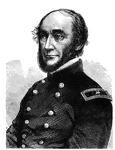
"General Cullum, born in New York city, February 25th, 1809, died in New York city, February 28th, 1892, was graduated from the United States Military Academy in 1833, and brevetted a second lieutenant in the Engineer Corps. During the Mexican War he rendered valuable services as superintending engineer for devising and constructing sapper, miner and pontoon trains. In 1861 he was appointed chief engineer of the Department of the Missouri, with the rank of brigadier general of volunteers, and made chief of staff to General Halleck. The latter position he continued to hold after Halleck was made general in chief, and accompanied him in his Southwestern campaigns, and afterward to headquarters in Washington, D. C., until 1864, when he became superintendent of the United States Military Academy."&mdash; Frank Leslie, 1896

General George W. Cullum

"General Cullum, born in New York city, February 25th, 1809, died in New York city, February 28th, 1892,…
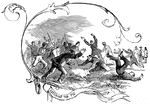
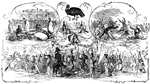
"Federal soldiers participating in a hurdle sack race. Thanksgiving festivities at Fort Pulaski, Ga., Thursday, November 27th, 1862. While the loyal citizens of the North were eating their turkeys the Federal soldiers in the South were also celebrating their Thanksgiving. We illustrate the amusement indulged in at Fort Pulaski, Ga. The grand attraction of the day, however, was th <em>fete</em> given by the officers of the Forty-eighth Regiment, New York Volunteers, Colonel Barton, and Company G, Third Rhode Island Regiment."— Frank Leslie, 1896

Hurdle Sack Race

"Federal soldiers participating in a hurdle sack race. Thanksgiving festivities at Fort Pulaski, Ga.,…
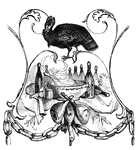
"Thanksgiving dinner. Thanksgiving festivities at Fort Pulaski, Ga., Thursday, November 27th, 1862. While the loyal citizens of the North were eating their turkeys the Federal soldiers in the South were also celebrating their Thanksgiving. We illustrate the amusement indulged in at Fort Pulaski, Ga. The grand attraction of the day, however, was th <em>fete</em> given by the officers of the Forty-eighth Regiment, New York Volunteers, Colonel Barton, and Company G, Third Rhode Island Regiment."— Frank Leslie, 1896

Thanksgiving Dinner

"Thanksgiving dinner. Thanksgiving festivities at Fort Pulaski, Ga., Thursday, November 27th, 1862.…
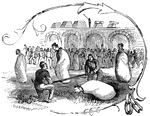
"Soldiers playing 'catch the pig.' Thanksgiving festivities at Fort Pulaski, Ga., Thursday, November 27th, 1862. While the loyal citizens of the North were eating their turkeys the Federal soldiers in the South were also celebrating their Thanksgiving. We illustrate the amusement indulged in at Fort Pulaski, Ga. The grand attraction of the day, however, was th <em>fete</em> given by the officers of the Forty-eighth Regiment, New York Volunteers, Colonel Barton, and Company G, Third Rhode Island Regiment."— Frank Leslie, 1896

Catching the Pig

"Soldiers playing 'catch the pig.' Thanksgiving festivities at Fort Pulaski, Ga., Thursday, November…
"Soldiers participating in a burlesque dress parade. Thanksgiving festivities at Fort Pulaski, Ga., Thursday, November 27th, 1862. While the loyal citizens of the North were eating their turkeys the Federal soldiers in the South were also celebrating their Thanksgiving. We illustrate the amusement indulged in at Fort Pulaski, Ga. The grand attraction of the day, however, was th <em>fete</em> given by the officers of the Forty-eighth Regiment, New York Volunteers, Colonel Barton, and Company G, Third Rhode Island Regiment."— Frank Leslie, 1896

Burlesque Dress Parade

"Soldiers participating in a burlesque dress parade. Thanksgiving festivities at Fort Pulaski, Ga.,…
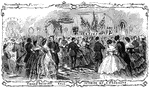
"Soldiers and women participating in a Thanksgiving Ball. Thanksgiving festivities at Fort Pulaski, Ga., Thursday, November 27th, 1862. While the loyal citizens of the North were eating their turkeys the Federal soldiers in the South were also celebrating their Thanksgiving. We illustrate the amusement indulged in at Fort Pulaski, Ga. The grand attraction of the day, however, was th <em>fete</em> given by the officers of the Forty-eighth Regiment, New York Volunteers, Colonel Barton, and Company G, Third Rhode Island Regiment."— Frank Leslie, 1896

Thanksgiving Ball

"Soldiers and women participating in a Thanksgiving Ball. Thanksgiving festivities at Fort Pulaski,…
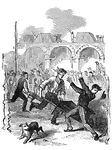
"Soldiers aparticipating in a wheelbarrow race. Thanksgiving festivities at Fort Pulaski, Ga., Thursday, November 27th, 1862. While the loyal citizens of the North were eating their turkeys the Federal soldiers in the South were also celebrating their Thanksgiving. We illustrate the amusement indulged in at Fort Pulaski, Ga. The grand attraction of the day, however, was th <em>fete</em> given by the officers of the Forty-eighth Regiment, New York Volunteers, Colonel Barton, and Company G, Third Rhode Island Regiment."— Frank Leslie, 1896

Wheelbarrow Race

"Soldiers aparticipating in a wheelbarrow race. Thanksgiving festivities at Fort Pulaski, Ga., Thursday,…
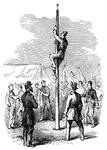
"Soldiers climbing up a greased pole. Thanksgiving festivities at Fort Pulaski, Ga., Thursday, November 27th, 1862. While the loyal citizens of the North were eating their turkeys the Federal soldiers in the South were also celebrating their Thanksgiving. We illustrate the amusement indulged in at Fort Pulaski, Ga. The grand attraction of the day, however, was th <em>fete</em> given by the officers of the Forty-eighth Regiment, New York Volunteers, Colonel Barton, and Company G, Third Rhode Island Regiment."— Frank Leslie, 1896

Climbing Pole

"Soldiers climbing up a greased pole. Thanksgiving festivities at Fort Pulaski, Ga., Thursday, November…
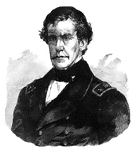
"Rear Admiral Wilkes, born in New York city, April 3rd, 1798, died in Washington, D. C., February 8th, 1877. He entered the navy as a midshipman, January 1st, 1818, and was promoted to lieutenant, April 28th, 1826. He served several years in the Mediterranean Sea and the Pacific Ocean. In 1843 Wilkes was on coast survey duty, being commissioned commander, July 13th, 1843; captain, September 14th, 1855; and placed in command of the sloop of war <em>San Jacinto</em> in 1861, on the outbreak of the Civil War. His first duty was the pursuit of the Confederate war vessel <em>Sumter</em>. On November 8th the <em>San Jacinto</em> encountered the English mail steamer <em>Trent</em>, which was on its way from Havana to St. Thomas, West Indies, having on board the Confederate Commissioners to France and Great Britain- John Slidell, of Louisiana, and James M. Mason, of Virginia- with their secretaries. On overtaking the <em>Trent</em> Wilkes ordered Lieutenant Fairfax to bring them off. The officials were removed to the <em>San Jacinto</em>, in which they were taken to Fort Warren, in Boston harbor. In 1862 Wilkes commanded the James River Flotilla, and shelled City Point. He was promoted to commodore on July 16th, 1862, and took charge of a special squadron in the West Indies. He was placed on the retired list, because of age, June 25th, 1864, and promoted to rear admiral on the retired list, July 25th, 1866."&mdash; Frank Leslie, 1896

Rear Admiral Charles Wilkes

"Rear Admiral Wilkes, born in New York city, April 3rd, 1798, died in Washington, D. C., February 8th,…
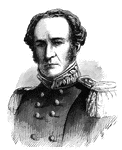
"General Stoneman, born in Busti, Chautauqua County, N. Y., August 8th, 1822, was graduated from the United States Military Academy in 1846, and entered the First Dragoons. In February, 1861, while in command of Fort Brown, Texas, he refused to obey the order of his superior, General Twiggs, for the surrender of the government property to the Secessionists, evacuated the fort and went to New York by steamer. He became major of the First Cavalry, May 9th, 1861, and served in Western virginia till August 13th, when he was appointed brigadier general of volunteers and chief of cavalry of the Army of the Potomac. He served during the Virginia Peninsular campaign of 1862. He was appointed major general, November 29th, 1862. He was engaged in the Atlanta campaign from May to July, 1864; was captured at Clinton, Ga., July 31st, and held a captive till October 27th. He became colonel of the Twenty-first Infantry, July 28th, 1866, and was brevetted colonel, brigadier and major-general for gallant conduct."&mdash; Frank Leslie, 1896

General George Stoneman

"General Stoneman, born in Busti, Chautauqua County, N. Y., August 8th, 1822, was graduated from the…
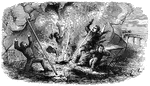
"Explosion of 3,000 musket cartridges in a tent at Fort Totten, New Berne, N. C., the headquarters of the Third New York Artillery. Our correspondent wrote: 'There is a great carelessness in the handling of munitions of war, of which we have just had a proof in our camp. Thinking to blow the flies from the tent by flashing powder- a common practice a spark caught a box of three thousand musket cartridges, thereby causing a tremendous explosion, which wounded four men (two dangerously) and blew the tent to atoms.'"— Frank Leslie, 1896

Explosion

"Explosion of 3,000 musket cartridges in a tent at Fort Totten, New Berne, N. C., the headquarters of…
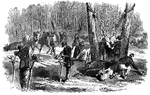
"Butchering and dressing cattle for distribution to the Federal Army. The romance and reality of life were never so strikingly displayed as in the Civil War. Fact and fiction never seemed more apart than the soldier waving his sword when leading the forlorn hope and when sitting before his tent cooking rations; for, despite all the commissariat arrangements, there was much room for improvement in these particulars. We give a couple of sketches which will enable our readers to see how matter-of-fact and mechanically base were some of the soldier's employments when in camp. Men who would shrink from turning butcher in New York, boston or Philadelphia were forced by the resistless tide of circumstances to lend a hand to the killing a beeve and afterward to the dressing and cooking it."&mdash; Frank Leslie, 1896

Butchering Cattle

"Butchering and dressing cattle for distribution to the Federal Army. The romance and reality of life…
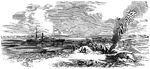
"The crew of the United States gunboat <em>Mahaska</em>, Captain Foxhall A. Parker destroying the water battery built by the Confederates at West Point, York River."— Frank Leslie, 1896

Mahaska Crew

"The crew of the United States gunboat Mahaska, Captain Foxhall A. Parker destroying the water…
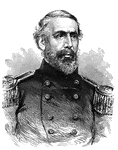
"General Ward, born in New York city, June 17th, 1823, was educated at Trinity Collegiate School; enlisted at the age of eighteen in the Seventh United States Infantry, and in four years rose through the several grades to that of sergeant major. In the Mexican War he participated in the siege of Fort Brown, received wounds at monterey, and was at the capture of Vera Cruz. At the beginning of the Civil War he recruited the Thirty-eighth New York volunteers, was appointed colonel of the regiment and let it at Bull Run and in all the battles of Peninsular campaign, and subsequently at the second Bull Run and Chantilly. Being promoted brigadier general of volunteers, October 4th, 1862, he commanded a brigade in the Third Corps at Fredericksburg, Chancellorsville, Gettysburg, where he was wounded, as also at Kelly's Ford and Wapping Heights, he was in temporary command of the division. He was wounded at Spottsylvania, and was frequently commended for courage and capacity in official reports."&mdash; Frank Leslie, 1896

General J. H. Hobart Ward

"General Ward, born in New York city, June 17th, 1823, was educated at Trinity Collegiate School; enlisted…
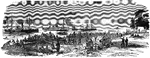
"The advance upon Charleston, S. C.- pioneer movement- landing of the One Hundredth New York Volunteers upon Cole's Island, March 28th, 1863. On the morning of the 28th of March, 1863, the One Hundredth New York Volunteers, Colonel G. B. Danby, landed on Cole's Island, at the foot of James Island, nine miles from Charleston. This regiment was part of the Eighteenth Army Corps, and may be considered the pioneer of the grand expedition against Charleston. A reconnoissance of the island disclosed a Confederate battery near the end of the causeway that leads from Cole's Island to James Island, and also evidences of numerous concealed works on Folly and James Islands, where the Confederates had gathered a very large force. We will briefly describe the topography of this scene of action. John's Island is to the southwest of James Island, and may be said to include Seabrook and Cole's Island, which are only separated from it by a sort of marshy bayou, which at times is almost emptied of water."— Frank Leslie, 1896

Advance upon Charleston

"The advance upon Charleston, S. C.- pioneer movement- landing of the One Hundredth New York Volunteers…
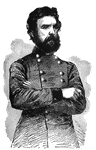
"General King, born in New York city, January 26th, 1814, died there, October 13th, 1876, was graduated at the United States Military Academy in 1833, and appointed to the Engineer Corps. He resigned from the army, September 30th, 1836, and became assistant engineer of the New York and Erie Railroad. From 1838 till 1843 he was adjutant general of the State of New York. He was then associate editor of the Albany <em>Evening Journal</em>, and of the Albany <em>Advertiser</em> from 1841 till 1845, when he removed to Wisconsin, and was editor of the Milwuakee <em>Sentinel</em> until 1861. He was United States minister to Rome from March 22nd till August 5th, 1861, but resigned, as he had offered his services in defense of the Union. He was made a brigadier general of volunteers, May 17th, 1861, and commanded a division at Fredericksburg, Groveton, Manassas, Yorktown and Fairfax, remaining in the army until 1863, when he was reappointed minister to Rome, where he resided until 1867."&mdash; Frank Leslie, 1896

General Rufus King

"General King, born in New York city, January 26th, 1814, died there, October 13th, 1876, was graduated…
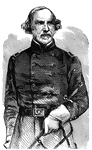
"General Tyler, born in Brooklyn, Windham County, Conn., January 7th, 1797, died in New York city, November 30th, 1882, was graduated from the United States Military Academy in 1819. He served as a lieutenant of artillery, was adjutant of the School of Practice at Fortress Monroe, 1824-'26; and while commanding the arsenal at Pikesville, Md., 1826-'27, translated 'Manoeuvres of Artillery' from the French. In 1828 he was sent abroad to observe the French improvements in artillery. This he did at Metz and elsewhere. In 1832 he was superintendent of the inspectors of arms furnished by contractors. Resigning in 1834, he became president of an iron and coal company. He was colonel of the First Connecticut Regiment in April, 1861; brigadier general of volunteers in March, 1862, and served in the Army of the Mississippi at the siege of Corinth in June. Served as one of the commission to investigate Buell's Kentucky campaign, and afterward in command at Harper's Ferry, in Baltimore and in Delaware. He withdrew from the army in April, 1864."&mdash; Frank Leslie, 1896

General Daniel Tyler

"General Tyler, born in Brooklyn, Windham County, Conn., January 7th, 1797, died in New York city, November…
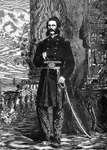
"General Baker, Chief of the United States Secret Service, born in Stafford, Genesee County, N. Y., October 13th, 1826, died in Philadelphia, Pa., July 2nd, 1868. In 1848 he went to New York and Philadelphia, and in 1853 to San Francisco, in each of these cities working as a mechanic. When the lawless element became dominant in San Francisco, in 1856, General Baker joined the Vigilance Committee and took an active part in the summary proceedings that restored order in the city. He went to New York on business in 1861, expecting to return at once, but the Civil War intervened, and he went to Washington and offered his services. At the suggestion of General Hiram Walbridge, of New York, he was introduced to General Scott, and as a result of the interview he started on foot for Richmond, where, in spite of arrest, imprisonment and several interviews with Jefferson Davis, while under suspension as a spy, he succeeded in collecting much information and returning to Washington after an absence of three weeks. This was but the first of a series of adventures involving high executive ability and a wonderful talent for tracing conspiracy and frustrating the designs of Confederate spies and agents. He was commissioned colonel, and subsequently brigadier general. His duties naturally made him enemies in influential quarters, and charges of a serious nature were several times preferred against him, but were never substantiated. When President Lincoln was assassinated General Baker organized the pursuit of the murderer, and was present at his capture and death."&mdash; Frank Leslie, 1896

General Lafayette C. Baker

"General Baker, Chief of the United States Secret Service, born in Stafford, Genesee County, N. Y.,…
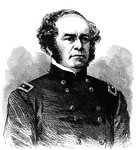
"General Benham, born in Connecticut in 1817, died in New York June 1st, 1884, was graduated from the United States Military Academy in 1837, and assigned to the Corps of Engineers. Served in the Mexican War, 1847-'8, and was brevetted captain for gallant and meritorious services in the battle of Buena Vista. At the beginning of the Civil War, in 1861, Captain Benham entered upon active service; was on General Morris's staff as engineer of the Department of the Ohio; was brevetted colonel for gallantry at the battle of Carrick's Ford, July 13th, 1861; in August was made brigadier general of volunteers, and was engaged in the Virginia campaigns. In 1862 he was present at the capture of Fort Pulaski and James Island; later in the year he superintended fortifications in Boston and Portsmouth harbors, and was in command of the Northern District of the Department of the South. He proved very efficient in throwing pontoon bridges across the Rappahannock, the Potomac and the James Rivers, and was in command of the Pontoon Department at Washington in 1864. In March, 1865, he was brevetted brigadier general and major general, United States Army, and major general, United States Volunteers, for gallant services during the Rebellion."&mdash; Frank Leslie, 1896

General Henry W. Benham

"General Benham, born in Connecticut in 1817, died in New York June 1st, 1884, was graduated from the…

"Presentation of colors to the Twentieth United States [African American] Infantry, Colonel Bartram, at the Union League Clubhouse, New York, March 5th, 1864. The Twentieth Regiment, United States [African American] Troops, left Riker's Island at nine o'clock on the 5th of March, 1864, on board the steamer <em>John Romer</em>, and were conveyed to the foot of Twenty-first Street, East River, New York, where they were disembarked and formed in regimental line, and marched to Union Square, arriving in front of the Union League Clubhouse at one o'clock. A vast crowd of citizens, of every shade of color and every phase of social and political life, filled the square and streets, and every door, window, veranda, tree and housetop that commanded a view of the scene was peopled with spectators. Over the entrance of the clubhouse was a large platform, ornamented with flags and filled with ladies. In the street was another platform, tastefully decorated and occupied by prominent citizens. From the stand the colors were presented by President King of Columbia College, who addressed them with warmth and eloquence. After the presentation ceremony was over the men stacked arms and partook of a collation provided for them."— Frank Leslie, 1896

Presentation of Colors

"Presentation of colors to the Twentieth United States [African American] Infantry, Colonel Bartram,…
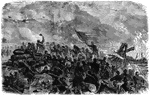
"The war in Tennessee. Hooker's Battle above the clouds, and capture of the Confederate position on Lookout Mountain, November 24th, 1863. The wild mountains of Tennessee, where nature reveals in producing the most fantastic forms, and piling rocks upon rocks, forms one of the mightiest ridges on the land, have been the scene of one of the most extraordinary battles in history; a battle fought with the mists and clouds rolling beneath the combatants, the flash and the roar of the guns appearing to the spectators in the plain below like the lightning and the thunder of heaven. By eight o'clock on Tuesday, November 24th, Hooker's column was moving up Lookout Valley, and, to the surprise of the enemy, disappeared in the woods south of Wauhatchie. But here, filing his troop to the left, General Hooker began the difficult task of the ascent of the mountain. The head of the column, having reached the palisades, went into line of battle facing to the north, and with the right resting against the palisades stretched down the mountain. Geary's division formed the front, with Greene's brigade of New York troops on the right. General Hooker then formed a second line of the two brigades of the Fourth Corps which had been sent him, placing Whittaker on the right and Grose on the left. General Osterhaus formed a third line, and held himself in readiness to aid any part of the line which might need it. Thus arranged, the corps was ordered forward, with a heavy line of skirmishers thrown out, and marching along the slope of the ridge, soon came upon the rear of the enemy, who were taken completely by surprise. Before those at the foot of the hill could comprehend the situation Colonel Ireland's skirmishers had penetrated far toward the point of the mountain, and got in a heavy fire upon the enemy, who were now trying to escape up the hill, while the Federals assaulted them from above. At the same time the Federal batteries on the Moccasin Point and those of the Confederates on Lookout Mountain opened a heavy fire upon each other, and soon the whole mountain was hid from the view in Chattanooga by the cloud of smoke which rose above and around it. The enemy made but little organized resistance, yet their skirmishers for a long time kept up a heavy fire from behind jutting rocks and from trees. Holding Ireland's right well against the palisades, Geary threw Kennedy forward on the left, and he, after being re-enforced by Grose, the enemy on the point of the mountain gradually gave way and fell back in some disorder to the line of breastworks on the east slope of the mountain, at Craven's House. General Geary swung around until his line was parallel with that of the enemy, and again advanced, but being met by organized and well-directed resistance, for a time recoiled. The enemy were now in strong position, Craven's House being the centre of a line of heavy breastworks; but they lacked numbers to man them, having lost severely. They were compelled to expose their right flank. Hooker then sent the Eighty-fourth and Seventy-fifth Illinois to hold the road across the mountain, and advanced on the enemy, with Geary on the right, Osterhaus on the left. Whittaker and Grose in the centre. Geary turned their left, as Osterhaus did the enemy's right, and then, with one charge of the whole line, Hooker carried the position."— Frank Leslie, 1896

Hooker's Battle

"The war in Tennessee. Hooker's Battle above the clouds, and capture of the Confederate position on…
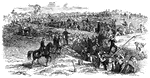
"The invasion of Pennsylvania- working on the fortifications near Harrisburg, Pa., June 16th, 1863. Our artist gives a view of the citizens of Harrisburg laboring on the fortifications of that city, showing that tardy but ineffective preparations made. Meanwhile the New York regiments all accustomed to military drill and evolution, some already tried by actual service, were hurrying to the scene of action; and on these men, till the War Department could assign regulars or volunteers, depended the safety of Pennsylvania."— Frank Leslie, 1896

Invasion of Pennsylvania

"The invasion of Pennsylvania- working on the fortifications near Harrisburg, Pa., June 16th, 1863.…
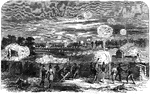
"The war in Virginia- Roemer's Battery, Third Division, Ninth Army Corps, shelling Petersburg. Our readers will be able to study the siege of Petersburg in our illustrations as they did that of Vicksburg. It is one of those cases where pictorial illustration has an advantage over mere verbal accounts. Here we see the Thirty-fourth New York Battery (Roemer's) and the Seventh Maine (Twitchell's), of Wilcox's Third Division of Burnside's Ninth Army Corps, shelling the city of Petersburg itself as it stands in full sight, and less than three miles off."— Frank Leslie, 1896

Roemer's Battery

"The war in Virginia- Roemer's Battery, Third Division, Ninth Army Corps, shelling Petersburg. Our readers…
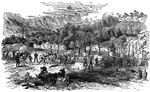
"Sherman's Campaign in Georgia- the attack of the Fourteenth, Sixteenth and Twentieth Army Corps on Kenesaw Mountain, June 22nd, 1864. Kenesaw Mountain, a second Lookout among its fellows, is about four miles in length and some four hundred feet high, difficult of ascent, with spurs on the flanks, and presenting a most dignified appearance. Sherman resolved to flank it, and on June 22nd the corps of the right and left of his army advanced, the centre maintaining its position around and upon the base of the mountain in the teeth of a very heavy artillery fire from the Confederate batteries. The Twentieth and Twenty-third wheeled on the left to hem in the Confederates between the Federal line and the railroad. The Fourteenth Kentucky met the enemy first, who charged furiously to check the movement. Schofield and Hooker were, however, ready. Williams's division drove back the enemy with artillery alone, without the employment of a musket. Batteries I and M of the First New York had second position, which gave them a cross fire upon the Confederates as they advanced over an open field, and it proved entirely too hot for them. Again, about six o'clock, they made the same attempt, and were driven back still more rapidly by a combined fire of artillery and musketry, which must, from the openness of the ground, have proved very destructive. The Federal losses were slight. They did not exceed two hundred killed and wounded during the day, and one-quarter of this loss was suffered by the Fourteenth Kentucky."— Frank Leslie, 1896

Sherman's Campaign

"Sherman's Campaign in Georgia- the attack of the Fourteenth, Sixteenth and Twentieth Army Corps on…
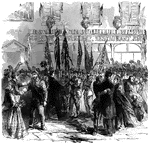
"The soldier's rest--the friends of the Seventh and Eighth Regiments, New York Volunteers, welcoming the return of their heroes to New York, Tuesday, April 28th, 1863."— Frank Leslie, 1896

Soldiers Resting

"The soldier's rest--the friends of the Seventh and Eighth Regiments, New York Volunteers, welcoming…

Seal, with a shovel and hoe on it.

True-temper seal

Seal, with a shovel and hoe on it.

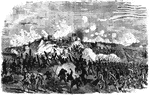
"First assault upon Fort Fisher, Sunday, January 15th, 1865. The One Hundred and Seventeenth New York troops, followed by the Third, planting the flag on the northern traverse of the fort. On the 13th of January the Federal fleet commenced the bombardment, which was continued with unabated vigor throughout the day. On the 15th it was resolved to take the place by storm. The boats containing the naval force intended to co-operate effected a landing on a shelving piece of beach about a mile and a half from the fort. At two o'clock, and when within eight hundred yards of the fort, the order to charge was given. The First Brigade of the Second Division of the Twenty-fourth Corps, headed by General Curtis, scaled the northeast salient of the fort, and forced a rapid entrance. Inch by inch they fought their way along the northeast face, the gallant First Brigade in the advance. It was a hand-to-hand struggle; bayonets were in general use; muskets were clubbed; and man stood up to man in deadly conflict. Night fell, and yet the fierce struggle raged unremittingly within the fort. About ten o'clock the final struggle took place, and, after a short but desperate hand-to-hand encounter, the Federals remained masters of the hitherto impregnable Fort Fisher."— Frank Leslie, 1896

Fort Fisher

"First assault upon Fort Fisher, Sunday, January 15th, 1865. The One Hundred and Seventeenth New York…
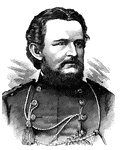
"General Merritt, born in New York city June 16th, 1836. He was graduated at the United States Military Academy July 1st, 1860, assigned to the dragoons and promoted first lieutenant May 13th, 1861, and captain April 13th, 1861, and captain April 5th, 1862. He took part in General George Stoneman's raid toward Richmond in April and May, 1863, and was in command of the reserve cavalry brigade in the Pennsylvania campaign of the same year, being commissioned brigadier general of volunteers in June. For gallant and meritrious services during the battle of Gettysburg he was brevetted major. Still in command of his brigade, he took part in the various engagements in Central Virginia in 1863-4, and was brevetted lieutenant colonel and colonel in the regular army and major general of volunteers, for gallantry at the battle of Yellow Tavern, Hawes's Shop and Winchester, respectively. On March 13th, 1865, he was brevetted brigadier general and major general in the regular army for bravery at the battle of Five Forks, and his services during the final Virginia campaign."&mdash; Frank Leslie, 1896

General Wesley Merritt

"General Merritt, born in New York city June 16th, 1836. He was graduated at the United States Military…
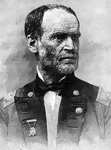
"General Sherman, born in Lancaster, Ohio, February 8th, 1820; died in New York city, February 14th, 1891."&mdash; Frank Leslie, 1896

Lieutenant General William Tecumseh Sherman

"General Sherman, born in Lancaster, Ohio, February 8th, 1820; died in New York city, February 14th,…
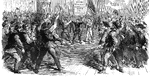
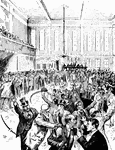
"The ('Billy') Wilson Zouaves, at Tammany Hall, taking the oath of fidelity to the flag, April 24th, 1861. Colonel Wilson was among the first to offer his services to the government on the breaking out of the war. He recruited a regiment of nearly twelve hundred men from the rowdy and criminal classes of New York City. The regiment was formally mustered in the old Tammany Hall, and there, on April 24th, with the men arranged around the room, with the officers in the centre, the colonel, with a sword in one hand and the American flag in the other, led the men into swearing to 'support the flag and never to flinch from its path through blood or death.' The Zouaves, a few days afterward, left for the South."— Frank Leslie, 1896

Billy Wilson Zouaves

"The ('Billy') Wilson Zouaves, at Tammany Hall, taking the oath of fidelity to the flag, April 24th,…
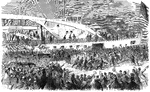
"Rhode Island Regiments embarking at Providence for New York and Washington. Within five days after the President's call for troops the Rhode Island Marine Artillery, with 8 guns and 110 horses, commanded by Colonel Tompkins, passed through New York on their way to Washington, and the First Regiment of infantry, 1,200 strong, under Colonel Ambrose E. Burnside, was ready to move. It was composed of many of the wealthier citizens of the State, and accompanied by the patriotic Governor, who had, from his private purse, armed and equipped the regiment, as well as contributed to the general war fun. The little State, on May 18th, 1861, appropriated $500,000 for equipping volunteers."&mdash; Frank Leslie, 1896

Rhode Island Regiments

"Rhode Island Regiments embarking at Providence for New York and Washington. Within five days after…
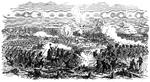
"Battle of Williamsburg, Va., on the peninsula between York and James Rivers, May 6th, 1862. General Hancock's sudden charge decided the battle, for it left the real key of the position in Federal hands. With the re-enforcements with McClellan had caused to be sent him immediately upon reaching the scene, late in the afternoon. Hancock took possession of all the ground he had previously occupied, and night closed upon what proved to be a dearly bought victory for the Federals. They had, in fact, gained it after substaining a loss of 2,228 in killed and wounded, the Confederate loss being only about half that number. Early on the 6th of May Williamsburg was occupied by the Federals, while Johnston's army was again beyond the Chickahominy."— Frank Leslie, 1896

Battle of Williamsburg

"Battle of Williamsburg, Va., on the peninsula between York and James Rivers, May 6th, 1862. General…
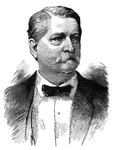
"General Hancock, born in Montgomery Square, Montgomery County, Pa., February 14th, 1824; died on Governor's Island, New York Harbor, February 9th, 1886. General Hancock served in the Civil War."&mdash; Frank Leslie, 1896

General Winfield Scott Hancock

"General Hancock, born in Montgomery Square, Montgomery County, Pa., February 14th, 1824; died on Governor's…
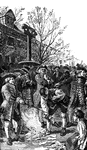
"Burning the Stamps in New York, during the opposition of the Stamp Act in 1764."—E. Benjamin Andrews, 1895

Burning Stamps

"Burning the Stamps in New York, during the opposition of the Stamp Act in 1764."—E. Benjamin Andrews,…
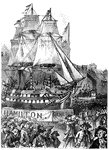
"Celebrating the adoption of the Constitution in New York."—E. Benjamin Andrews, 1895

Constitution Celebration

"Celebrating the adoption of the Constitution in New York."—E. Benjamin Andrews, 1895
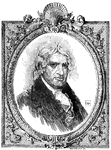
(1739-1812) George Clinton, was governor of New York (1777-1795} and fourth vice president of the United States under Thomas Jefferson and James Madison.

George Clinton

(1739-1812) George Clinton, was governor of New York (1777-1795} and fourth vice president of the United…
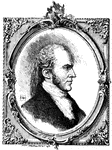
"Aaron Burr was the grandson of President Edwards and Attorney-general of New York in 1789."—E. Benjamin Andrews, 1895

Aaron Burr

"Aaron Burr was the grandson of President Edwards and Attorney-general of New York in 1789."—E. Benjamin…
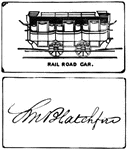
"Obverse and Reverse of a ticket used in 1838 on the New York and Harlem Railroad."—E. Benjamin Andrews, 1895

Railroad Ticket

"Obverse and Reverse of a ticket used in 1838 on the New York and Harlem Railroad."—E. Benjamin Andrews,…
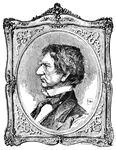
"William H. Seward, former United States Senator from New York involved in slavery issues."—E. Benjamin Andrews 1895

William H. Seward

"William H. Seward, former United States Senator from New York involved in slavery issues."—E. Benjamin…
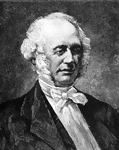
"Cornelius Vanderbilt was involved in the New York Central Station."—E. Benjamin Andrews 1895

Cornelius Vanderbilt

"Cornelius Vanderbilt was involved in the New York Central Station."—E. Benjamin Andrews 1895
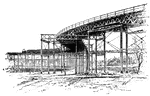
"The Manhattan elevated railway, new York."—E. Benjamin Andrews 1895

Manhattan Railway

"The Manhattan elevated railway, new York."—E. Benjamin Andrews 1895

"The New York Gold Room on 'Black Friday,' September 24, 1869."—E. Benjamin Andrews 1895

Black Friday

"The New York Gold Room on 'Black Friday,' September 24, 1869."—E. Benjamin Andrews 1895
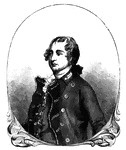
Sir Guy Carleton, afterward Lord Dorchester, was Wolfe's quartermaster at the storming of Quebec, and was appointed a major in the British army in 1772. In 1774 he was constituted Captain-general and Governor of Quebec or Canada. He successfully commanded the British at Quebec when attacked by Montgomery in 1775, compelled the Americans to raise the siege in 1776, and drove them out of the province. In October he recaptured Crown Point. He was unjustly superseded in military command by Burgoyne in 1777. He was appointed to succeed Sir Henry Clinton in 1782, and was in command of the British troops when they evacuated New York on the 25th of November, 1783. He died in England at the close of 1808, aged 83 years.

Sir Guy Carleton

Sir Guy Carleton, afterward Lord Dorchester, was Wolfe's quartermaster at the storming of Quebec, and…
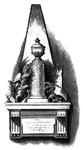
Richard Montgomery's Monument, states: "This monument is erected by order of Congress, 25th of January, 1776, to transmit to posterity a grateful remembrance of the patriotic conduct, enterprise, and preseverance of Major-general Richard Montgomery, who, after a series of success amid the most discouraging difficulties, fell in the attack on Quebec, 31st December, 1775, aged 37 yeras.

Richard Montgomery's Monument

Richard Montgomery's Monument, states: "This monument is erected by order of Congress, 25th of January,…