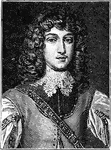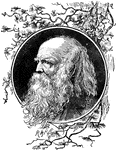
William Cullen Bryant (November 3, 1794 - June 12, 1878) was an American romantic poet, journalist, and long-time editor of the New York Evening Post.

William C. Bryant

William Cullen Bryant (November 3, 1794 - June 12, 1878) was an American romantic poet, journalist,…
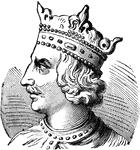
Henry I (c. 1068/1069 – 1 December 1135) was the fourth son of William I the Conqueror, the first King of England after the Norman Conquest of 1066. He succeeded his elder brother William II as King of England in 1100 and defeated his eldest brother, Robert Curthose, to become Duke of Normandy in 1106. He was called Beauclerc for his scholarly interests and Lion of Justice for refinements which he brought about in the rudimentary administrative and legislative machinery of the time. Henry's reign is noted for its political opportunism. His succession was confirmed while his brother Robert was away on the First Crusade and the beginning of his reign was occupied by wars with Robert for control of England and Normandy. He successfully reunited the two realms again after their separation on his father's death in 1087. Upon his succession he granted the baronage a Charter of Liberties, which formed a basis for subsequent challenges to rights of kings and presaged Magna Carta, which subjected the King to law.

Henry I of England

Henry I (c. 1068/1069 – 1 December 1135) was the fourth son of William I the Conqueror, the first…
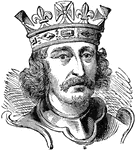
Richard I (8 September 1157 – 6 April 1199) was King of England from 6 July 1189 until his death. He also ruled as Duke of Normandy, Duke of Aquitaine, Duke of Gascony, Lord of Ireland, Lord of Cyprus, Count of Anjou, Count of Nantes and Overlord of Brittany at various times during the same period. He was known as Richard the Lionheart, or Cœur de Lion, even before his accession, because of his reputation as a great military leader and warrior. At only 16, Richard was commanding his own army, putting down rebellions in Poitou against his father, King Henry II. Richard was a central Christian commander during the Third Crusade, effectively leading the campaign after the departure of Philip Augustus, and scoring considerable victories against his Muslim counterpart, Saladin. While he spoke very little English and spent very little time in his Kingdom, preferring to use it as a source of revenue to support his armies, he was seen as a pious hero by his subjects. He remains one of the very few Kings of England remembered by his epithet, not number, and is an enduring, iconic figure in England.

Richard I of England

Richard I (8 September 1157 – 6 April 1199) was King of England from 6 July 1189 until his death.…
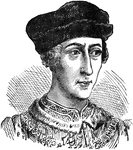
Henry V (16 September 1386 – 31 August 1422) was one of the most significant English warrior kings of the 15th century. He was born at Monmouth, Wales, in the tower above the gatehouse of Monmouth Castle, and reigned as King of England from 1413 to 1422. Henry was the son of Henry of Bolingbroke, later Henry IV, and sixteen-year-old Mary de Bohun, who was to die in childbirth at 26, before Bolingbroke became king. At the time of his birth during the reign of Richard II, Henry was fairly far removed from the throne, preceded by the king and another collateral line of heirs. The precise date and even year of his birth are therefore not definitely recorded; sources offer as the most likely either 9 August or 16 September, in 1386 or 1387. By the time Henry died, he had not only consolidated power as the King of England but had also effectively accomplished what generations of his ancestors had failed to achieve through decades of war: unification of the crowns of England and France in a single person. In 2002, he was ranked 72nd in the 100 Greatest Britons

Henry V of England

Henry V (16 September 1386 – 31 August 1422) was one of the most significant English warrior kings…
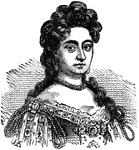
Mary I (18 February 1516 - 17 November 1558), was Queen of England and Queen of Ireland from 19 July 1553 until her death. The fourth crowned monarch of the Tudor dynasty, she is remembered for restoring England to Roman Catholicism after succeeding her short-lived half brother, Edward VI, to the English throne. In the process, she had almost 300 religious dissenters burned at the stake in the Marian Persecutions, earning her the sobriquet of Bloody Mary. Her reestablishment of Roman Catholicism was reversed by her successor and half-sister, Elizabeth I.

Mary I of England

Mary I (18 February 1516 - 17 November 1558), was Queen of England and Queen of Ireland from 19 July…
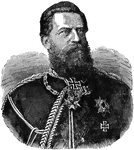
Frederick III (October 18, 1831 - June 15, 1888), was German Emperor and King of Prussia, ruling for 99 days until his death on June 15, 1888. Frederick III was a war hero during the Second Schleswig War, the Austro-Prussian War, and the Franco-Prussian War before his reign as German Emperor, yet his father's unusually long reign and longevity never let Frederick III capitalize on his military successes, popularity, and youth as emperor. He was more liberal than previous German leaders and represented a possibility for the earlier liberalization of German society and government. However, Frederick III developed larynx cancer shortly before he assumed the throne which severely limited his time and effectiveness as German Emperor. After his largely ineffectual reign and lost impact on German society, his successor, Wilhelm II, abandoned any path toward liberalization that Frederick III previously leaned towards.

Frederick III, German Emperor

Frederick III (October 18, 1831 - June 15, 1888), was German Emperor and King of Prussia, ruling for…
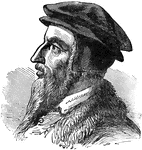
John Calvin (or Jean Calvin) (10 July 1509 - 27 May 1564) was a French Protestant theologian during the Protestant Reformation and was a central developer of the system of Christian theology called Calvinism or Reformed theology. In Geneva, his ministry both attracted other Protestant refugees and over time made that city a major force in the spread of Reformed theology. He is famous for his teachings and writings, in particular for his Institutes of the Christian Religion.

John Calvin

John Calvin (or Jean Calvin) (10 July 1509 - 27 May 1564) was a French Protestant theologian during…
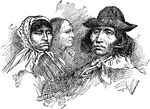
The Cherokee are a people native to North America, who, at the time of European contact in the sixteenth century, inhabited what is now the Eastern and Southeastern United States.

Cherokee Indians

The Cherokee are a people native to North America, who, at the time of European contact in the sixteenth…
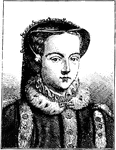
Mary I (18 February 1516 – 17 November 1558), was Queen of England and Queen of Ireland from 19 July 1553 until her death. The fourth crowned monarch of the Tudor dynasty, she is remembered for restoring England to Roman Catholicism after succeeding her short-lived half brother, Edward VI, to the English throne. In the process, she had almost 300 religious dissenters burned at the stake in the Marian Persecutions, earning her the sobriquet of Bloody Mary. Her re-establishment of Roman Catholicism was reversed by her successor and half-sister, Elizabeth I.

Queen Mary Tudor

Mary I (18 February 1516 – 17 November 1558), was Queen of England and Queen of Ireland from 19…
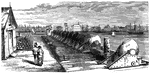
An illustration of a mortar battery located at the Brooklyn Navy Yard. A mortar is a muzzleloading indirect fire weapon that fires shells at low velocities, short ranges, and high-arcing ballistic trajectories. A battery is a until of weapons grouped in order to facilitate better battlefield communication and command and control, as well as to provide dispersion for its constitute gunnery crews and their systems.

Mortar Battery

An illustration of a mortar battery located at the Brooklyn Navy Yard. A mortar is a muzzleloading indirect…
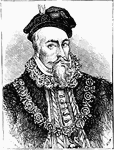
Robert Dudley, 1st Earl of Leicester (24 June 1532~1533 – 4 September 1588) was the long standing favourite of Elizabeth I of England. Robert Dudley was temporarily imprisoned, along with his father and brothers Guilford, John, Ambrose and Henry Dudley, in the Tower of London, where his stay coincided with the imprisonment of his childhood friend, Lady Elizabeth Tudor, who had been sent there on the orders of her estranged elder sister, Queen Mary I of England. By this time he was already married to Amy Robsart. A document titled "Leycester's Commonwealth", banned in England when published in Europe, proposes an elaborate conspiracy regarding Dudley.

Robert Dudley, Earl of Leicester

Robert Dudley, 1st Earl of Leicester (24 June 1532~1533 – 4 September 1588) was the long standing…
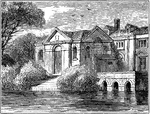
The Gunpowder Plot of 1605, or the Powder Treason, as it was known at the time, was a failed assassination attempt by a group of provincial English Catholics against King James I of England and VI of Scotland. The plot intended to kill the king, his family, and most of the Protestant aristocracy in a single attack by blowing up the Houses of Parliament during the State Opening on 5 November 1605. The conspirators had also planned to abduct the royal children, not present in Parliament, and incite a popular revolt in the Midlands.

Gunpowder Conspirators' House, Lambeth

The Gunpowder Plot of 1605, or the Powder Treason, as it was known at the time, was a failed assassination…
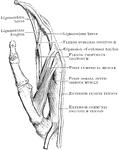
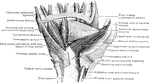
The tendons attached to the index finger.

Finger Tendons

The tendons attached to the index finger.

Short muscles of the hand.

Short Muscles of the Hand

Short muscles of the hand.

Rupert, Count Palatine of the Rhine, Duke of Bavaria, commonly called Prince Rupert of the Rhine, (17 December 1619 – 29 November 1682), soldier, inventor and amateur artist in mezzotint. He was a soldier from a young age, fighting against Spain in the Netherlands and the Holy Roman Empire in Germany. Aged 23, he was appointed commander of the Royalist cavalry during the English Civil War. He surrendered after the Battle of Naseby and was banished from the British Isles. He spent some time in Royalist forces in exile, first on land then at sea. He then became a buccaneer in the Caribbean. Following the restoration, Rupert returned to England, becoming a naval commander, inventor, artist and first Governor of the Hudson's Bay Company. Prince Rupert died in England in 1682, aged 62.

Prince Rupert of the Rhine

Rupert, Count Palatine of the Rhine, Duke of Bavaria, commonly called Prince Rupert of the Rhine, (17…
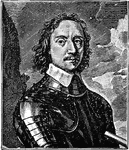
Oliver Cromwell (25 April 1599 Old Style– 3 September 1658 Old Style) was an English military and political leader best known for his involvement in making England into a republican Commonwealth and for his later role as Lord Protector of England, Scotland, and Ireland. He was one of the commanders of the New Model Army which defeated the royalists in the English Civil War. After the execution of King Charles I in 1649, Cromwell dominated the short-lived Commonwealth of England, conquered Ireland and Scotland, and ruled as Lord Protector from 1653 until his death in 1658.

Oliver Cromwell

Oliver Cromwell (25 April 1599 Old Style– 3 September 1658 Old Style) was an English military…
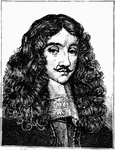
Charles II (Charles Stuart; 29 May 1630 – 6 February 1685) was the King of England, Scotland, and Ireland. According to royalists (and retrospective English law), Charles II became king when his father Charles I was executed at Whitehall on 30 January 1649, the climax of the English Civil War. The English Parliament did not proclaim Charles II king at this time, passing a statute making it unlawful, and England entered the period known to history as the English Interregnum. The Parliament of Scotland, on the other hand, proclaimed Charles II King of Scots on 5 February 1649 in Edinburgh. He was crowned King of Scots at Scone on 1 January 1651.

Charles II of England

Charles II (Charles Stuart; 29 May 1630 – 6 February 1685) was the King of England, Scotland,…
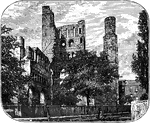
Kelso Abbey is a Scottish abbey built in the 12th century by a community of Tironensian monks who had moved from the nearby Selkirk Abbey. The monks constructed the Abbey on land granted to them by King David I. The construction commenced in 1128, and when completed fifteen years later, in 1143, it was dedicated to The Blessed Virgin and Saint John. The importance of the Abbey at that time was shown when King James III of Scotland was crowned at the Abbey in 1460. However, the Abbey's proximity to the border with England led to it suffering damage from cross-border raids. It was first damaged in the Anglo-Scottish wars at the start of the 1300s, but was later repaired by the monks.

Ruins of Kelso Abbey

Kelso Abbey is a Scottish abbey built in the 12th century by a community of Tironensian monks who had…
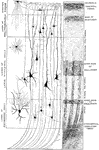
Diagram to illustrate minute structure of the cerebral cortex. Labels: A and B, neuroglia cells; C, cells with short axon (N) which breaks up in free arborisation; D, spindle-shaped cell in stratum zonate; E, small pyramidal cell; F, large pyramidal cell; G, cell of Martinotti; H, polymorphic cell; K, corticipetal fibers.

Minute Structure of Cerebral Cortex

Diagram to illustrate minute structure of the cerebral cortex. Labels: A and B, neuroglia cells; C,…
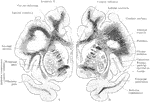
Two coronal sections through the cerebral hemisphere of an orangoutang, in the plan of the anterior commissure. A, Section through the left hemisphere n a plane a short distance behind B, which is a section through the right hemisphere.

Coronal Sections of the Cerebral Hemispheres

Two coronal sections through the cerebral hemisphere of an orangoutang, in the plan of the anterior…
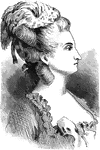
Anne Vallayer-Coster (1744-1818) was an eighteenth-century French painter. Known as a prodigy artist at a young age, she achieved fame and recognition very early in her career, being admitted to the Royal Academy in 1770, at the age of twenty-six. Despite the negative reputation that still-life painting had at this time, Vallayer-Coster's highly developed skills, especially in the depiction of flowers, soon generated a great deal of attention from collectors and other artists. Her "precocious talent and the rave reviews" earned her the attention of the court, where Marie-Antoinette took a particular interest in Vallayer-Coster's paintings.

Anne Vallayer-Coster

Anne Vallayer-Coster (1744-1818) was an eighteenth-century French painter. Known as a prodigy artist…
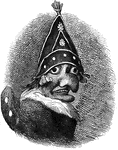
An illustration of Mr. Punch, a puppet from the popular English puppet show Punch and Judy. Punch and Judy is a traditional, popular English puppet show featuring the characters of Punch and his wife Judy. The performance consists of a sequence of short scenes, each depicting an interaction between two characters, most typically the anarchic Punch and one other character. The show is traditionally performed by a single puppeteer, known since Victorian times as a Professor

Mr. Punch

An illustration of Mr. Punch, a puppet from the popular English puppet show Punch and Judy. Punch and…
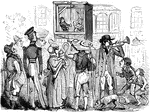
An illustration of a typical Punch and Judy show. Punch and Judy is a traditional, popular English puppet show featuring the characters of Punch and his wife Judy. The performance consists of a sequence of short scenes, each depicting an interaction between two characters, most typically the anarchic Punch and one other character. The show is traditionally performed by a single puppeteer, known since Victorian times as a Professor

Punch and Judy

An illustration of a typical Punch and Judy show. Punch and Judy is a traditional, popular English puppet…
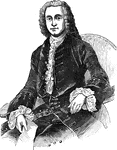
George Grenville (14 October 1712 - 13 November 1770), was a British Whig statesman who served in government for the relatively short period of seven years, reaching the position of Prime Minister of Great Britain.

George Grenville

George Grenville (14 October 1712 - 13 November 1770), was a British Whig statesman who served in government…
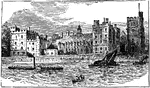
Lambeth Palace is the official London residence of the Archbishop of Canterbury. It is located in Lambeth, on the south bank of the River Thames a short distance upstream of the Palace of Westminster on the opposite shore. It was acquired by the archbishopric around 1200.

Lambeth Palace, 1867

Lambeth Palace is the official London residence of the Archbishop of Canterbury. It is located in Lambeth,…
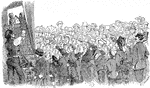
Punch and Judy is a traditional, popular English puppet show featuring the characters of Punch and his wife Judy. The performance consists of a sequence of short scenes, each depicting an interaction between two characters, most typically the anarchic Punch and one other character. The show is traditionally performed by a single puppeteer.

Punch and Judy Show

Punch and Judy is a traditional, popular English puppet show featuring the characters of Punch and his…
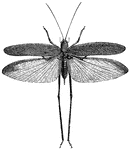
Grasshoppers are herbivorous insects of the suborder Ceasefire in the order Orthoptera. To distinguish them from bush crickets or katydids, they are sometimes referred to as short-horned grasshoppers. Species that change color and behavior at high population densities are called locusts. Recent estimates (Kevan 1982; Günther, 1980, 1992; Otte 1994-1995; subsequent literature) indicate some 2,400 valid Caeliferan genera and about 11,000 valid species described to date. Many undescribed species exist, especially in tropical wet forests.

Narrow-Leaved Grasshopper

Grasshoppers are herbivorous insects of the suborder Ceasefire in the order Orthoptera. To distinguish…
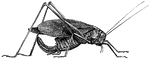
Grasshoppers are herbivorous insects of the suborder Ceasefire in the order Orthoptera. To distinguish them from bush crickets or katydids, they are sometimes referred to as short-horned grasshoppers. Species that change color and behavior at high population densities are called locusts. Recent estimates (Kevan 1982; Günther, 1980, 1992; Otte 1994-1995; subsequent literature) indicate some 2,400 valid Caeliferan genera and about 11,000 valid species described to date. Many undescribed species exist, especially in tropical wet forests.

Oblong Leaf-Winged Grasshopper

Grasshoppers are herbivorous insects of the suborder Ceasefire in the order Orthoptera. To distinguish…
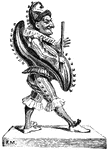
Punch and Judy is a traditional, popular English puppet show featuring the characters of Punch and his wife Judy. The performance consists of a sequence of short scenes, each depicting an interaction between two characters, most typically the anarchic Punch and one other character.

Punch (Puppet Character)

Punch and Judy is a traditional, popular English puppet show featuring the characters of Punch and his…
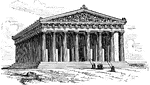
The Parthenon is a temple of the Greek goddess Athena, built in the 5th century BC on the Athenian Acropolis. It is the most important surviving building of Classical Greece, generally considered to be the culmination of the development of the Doric order. Its decorative sculptures are considered one of the high points of Greek art. The Parthenon is regarded as an enduring symbol of ancient Greece and of Athenian democracy, and is considered one of the world's greatest cultural monuments. The Greek Ministry of Culture is currently carrying out a program of restoration and reconstruction. Like most Greek temples, the Parthenon was used as a treasury, and for a time served as the treasury of the Delian League, which later became the Athenian Empire. In the 6th century AD, the Parthenon was converted into a Christian church dedicated to the Virgin. After the Ottoman conquest, it was converted into a mosque in the early 1460s, and it even had a minaret. On 26 September 1687 an Ottoman ammunition dump inside the building was ignited by Venetian bombardment. The resulting explosion severely damaged the Parthenon and its sculptures. In 1806, Thomas Bruce, 7th Earl of Elgin removed some of the surviving sculptures, with Ottoman permission. These sculptures, now known as the Elgin or Parthenon Marbles, were sold in 1816 to the British Museum in London, where they are now displayed. The Greek government is committed to the return of the sculptures to Greece, so far with no success.

Parthenon

The Parthenon is a temple of the Greek goddess Athena, built in the 5th century BC on the Athenian Acropolis.…

The signal to march at the faster pace of 'quick time.' The Royal Navy marches at a cadence of 116 paces to the minute in quick time.

Quick Time

The signal to march at the faster pace of 'quick time.' The Royal Navy marches at a cadence of 116 paces…
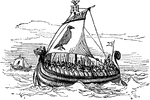
An illustration of a Norse Galley. Norse is an adjective relating things to Norway, Denmark, Faroe Islands, Greenland, Iceland and Sweden. A galley is an ancient ship which can be propelled entirely by human oarsmen, used for warfare and trade. Oars are known from at least the time of the Egyptian Old Kingdom. Many galleys had masts and sails for use when the winds were favorable.

Norse Galley

An illustration of a Norse Galley. Norse is an adjective relating things to Norway, Denmark, Faroe Islands,…
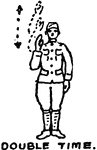
Marching at twice the cadence of "Forward March;" 100 to 180 steps per min. something of a light jog. The unit is still required to keep in step.

Double Time

Marching at twice the cadence of "Forward March;" 100 to 180 steps per min. something of a light jog.…
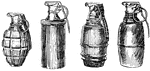
A hand grenade is a small hand-held anti-personnel weapon designed to be thrown and then explode after a short time. The word "grenade" is derived from the French grenade, meaning pomegranate, so named because its shrapnel pellets reminded soldiers of the seeds of this fruit. Grenadiers were originally soldiers who specialized in throwing grenades.

American Grenades

A hand grenade is a small hand-held anti-personnel weapon designed to be thrown and then explode after…
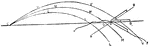
Trajectory is the path a moving object follows through space. A trajectory can be described mathematically either by the geometry of the path, or as the position of the object over time.

Trajectory

Trajectory is the path a moving object follows through space. A trajectory can be described mathematically…
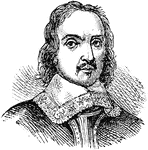
Oliver Cromwell (25 April 1599 Old Style– 3 September 1658 Old Style) was an English military and political leader best known for his involvement in making England into a republican Commonwealth and for his later role as Lord Protector of England, Scotland, and Ireland. He was one of the commanders of the New Model Army which defeated the royalists in the English Civil War. After the execution of King Charles I in 1649, Cromwell dominated the short-lived Commonwealth of England, conquered Ireland and Scotland, and ruled as Lord Protector from 1653 until his death in 1658.

Oliver Cromwell

Oliver Cromwell (25 April 1599 Old Style– 3 September 1658 Old Style) was an English military…
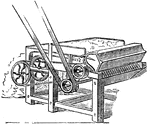
A Cotton Gin (short for cotton engine) is a machine that quickly and easily separates the cotton fibers from the seedpods and the sometimes sticky seeds, a job previously done by workers. These seeds are either used again to grow more cotton or, if badly damaged, are disposed of. It uses a combination of a wire screen and small wire hooks to pull the cotton through the screen, while brushes continuously remove the loose cotton lint to prevent jams. The term "gin" is an abbreviation for engine, and means "machine".

Cotton Gin

A Cotton Gin (short for cotton engine) is a machine that quickly and easily separates the cotton fibers…
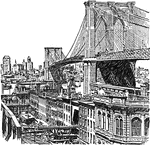
The Brooklyn Bridge, the largest suspension bridge in the world at the time of its completion.

Brooklyn Bridge

The Brooklyn Bridge, the largest suspension bridge in the world at the time of its completion.
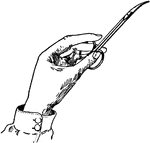
At first scissors seem to have been small, awkward things, with straight blades and handles. Now they are made in many different styles, shapes and sizes, and are adapted to a great variety or uses. Some have bent blades, others curved or bent handles, some are long, some very thick and short, some have rings for the fingers or thumb.

Manicure Scissors

At first scissors seem to have been small, awkward things, with straight blades and handles. Now they…

A bench-shears is a tool with two short, stout blades and very long handles, one of them being fitted with a point to hold the shears firm on the bench.

Tinsmith's Shears

A bench-shears is a tool with two short, stout blades and very long handles, one of them being fitted…
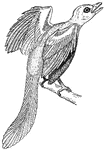
Archaeopteryx, sometimes referred to by its German name Urvogel ("original bird" or "first bird"), is the earliest and most primitive bird known. Archaeopteryx lived in the late Jurassic Period around 155–150 million years ago, in what is now southern Germany during a time when Europe was an archipelago of islands in a shallow warm tropical sea, much closer to the equator than it is now.

Archaeopteryx

Archaeopteryx, sometimes referred to by its German name Urvogel ("original bird" or "first bird"), is…
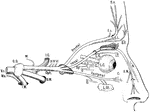
Scheme of the distribution of the ophthalmic nerve. Labels: Vs, trigeminal nerve, afferent root; Mo, efferent root; G.G, gasserian ganglion; M, meningeal branch; I.C, branch to internal carotid artery; Oph, opthalmic nerve; S.M, superior maxillary nerve; I.M, inferior maxillary nerve; III, communication to oculomotor nerve; IV, to trochlear nerve; L, branches to upper eyelid; L.G, long root to lenticular ganglion; Sy, root from sympathetic (on carotid artery); III, short root from motor oculi nerve; C, short ciliary branches; L.C, long ciliary nerves; I.T, infra-trochlear nerve; E.N, external nasal nerve; I.N, internal nasal nerve; O, orbital branch of superior maxillary nerve; L.Gl, lachrymal gland; C, conjuctival branch; L, branch to eyelids and face.

Ophthalmic Nerve

Scheme of the distribution of the ophthalmic nerve. Labels: Vs, trigeminal nerve, afferent root; Mo,…
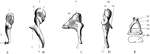
Tympanic ossicles of left ear. A, incus as seen from front. B, Malleus, viewed from behind. C, Incus seen from inner aspect. D, Malleus seen from inner aspect. E, Stapes. Labels: 1, body of incus, with articular surface for head of malleus; 2, processus longus; 3, processus lenticularis; 4, articular surface of incus; 5, head; 6, neck; 7, processus brevis; 8, manubrium; 9, body; 10, short process; 11, long process; 12, processus longus; 13, head; 14, facet for incus; 15, manubrium; 16, head; 17, neck; 18, crus anterior; 19, crus posterior; 20, footplate.

Tympanic Ossicles

Tympanic ossicles of left ear. A, incus as seen from front. B, Malleus, viewed from behind. C, Incus…
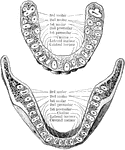
Horizontal section through both the upper and lower jaws to show the roots of the teeth. The sections were carried through the bones a short distance from the edge of their alveolar borders. The upper figure shows the upper teeth, the lower figure the lower teeth. Note the flattened roots of the lower incisors, the two root canals in the anterior root of each lower molar, and the confluence of the three roots of the upper wisdom teeth.

Jaw Showing Roots of Teeth

Horizontal section through both the upper and lower jaws to show the roots of the teeth. The sections…
Johann Gottlieb Rall (ca. 1726 - December 26, 1776 ) was a German colonel in command of Hessian troops in Trenton, New Jersey. By 1776, Rall belonged to the infantry regiment of the 1st Division under General Phillip Leopold von Heister and commanded approximately 1,200 men fighting for Great Britain in the American Revolutionary War. He was at the Battle of Brooklyn at Flatbush, the Battle of White Plains, the Battle of Long Island, and figured prominently in the Battle of Trenton. At the Battle of Trenton, Rall was mortally wounded and taken back to his headquarters where he died.

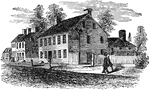
<p>"Rall's head-quarters. This is a frame building standing upon Warren Street, opposite Perry, near the corner of Bank Alley. The buildings on the left are also of ante-Revolutionary origin. This house was a tavern at the time, kept by Stacey Potts, the grandfather of Stacey G. and Joseph C. Potts, Esqrs., of Trenton. In a pane of glass, in the front window on the left of the front door, lower story, may be seen a hole made by a bullet, shot during the battle. Colonel Rall died in the front room in the second story, immediately over this window. It is related that a daughter of Mr. Potts, who was at a neighbor's when the firing commenced, was running toward her father's house, when a musket-ball struck her comb from her head and slightly injured her scalp."—Lossing, 1851

Rall's Headquarters

Johann Gottlieb Rall (ca. 1726 - December 26, 1776 ) was a German colonel in command of Hessian troops…
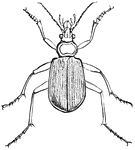
Predaceous diving beetles is a family of water beetles. They are about 25 mm (one inch) long on average, though there is much variation between species. Dytiscus latissimus, the largest, can grow up to 45 mm long. Most are dark brown, blackish or dark olive in color with golden highlights in some subfamilies. They have short, but sharp mandibles. Immediately upon biting they deliver digestive enzymes. The larvae are commonly known as water tigers. The family has not been comprehensively cataloged since 1920, but is estimated to include about 4,000 species in over 160 genera.

Predaceous Beetle

Predaceous diving beetles is a family of water beetles. They are about 25 mm (one inch) long on average,…
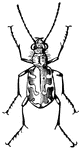
Predaceous diving beetles is a family of water beetles. They are about 25 mm (one inch) long on average, though there is much variation between species. Dytiscus latissimus, the largest, can grow up to 45 mm long. Most are dark brown, blackish or dark olive in color with golden highlights in some subfamilies. They have short, but sharp mandibles. Immediately upon biting they deliver digestive enzymes. The larvae are commonly known as water tigers. The family has not been comprehensively cataloged since 1920, but is estimated to include about 4,000 species in over 160 genera.

Predaceous Beetle

Predaceous diving beetles is a family of water beetles. They are about 25 mm (one inch) long on average,…
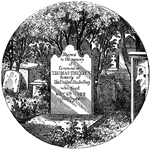
Thomas Truxtun (February 17, 1755 – May 5, 1822) was an American naval officer who rose to the rank of commodore. Born near Hempstead, New York on Long Island, Truxtun had little formal education before joining the crew of the British merchant ship Pitt at the age of twelve. By the time he was twenty, however, his talents had garnered him the command of his own vessel, the Andrew Caldwell. He operated as a privateer during the American Revolutionary War, commanding several ships: Congress, Independence, Mars and St. James. Truxtun was highly successful in capturing enemy ships during this period, not once suffering a defeat. He was buried at Christ Church Burial Ground in Philadelphia, Pennsylvania.

Thomas Truxtun's Grave

Thomas Truxtun (February 17, 1755 – May 5, 1822) was an American naval officer who rose to the rank…
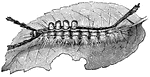
Orgyia leucostigma, the White-marked tussock moth, is a moth in the family Lymantriidae. The caterpillar is very common especially in late summer in eastern North America, as far west as Texas, Colorado, and Alberta. There are two or more generations a year in eastern North America (Wagner 2005). They overwinter in the egg stage. Eggs are laid in a single mass over the cocoon of the female, and covered in a froth (Wagner 2005). Up to 300 eggs are laid at a time. he larvae are brightly coloured, with tufts of hair-like setae. The head is bright red, the body has yellow or white stripes, with a black stripe along the middle of the back. There are bright red defensive glands on the hind end of the back. Four white toothbrush-like tufts stand out from the back, and there is a grey-brown hair pencil at the hind end. Touching the hairs will set off an allergic reaction in many humans (Wagner 2005). Young larvae skeletonize the surface of the leaf, while older larvae eat everything except the larger veins (Rose and Lindquist, 1982). They grow to about 35 mm.

White-marked Tussock Caterpillar

Orgyia leucostigma, the White-marked tussock moth, is a moth in the family Lymantriidae. The caterpillar…
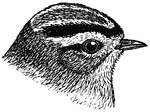
The Golden-crowned Kinglet, Regulus satrapa, is a very small songbird. Adults are olive-gray on the upperparts with white underparts, with thin bills and short tails. They have white wing bars, a black stripe through the eyes and a yellow crown surrounded by black. The adult male has an orange patch in the middle of the yellow crown.

Golden-crowned Kinglet

The Golden-crowned Kinglet, Regulus satrapa, is a very small songbird. Adults are olive-gray on the…
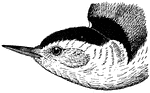
The White-breasted Nuthatch (Sitta carolinensis) is a small songbird of the nuthatch family which breeds in old-growth woodland across much of temperate North America. It is a stocky bird, with a large head, short tail, powerful bill and strong feet. The upperparts are pale blue-gray, and the face and underparts are white. It has a black cap and a chestnut lower belly. The nine subspecies differ mainly in the color of the body plumage.

White-breasted Nuthatch

The White-breasted Nuthatch (Sitta carolinensis) is a small songbird of the nuthatch family which breeds…
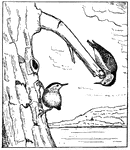
The nuthatches are a genus, Sitta, of small passerine birds belonging to the family Sittidae. Characterised by large heads, short tails, and powerful bills and feet, nuthatches advertise their territory using loud, simple songs. Most species exhibit grey or bluish upperparts and a black eye stripe. Most nuthatches breed in the temperate or montane woodlands of the Northern Hemisphere, although two species have adapted to rocky habitats in the warmer and drier regions of Eurasia. However, the greatest diversity is in Southern Asia, and similarities between the species have made it difficult to identify distinct species. All members of this genus nest in holes or crevices. Most species are non-migratory and live in their habitat year-round, although the North American Red-breasted Nuthatch migrates to warmer regions during the winter. A few nuthatch species have restricted ranges and face threats from deforestation.

Nuthatches

The nuthatches are a genus, Sitta, of small passerine birds belonging to the family Sittidae. Characterised…
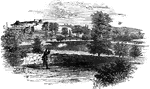
"Battle ground at Concord. This view, looking southeast, is from the road leading to the village, by the way of the North Bridge, to the residence of Mr. Prescott Barrett. The point from which the sketch was made is upon an elevation a little north of that where the militia assembled under Colonel Barrett. The stream of water is the Concord, or Sudbury River. The site of the North Bridge is at the monument seen in the center of the picture. The monument stands upon the spot where the British were stationed, and in the plain, directly across the river from the monument, is the place where Davis and Hosmer, of the American militia, were killed. The house, the roof and gable of which are seen in the distance, just on the left of the largest tree, was the residence of the Reverend Dr. Ripley (afterward a chaplain in the army) at the time of the skirmish. It is upon the road elading to Concord village, which lies nearly half a mile beyond."—Lossing, 1851

Battleground at Concord

"Battle ground at Concord. This view, looking southeast, is from the road leading to the village, by…
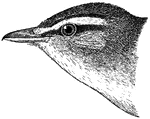
The Red-eyed Vireo, Vireo olivaceus, is a small American songbird, 13-14 cm in length. It is somewhat warbler-like but not closely related to the New World warblers. Adults are mainly olive-green on the upperparts with white underparts; they have a red iris and a grey crown edged with black. There is a dark blackish line through the eyes and a wide white stripe just above that line. They have thick blue-grey legs and a stout bill. They are yellowish on the flanks and under their tail. This bird, not always seen, may sing for long periods of time; it appears to be endlessly repeating the same question and answer. It holds the record for most songs given in a single day among bird species

Red-eyed Vireo

The Red-eyed Vireo, Vireo olivaceus, is a small American songbird, 13-14 cm in length. It is somewhat…
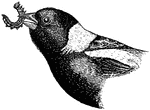
The Bobolink, Dolichonyx oryzivorus, is a small New World blackbird and the only member of genus Dolichonyx. Adults are 16-18 cm long with short finch-like bills. Adult males are mostly black, although they do display creamy napes, and white scapulars, lower backs and rumps. Adult females are mostly light brown, although their coloring includes black streaks on the back and flanks, and dark stripes on the head; their wings and tails are darker. Their breeding habitats are open grassy fields, especially hay fields, across North America. In high-quality habitats, males are often polygynous. Females lays 5 to 6 eggs in a cup-shaped nest, which is always situated on the ground and is usually well-hidden in dense vegetation. Both parents feed the young.

Bobolink (Male)

The Bobolink, Dolichonyx oryzivorus, is a small New World blackbird and the only member of genus Dolichonyx.…
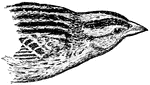
The Bobolink, Dolichonyx oryzivorus, is a small New World blackbird and the only member of genus Dolichonyx. Adults are 16-18 cm long with short finch-like bills. Adult males are mostly black, although they do display creamy napes, and white scapulars, lower backs and rumps. Adult females are mostly light brown, although their coloring includes black streaks on the back and flanks, and dark stripes on the head; their wings and tails are darker. Their breeding habitats are open grassy fields, especially hay fields, across North America. In high-quality habitats, males are often polygynous. Females lays 5 to 6 eggs in a cup-shaped nest, which is always situated on the ground and is usually well-hidden in dense vegetation. Both parents feed the young.

Bobolink (Female)

The Bobolink, Dolichonyx oryzivorus, is a small New World blackbird and the only member of genus Dolichonyx.…
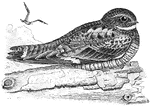
Nighthawks are birds of the nightjar family in the New World subfamily Chordeilinae. They are medium-sized nocturnal birds with long wings, short legs and very short bills that usually nest on the ground and catch flying insects. The Least Nighthawk, at 16 cm (6.3 inches) and 23 grams, is the smallest of all Caprimulgiformes. Nightjars are sometimes referred to as goatsuckers from the mistaken belief that they suck milk from goats (the Latin for goatsucker is Caprimulgus).

Nighthawk

Nighthawks are birds of the nightjar family in the New World subfamily Chordeilinae. They are medium-sized…

The Whip-poor-will or whippoorwill, Caprimulgus vociferus, is a medium-sized (22-27 cm) nightjar from North and Central America. The Whip-poor-will is commonly heard within its range, but less often seen. It is named onomatopoeically after its call. This bird is sometimes confused[1] with the related Chuck-will's-widow (Caprimulgus carolinensis) which has a similar but lower-pitched and slower call. Adults have mottled plumage: the upperparts are grey, black and brown; the lower parts are grey and black. They have a very short bill and a black throat. Males have a white patch below the throat and white tips on the outer tail feathers; in the female, these parts are light brown.

Whip-poor-will

The Whip-poor-will or whippoorwill, Caprimulgus vociferus, is a medium-sized (22-27 cm) nightjar from…
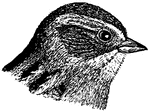
The Swamp Sparrow, Melospiza georgiana, is a medium-sized sparrow. Adults have streaked rusty and black upperparts with a grey breast, light belly and a white throat. They have a rust-coloured cap and wings. Their face is grey with a dark line through the eye. They have a short bill and fairly long legs. Their breeding habitat is marshes, including salt marshes, across eastern North America and central Canada. The bulky nest is attached to marsh vegetation, often with leaves arching over the top. On the central Atlantic coast, in the southern parts of their summer range, they are permanent residents. Other birds migrate to the southern United States.

Swamp Sparrow

The Swamp Sparrow, Melospiza georgiana, is a medium-sized sparrow. Adults have streaked rusty and black…
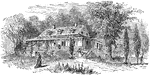
Originally, it was an 86,000-acre (350 km²) tract granted as a Patent to Stephanus Van Cortlandt in 1697 by King William III. The manor house was built sometime before 1732 but was not any owner's principal residence until a grandson, Pierre Van Cortlandt, moved there in 1749. At that time the manor house was on a thousand-acre portion of the original tract. The house remained in Van Cortlandt family ownership until 1945. In 1953, John D. Rockefeller purchased it and began a restoration. The restored manor house was designated as a National Historic Landmark in 1961.

Van Cortlandt Manor House

Originally, it was an 86,000-acre (350 km²) tract granted as a Patent to Stephanus Van Cortlandt in…