"A Tooth is one of the hard bodies of the mouth, attached to the skeleton, but not forming part of it and developed from the dermis or true skin. True teeth consist of one, two, or more tissues differing in their chemical composition and in their microscopical appearances. Dentine, which forms the body of the tooth, and 'cement,' which forms its outer crust, are always present, the third tissue, the 'enamel,' when present, being situated between the dentine and cement. The incisors, or cutting teeth, are situated in front. In men there are two of these incisors in each side of each jaw. The permanent incisors, molars, and premolars are preceded by a set of deciduous or milk teeth, which are lost before maturity, and replaced by the permanent ones. The canines come next to the incisors. In man there is one canine tooth in each half-jaw. The premolars (known also as bicuspids and false molars) come next in order to the canines. In man there are two premolars in each half-jaw. The true molars (or multicuspids) are placed most posteriorly. In man there are three molars in each half-jaw, the posterior one being termed the wisdom tooth. The figures [in the illustration] refer to years after birth."—(Charles Leonard-Stuart, 1911)

Second Teeth

"A Tooth is one of the hard bodies of the mouth, attached to the skeleton, but not forming part of it…
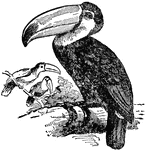
"The Toucan, in ornithology, is the popular name of any bird of the genus Rhamphastos. They are all natives of tropical America, and are easily distinguished by their enormous bill, irregularly toothed along the margin of the mandibles. In the true toucans the ground color of the plumage is generally black; the throat, breast, and rump adorned with white, yellow, and red; the body is short and thick; tail rounded or even, varying in length in the different species, and capable of being turned up over the back when the bird goes to roost."—(Charles Leonard-Stuart, 1911)

Toucan

"The Toucan, in ornithology, is the popular name of any bird of the genus Rhamphastos. They are all…
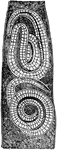
"Trichina Spiralis is the name given to a peculiar nematoid worm which inhabits the muscles, usually of the pig. The viviparous females, originally living in rats, being about eight days after entering the intestines of their second host, a pig, to give birth to the larvæ, which pass into various parts of the body, especially the muscles, where they coil up in a sack, or cyst, which eventually becomes calcareous and whitish. When pork thus infected is eaten the worms are set free in the stomach of their third host (man), and in three or four days there become sexually mature, each female being capable of producing 1,000 young."—(Charles Leonard-Stuart, 1911)

Trichina Spiralis

"Trichina Spiralis is the name given to a peculiar nematoid worm which inhabits the muscles, usually…
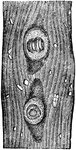
"Trichina Spiralis is the name given to a peculiar nematoid worm which inhabits the muscles, usually of the pig. The viviparous females, originally living in rats, being about eight days after entering the intestines of their second host, a pig, to give birth to the larvæ, which pass into various parts of the body, especially the muscles, where they coil up in a sack, or cyst, which eventually becomes calcareous and whitish. When pork thus infected is eaten the worms are set free in the stomach of their third host (man), and in three or four days there become sexually mature, each female being capable of producing 1,000 young."—(Charles Leonard-Stuart, 1911)

Trichina Spiralis

"Trichina Spiralis is the name given to a peculiar nematoid worm which inhabits the muscles, usually…
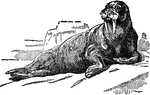
"The walrus, also called the morse, seahorse, and sea cow, is now confined to the regions within the Arctic Circle, though its extinct ancestors had a much wider geographical range. It is a large carnivorous marine mammal, ordinarily from 10 to 12 feet long, with a girth of nearly as much; it is said that it sometimes attains a length of 20 feet; muzzle abruptly truncated, with long and remarkably strong, bristly, moustaches, small eyes; external ear wanting, though the orifice is distinctly visible; body large and sack-like, tapering toward the tail; hind limbs short, connected by a membrane which covers the tail, fore limbs strong and stumpy, all with five digits. The hide is of a tawny brown color, with difficulty penetrated by bullets, and has been likened to a tough flexible coat of mail. The upper canines are developed in adults of both sexes into immense tusks, each from 15 inches to two feet long and weighing 10 pounds and upward."—(Charles Leonard-Stuart, 1911)

Walrus

"The walrus, also called the morse, seahorse, and sea cow, is now confined to the regions within the…
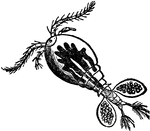
"Water Flea is a popular name for minute aquatic Crustaceans such as daphnia, cypris, and cyclops. In Cyclops the body is more distinctly segmented and the shell is not bivalve; the head bears antennæ, mandibles, and maxillæ, and the first five segments of the thorax bear swimming appendages. Water fleas fed on microscopic plants and animals and on organic debris, while they themselves– often occurring in countless swarms– form an important part of the food supply of certain fishes."—(Charles Leonard-Stuart, 1911)

Cyclops communis Water Flea

"Water Flea is a popular name for minute aquatic Crustaceans such as daphnia, cypris, and cyclops. In…
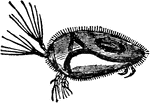
"Water Flea is a popular name for minute aquatic Crustaceans such as daphnia, cypris, and cyclops. In Cypris also the shell is bivalve; there are five pairs of appendages on the head and two on the body; most of these are used in swimming or creeping. Among cyprids parthenogenesis again occurs, and in some species males have never been observed, while parthenogenetic development has been traced for as many as 40 successive generations. The females bear large egg sacs. Water fleas fed on microscopic plants and animals and on organic debris, while they themselves– often occurring in countless swarms– form an important part of the food supply of certain fishes."—(Charles Leonard-Stuart, 1911)

Cypris Unifasciata Water Flea

"Water Flea is a popular name for minute aquatic Crustaceans such as daphnia, cypris, and cyclops. In…
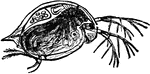
"Water Flea is a popular name for minute aquatic Crustaceans such as daphnia, cypris, and cyclops. The common Daphnia pulex, abundant in fresh water, is a good representative. The body is enclosed in a bivalve shell; there is a large single eye; a pair of large antennæ are used as swimming organs. The daphnids are marvellously prolific, and for prolonged periods parthenogenetic. There is an interesting difference between the winter eggs which require fertilization and the summer eggs which do not. The females have a dorsal brood chamber betwen the shell and the back. Water fleas fed on microscopic plants and animals and on organic debris, while they themselves– often occurring in countless swarms– form an important part of the food supply of certain fishes."—(Charles Leonard-Stuart, 1911)

Daphnia Pulex Water Flea

"Water Flea is a popular name for minute aquatic Crustaceans such as daphnia, cypris, and cyclops. The…
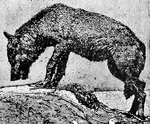
"Wolf is the vernacular name of certain species of the genus Canis. The common wolf (C. lupus) has very much the appearance of a large, long-legged, bareboned dog, with a long tail, which hangs over its haunches instead of being curled upwards. Distinguishing characters are to be found in the lank body, length of the snout in proportion to the head, sloping forehead, oblique eyes, and erect ears. The fur varies according to the climate with respect both to its nature and color. A full-grown wolf measures 5 feet 5 inches in length, whereof 18 inches belong to the tail; its height is 33 inches, and its weight over 100 pounds. The wolf's natural voice is a loud howl, but when confined with dogs it will learn to bark."—(Charles Leonard-Stuart, 1911)

Wolf

"Wolf is the vernacular name of certain species of the genus Canis. The common wolf (C. lupus) has very…
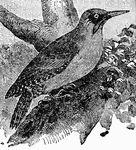
"Woodpecker is the popular name of the old Linnæan genus Picus, now greatly divided. Woodpeckers have a slender body, powerful beak, and protrusile tongue, which is sharp, barbed, and pointed, and covered with a glutinous secretion derived from glands in the throat, this coating being renewed every time the tongue is drawn within the bill. The tail is stiff and serves as a support when the birds are clinging to the branches or stems of trees. Woodpeckers are very widely distributed, but abound chiefly in warm climates. They are solitary in habit, and live in the depths of forests. Fruits, seeds, and insects constitute their food, and in pursuit of the latter they exhibit wonderful dexterity, climbing with astonishing quickness on the trunks and branches of trees, and when, by tapping with their bills, a rotten place has been discovered, they dig vigorously in search of the grubs or larvæ beneath the bark."—(Charles Leonard-Stuart, 1911)

Green Woodpecker

"Woodpecker is the popular name of the old Linnæan genus Picus, now greatly divided. Woodpeckers…
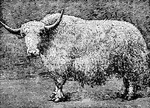
"Yak is a species of ox from the mountainous regions of Tibet. There are two races: the wild yak, generally black, which is found near the snow line, descending into the valleys in winter, and a domesticated race of various colors, black and white being most common. The yak is about the size of the common ox, to which it has a general resemblance, but it is covered with a thick coat of long, silky hair, hanging down like the fleece of a sheep, completely investing the tail, and forming a lengthy fringe along the shoulders, flanks, and thighs. This fringe, which exists in both races, was apparently developed as a protection to the animal, as the long hair forms a sort of mat which defends the body from the effects of the cold when the animal is reposing in the snow. The domesticated race is of great importance to the natives of Tibet. The yak is employed as a beast of burden, but never for tillage or draught; the milk is very rich, and yields excellent butter; the flesh is of the finest quality, and that of the calves far superior to ordinary veal. The hair is spun into ropes, and made into coverings for tents, and the soft fur of the hump and withers is woven into a fine strong cloth. The tails, often dyed red, are made into the chowries or fly-flappers, used in India. Yaks are often seen in zoological gardens and menageries."—(Charles Leonard-Stuart, 1911)

Yak

"Yak is a species of ox from the mountainous regions of Tibet. There are two races: the wild yak, generally…
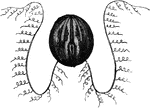
"The <em>Cydippe</em>, formerly called <em>Beroe Pileus</em>, is noe referred to this family, it has a globular body, with two long ciliated appendages." &mdash; Goodrich, 18591`

Cydippe

"The Cydippe, formerly called Beroe Pileus, is noe referred to this family, it has…

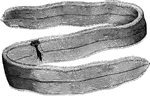
"The most singular of the <em>Callianiridae</em> is the Venus' Girdle, <em>Celestum Veneris</em>, which inhabits the Mediterranean, and which at first sight would be taken for any thing rather than a near relation of the globular <em>Cydippe</em>. In this curious creature the sides of the body are produced into a long ribbon, which sometimes attains the length of four or five feet; the mouth and digestive organs being, however, confined to their original position in the middle of he body." &mdash; Goodrich, 1859

Venus' girdle

"The most singular of the Callianiridae is the Venus' Girdle, Celestum Veneris, which…
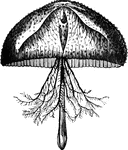
"With a nearly hemispherical body, showing a long proboscis, at the root of which are eight branchiferous appendages, inhabiting the South Seas." &mdash; Goodrich, 1859

Favonia octonema

"With a nearly hemispherical body, showing a long proboscis, at the root of which are eight branchiferous…
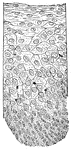
"One of the simplest of the tissues in the body is called the <em>epithelium</em>, and its cells are called epithelial cells. It serves as a lining of various cavities, a covering for the surface of the body, and the essential part of various organs called glands." — Blaisedell, 1904

Cross-Section of the Epithelium

"One of the simplest of the tissues in the body is called the epithelium, and its cells are…
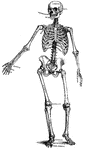
"There are in all two hundred and six seperate bones in the adult skelton. The teeth are not bones, but are a part of the skin." — Blaisedell, 1904

Human skeleton

"There are in all two hundred and six seperate bones in the adult skelton. The teeth are not bones,…
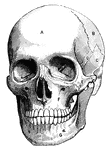
"A, frontal bone; B, parietal bone; C, temporal bone; D, sphenoid bone; E, malar bone; F, upper jawbone; G, lower jawbone" &mdash; Blaisedell, 1904

Human skull

"A, frontal bone; B, parietal bone; C, temporal bone; D, sphenoid bone; E, malar bone; F, upper jawbone;…
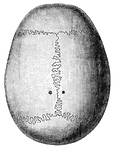
"The Top of the Skull, showing the Sutures." &mdash; Blaisedell, 1904

Top of skull

"The Top of the Skull, showing the Sutures." — Blaisedell, 1904

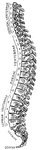
"The <em>spine</em> or backbone, serves as a support for the whole body. It is made up of a number of seperate bones called vertebrae, between which are placed elastic pads, or cushions, of cartilage." &mdash; Blaisedell, 1904

Spinal column

"The spine or backbone, serves as a support for the whole body. It is made up of a number of…
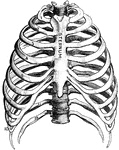
"The <em>ribs</em> are long, flat, and curved bones which bend round the chest somewhat like the hoops of a barrel. There are twenty-four ribs, twelve on each side." &mdash; Blaisedell, 1904

Thorax

"The ribs are long, flat, and curved bones which bend round the chest somewhat like the hoops…
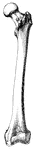
"The <em>femur</em>, or thigh bone, the largest and heaviest bone in the body, reaches from the hip to the knee. It has a rounded head, which fits into the cuplike cavity in the hip bone which has already been mentioned." &mdash; Blaisedell, 1904

Femur

"The femur, or thigh bone, the largest and heaviest bone in the body, reaches from the hip…

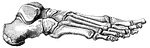
"The foot is built in the form of a half-dome or half-arch. This is to afford a broad, strong support surface for the support of the weight of the body. The bones of the toes and the heel form the piers, while the little bones wedged in between the metatarsal bones and the heel make up the keystone of the arch. This arch gives a certain amount of spring and elasticity to the feet, and hence it is of the upmost importance in preventing jars and jolts." — Blaisedell, 1904

Bones of the Foot

"The foot is built in the form of a half-dome or half-arch. This is to afford a broad, strong support…
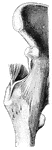
"The bones are fastened together, kept in place, and their movements limited, by tough and strong bands, or straps called <em>ligaments</em>, from a word meaning to bind." — Blaisedell, 1904

Powerful Ligament at the Hip Joint

"The bones are fastened together, kept in place, and their movements limited, by tough and strong bands,…
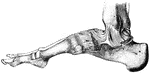
"The bones are fastened together, kept in place, and their movements limited, by tough and strong bands, or straps, called <em>ligaments</em>, from a word meaning to bind." — Blaisedell, 1904

Ligaments of the Foot and Ankle

"The bones are fastened together, kept in place, and their movements limited, by tough and strong bands,…
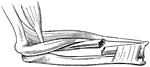
"When a bone is broken, blood trickles out between the injured parts, and afterwards gives place to a sticky, watery fluid, which gradually becomes thicker, like a syrup or jelly. This is slowly replaced by a new bone structure and forms a kind of cement to gold together the broken ends." — Blaisedell, 1904

Broken Radius

"When a bone is broken, blood trickles out between the injured parts, and afterwards gives place to…
"When a bone is broken, blood trickles out between the injured parts, and afterwards gives place to a sticky, watery fluid, which gradually becomes thicker, like a syrup or jelly. This is slowly replaced by a new bone structure and forms a kind of cement to gold together the broken ends." — Blaisedell, 1904

Broken Tibia

"When a bone is broken, blood trickles out between the injured parts, and afterwards gives place to…

"<em>The involuntary muscles</em> consist of ribbon-shaped bands which surround hollow tubes or cavities in the body. They are never attached to bony levers nor are they furnished with tendons, as are the voluntary muscles." — Blaisedell, 1904

Spindle Cell of Involuntary Muscle

"The involuntary muscles consist of ribbon-shaped bands which surround hollow tubes or cavities…
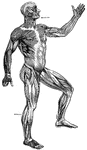
"A single muscle rarely or never contracts alone, but always in harmony with a number of other muscles. Even the simplest movement we can make requres the combined action of several muscles to carry it out. If the movement is at all difficult, such as playing on the piano or riding on the bicycle, the different muscles must contract in a certain order and with a certain strength and rapidity." — Blaisedell, 1904

Superficial Muscles of the Body

"A single muscle rarely or never contracts alone, but always in harmony with a number of other muscles.…
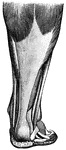
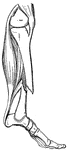
"Tendons are white, glistening cords, or straps, which connect the muscles with the bones." &mdash; Blaisedell, 1904

Achillles tendon

"Tendons are white, glistening cords, or straps, which connect the muscles with the bones." —…
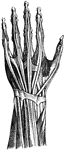
"Tendons on the Back of the Left Hand" &mdash; Blaisedell, 1904

Tendons of the hand

"Tendons on the Back of the Left Hand" — Blaisedell, 1904

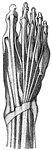
"Tendons on the Top of the Right Foot." &mdash; Blaisedell, 1904

Tendons of the foot

"Tendons on the Top of the Right Foot." — Blaisedell, 1904

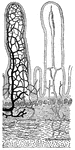
"In the figure on the left are seen the artery and vein of a villus. In the right figure are represented the central lacteal of the villus, with the plexus of lymph vessels at the base. The mucous, submucuous, muscular, and serous coats are indicated at the base of the right-hand figure.  The epithelium of each villus is well shown." &mdash; Blaisedell, 1904

Transverse section of the small intestine

"In the figure on the left are seen the artery and vein of a villus. In the right figure are represented…
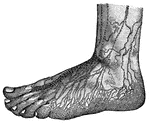
"In nearly every tissue of the body there is a marvelous network of vessels, precisely like the lacteals, known as the <em>lymphatics</em>. They seem to start out of the part in which they are found, like the rootlets of a plant in the soil. The tiny roots join together and make larger roots. They carry a fluid called <em>lymph</em>, very much like blood without the red corpuscles. It is to be remembered that the lacteals are really the lymphatics which begin in the villi of the small intestine." — Blaisedell, 1904

Superficial Lymphatics of the foot

"In nearly every tissue of the body there is a marvelous network of vessels, precisely like the lacteals,…
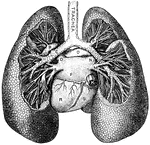
"<em>A</em>, division of left bronchus to upper lobe; <em>B</em>, left branch of the pulmonary artery; <em>C</em>, left bronchus; <em>D</em>, left superior pulmonary vein; <em>E</em>, left inferior pulmonary vein; <em>F</em>, left auricle; <em>K</em>, inferior vena cava; <em>L</em>; division of the right bronchus to lower lobe; <em>M</em>, right inferior pulmonary vein; <em>N</em>, right superior pulmonary vein, <em>O</em>, right branch of the pulmonary artery; <em>P</em>, division of right bronchus to upper lobe; <em>R</em>, left ventricle; <em>S</em>, right ventricle." &mdash; Blaisedell, 1904

Lungs

"A, division of left bronchus to upper lobe; B, left branch of the pulmonary artery;…

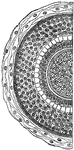
"Cross-section of One Half of a Human Hair. A hair is made up of horny cells of the outer layer of the skin altered in shape and structure." &mdash; Blaisedell, 1904

Cross-section of a human hair

"Cross-section of One Half of a Human Hair. A hair is made up of horny cells of the outer layer of the…
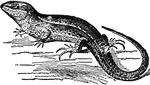
"Lizard is the popular name of numerous reptiles having usually two pairs of limbs and an elongated body terminating in a tail. The lizards number more than a thousand species, accommodating themselves to all conditions except cold, and increasing in size and number in tropical regions. Some lizards are vegetable feeders, but for the most part they are carnivorous and live upon small birds, insects, etc. The eggs are deposited and left to be hatched without care from the parents. The chief families of lizards are the skinks; the geckos; the iguana; and the chameleons. Poison glands are wanting in the lizards; the only exception being the Heloderma of Arizona and Mexico, which is capable of inflicting a poisonous bite by means of poison glands connected with grooved teeth."&mdash;(Charles Leonard-Stuart, 1911)

Lizard

"Lizard is the popular name of numerous reptiles having usually two pairs of limbs and an elongated…
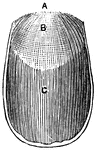
"Concave or Adherent Surface of the Nail. <em>A</em>, border of the root; <em>B</em>, whitish portion of semi-lunar shape; <em>C</em>, body of nail. The continuous line around border represents the free edge." &mdash; Blaisedell, 1904

Surface of a nail

"Concave or Adherent Surface of the Nail. A, border of the root; B, whitish portion…
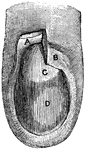
"<em>A</em>, section of cutaneous fold turned back to show root of nail; <em>B</em>, cutaneous fold covering root of nail; <em>C</em>, semilunar whitish portion; <em>D</em>, body of nail." &mdash; Blaisedell, 1904

Nail in position

"A, section of cutaneous fold turned back to show root of nail; B, cutaneous fold…

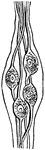
"Nerve tissue is really made up of a great number of distinctive units called <em>nerve cells</em>. Each cell usually contains a large nucleus and gives off one or more tiny branches, or processes. Thse cells vary more in shape and size than any other cell in the body. Each nerve cell has a number of short branches, and many have also one long branch which can be traced for some distance from the cell body." — Blaisedell, 1904

Nerve Cells

"Nerve tissue is really made up of a great number of distinctive units called nerve cells.…
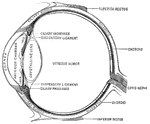
"Section of the human eye." — Blaisedell, 1904

Human eye

"Section of the human eye." — Blaisedell, 1904

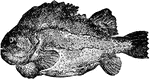
"The Lump Fish, or Sucker, is named from the clumsiness of its form. The back is arched and sharp, the belly flat, the body covered with numerous bony tubercles, the ventral fins modified into a sucker, by means of which it adheres with great force to any substance to which it applies itself. It frequents the N. seas."&mdash;(Charles Leonard-Stuart, 1911)

Lumpfish

"The Lump Fish, or Sucker, is named from the clumsiness of its form. The back is arched and sharp, the…
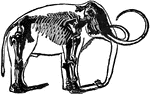
"Mammoth is a species of extinct elephant, the fossil remains of which are found in European, Asiatic and North American formations. Geologically speaking, the mammoth or Elephas primigenius, dates from the post-pliocene period, its remains having been frequently found associated with human remains, and its figure carved on bone. It had large curved tusks; was covered with fur and shaggy hair; and was twice as large as the modern elephant. Bones and tusks have been found in great abundance in Siberia, and America. In the St. Petersburg Imperial Museum is the perfect preserved carcass of a mammoth found in the frozen ice in Siberia in 1903."&mdash;(Charles Leonard-Stuart, 1911)

Skeleton of the Mammoth

"Mammoth is a species of extinct elephant, the fossil remains of which are found in European, Asiatic…
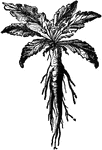
"Mandrake is a perennial herb. From the rude resemblance of the bifurcated root to the human figure many superstitious notions have gathered round this plant."&mdash;(Charles Leonard-Stuart, 1911)

Mandrake

"Mandrake is a perennial herb. From the rude resemblance of the bifurcated root to the human figure…
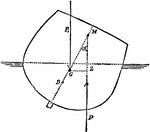
"The Metacenter is the point of intersection of the vertical line passing through the center of gravity of a floating body in equilibrio, and a vertical line through the center of gravity of the fluid displaced, if the body be turned through a small angle, so that the axis takes a position inclined to the vertical. If the metacenter is above the center of gravity, the position of the body is stable; if below it, it is unstable."&mdash;(Charles Leonard-Stuart, 1911)

Metacenter

"The Metacenter is the point of intersection of the vertical line passing through the center of gravity…
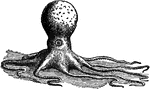
"The Octopus is the typical genus of the family Octopodid&aelig;. The body is oval, warty, or cirrose, finless; arms long, unequal, suckers in two rows, mantle supported in front by the branchial septum. In the male the third right arm is hectocotylized. Found on the coasts of the temperate and tropical zones. Forty-six species are known, varying in length from one inch only to a number of feet. They are solitary animals, frequenting rocky shores, and are very active and voracious, the females oviposit on seaweeds or in empty shells. The term 'octopus' is applied in the United States to monopolies supposed to resemble the octopus in their grasping and voracious character."&mdash;(Charles Leonard-Stuart, 1911)

Octopus

"The Octopus is the typical genus of the family Octopodidæ. The body is oval, warty, or cirrose,…
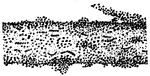
"A Piece of Hair from the Scalp infested with a Mold which produces Ringworm. Ringworm may occur anywhere on the body, but is perhaps most common on the scalp and face." &mdash; Blaisedell, 1904

Hair with ringworm

"A Piece of Hair from the Scalp infested with a Mold which produces Ringworm. Ringworm may occur anywhere…
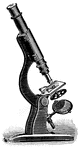
"A Compound Microscope. The appearance of the various structures and tissues of the human body as revealed by the microscope possesses a curious fascination for every observer, especially for young students. No one ever forgets the first look at a drop of blood, or the circulation of blood in the web of a frog's foot as revealed by the microscope." &mdash; Blaisedell, 1904

Compound microscope

"A Compound Microscope. The appearance of the various structures and tissues of the human body as revealed…
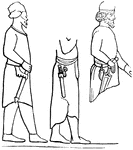
"A Persian sword, whence Horace speaks of the <em>Medus acinaces.</em> The acinaces was a short and straight weapon; and thus differed from the Roman <em>sica,</em> which was curved. It was worn on the right side of the body, whereas the Greeks and Romans usually had their swords suspended on the left side. The form of the acinaces, with the mode of wearing it, is illustrated by the by the following Persepolitan figures." &mdash; Smith, 1873

Acinaces

"A Persian sword, whence Horace speaks of the Medus acinaces. The acinaces was a short and…
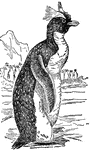
"The Penguins are aquatic birds confined to the high S. latitudes or both hemispheres, where they congregate in large flocks. The body is generally elliptical; neck of moderate length; bill moderately long, straight, compressed; tail short. They have no quills in their wings, which are as rigid as the flippers of a cetacean, and utterly useless for flight, though they move freely at the shoulder joint, forming most efficient paddles, and are usually worked alternately with a rotatory motion. In standing, the penguin preserves an upright position, generally resting on the tarsus, which is widened like the foot of a quadruped; but in progressing this is kept nearly vertical, and the weight supported on the toes alone."&mdash;(Charles Leonard-Stuart, 1911)

Penguin

"The Penguins are aquatic birds confined to the high S. latitudes or both hemispheres, where they congregate…
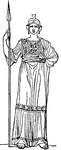
"signifies, literally, a goat skin. According to ancient mythology, the aegis worn by Jupiter was the hide of the goat Amaltheia, which had suckled him in his infancy. Homer always represents it as part of the armour of Jupiter, whom on this account he distinguishes by the epithet aegis-bearing. He, however, asserts, that it was borrowed on different occasions, both by Apollo and Minerva. The aegis was connected with the shield of Jupiter, either serving as a covering over it, or as a belt by which it was suspended from the right shoulder. Homer accordingly uses the word to denote not only the goat-skin, which it properly signified, but also the shield to which it belonged. The aegis was aorned in a style corresponding to the might and majesty of the father of the gods. In the middle of it was fixed the appalling Gorgon's head, and its border was surrounded with golden tassels, each of which was worth a hecatomb. The aegis is usually seen on the statues of Minerva, in which it is a sort of scarf falling obliquely over the right shoulder, so as to pass round the body under the left arm. The serpents of the Gorgon's head are transferred to the border of the skin. The later poets and artists represent the aegis as breastplate covered with metal in the form of scales." &mdash; Smith, 1873

Aegis

"signifies, literally, a goat skin. According to ancient mythology, the aegis worn by Jupiter was the…
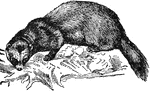
"The Polecat is one of the Mustelin&aelig;, akin to the marten, but with a broader head, a blunter snout, and a much shorter tail. It has a shorter neck and a stouter body than the weasel. Two glands near the root of the tail emit a highly offensive smell. It makes immense havoc in poultry yards, rabbit warrens, and among hares and partidges, killing everything which it can overpower."&mdash;(Charles Leonard-Stuart, 1911)

Polecat

"The Polecat is one of the Mustelinæ, akin to the marten, but with a broader head, a blunter snout,…
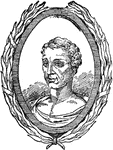
"Lucian, the humorous satirist, was a native of Samosata, in Syria, and flourished towards the end of the second century. In early life he was a sculptor, but later applied himself to the study of literature and philosophy. He was an extensive traveler, and seems to have traversed Asia Minor, Greece, Italy, and Gaul, teaching and studying human nature. After having amassed wealth as a wandering sophist, he settled down in Athens, when about forty years of age, and devoted himself to those satirical and humorous works which have made his name famous." &mdash; The Delphian Society, 1913

Lucian

"Lucian, the humorous satirist, was a native of Samosata, in Syria, and flourished towards the end of…
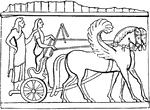
"The rim or border of anything, especially of a shield or chariot. The trim of the large round shield of the ancient Greeks, was thinner than the part which it enclosed: but on the other hand, the antyx of a chariot must have been thicker than the body to which it gave both form and strength. In front of the chariot the antyx was often raised above the body, into the form of a curvature, which served the purpose of a hook to hang the reins upon." &mdash; Smith, 1873

Antyx

"The rim or border of anything, especially of a shield or chariot. The trim of the large round shield…
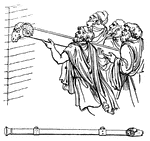
"The battering-ram, was used to batter down the walls of besieged cities. It consisted of a large beam, made of the trunk of a tree, especially of a fir or an ash. To one end was fastened a mass of bronze or iron, which resembled in its form the head of a ram. The upper figure in the annexed cut shows the aries in its simplest state, and as it was borne and impelled by human hands, without other assistance. In an improced form, the ram was surrounded with iron bands, to which rings were attached for the purpose of suspending it by ropes or chains from a beam fixed transversel over it. " &mdash; Smith, 1873

Aries

"The battering-ram, was used to batter down the walls of besieged cities. It consisted of a large beam,…
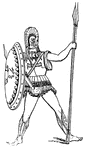
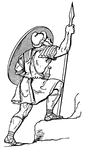
"Homer describes in various passages an entire suit of armour, and we observe that it consisted of the same portions which were used by the Greek soldiers ever after. Moreover, the order of putting them on is always the same. The heavy-armed warrior, having already a tunic around his body, and preparing for combat, puts on-1. his greaves; 2. his cuirass; 3. his sword, hung on the left side of his body by means of a belt which passed over the right shoulder; 4. the large round shield, supported in the same manner; 5. his helmet; 6. he took his spear." &mdash; Smith, 1873

Arma

"Homer describes in various passages an entire suit of armour, and we observe that it consisted of the…
"Homer describes in various passages an entire suit of armour, and we observe that it consisted of the same portions which were used by the Greek soldiers ever after. Moreover, the order of putting them on is always the same. The heavy-armed warrior, having already a tunic around his body, and preparing for combat, puts on-1. his greaves; 2. his cuirass; 3. his sword, hung on the left side of his body by means of a belt which passed over the right shoulder; 4. the large round shield, supported in the same manner; 5. his helmet; 6. he took his spear." &mdash; Smith, 1873

Arma

"Homer describes in various passages an entire suit of armour, and we observe that it consisted of the…
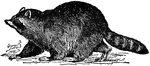
"The Raccoon, or Racoon, is a handsome animal, about the size of a large cat, brown furry hair, tail bushy and ringed; body large and unwieldy, legs short, feet with strong fossorial claws. It is omnivorous and ranges over a large part of North America, where it is hunted for its fur. The crab-eating raccoon of South America, ranging as far N. as Panama, differs chiefly from the former in the shortness of its fur, and consequent slender shape."&mdash;(Charles Leonard-Stuart, 1911)

Procyon Lotor Raccoon

"The Raccoon, or Racoon, is a handsome animal, about the size of a large cat, brown furry hair, tail…
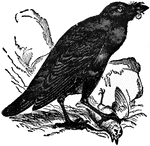
"The Raven is a large bird of the crow family. The raven has played an important part in mythology and folk-lore. It is the first bird mentioned by name in the Old Testament; by the ministry of ravens Elijah was fed, and they were to be the ministers of vengeance on unruly children. The raven was the bird of Odin, and in classic mythology was of ill-omen, a character often attributed to it by the early English dramatists. Marlowe calls it the 'sad presageful raven.' and Shakespeare repeatedly refers to the belief that its appearance foreboded misfortune. This belief, which is widespread, probably arose from the preternaturally grave manner of the bird, its sable plumage, and the readiness with which it learns to imitate human speech."&mdash;(Charles Leonard-Stuart, 1911)

Raven

"The Raven is a large bird of the crow family. The raven has played an important part in mythology and…
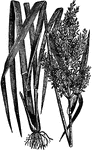
"Rice is a well known genus of grasses, having panicles of one-flowered spike-lets, with two very small pointed glumes, the florets compressed, the pale&aelig; strongly nerved, awned or awnless, six stamens, one germen, and two feather stigmas. The only important species is the common rice, one of the most useful and extensively cultivated of all grains, supplying the principal food of nearly one-third of the human race. It seems to be originally a native of the East Indies, but is now cultivated in all quarters of the globe. Rice requires a moist soil, sometimes flooded. "&mdash;(Charles Leonard-Stuart, 1911)

Water Rice

"Rice is a well known genus of grasses, having panicles of one-flowered spike-lets, with two very small…
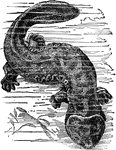
"Salamander is a genus of reptiles closely allied to the frog, from which it differs in having an elongated body terminated by a tail, and four feet of equal length. Together with the frog, this genus is included under the order Batrachia, and is easily distinguished from the lizards by having no nails on the toes, a naked skin destitute of scales, and a heart with a single auricle. "&mdash;(Charles Leonard-Stuart, 1911)

Salamander

"Salamander is a genus of reptiles closely allied to the frog, from which it differs in having an elongated…