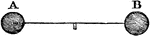
"The center of gravity, in any body or system of bodies is that point upon which the body, or system of bodies, acted upn only by gravity will balance itself in all positions." -Comstock 1850

Center of Gravity

"The center of gravity, in any body or system of bodies is that point upon which the body, or system…
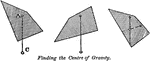
"In a body of equal thickness, as a board, or a slab of marble, but otherwise of an irregular shape, the centre of gravity may be found by suspending it, first from one point, and then from another, and marking, by means of a plumb line, the perpendicular ranges from the point of suspension. the centre of gravity will be the point where these two lines cross each other." -Comstock 1850

Center of Gravity

"In a body of equal thickness, as a board, or a slab of marble, but otherwise of an irregular shape,…
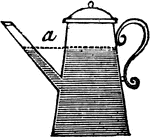
"Therefore, the small quantity in the spout balances the large quantity in the pot, or presses with the same force downwards, as that in the body of the pot presses upwards." -Comstock 1850

Water Pressure

"Therefore, the small quantity in the spout balances the large quantity in the pot, or presses with…
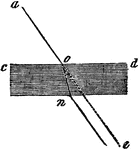
"Although a ray of light will pass in a straight line, when not interrupted, yet when it passes obliquely from one transparent body into another, of a different density, it leaves its linear direction, and is bent, or refracted more or less, out of its former course." -Comstock 1850

Refraction of Light

"Although a ray of light will pass in a straight line, when not interrupted, yet when it passes obliquely…
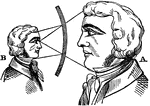
"When the concave mirror is large, say six inches in diameter, and eight or ten inches focal distance, it exhibits the human face of enormous bulk, the spectator being frightened at the size and courseness of his own features." -Comstock 1850

Magnified Face in a Concave Mirror

"When the concave mirror is large, say six inches in diameter, and eight or ten inches focal distance,…
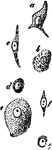
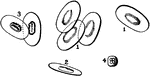
Forms of cells from the body, showing their various shapes.

Forms of Cells

Forms of cells from the body, showing their various shapes.

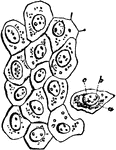
Flat cells from the surface of the lining membrane of the abdomen (peritoneum). Labels: a, cell-body; b, nucleus; c, nucleoli.

Cells from the Abdominal Lining

Flat cells from the surface of the lining membrane of the abdomen (peritoneum). Labels: a, cell-body;…
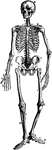
The bony and cartilaginous skeleton.

Human Skeleton, Showing Bony and Cartilage Tissue

The bony and cartilaginous skeleton.

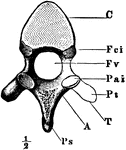
The dorsal vertebra seen from behind, i.e. the end turned from the head. Labels: C, the body; A, neural arch; Fv, the neural ring; Ps, spinous process; Pai, posterior articular process; Pt, transverse process; Fci, articular surfaces on the centrum for articulation with a rib.

Dorsal Vertebra

The dorsal vertebra seen from behind, i.e. the end turned from the head. Labels: C, the body; A, neural…
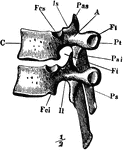
Two dorsal vertebrae viewed from the left side, and in their natural relative positions. Labels: C, the body; A, neural arch; Fv, the neural ring; Ps, spinous process; Pas, anterior articular process; Pai, posterior articular process; Pt, transverse process; Ft, facet for articulation with the tubercle of a rib; Fcs, Fci, articular surfaces on the centrum for articulation with a rib.

Dorsal Vertebra

Two dorsal vertebrae viewed from the left side, and in their natural relative positions. Labels: C,…
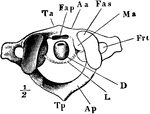
The atlas, which is the first cervical vertebra. Labels: Aa, body of atlas, D, odontoid process of axis; Fas, facet on upper side of atlas with which the skull articulates; L, transverse ligament; Frt, vertebral foramen.

The Atlas (1st Cervical Vertebra)

The atlas, which is the first cervical vertebra. Labels: Aa, body of atlas, D, odontoid process of axis;…
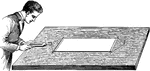
"Tenacity is that property of matter by virtue of which some bodies resist a force tending to pull their particles asunder Its measure is the ratio between the breaking weight and the area of the cross section of the body broken. It varies with different substances, with the form of the body, with the temperature, and with the duration of the pull." -Avery 1895

Testing for Tenacity

"Tenacity is that property of matter by virtue of which some bodies resist a force tending to pull their…
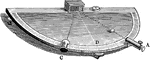
"The angle, ABD, included between the direction of the moving body before it strikes the reflecting surface, and a perpendicular to that surface drawn from the point of contact, is called the angle of incidence. The angle between the perpendicular and the direction of the moving body after striking is called the angle of reflection." -Avery 1895

Law of Reflected Motion

"The angle, ABD, included between the direction of the moving body before it strikes the reflecting…
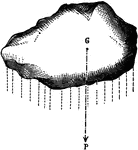
"A body's center of mass is the point about which all matter composing the body may be balanced. It is also called the center of inertia. In some cases, this is also the center of gravity." -Avery 1895

Center of Mass

"A body's center of mass is the point about which all matter composing the body may be balanced. It…
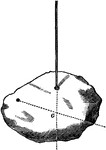
"Let any irregularly shpaed body, as a stone or chair, be suspended so as to move freely. Drop a plumb line from the point of the suspendsion, and make it fast or mark its direction. The center of mass will lie in this line. From a second point, not in the line already determined, suspend the body; let it fall a plumb line as before. The center of mass will lie in this line also. But to lie in both lines, it must lie at their intersection." -Avery 1895

Finding the Center of Mass

"Let any irregularly shpaed body, as a stone or chair, be suspended so as to move freely. Drop a plumb…

"The most common way of determining the density of such a body [that is heavier than water] if it is unsoluble in water, is to find its weight in air (w); find its weight when immersed in water (w'); divide the weight in air by the loss of weight in water." -Avery 1895

Scale Designed to Weigh Objects While Underwater

"The most common way of determining the density of such a body [that is heavier than water] if it is…
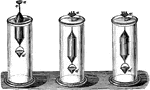
"The Nicholson hydrometer of constant volume is a hollow cylinder carrying at its lower end a basket, d, heavy enough to keep the apparatus upright in water. At the top of the cylinder is a vertical rod carrying a pan, a, for holding weights, etc. The whole apparatus must be lighter than water, so that a certain weight (W) must be put into the pan to sink the apparatus to a fixed point marked on the rod (as c). The given body, which must weigh less than W, is placed in the pan, and enought weights (w) added to sink the point c, to the water line It is evident that the weight of the given body is W-w." -Avery 1895

Nicholson Hydrometer

"The Nicholson hydrometer of constant volume is a hollow cylinder carrying at its lower end a basket,…
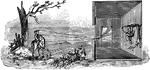
"If light from a highly luminous body is admitted to a darkened room through a small hole in the shutter and ther received upon a white screen, it will form an inverted image of the object." -Avery 1895

Image by Aperature

"If light from a highly luminous body is admitted to a darkened room through a small hole in the shutter…
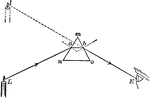
"A prism is a transparent body with two refraction surfaces that lie in intersecting planes. The angle formed by these planes is called the refracting angle." -Avery 1895

Prism

"A prism is a transparent body with two refraction surfaces that lie in intersecting planes. The angle…
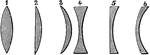
"A lens is a transparent body the two refracting surfaces of which are curved, or one of which is curved and the other plane.(1) Double convex(2) Plano convex(3) Meniscus(4)Double concave(5) Plano concave(6) Concavo concave." -Avery 1895

Lens

"A lens is a transparent body the two refracting surfaces of which are curved, or one of which is curved…
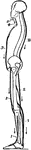
Diagram illustrating the muscles (drawn in thick black lines) which pass before and behind the joints, and by their balanced activity keep the joints rigid and the body erect.

Muscles

Diagram illustrating the muscles (drawn in thick black lines) which pass before and behind the joints,…
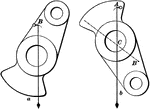
"In a body free to move, the center of gravity will lie in a vertical plumb-line drawn through the point of support. Therefore, to find the position of the center of gravity of an irregular solid, as the crank, Fig 8, suspended it at some point, as B, so that it will move freely. Drop a plumb line from the point of suspension and mark its direction. Suspend the body at another point, as A, and repeat the process. The intersection C of the two lines will be directly over the center of gravity." —Hallock 1905

Center of Gravity of a Solid

"In a body free to move, the center of gravity will lie in a vertical plumb-line drawn through the point…
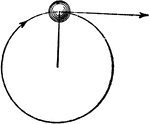
"If a body be fastened to a string and whirled, so as to give it a circular motion, there will be a pull on the string that will be greater or less according as the velocity increases or decreases... If the string were cut, the pulling force that drew it away from the straight line would be removed, and the body would then fly off at a tangent; that is, it would move in a straight line tangent to the circle, as shown in Fig. 9." —Hallock 1905

Centrifugal Force

"If a body be fastened to a string and whirled, so as to give it a circular motion, there will be a…
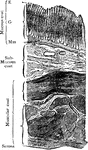
Wall of human stomach. Labels: E, epithelium; G, glands; Mm, muscularis mucosae.

Stomach Wall

Wall of human stomach. Labels: E, epithelium; G, glands; Mm, muscularis mucosae.

Red corpuscles (blood cells) of the frog. The red blood cells of birds, reptiles, amphibians and fishes are oval and contain a nucleus in the center that is not found in human red corpuscles.

Blood Cells

Red corpuscles (blood cells) of the frog. The red blood cells of birds, reptiles, amphibians and fishes…
"The human eye-essential parts shown in section." —Croft 1917

Eye

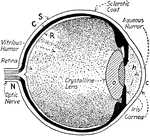
"The human eye-essential parts shown in section." —Croft 1917

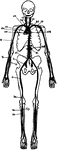
The main arteries of the body. Labels: Crd, and Crs, right and left coronary arteries of the heart, cut short near their origin; Aa, and aA, aortic arch; At, thoracic aorta; Aab, abdominal aorta; K, renal artery; Sd, right, and Ssi, left subclavian; Cd, right, and Cs, left carotid; Ax, axillary artery; B, brachial artery; U, ulner artery; R, radial artery; Ai, common iliac artery; I, external iliac artery; C, femoral artery; Po, popliteal artery; Ta, anterior, and Tp, posterior tibial artery; Pe, peroneal artery.

The Main Arteries of the Body

The main arteries of the body. Labels: Crd, and Crs, right and left coronary arteries of the heart,…

Torso of the Statue known as Venus of Melos (left) and New York Fashion, 1898 (right). "Since abdomen and chest alternately expand and contract in healthy breathing, anything which impedes their free movement is to be avoided. The tight lacing which is still indulged [in 1900] by those who think a distorted form beautiful, seriously impedes one of the most important functions of the body, and leads not only to shortness of breath and an incapacity for muscular exertion, but in many cases to actual deformity or disease." — Newell, 1900.

Effect of Corset Use on Respiration

Torso of the Statue known as Venus of Melos (left) and New York Fashion, 1898 (right). "Since abdomen…
Torso of the Statue known as Venus of Melos (left) and New York Fashion, 1898 (right). "Since abdomen and chest alternately expand and contract in healthy breathing, anything which impedes their free movement is to be avoided. The tight lacing which is still indulged [in 1900] by those who think a distorted form beautiful, seriously impedes one of the most important functions of the body, and leads not only to shortness of breath and an incapacity for muscular exertion, but in many cases to actual deformity or disease." — Newell, 1900.

Effect of Corset Use on Respiration

Torso of the Statue known as Venus of Melos (left) and New York Fashion, 1898 (right). "Since abdomen…

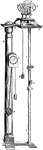
"Machine designed by Atwood to allow the measurement and calculation of the velocities of falling bodies at various points accurately and easily." —Quackenbos 1859

Atwood's Machine

"Machine designed by Atwood to allow the measurement and calculation of the velocities of falling bodies…

"The part of the body in which the centre of gravity is situated, may be found, in some cases, by balancing it on a point. Thus the centre of gravity of the poker represented [here] lies directly over the point on which it is balanced." —Quackenbos 1859

Center of Gravity

"The part of the body in which the centre of gravity is situated, may be found, in some cases, by balancing…

"When a line of direction falls within the base, a body stands when not, it falls... On the same principle, a load of stone may pass safely over a hillside, on which a load of hay would be overturned [as shown by the line of direction in this illustration]." —Quackenbos 1859

Line of Direction from the Center of Gravity of an Object

"When a line of direction falls within the base, a body stands when not, it falls... On the same principle,…
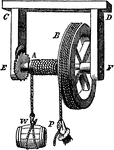
"The wheel and axle is simply a revolving lever of the first kind. One application of the lever can not move a body any great distance; but, by means of the wheel and axle, the action of the lever is continued uninterruptedly." —Quackenbos 1859

Wheel and Axle

"The wheel and axle is simply a revolving lever of the first kind. One application of the lever can…
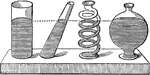
"No matter what the size or shape of a body of water may be, its surface has the same level throughout." —Quackenbos 1859

Uniform Water Level

"No matter what the size or shape of a body of water may be, its surface has the same level throughout."…
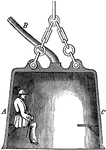
"The large iron vessel does not allow air to escape once it is lowered into a body of water for underwater work. The hose attached to the top allows for new air to enter the bell." —Quackenbos 1859

Diving Bell

"The large iron vessel does not allow air to escape once it is lowered into a body of water for underwater…
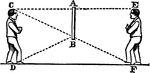
"Mirror A/B is only half of person C's height. C is able to view his entire body through such a small mirror due to the angle of incidence from D to B to F." —Quackenbos 1859

Angle of Incidence and Reflection

"Mirror A/B is only half of person C's height. C is able to view his entire body through such a small…
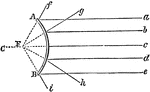
"Parallel rays strike the convex mirror, reflect, and diverge as if they had originated from a virtual focus inside the mirror. Focus F is located between the surface of the mirror and the mirror's center if it were a full body sphere." —Quackenbos 1859

Reflection by Convex Mirrors

"Parallel rays strike the convex mirror, reflect, and diverge as if they had originated from a virtual…
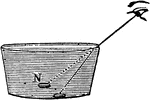
"If the coin were to be observed in an empty pan and then watched as the pan was filled with water, the image of the coin would be refracted to position N." —Quackenbos 1859

Refraction as seen by the Human Eye

"If the coin were to be observed in an empty pan and then watched as the pan was filled with water,…
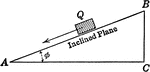
Inclined plane forming right triangle showing the velocity of a body sliding a distance,s, down a smooth horizontal plane.

Inclined Plane Forming Right Triangle

Inclined plane forming right triangle showing the velocity of a body sliding a distance,s, down a smooth…
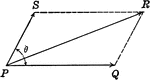
Illustration of the resultant vector when two vectors are acting upon a body at point P.

Resultant Vectors

Illustration of the resultant vector when two vectors are acting upon a body at point P.
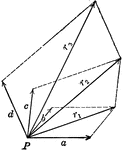
Illustration of the resultant vector when four vectors are acting upon a body at point P.

Resultant Vector From 4 Forces

Illustration of the resultant vector when four vectors are acting upon a body at point P.
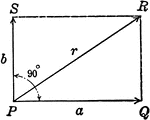
Illustration of the resultant vector when two vectors are acting upon a body at point P at 90 degrees.
Resultant Vector With Vectors at 90 degrees

Illustration of the resultant vector when two vectors are acting upon a body at point P at 90 degrees.

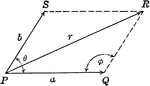
Illustration of the resultant vector when two vectors are acting upon a body at point P at Ǝ degrees.
Resultant Vector With Vectors at Angle Ǝ

Illustration of the resultant vector when two vectors are acting upon a body at point P at Ǝ degrees.

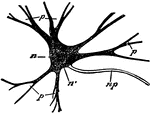
A large nerve cell from the ventral horn of the spinal cord. Labels: n, nucleus; n', small body, called the nucleolus, inside the nucleus; p, branched processes; n.p., unbranched process continued into the axis cylinder of a motor nerve fiber.

Nerve Cell

A large nerve cell from the ventral horn of the spinal cord. Labels: n, nucleus; n', small body, called…
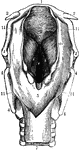
The larynx viewed from its pharyngeal opening. The back wall of the pharynx has been divided and its edges (11) turned aside. Labels: 1, body of hyoid; 2, its small, and 3, its great, horns; 4, upper and lower horns of thyroid cartilage; 5, mucous membrane of front of pharynx, covering the back of the cricoid cartilage; 6, upper end of gullet; 7, windpipe, lying in front of the gullet; 8, eminence caused by cartilage of Santorini; 9, eminence caused by cartilage of Wrisberg -- both lie in, 10, the aryteno-epiglottidean fold of mucous membrane, surrounding the opening (aditus laryngis) from pharynx to larynx; a, projecting tip of epiglottis; c, the glottis -- the lines leading from the letter point to the free vibrating edges of the vocal cords; b' the ventricles of the larynx -- their upper edges, marking them off from the eminences b, are the false vocal cords.

Larynx

The larynx viewed from its pharyngeal opening. The back wall of the pharynx has been divided and its…
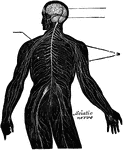
View of the nervous system of man, showing the nerve centers (brain and spinal cord) giving off nerves to supply the whole of the body.

The Nervous System

View of the nervous system of man, showing the nerve centers (brain and spinal cord) giving off nerves…
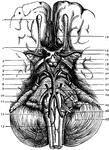
The base of brain. Labels: 1. Olfactory Bulb; 2. Second, or Optic Nerves; 3. Anterior Perforated Space; 4. Optic Tract; 5. Crus Cerebri; 6. 3rd Nerve; 7. 4th Nerve.; 8. 5th Nerve; 9. 6th Nerve; 10. Pyramid; 11. Olivary Body; 12. Vertebral Artery; 13. Anterior Spinal Artery; 14. Anterior Cerebral Artery; 15. Lamina Cinerea; 16. Middle Cerebral Artery; 17. Tuber Cinereum; 18. Corpora Albicantia; 19. Posterior Perforated Space; 20. Posterior Cerebral Artery; 21. Superior Cerebral Artery; 22. Pons Varolii; 23. Inferior Cerebellar Artery; 24. 7th and 8th Nerves; 25. 9th, 10th, and 11th Nerves; 26. 12th Nerve; 27. Cerebellum.

Base of the Brain

The base of brain. Labels: 1. Olfactory Bulb; 2. Second, or Optic Nerves; 3. Anterior Perforated Space;…
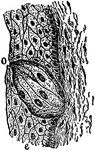
A taste bud, which is a flask shaped body, situated in the epidermis of the vallate and some of the fungiform papillae, also found at the sides of the broad base, which rests on the corium, and a neck opening on the mucous surface by an orifice, the gustatory pore.

Taste Buds

A taste bud, which is a flask shaped body, situated in the epidermis of the vallate and some of the…
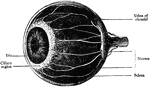
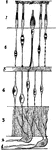
The choroid, ciliary body, and iris of the eyeball.

The Choroid, Ciliary Body, and Iris

The choroid, ciliary body, and iris of the eyeball.

Structure of the human retina, showing the various layers.

Structure of the Retina

Structure of the human retina, showing the various layers.

The crystalline lens, which is a bi-convex, elastic, transparent body, enclosed in a capsule, held in place by a suspensory ligament, and situation immediately behind the pupil ad in front of the vitreous body, in the fossa patellaris of which its posterior and most convex surface rests.

Lens of the Eye

The crystalline lens, which is a bi-convex, elastic, transparent body, enclosed in a capsule, held in…
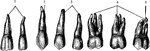
Characteristics of the teeth. Teach tooth consists of a crown or body, projecting above the gum; root or fang, embedded within the alveolus; and the neck, the constricted portion between the grown and the fang. There are 4 classes of teeth: incisors (1), canines (2), premolars or bicuspids (3), and molars (4).

The Teeth

Characteristics of the teeth. Teach tooth consists of a crown or body, projecting above the gum; root…
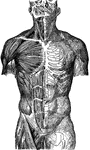
Front view of the body and outline of skeleton and covering.

Front View of the Body

Front view of the body and outline of skeleton and covering.

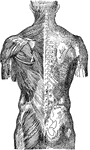
Back view of the body and outline of skeleton and covering.

Back View of the Body

Back view of the body and outline of skeleton and covering.

A dorsal vertebra. Labels: 1, the body; 2, face for the head of a rib; 3, superior face of the body; 4, superior half of the intervertebral notch; 5, interior half of the intervertebral notch; 6, spinous process; 7, articular face for the tubercle of a rib; 8, two superior oblique processes; 9, two inferior oblique processes.

Dorsal Vertebra

A dorsal vertebra. Labels: 1, the body; 2, face for the head of a rib; 3, superior face of the body;…
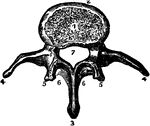
A lumbar vertebra. Labels: 1, face for the intervertebral substance; 2, anterior surface of the body; 3, spinous process; 4, transverse process; 5, oblique process; 6, a portion or the body bridges; 7, the spinal foramen.

Lumbar Vertebra

A lumbar vertebra. Labels: 1, face for the intervertebral substance; 2, anterior surface of the body;…
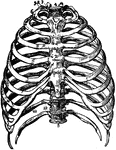
Front view of the bones of the thorax, including the ribs, sternum and vertebrae. Labels: 1, first bone of the sternum; 2, second bone of the sternum; 3, third bone or ensiform cartilage; 4, first dorsal vertebra; 5, last or twelfth dorsal vertebra; 6, first rib; 7, its head; 8, its neck; 9, its tubercle; 10, seventh or last true rib; 11, its cartilage; 12, angle of eleventh rib; 13, its body.

The Bones of the Thorax

Front view of the bones of the thorax, including the ribs, sternum and vertebrae. Labels: 1, first bone…
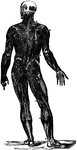
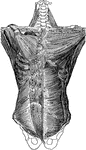
Muscle of the body, back view: The fascia is left upon the left limbs, removed from the right.

Back View of the Muscles of the Body

Muscle of the body, back view: The fascia is left upon the left limbs, removed from the right.
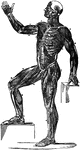
Muscle of the body, front view: On the right half, the superficial muscles; left half, deep-seated muscles.
Front View of the Muscles of the Body

Muscle of the body, front view: On the right half, the superficial muscles; left half, deep-seated muscles.

Front view of the body, showing deep muscles.

Deep Muscles of the Trunk of the Body

Front view of the body, showing deep muscles.