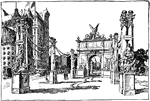
The arch erected in New York City to celebrate the return of Admiral George Dewey.

Triumphal Arch in New York City

The arch erected in New York City to celebrate the return of Admiral George Dewey.
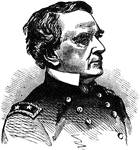
John Adams Dix (July 24, 1798 – April 21, 1879) was an American politician from New York. He served as Secretary of the Treasury, U.S. Senator, and New York Governor. He was also a distinguished Civil War General.

John Adams Dix

John Adams Dix (July 24, 1798 – April 21, 1879) was an American politician from New York. He served…
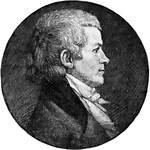
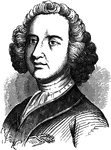
James Duane (February 6, 1733–February 1, 1797) was a lawyer, jurist, and Revolutionary leader from New York. He served as a delegate to the Continental Congress, a U.S. District Judge, New York state senator, and as Mayor of New York.

James Duane

James Duane (February 6, 1733–February 1, 1797) was a lawyer, jurist, and Revolutionary leader from…
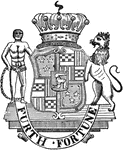
The seal of Lord John Murray of Dunmore.

Seal of Lord Dunmore

The seal of Lord John Murray of Dunmore.

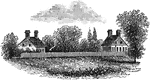
The remains of John Murray, the 4th Earl of Dunmore's palace.

Remains of Lord Dunmore's Palace

The remains of John Murray, the 4th Earl of Dunmore's palace.

Theodore William Dwight (1822-1892), American jurist and educator, cousin of Theodore Dwight Woolsey and of Timothy Dwight V, was born July 18, 1822 in Catskill, New York.

Theodore William Dwight

Theodore William Dwight (1822-1892), American jurist and educator, cousin of Theodore Dwight Woolsey…
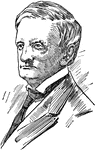
William Maxwell Evarts (February 6, 1818 – February 28, 1901) was an American lawyer and statesman who served as US Secretary of State, US Attorney General and US Senator from New York.

William Maxwell Evarts

William Maxwell Evarts (February 6, 1818 – February 28, 1901) was an American lawyer and statesman…
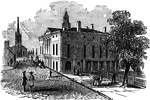
Federal Hall, located at 26 Wall Street in New York City, was the first capitol of the United States of America and the site of George Washington's first inauguration in 1789. It is also the place where the United States Bill of Rights was passed.

Federal Hall

Federal Hall, located at 26 Wall Street in New York City, was the first capitol of the United States…
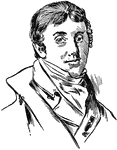
Nicholas Fish (1758-1833) was an American Revolutionary soldier, born in New York City.

Nicholas Fish

Nicholas Fish (1758-1833) was an American Revolutionary soldier, born in New York City.
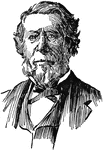
Hamilton Fish (August 3, 1808 – September 7, 1893), born in New York City, was an American statesman who served as Governor of New York, United States Senator from New York and United States Secretary of State.

Hamilton Fish

Hamilton Fish (August 3, 1808 – September 7, 1893), born in New York City, was an American statesman…
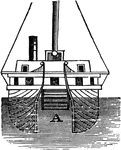
USS <em>Fulton</em>, a 2455-ton center-wheel steam battery, was built at New York City to a design prepared by Robert Fulton, who called her "Demologos".

Section of the Floating Battery Fulton

USS Fulton, a 2455-ton center-wheel steam battery, was built at New York City to a design prepared…
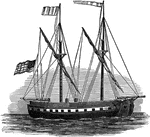
USS <em>Fulton</em>, a 2455-ton center-wheel steam battery, was built at New York City to a design prepared by Robert Fulton, who called her "Demologos".

Floating Battery Fulton the First

USS Fulton, a 2455-ton center-wheel steam battery, was built at New York City to a design prepared…
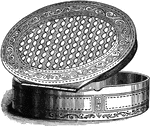
The gold box that the city of New York gave to Gen. Jacob Brown after the battles of Chippewa and Lundy's Lane.

General Brown's Gold Box

The gold box that the city of New York gave to Gen. Jacob Brown after the battles of Chippewa and Lundy's…
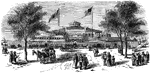
An illustration of Castle Garden, known today as Castle Clinton or Fort Clinton. Castle Clinton or Fort Clinton was once a circular sandstone fort now located in Battery Park at the southern tip of Manhattan, New York City, in the United States. It subsequently became a beer garden, a theater, the first immigration station (predating Ellis Island), a very popular public aquarium, and finally a national monument.

Castle Garden

An illustration of Castle Garden, known today as Castle Clinton or Fort Clinton. Castle Clinton or Fort…
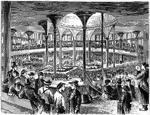
An illustration of the interior of Castle Garden, known today as Castle Clinton or Fort Clinton. Castle Clinton or Fort Clinton was once a circular sandstone fort now located in Battery Park at the southern tip of Manhattan, New York City, in the United States. It subsequently became a beer garden, a theater, the first immigration station (predating Ellis Island), a very popular public aquarium, and finally a national monument.

Castle Garden (Interior)

An illustration of the interior of Castle Garden, known today as Castle Clinton or Fort Clinton. Castle…
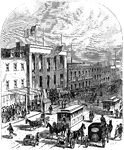
An illustration of Bowery Theater, a playhouse in the Bowery neighborhood of New York City. Although it was founded by rich families to compete with the upscale Park Theater, the Bowery saw its most successful period under the populist, pro-American management of Thomas Hamblin in the 1830s and 1840s. By the 1850s, the theater came to cater to immigrant groups such as the Irish, Germans, and Chinese. It burnt down 5 times in 17 years, a fire in 1929 destroying it for good. Although the theater's name changed several times (Thalia Theater, Fay's Bowery Theater, etc.), it was generally referred to as the "Bowery Theater".

Bowery Theater

An illustration of Bowery Theater, a playhouse in the Bowery neighborhood of New York City. Although…
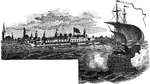
Fort George, the name of four defensive works connected with warfare in the United States.

Fort George, Old New York City

Fort George, the name of four defensive works connected with warfare in the United States.
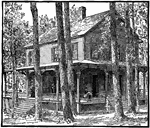
The house in which General Ulysses S. Grant died in Mount McGregor, New York

The House in which General Grant Died

The house in which General Ulysses S. Grant died in Mount McGregor, New York
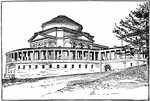
The Hall of Fame for Great Americans at Bronx Community College, the original "Hall of Fame" in the United States, is a New York landmark institution founded in 1900 to honor prominent Americans who have had a significant impact on this nation's history.

The Hall of Fame for Great Americans

The Hall of Fame for Great Americans at Bronx Community College, the original "Hall of Fame" in the…
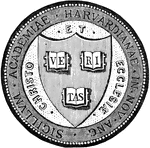
The seal of Harvard University in Massachusetts.

Seal of Harvard

The seal of Harvard University in Massachusetts.

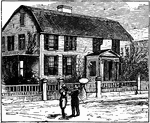
Samuel Seabury graduated from Yale in 1748; studied theology with his father; studied medicine in Edinburgh from 1752 to 1753; was ordained deacon by the bishop of Lincoln and priest by the bishop of Carlisle in 1753; was rector of Christ Church, New Brunswick, New Jersey from 1754 to 1757, rector in Jamaica, New York from 1757 to 1766, and of St Peter's, Westchester (now annexed to The Bronx) from 1766 to 1775.

Bishop Seabury's House, Springfield, CT

Samuel Seabury graduated from Yale in 1748; studied theology with his father; studied medicine in Edinburgh…
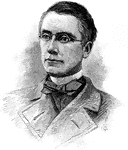
Morgan Dix (born November 1, 1827 in New York City; died April 29, 1908) was an American priest, "divine" (a theologian) and religious author. The son of John A. Dix and Catherine Morgan, he was educated at Columbia College and the General Theological Seminary. For almost fifty-three years, he was identified with Trinity Church, New York, of which he became assistant minister in 1855 and rector in 1862. As well as being a very active churchman, Dix also wrote widely about the practice of Christianity. Among his major works are Commentaries on Romans and on Galatians and Colossians; The Calling of a Christian Woman; The Seven Deadly Sins; The Sacramental System; and Lectures on the First Prayer-Book of Edward VI.

Morgan Dix

Morgan Dix (born November 1, 1827 in New York City; died April 29, 1908) was an American priest, "divine"…
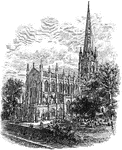
Trinity Church, at 79 Broadway in New York City, is a historic full service parish church in the Episcopal Diocese of New York. Trinity Church is located at the intersection of Broadway and Wall Street in downtown Manhattan. n 1696, Governor Benjamin Fletcher approved the purchase of land in Lower Manhattan by the Church of England community for construction of a new church. The parish received its charter from King William III of England on May 6, 1697. Its land grant specified an annual rent of one peppercorn due to the English crown. The present day Trinity Church, designed by architect Richard Upjohn, is considered a classic example of Gothic Revival architecture and was designated a National Historic Landmark in 1976 for its architectural significance and place within the history of New York City.

Trinity Church

Trinity Church, at 79 Broadway in New York City, is a historic full service parish church in the Episcopal…
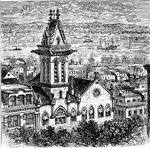
Trinity School is a private, preparatory, co-educational day school for grades K-12 located in New York City, USA, and a member of both the New York Interschool and the Ivy Preparatory School League. Founded in 1709 in the Tower of the old Trinity Church at Broadway and Wall Street, the school is the fifth oldest in the United States and the oldest continually operational school in New York City.

Trinity School

Trinity School is a private, preparatory, co-educational day school for grades K-12 located in New York…
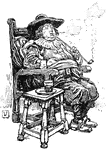
(1606-1654) Director general of the Dutch colony of New Amsterdam.

Wouter Van Twiller

(1606-1654) Director general of the Dutch colony of New Amsterdam.

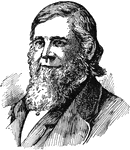
Daniel Huntington (October 4, 1816 - April 19, 1906), American artist, was born in New York City, New York.

Daniel Huntington

Daniel Huntington (October 4, 1816 - April 19, 1906), American artist, was born in New York City, New…

William Hutchings was born in York, Maine in 1764. He was a soldier who fought in the American Revolutionary War.

William Hutchings

William Hutchings was born in York, Maine in 1764. He was a soldier who fought in the American Revolutionary…
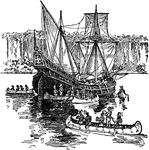
Henry Hudson's ship "Half Moon" on the Hudson River in New York.

Half Moon

Henry Hudson's ship "Half Moon" on the Hudson River in New York.

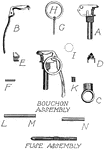
<p>A: Bouchon<br>B: Lever<br>C: Bouchon Seal<br>D: Striker<br>E: Spring<br>F: Hinge Pin<br>G: Split Pin<br>H: Split Pin Ring<br>I: Moisture Cap<br>K: Primer<br>L: Priming Powder<br>M: Fuse<br>N: Detonator</p>

Grenade Parts

A: Bouchon B: Lever C: Bouchon Seal D: Striker E: Spring F: Hinge Pin G: Split Pin H: Split Pin Ring…
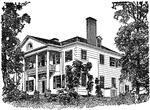
The Jumel Mansion in New York City is a historic location which served as the headquarters for both sides of the American Revolution.

Jumel Mansion

The Jumel Mansion in New York City is a historic location which served as the headquarters for both…
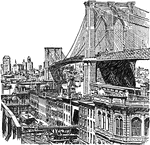
The Brooklyn Bridge, the largest suspension bridge in the world at the time of its completion.

Brooklyn Bridge

The Brooklyn Bridge, the largest suspension bridge in the world at the time of its completion.
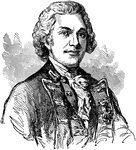
Silas Talbot (11 January 1751 - 30 June 1813) was an officer in the Continental Army and in the Continental Navy. Talbot is most famous for commanding the USS Constitution from 1798 to 1801. Talbot was born in Dighton, Massachusetts. He was commissioned a captain in the Continental Army on 1 July 1775. After participating in the siege of Boston and aiding in the transportation of troops to New York, he obtained command of a fire ship and attempted to use it to set fire to the British warship HMS Asia (1764). The attempt failed, but the daring it displayed won him a promotion to major on 10 October 1777.

Silas Talbot

Silas Talbot (11 January 1751 - 30 June 1813) was an officer in the Continental Army and in the Continental…
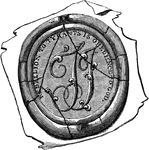
Thomas Jefferson's seal with the motto: "Rebellion to tyrants is obedience to God."

Jefferson's Seal

Thomas Jefferson's seal with the motto: "Rebellion to tyrants is obedience to God."
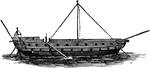
One of the prisons used by the British at New York during the American Revolutionary War.

The Jersey Prison Ship

One of the prisons used by the British at New York during the American Revolutionary War.
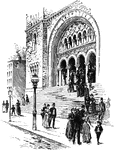
The entrance to the Temple Beth-el, a Jewish synagogue in New York City.

Temple Beth-el

The entrance to the Temple Beth-el, a Jewish synagogue in New York City.

Sir William Johnson, 1st Baronet (1715 – 11 July 1774), founder of Johnstown, New York, was an Irish pioneer and army officer in colonial New York, and the British Superintendent of Indian Affairs from 1755 to 1774.

Sir William Johnson

Sir William Johnson, 1st Baronet (1715 – 11 July 1774), founder of Johnstown, New York, was an Irish…
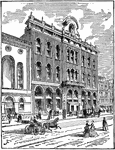
Tammany Hall was the Democratic Party political machine that played a major role in controlling New York City politics and helping immigrants (most notably the Irish) rise up in American politics from the 1790s to the 1960s. It usually controlled Democratic Party nominations and patronage in Manhattan from the mayoral victory of Fernando Wood in 1854 up to (but not including) the election of Fiorello La Guardia in 1934, whereupon it weakened and collapsed.

Tammany Hall

Tammany Hall was the Democratic Party political machine that played a major role in controlling New…
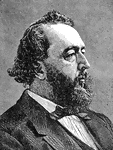
Bayard Taylor (James) (January 11, 1825 &ndash; December 19, 1878) was an American poet, literary critic, translator, and travel author. In 1844-46 he made a tour on foot in Europe, of which he published (1846) an account in <em>Views Afoot</em>. In 1847 he went to New York and wrote for the <em>Literary World</em> and published <em>Rhymes of Travel</em>.

Bayard Taylor

Bayard Taylor (James) (January 11, 1825 – December 19, 1878) was an American poet, literary critic,…
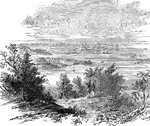
The crossing between Lakes George and Champlain had been used by natives for thousands of years. The town was located on the direct route, utilizing rivers and two long lakes, between New York City to the south and the French settlement of Montreal to the north. The town was the setting for historic battles and maneuvers during both the French and Indian War and the American Revolution. The site of Fort Ticonderoga marked the location of an important portage between Lake George and Lake Champlain.

Ticonderoga and the Lake, from Mount Defiance

The crossing between Lakes George and Champlain had been used by natives for thousands of years. The…
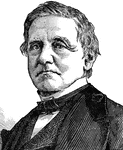
Samuel Jones Tilden (February 9, 1814 – August 4, 1886) was the Democratic candidate for the U.S. presidency in the disputed election of 1876, the most controversial American election of the 19th century. A political reformer, he was a Bourbon Democrat who worked closely with the New York City business community, led the fight against the corruption of Tammany Hall, and fought to keep taxes low.

Samuel Jones Tilden

Samuel Jones Tilden (February 9, 1814 – August 4, 1886) was the Democratic candidate for the U.S.…
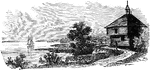
York is a community in Toronto, Ontario, Canada. Formerly a separate city, it was one of six municipalities that amalgamated in 1998 to form the current city of Toronto. York Township was incorporated by Canada West in 1850 (Canada West later became Ontario in 1867).

York (Toronto) in 1813, From the Block House East of the Don

York is a community in Toronto, Ontario, Canada. Formerly a separate city, it was one of six municipalities…
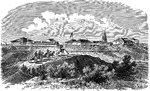
The fort was built by the British Army and Canadian militia troops in the late eighteenth and early nineteenth centuries, to defend the settlement and the new capital of the Upper Canada region from the threat of a military attack, principally from the newly independent United States.

Fort York

The fort was built by the British Army and Canadian militia troops in the late eighteenth and early…
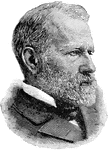
Benjamin Franklin Tracy (April 26, 1830 &ndash; August 6, 1915) was a United States political figure who served as Secretary of the Navy from 1889 through 1893, during the administration of U.S. President Benjamin Harrison. Tracy was a lawyer active in Republican Party politics during the 1850s. During the Civil War, he commanded the 109th New York Infantry Regiment, and served as a Union brigadier general. He was awarded a Medal of Honor for his actions during the Battle of the Wilderness on May 6, 1864.

Benjamin Franklin Tracy

Benjamin Franklin Tracy (April 26, 1830 – August 6, 1915) was a United States political figure…
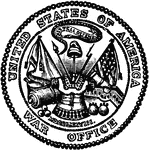
The seal of the War Office of the United States of America. The term "War Office" used during the Revolution, and for many years afterward, was associated with the Headquarters of the Army.

United States of America War Office

The seal of the War Office of the United States of America. The term "War Office" used during the Revolution,…
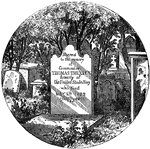
Thomas Truxtun (February 17, 1755 – May 5, 1822) was an American naval officer who rose to the rank of commodore. Born near Hempstead, New York on Long Island, Truxtun had little formal education before joining the crew of the British merchant ship Pitt at the age of twelve. By the time he was twenty, however, his talents had garnered him the command of his own vessel, the Andrew Caldwell. He operated as a privateer during the American Revolutionary War, commanding several ships: Congress, Independence, Mars and St. James. Truxtun was highly successful in capturing enemy ships during this period, not once suffering a defeat. He was buried at Christ Church Burial Ground in Philadelphia, Pennsylvania.

Thomas Truxtun's Grave

Thomas Truxtun (February 17, 1755 – May 5, 1822) was an American naval officer who rose to the rank…
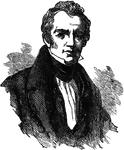
James Kent (July 31, 1763 – December 12, 1847) was an American jurist and legal scholar from New York.
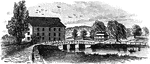
James Kent

James Kent (July 31, 1763 – December 12, 1847) was an American jurist and legal scholar from New York.

The King's Bridge, erected in 1693 by Frederick Philipse a local Lord loyal to the British Monarch. It is located in the northwest Bronx, New York.

King's Bridge in 1860

The King's Bridge, erected in 1693 by Frederick Philipse a local Lord loyal to the British Monarch.…
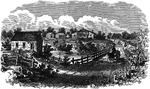
The Second Battle of Lacolle Mills was fought on March 30, 1814 during the War of 1812. The small garrison of a British outpost position, aided by reinforcements, fought off a strong but poorly executed American attack.

La Colle Mill and Blockhouse

The Second Battle of Lacolle Mills was fought on March 30, 1814 during the War of 1812. The small garrison…
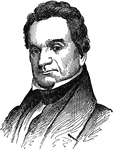
Edward Livingston (26 May 1764–23 May 1836) was a prominent American jurist and statesman. He was an influential figure in the drafting of the Louisiana Civil Code of 1825, a civil code based largely on the Napoleonic Code. He represented both New York, and later Louisiana in Congress and he served as the U.S. Secretary of State from 1831 to 1833.

Edward Livingston

Edward Livingston (26 May 1764–23 May 1836) was a prominent American jurist and statesman. He was…
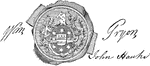
The seal and signature of William Tryon. Tryon was the royal governor North Carolina and New York. The history of Tryon's administration is a record of folly, extortion, and crime, and he gained the name of "The Wolf of North Carolina." He was governor of New York when the Revolutionary War broke out, and he was the last governor of that province appointed by the crown.

Seal and Signature of Tryon

The seal and signature of William Tryon. Tryon was the royal governor North Carolina and New York. The…
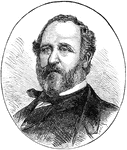
William M. Tweed (April 3, 1823 – April 12, 1878), sometimes informally called Boss Tweed, was an American politician who was convicted for stealing between 40 million and 200 million dollars from New York City taxpayers through political corruption. Tweed was head of Tammany Hall, the Democratic Party political machine that played a major role in the politics of 19th century New York. He died in jail.

William Marcy Tweed

William M. Tweed (April 3, 1823 – April 12, 1878), sometimes informally called Boss Tweed, was an…
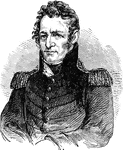
Solomon Van Vechten Van Rensselaer (August 6, 1774 – April 23, 1852) was an United States Representative from the state of New York, a lieutenant colonel during the War of 1812, and a postmaster. He was the son of Jeremiah Van Rensselaer and nephew of Killian Van Rensselaer, who were also Representatives.

Solomon Van Rensselaer

Solomon Van Vechten Van Rensselaer (August 6, 1774 – April 23, 1852) was an United States Representative…
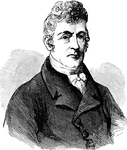
Stephen Van Rensselaer III (November 1, 1765 – January 26, 1839) was Lieutenant Governor of New York as well as a statesman, soldier, and land-owner, the heir to one of the greatest estates in the New York region at the time. He was the father of Henry Bell Van Rensselaer, who was a politician and general in the Union Army during the American Civil War.

Stephen Van Rensselaer

Stephen Van Rensselaer III (November 1, 1765 – January 26, 1839) was Lieutenant Governor of New York…
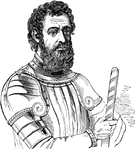
Giovanni da Verrazzano (c. 1485 – c. 1528) was an Italian explorer of North America, in the service of the French crown. He is renowned as the first European to explore the Atlantic coast of North America between South Carolina and Newfoundland, including New York Harbor and Narragansett Bay, in 1524.

Giovanni da Verrazzano

Giovanni da Verrazzano (c. 1485 – c. 1528) was an Italian explorer of North America, in the service…
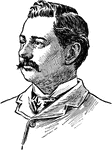
Seth Low (January 18, 1850 - September 17, 1916), born in Brooklyn, New York, was an American educator and political figure who served as mayor of Brooklyn, as President of Columbia University, as diplomatic representative of the United States, and as Mayor of New York City.

Seth Low

Seth Low (January 18, 1850 - September 17, 1916), born in Brooklyn, New York, was an American educator…
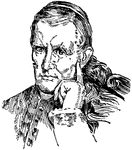
John Cardinal McCloskey, (March 10, 1810 - October 10, 1885) was an American cardinal, the fifth bishop (second archbishop) of the Roman Catholic diocese of New York.

Cardinal McCloskey

John Cardinal McCloskey, (March 10, 1810 - October 10, 1885) was an American cardinal, the fifth bishop…
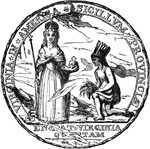
The Colonial Seal of Virginia. An Indian kneels before a prominent royal figure.

Colonial Seal of Virginia

The Colonial Seal of Virginia. An Indian kneels before a prominent royal figure.
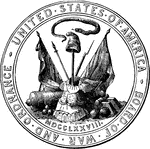
In 1776 the Board of War and Ordnance was created for issuing supplies to troops in the field, and the first Ordnance magazine was established at Carlisle, Pennsylvania the following year. An armory and arsenal at Springfield, Massachusetts (1777-1968) was also established along with later armories such as Harpers Ferry, West Virginia (1799-1861), and Watertown, Massachusetts (1816-1968).

Seal of the Board of War and Ordnance

In 1776 the Board of War and Ordnance was created for issuing supplies to troops in the field, and the…
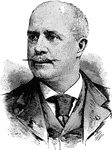
George Edwin Waring was born in Poundridge, NY, July 4, 1833. He was agricultural engineer of Central Park, New York City in 1857. He was the drainage engineer of the park until the Civil War broke out, when he entered the Union army as major of the 39th New York Volunteers, and later served as colonel of the 4th Missouri Cavalry, till its close. After the epidemic of yellow fever in Memphis in 1878, he changed the sewerage system of the city on an original plan, which was adopted in many cities of the United States.

George Edwin Waring

George Edwin Waring was born in Poundridge, NY, July 4, 1833. He was agricultural engineer of Central…
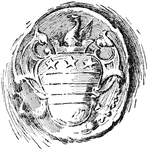
Washington's Seal incorporates the same design which can be found in Washington's Arms. The coat of arms of George Washington, President of the United States of America from 1789 to 1797, were first used to identify the family in the twelfth century, when one of George Washington's ancestors took possession of Washington Old Hall, then in County Durham, in north-east England.

Washington's Seal (From a Letter to Bouquet, 1758)

Washington's Seal incorporates the same design which can be found in Washington's Arms. The coat of…