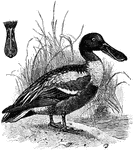
The Northern Shoveler (Anas clypeata) is a common duck in the Anatidae family of water birds.

Northern Shoveler

The Northern Shoveler (Anas clypeata) is a common duck in the Anatidae family of water birds.
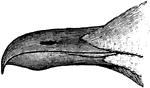
The bill of the gull (Laridae) is epignathous: "hook-billed; having the end of the upper mandible decurved over and beyond that of the lower one." -Whitney, 1911

Gull Bill

The bill of the gull (Laridae) is epignathous: "hook-billed; having the end of the upper mandible decurved…
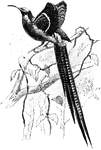
The Great Sickle-Bill (Epimachus speciosus) is a bird of paradise in the Paradisaeidae family.

Great Sickle-Bill Bird of Paradise

The Great Sickle-Bill (Epimachus speciosus) is a bird of paradise in the Paradisaeidae family.
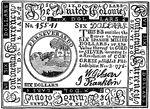
This six dollar bill is an example of Continental paper money of the United colonies issued in 1776.
Continental Paper Money

This six dollar bill is an example of Continental paper money of the United colonies issued in 1776.

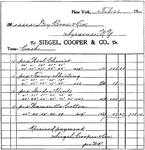
A company's bill for dry goods with a breakdown of costs and a note of receipt at the bottom.

Receipted Bill for Dry Goods

A company's bill for dry goods with a breakdown of costs and a note of receipt at the bottom.
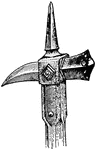
"Falcon-bill of about 1450. A form of martel-de-fer, distinguished by its slightly curved and sharp point." -Whitney, 1911

Falcon Bill

"Falcon-bill of about 1450. A form of martel-de-fer, distinguished by its slightly curved and sharp…
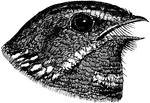
"In ornithology, having the beak broad and deeply cleft, as a swallow, swift, or goatsucker" or nightjar. -Whitney, 1911

Fissirostral Bill of Nightjar

"In ornithology, having the beak broad and deeply cleft, as a swallow, swift, or goatsucker" or nightjar.…
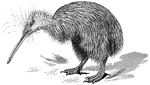
Kiwi, Apteryx australis, of the South Island, is lighter (than the Apteryx mantelli of North Island), and feels soft instead of harsh when grasped." "These birds are at once distinguished from all their allies by their small size, and by the long, weak, decurved bill, which tapers regularly and has the nostrils placed almost at the extremity. The head and eyes are comparatively small... The legs are very stout and situated backwardly, a small elevated hallux is present, and the toes are provided with long, sharp claws. The wings are small-boned and invisible, with functionless quills, the tail is rudimentary, the aftershaft and the furcula are absent, while many elongated hairs occur on the front of the head." - A. H. Evans, 1900

Kiwi

Kiwi, Apteryx australis, of the South Island, is lighter (than the Apteryx mantelli of North Island),…
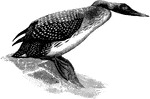
The Great Northern Diver, Colymbus glacialis, "...is black above, with belts of white spots making a "chess-board" pattern; the lower surface is white, and the throat is crossed by two bands of white with longitudinal black bars, while the head and neck are black with a purplish gloss, changing to green below." "...the bill is normally black, and the feet are bluish or greenish grey." "The Great Northern Diver, has a much more restricted range, breeding in Iceland, Greenland, and the Fur Countries as far west as the Great Slave Lake..." - A. H. Evans, 1900

Great Northern Diver

The Great Northern Diver, Colymbus glacialis, "...is black above, with belts of white spots making a…
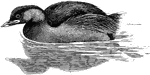
"Both sexes of the Little Grebe are mainly dusky brown or blacking grey above, and silvery white below, often with some white on the wing. Podicipes fluviatilis, the Little Grebe or Dabchick, ranging over Europe, Africa, and Asia to the Malay Countries and North Australia, has rich chestnut cheeks, throat, and sides of the neck, horn-coloured bill, and greenish feet. In winter the chestnut fades to buff with the white chin." - A. H. Evans, 1900

Little Grebe

"Both sexes of the Little Grebe are mainly dusky brown or blacking grey above, and silvery white below,…
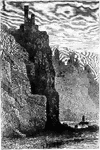
One of four standing medieval castles in Neckarsteinach, also known as "Vier Burgeneck" because of its four standing medieval castles, is a town in the Kreis Bergstraße, in Hesse, Germany.  The town was originally called Steinach, when it received city rights in 1377 it was renamed Neckarsteinach. The Knights of Steinach, lived in the local castle at the time. Two of the castles are still occupied by residents, and the two others are in ruins.

Castle of Neckarsteinach

One of four standing medieval castles in Neckarsteinach, also known as "Vier Burgeneck" because of its…
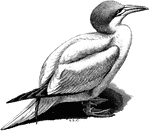
"The Gannet (S. bassana) has slate-grey wing-quills, purplish-grey bill, reddish feet and naked parts." A. H. Evans, 1900 Additionally, these birds have white plumage and blue eyes.

Gannet

"The Gannet (S. bassana) has slate-grey wing-quills, purplish-grey bill, reddish feet and naked parts."…
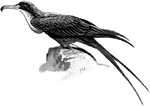
"The Frigate pr Mana-of-War-Bird... is met throughout the tropical regions, breeds in Laysan and has strayed to Nova Scotia. It is blackish-brown with green and purple reflexions; the bill is bluish, the feet are black, the orbits, lores, and pouch-inflated in flight-scarlet." A. H. Evans, 1900

Frigate Bird

"The Frigate pr Mana-of-War-Bird... is met throughout the tropical regions, breeds in Laysan and has…
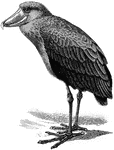
"Balaeniceps rex, the Shoebill, of the White Nile, has a short crest, and is brownish-grey with blackish wings, tail, and feet the bill being yellow with dusky mottlings." A. H. Evans, 1900

Shoebill

"Balaeniceps rex, the Shoebill, of the White Nile, has a short crest, and is brownish-grey with blackish…
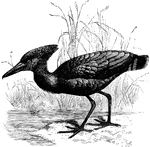
"Scopus umbretta, the Hammerhead, of Madagascar and a large part of the Ethiopian Range, is purplish-brown, with black tail-bars, wider towards the tip; the head exhibits a thick erectile crest, generally carried horizontally; the bill is black and the feet are brownish." A. H. Evans, 1900

Hammerhead Standing Near Water

"Scopus umbretta, the Hammerhead, of Madagascar and a large part of the Ethiopian Range, is purplish-brown,…
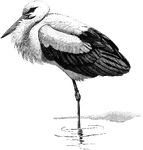
"Ciconia ciconia, the White Stork, ...is white with black wings and orbits, red bill and feet." A. H. Evans, 1900. This bird is a large wading bird that inhabits areas of Europe, Africa, and Asia.

White Stork

"Ciconia ciconia, the White Stork, ...is white with black wings and orbits, red bill and feet." A. H.…
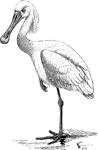
"Platalea leucorodia, the Spoonbill, has white plumage, with bare lores, orbits, and throat, and a fine nuchal crest in the breeding season, the fore-neck being tinged with buff. P. leucorodia has yellow naked areas, black feet and bill, with yellow bars and tip to the latter." A. H. Evans, 1900

Spoonbill Standing on One Leg

"Platalea leucorodia, the Spoonbill, has white plumage, with bare lores, orbits, and throat, and a fine…
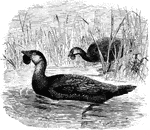
Biziura lobata, (Musk Duck) of Tasmania and Australia -except the north-is brown with buff mottlings, the bill and its leathery appendage being greenish-black and the feet dusky. The smaller female has less chin lobe." A. H. Evans

Two Musk Ducks Swimming between the Tall Grass in a Lake

Biziura lobata, (Musk Duck) of Tasmania and Australia -except the north-is brown with buff mottlings,…
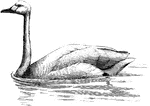
"Cygnus bewicki, Buck's Swan, is white with black feet and bill, the basal half of the latter being yellow, while that colour extends further on the sides. ... where the yellow on the bill does not reach the nostrils, inhabits the Arctic districts from the White Sea to the Pacific, wandering in the winter to Britain, the Mediterranean, South Siberia, China, and Japan." A. H. Evans, 1900

Bewick's Swan

"Cygnus bewicki, Buck's Swan, is white with black feet and bill, the basal half of the latter being…
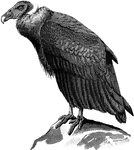
"On the Sarcorhamphus gryphus the Condor, the head and neck are bare, with dull red skin, wrinkled in folds on the latter; while an oblique ruff of white down surmounts the black plumage, which shews white edges to the wing-coverts and secondaries. The male has a fleshy crest extending from the mid-cere to the crown, a large wattle on the throat, and a small caruncle below; the irides being in the sex brown, in the female garnet red. The bill is white with brown base." A. H. Evans, 1900

Condor

"On the Sarcorhamphus gryphus the Condor, the head and neck are bare, with dull red skin, wrinkled in…
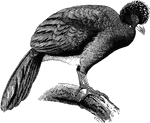
Crax alector, Crested Curassow, is black with a purplish gloss, the belly being white, the naked lores and orbits black, the cere and base of the bill yellow, the tip bluish, and the feet horn-coloured. Throughout the whole genus, which is Central ad South American, the female has a curly crest barred with white." A. H. Evans, 1900

Crested Curassow

Crax alector, Crested Curassow, is black with a purplish gloss, the belly being white, the naked lores…
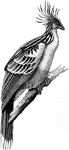
"The Hoatzin (Opisthocomus cristatus) is curious and highly specialized. "The body is long and thin, the bill is strong with basal serrations on the maxilla; bristles surround the gape, and the eye-lids have distinct lashes- a rare fact among birds. The reticulated metatarsi are fairly stout; the toes are long; the hallux being unusually developed and the claws slightly curved. The short rounded wings have ten primaries and nine secondaries. The plumage in both sexes is olive above with white markings, and dull rufous below; the long loose crest and the tip of the tail are yellowish, and patch of bare bluish-black skin surrounds the eyes." A. H. Evans, 1900

Hoatzin

"The Hoatzin (Opisthocomus cristatus) is curious and highly specialized. "The body is long and thin,…
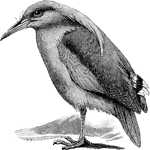
"Rhinochetus jubatus, the Kuga ... has powder-down patches that are profusely distributed over the whole body, except toward the remiges and rectrices. The plumage is slaty-grey, with indistinct dark bars on the wings and tail; while the former expanded rufous and white bands appear, varied by black markings; while a long, erectile whitish-grey crest adorns the occiput and nape. The bill and feet are orange and red." A. H. Evans, 1900

Kagu

"Rhinochetus jubatus, the Kuga ... has powder-down patches that are profusely distributed over the whole…
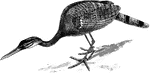
"Eurypyga helias, Sun-Bittern, has a black head, with a white stripe above and under each eye, and a white throat: the remaining plumage "being variegated with black, brown, chestnut, bay, buff, grey, and white-so mottled, speckled, and belted either in wave-like or zigzag forms, as somewhat to resemble certain moths. The bay colour forms two conspicuous patches on each wing, and also an antepenultimate bar on the tail, behind which is a subterminal band of black. The irides are red; the bill isgreenish-olive; and the legs are pale yellow." A. H. Evans, 1900

Sun-Bittern

"Eurypyga helias, Sun-Bittern, has a black head, with a white stripe above and under each eye, and a…
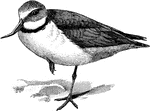
Anarhynchus frontalis, the Wry-bill of New Zealand, is grey, with a black gorget and whitish lower parts; the habits are as in Aegialitis, but the laterally-twisted bill enables the bird to pick up insects from around stones with the greatest ease." A. H. Evans, 1900

Wry-bill

Anarhynchus frontalis, the Wry-bill of New Zealand, is grey, with a black gorget and whitish lower parts;…
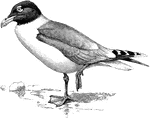
"Larus ichthyaetus, the Great Black-headed Gull, ranging from the Black Sea and the Levant to Tibet, and wintering in Southern Asia, has the bill almost orange." A. H. Evans, 1900. The adults have a black hood, grey wings and back, and white wing tips.

Great Black-Headed Gull

"Larus ichthyaetus, the Great Black-headed Gull, ranging from the Black Sea and the Levant to Tibet,…
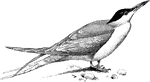
Sterna fluviatilis, the Common Tern, occupying the coasts and inland waters of Europe, temperate Asia, and temperate America-chiefly on the eastern side in the last case- and migrating to South Africa, India, Ceylon, and Brazil, has red feet, and bill with horn-coloured tip, the lower parts being vinaceous grey." A. H. Evans, 1900

Common Tern

Sterna fluviatilis, the Common Tern, occupying the coasts and inland waters of Europe, temperate Asia,…
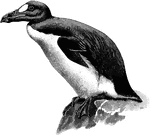
"This species (Alca impennis or Great Auk), extirpated chiefly by the persecution of fisherman, but subsequently by collectors, resembles a flightless Razorbill, though double the size; it had no white stripes on the head or bill, but shewed a large white patch before each eye. A. impennis, the extinct Great Auk or Garefowl, inhabited the North Atlantic, chiefly in the neighborhood of Ice A. H. Evans, 1900

Great Auk

"This species (Alca impennis or Great Auk), extirpated chiefly by the persecution of fisherman, but…
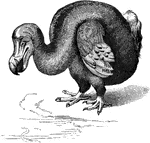
"The Dodo, ...was an immense Pigeon-like bird bigger than a Turkey, with an aborted keel to the sternum and the wings also aborted. The coracoid and scapula met at an obtuse angle, as in many other flightless species. The huge blackish bill terminated in a large horny hook, the cheeks were partly bare, the short yellow legs were stout, scaly, and feathered on the upper portion; the plumage was dark ash- coloured, with whitish breast and tail, yellowish-white wings, and black tips to their coverts. The short rectrices formed a curled tuft, and the first four primaries were directed backwards." A. H. Evans, 1900

Dodo

"The Dodo, ...was an immense Pigeon-like bird bigger than a Turkey, with an aborted keel to the sternum…
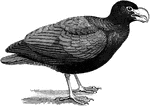
Didunculus strigirostris, the Manu-mea or Red Bird of the islands of Upolu, Salvai, and Tutuila in Samoan group, is glossy greenish-black, with chestnut back, rump, wing-coverts, tail and under tail-coverts, but browner-quills and abdomen. The hooked and toothed bill is orange, the feet are reddish, and the naked orbits red. The sexes are similar, the young entirely brown." A. H. Evans, 1900

Tooth-Billed Pigeon

Didunculus strigirostris, the Manu-mea or Red Bird of the islands of Upolu, Salvai, and Tutuila in Samoan…
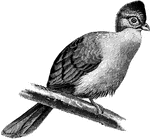
"The Gallirex chlorochlyamys, Green-mantled Turaco, has a general coloration of metallic blue and green or greyish-brown, usually varied with crimson, ...all have erectile crests of different sizes. The bill is red, yellowish, or black, the feet are black. The sexes are alike, the younger are duller. The red feathers yield a peculiar pigment, containing copper, called Turacin, which is reducible to a powder; this is so soluble that the colour is washed away during the rain or in a bath, though regained subsequently." A. H. Evans, 1900

Green-Mantled Turaco Sitting on a Tree Limb

"The Gallirex chlorochlyamys, Green-mantled Turaco, has a general coloration of metallic blue and green…
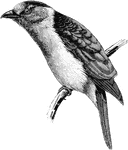
"Leptosoma discolor, the Kiromobo or Vorondreo of Madagascar, and the Comoro Islands, which has a big crested head; a long, slightly hooked bill, overhung at the base by recurved loral feathers; linear nostrils, places far forward and covered by a partly reversible outer toe. The wings are moderate, having ten primaries and twelve secondaries; the long, square tail has twelve feathers; the tongue is tapering, horney and channeled; a large aftershaft is present is present, and there is a considerable powder-down patch on each side of the rump. The head is grey, glossed with copper and green, the neck duller; the upper parts are shining green and coppery-red, the under parts grey with white abdomen. The slightly larger female is reddish-brown above, with buff markings and only dull gloss; the head is chiefly lack, the lower surface fawn-coloured spotted with black." A. H. Evans, 1900

Kirombo

"Leptosoma discolor, the Kiromobo or Vorondreo of Madagascar, and the Comoro Islands, which has a big…
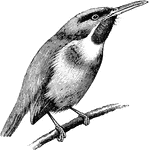
"Todus viridis, Tody, has coloration that is green, with a red throat, yellowish-white or pinkish under parts, and yellow, green, or pink feathers on the flanks. The bill is dull red. The T. viritis inhabits Jamaica. A. H. Evans

Tody

"Todus viridis, Tody, has coloration that is green, with a red throat, yellowish-white or pinkish under…
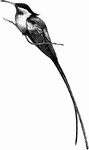
"Aithurus polytmus, the Long-tailed Hummingbird, peculiar to Jamaica, the two tail-feathers next to the outer pair are immensely elongated, and, after crossing one another, bend outwards in a curve; the lateral rectrices are bluish-black, as is the head with its divided crest; all the outer parts being luminous green, and the bill red with black tip. The female is chiefly green above and white below, with brownish brown." A. H. Evans, 1900

Long Tailed Hummingbird

"Aithurus polytmus, the Long-tailed Hummingbird, peculiar to Jamaica, the two tail-feathers next to…
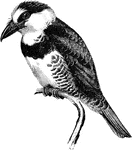
"Bucco hyperrhynchus, or Puff-bird, is blue-black, with a white under surface crossed by a broad black band, and a white forehead and nape, with a large bill." A. H. Evans

Puff-bird

"Bucco hyperrhynchus, or Puff-bird, is blue-black, with a white under surface crossed by a broad black…
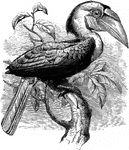
The Rytidoceros undulatus, Plait-billed Hornbill, or Wreathed Hornbill, has black wings, belly, and back. The male has a buff colored head with red plumes from the nape, a naked yellow gular pouch that has a black stripe. The female has a black head and neck with a blue gular pouch. The feet are black, the bill yellow, the the iris red.

Plait-billed Hornbill

The Rytidoceros undulatus, Plait-billed Hornbill, or Wreathed Hornbill, has black wings, belly, and…
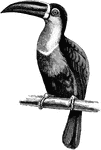
The Rhamphastus ariel, or Ariel Toucan, is black with a yellow or orange rump and throat. The brilliant bill and orbits vary in colour; the tail is square.

Ariel Toucan

The Rhamphastus ariel, or Ariel Toucan, is black with a yellow or orange rump and throat. The brilliant…
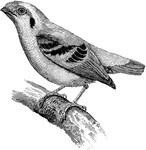
"The plumage in the Calyptomena viridis of the Indo-Malay countries is bright green, with large black post-auricular and a yellow pre-ocular spot, three black bars on the wing-coverts, and blackish wing- and tail-quills. The duller female has no black spots or bars. The dense feathers project forward over the beak. A. H. Evans, 1900

A Broadbill Sitting on a Tree Branch

"The plumage in the Calyptomena viridis of the Indo-Malay countries is bright green, with large black…
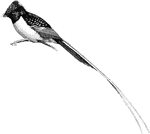
"Terpsiphone paradisi, Paradise Flycatchers, have fine crests, shorter in the female; while fleshy wattles, round or above the eye, of scarlet, blue, or yellow, are found. The bill is sometimes reddish or blue, and the inside of the mouth green or yellowish, as in certain Birds of Paradise. The female is rich bay above, with similar head, but grey cheeks and throat. In other species the males are said to be maroon, cinnamon, chestnut, blue-grey, or glossy-black above." A. H. Evans, 1900

Paradise Flycatcher

"Terpsiphone paradisi, Paradise Flycatchers, have fine crests, shorter in the female; while fleshy wattles,…
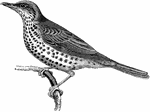
"Turdus viscivorus, Mistletoe Thrush, the coloration is ordinarily plain black or brown, more or less varied with grey, white, rufous, or chestnut, occasionally in the form of a collar; many Thrushes, moreover, exhibit the characteristic white breast spotted with brown. The bill if frequently orange or yellow." A. H. Evans

Mistletoe Thrush

"Turdus viscivorus, Mistletoe Thrush, the coloration is ordinarily plain black or brown, more or less…
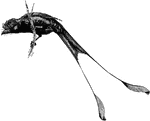
"Dissemurus paradiseus, the Drongo, both sexes are typically black, with metallic gloss of blue, purple, or green, though a few are greyer or browner, or have a little white below. The variable bill is usually large and more or less curved, with a hooked tip, a notched maxilla, and fairly strong rictal bristles. The bill and feet are black; eyes red, white, or brown." A. H. Evans, 1900

Drongo

"Dissemurus paradiseus, the Drongo, both sexes are typically black, with metallic gloss of blue, purple,…
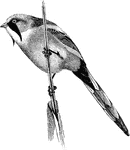
"Panurus biarmicus, the "Bearded Tit" or "Reed-Pheasant" plumage is orange-brown above, with grey crown and a black streak from the lores down the cheeks, where the feathers are elongated and point backwards; the wings are varied with black and white; the throat is greyish, the breast pinkish; the abdomen coloured like the back; the under tail-coverts are black, the bill is yellow. The hen has a buff head, while she lacks the black "moustache" and under tail-coverts." A. H. Evans, 1900

Reed Pheasant

"Panurus biarmicus, the "Bearded Tit" or "Reed-Pheasant" plumage is orange-brown above, with grey crown…
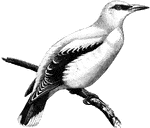
"The Golden Oriole, Oriolus galbula, which breeds exceptionally in England, is orange-yellow, with black lores and mainly black wings and tail. The bill is crimson, pinkish, or bluish." A. H. Evans, 1900

Golden Oriole

"The Golden Oriole, Oriolus galbula, which breeds exceptionally in England, is orange-yellow, with black…
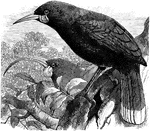
"Heteralocha acutirostris, the New Zealand Huia, the female has a remarkably long, curved bill, that of the male being short, stout, and nearly straight, The plumage is greenish-black, with a white-tipped tail; the bill is whitish, the feet are blue-grey, the large rictal wattles orange." A. H. Evans, 1900

Huia

"Heteralocha acutirostris, the New Zealand Huia, the female has a remarkably long, curved bill, that…
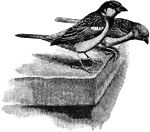
"Passer domesticus, House Sparrow, The sexes may be similarly coloured or very different, the hues being commonly sober, but sometimes particularly brilliant. The feet are usually dull... the bill may be blackish, yellowish, dusky, or even red." A. H. Evans, 1900

Two House Sparrows, One Looking Down, One looking Straight, Sitting on the Top and Edge of a Structure

"Passer domesticus, House Sparrow, The sexes may be similarly coloured or very different, the hues being…
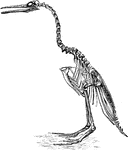
"Hesperornis regalis, (a fossilized restoration) which stood about three feet high, had blunt teeth in the grooves of both maxilla and mandible, the number being thirty or more below, but considerably less above, where they did not reach to the exterior extremity. The bill was long and pointed, the rami of the lower jaw being entirely separate; the head was rather small, the neck long, and the quadrate bone articulated with the skull by one knob only. The sternum was long, broad, and flat, without keel; the furcula was decidedly reduced, the metatarsus, being little more than a humerus; the tail was fairly long and broad, but had no pygostyle." A. H. Evans, 1900

The Restoration of the Hesperornis Regalis

"Hesperornis regalis, (a fossilized restoration) which stood about three feet high, had blunt teeth…
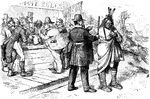
Nast depicts the criticism of Native American's exclusion from franchise by the caption "move on!". "Has the Native American no rights that the naturalized American is bound to respect? The other nationalities may vote, but not the original American."

Criticism of Native American's Exclusion from Franchise

Nast depicts the criticism of Native American's exclusion from franchise by the caption "move on!".…
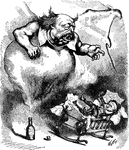
Benjamin Butler as the Genie of Massachusetts smells blue blood, threatening the "cradle of liberty" with his 1874 Inflation Bill.

1874 Inflation Bill

Benjamin Butler as the Genie of Massachusetts smells blue blood, threatening the "cradle of liberty"…
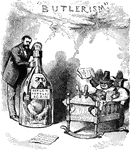
President Grant vetoes the 1874 Inflation Bill, bottling the Genie of Butler.

Grant Vetoes Inflation Bill

President Grant vetoes the 1874 Inflation Bill, bottling the Genie of Butler.
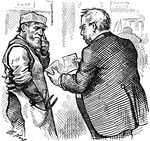
Capital divided the Dollar in front of Labourer.

Inflation Is As Easy As Lying

Capital divided the Dollar in front of Labourer.

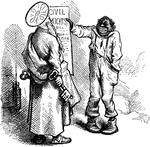
The Civil Rights Act of 1875 depicted with an African American talking to Saint Peter that he can't object to keeping the gates open now.

Civil Rights Act of 1875

The Civil Rights Act of 1875 depicted with an African American talking to Saint Peter that he can't…
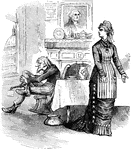
Passage of the bland Silver Bill as Columbia abuses Uncle Sam for his doubtful financial policy.

Silver Bill Passage

Passage of the bland Silver Bill as Columbia abuses Uncle Sam for his doubtful financial policy.
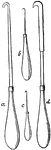
"Figure 7-hooks for extracting embryos, natural size; a,b,c, plain hooks; d, bill-hook, having cutting edge along the concavity." Elliot Coues, 1884

Hooks Used in the Process of Egg Blowing for the Purpose of Extracting Embryos

"Figure 7-hooks for extracting embryos, natural size; a,b,c, plain hooks; d, bill-hook, having cutting…
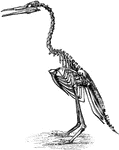
"Hesperornis regalis, (a fossilized restoration) which stood about three feet high, had blunt teeth in the grooves of both maxilla and mandible, the number being thirty or more below, but considerably less above, where they did not reach to the exterior extremity. The bill was long and pointed, the rami of the lower jaw being entirely separate; the head was rather small, the neck long, and the quadrate bone articulated with the skull by one knob only. The sternum was long, broad, and flat, without keel; the furcula was decidedly reduced, the metatarsus, being little more than a humerus; the tail was fairly long and broad, but had no pygostyle." A. H. Evans, 1900

Restoration of Hesperornis regalis

"Hesperornis regalis, (a fossilized restoration) which stood about three feet high, had blunt teeth…
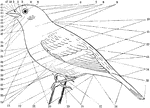
"fig. 25 - Topography of a Bird. 1, forehead (frons). 2, lore. 3, circumocular region. 4, crown (vertex). 5, eye. 6, hind head (occiput). 7, nape (nucha). 8, hind neck (cervix). 9, side of neck. 10, interscapular region. 11, dorsum, or back proper, including 10. 12, notaeum, or upper part of body proper, including 10, 11, and 13. 13, rump (uropygium). 14, upper tail-coverts. 15, tail. 16, under tail-coverts (crissum). 17, tarsus. 18, abdomen. 19, hind toe (hallux). 20, gastraeum, including 18 and 24. 21, outer and fourth toe. 22, middle and third toe. 23, side of the body. 24, breast (pectus). 25, primaries. 26, secondaries. 27, tertiaries; nos. 25, 26, 27 are all coverts. 28, primary coverts. 29, alula, or bastard wing. 30, greater coverts. 31, median coverts. 32, lesser coverts. 33, the "throat," including 34, 37, 38. 34, jugulum or lower throat. 35, auriculars. 36, malar region. 37, gula, or middle throat. 38, mentum, or chin. 39, angle of commissure, or corner of mouth. 40, ramus of under mandible. 41, side of under mandible. 42, gonys. 43, apex, or tip of bill. 44, tomia, or cutting edges of the bill. 45, culmen, or ridge of upper mandible, corresponding to gonys. 46, side of upper mandible. 47, nostril. 48, passes across the bill a little in front of it base." Elliot Coues, 1884

Topography of a Bird

"fig. 25 - Topography of a Bird. 1, forehead (frons). 2, lore. 3, circumocular region. 4, crown (vertex).…
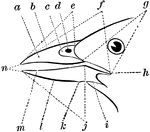
"Fig. 26 - Parts of a Bill. a, side of upper mandible; b, culmen; c, nasal fossa; d, nostril; e(see below); f, gape, or whole commissural line; g, rictus; h, commissural point or angle of the mouth; i, ramus of under jaw; j, tomia of under mandible (the reference lines e should have been drawn to indicate the correct tomia of upper mandible):k, angle of gonys; l, gonys; m, side of under mandible; n, tips of mandibles." Elliot Coues, 1884

The Parts of a Bird Bill

"Fig. 26 - Parts of a Bill. a, side of upper mandible; b, culmen; c, nasal fossa; d, nostril; e(see…
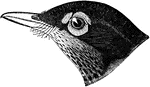
"Robin: Upper parts slate-color, with a shade of olive. Head black, the eyelids and a spot before the eye white, and the throat streaked with white. Quills of the wings dusky, edged with hoary ash, and with the color of the back. Tail blackish, the outer feather usually tipped with white. Underparts, to the vent, including the under wing-coverts and tibiae white, showing more or less plumbeous. Bill yellow, often with a dusky tip. Mouth yellow. Eyes dark brown. Feet blackish, the soles yellowish." Elliot Coues, 1884

Robin

"Robin: Upper parts slate-color, with a shade of olive. Head black, the eyelids and a spot before the…
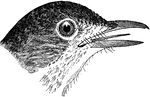
"Wood Thrush. Upper parts, including the surface of the closed wings, tawny-brown, purest and deepest on the head, shading insensibly into olivaceous on the rump and tail. Below, pure white, faintly tinged on the breast with buff, and everywhere, rounded or subtriangular blackish spots. Inner webs and ends of quills fuscous, with a white or buffy edging toward the base. Greater under wing-coverts mostly white. Auriculars sharply streaked with dusky and white. Bill blackish-brown, with flesh-colored or yellowish base. Feet like this part of the bill." Elliot Coues, 1884

Wood Thrush

"Wood Thrush. Upper parts, including the surface of the closed wings, tawny-brown, purest and deepest…
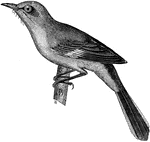
"Mocking-Birds. Bill much shorter than head, scarcely curved as a whole, but with gently-curved commissure, notched near the end. Rictal vibrissae well developed. Tail rather longer than wings, rounded, the lateral feathers being considerably graduated. Wings rounded. (Tarsal scutella sometimes obsolete.) Tarsi longer than the middle toe and claw. Of this genus there are two well marked sections (represented by the mocking-bird and cat-bird respectively), which ay be distinguished by color:" Elliot Coues, 1884

Mockingbird

"Mocking-Birds. Bill much shorter than head, scarcely curved as a whole, but with gently-curved commissure,…
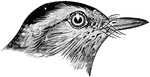
"Cat-Bird. Slate-gray, paler and more grayish-plumbeous below; crown of head, tail, bill, and feet black. Quills of the wing blackish, edged with the body-color. Under tail-coverts rich dark chestnut or mahogany-color" Elliot Coues, 1884

Catbird

"Cat-Bird. Slate-gray, paler and more grayish-plumbeous below; crown of head, tail, bill, and feet black.…