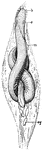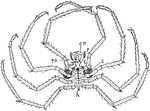
"Male of Nymphon. PR., Proboscis; CH., chelophores; P., pedipalps; E., eggs carried on ovigerous legs; A., rudimentary abdomen." -Thomson, 1916

Nymphon Sea Spider

"Male of Nymphon. PR., Proboscis; CH., chelophores; P., pedipalps; E., eggs carried on ovigerous legs;…
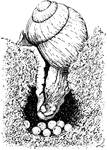
"Snail (Helix pomatia) laying its eggs." -Thomson, 1916

Roman Snail Eggs

"Snail (Helix pomatia) laying its eggs." -Thomson, 1916

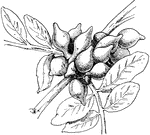
"Bunch of Sepia eggs attached to plant." -Thomson, 1916

Cuttlefish Eggs

"Bunch of Sepia eggs attached to plant." -Thomson, 1916

"Bdellostoma stouti (Californian hag), enveloped in sheath of mucus. b., barbules e., eyes m. mucus; eg., eggs." -Thomson, 1916

Californian Hagfish

"Bdellostoma stouti (Californian hag), enveloped in sheath of mucus. b., barbules e., eyes m. mucus;…
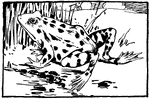
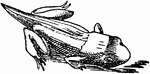
"The edible frog (Rana esculenta)." -Thomson, 1916

Edible Frog

"The edible frog (Rana esculenta)." -Thomson, 1916

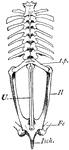
"Vertebral column and pelvic girdle of bull-frog. t.p., Transvers processes of sacral vertebra; Il., ilium; U., urostyle; Fe., femur; Isch., ischiac region." -Thomson, 1916

Bullfrog Vertebrae

"Vertebral column and pelvic girdle of bull-frog. t.p., Transvers processes of sacral vertebra; Il.,…
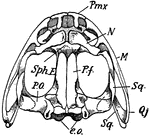
"Skull of frog. Upper surface-- Pmx., premaxilla; N., nasal; M., maxilla; Sq., squamosal; Q.j., quadrato-jugal; e.o., ex-occipitals; P.f., parieto-frontals; Sph.E., sphenethmoid; P.O., pro-otic." -Thomson, 1916

Upper Surface of Frog Skull

"Skull of frog. Upper surface-- Pmx., premaxilla; N., nasal; M., maxilla; Sq., squamosal; Q.j., quadrato-jugal;…
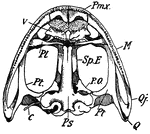
"Skull of frog. Lower surface-- Pmx., premaxilla; M., maxilla; Q.j., quadrato-jugal; Q., quadrate; Pt., pterygoid; Ps., parasphenoid; P.O., pro-otic; Sp.E., sphenethmoid; Pl., palatine; V., vomer; c., columella." -Thomson, 1916

Lower Surface of Frog Skull

"Skull of frog. Lower surface-- Pmx., premaxilla; M., maxilla; Q.j., quadrato-jugal; Q., quadrate; Pt.,…
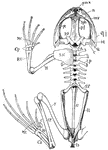
"Skeleton of frog. The half of the pectoral girdle, and fore- and hind-limb of the right side are not shown. pmx., premaxilla; m.x., maxilla; n., nasal; sph., sphenethmoid; p.f., parieto-frontal; P.O., pro-otic; pt., pterygoid; q.j., quadrato-jugal; sq., squamosal; Q., quadrate; c., columella auris; A., atlas; t.p., transverse process; S.V., sacral vertebra; U., urostyle; S.sc., supra scapula; H., humerus; R.U., radio ulna; Cp., carpals; Mc., metacarpals; Il., ilium; Is., ischium; F., femur; T.F., tibio-fibula; Ca., calcaneum; As., astragalus; C., calcar; Mt., metatarsals." -Thomson, 1916

Frog Skeleton

"Skeleton of frog. The half of the pectoral girdle, and fore- and hind-limb of the right side are not…
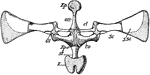
"Pectoral girdle of Rana esculenta. The cartilaginous parts are dotted. Ep., Episternum; om., omosternum; Ep.c., Epicoracoids; st., sternum; x., xiphisternum; cl., clavicle with underlying precoracoid cartilage; co., coracoid; Sc., scapula; S.sc., supra-scapula; Gl., glenoid cavity for humerus." -Thomson, 1916

Frog Pectoral Girdle

"Pectoral girdle of Rana esculenta. The cartilaginous parts are dotted. Ep., Episternum; om., omosternum;…
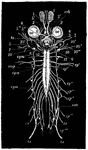
"Nervous system of frog. 1-10, The cranial nerves; oc., eyes; crb., in front of optic chiasma; to., optic tract; sym., sympathetic system; msp., spinal cord; sp., spinal nerves." -Thomson, 1916

Frog Nervous System

"Nervous system of frog. 1-10, The cranial nerves; oc., eyes; crb., in front of optic chiasma; to.,…
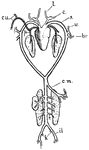
"Arterial system of frog. l., Lingual; c., carotid; s., systemic; cu., cutaneous; p., pulmonary; v., occipito-vertebral; br., brachial; c.m., coeliaco-mesenteric; r., renal; il., common iliacs; h., haemorrhoidal." -Thomson, 1916

Frog Arterial System

"Arterial system of frog. l., Lingual; c., carotid; s., systemic; cu., cutaneous; p., pulmonary; v.,…
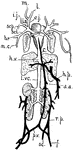
"Venous system of frog. m., l., Mandibular and lingual; e.j., external jugular; i.j., internal jugular; scp., subscapular; in., innominate; scl., subclavian; br., brachial; m.c., musculo-cutaneous; h.v., hepatic vein; h.p., hepatic portal; a.a., anterior abdominal; r.p., renal-portal; p.v., pelvic; sc., sciatic; f., femoral; i.v.c., inferior vena cava; c., cardiac vein." -Thomson, 1916

Frog Venous System

"Venous system of frog. m., l., Mandibular and lingual; e.j., external jugular; i.j., internal jugular;…
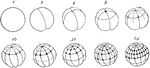
"Division of frog's ovum. The numbers indicate the number of cells or blastomeres." -Thomson, 1916
Frog Ovum Division

"Division of frog's ovum. The numbers indicate the number of cells or blastomeres." -Thomson, 1916

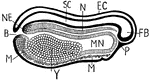
"Longitudinal vertical section of frog embryo, shortly before closure of blastopore. FB., fore-brain; EC., ectoderm; N., notochord; SC., canal of spinal cord; NE., nerenteric canal; B., blastopore; M., mesoderm; P., beginning of pituitary invagination." -Thomson, 1916

Frog Embryo

"Longitudinal vertical section of frog embryo, shortly before closure of blastopore. FB., fore-brain;…
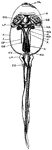
"Dissection of tadpole. DL., Lower lip; H., ventricle of heart; DE., oesophagus; NA., head kidney; A., aorta; K., kidney; KU., ureter; DO., cloaca; LH., hind-limb; KV., opening of ureter into cloaca; GR., genital ridge; GF., fatty body; LF., fore-limb; OG., gills; a, epidermis; b, dermis." -Thomson, 1916

Tadpole Dissection

"Dissection of tadpole. DL., Lower lip; H., ventricle of heart; DE., oesophagus; NA., head kidney; A.,…
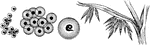
"Life history of a frog. Developing ova." -Thomson, 1916

Frog Stage 1

"Life history of a frog. Developing ova." -Thomson, 1916

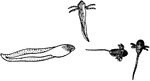
"Life history of a frog. Newly hatched forms hanging to water-weeds. Stages with external gills." -Thomson, 1916

Frog Stage 2

"Life history of a frog. Newly hatched forms hanging to water-weeds. Stages with external gills." -Thomson,…
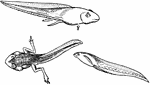
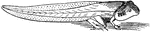
"Life history of a frog. Tadpoles during emergence of limbs." -Thomson, 1916

Frog Stage 3

"Life history of a frog. Tadpoles during emergence of limbs." -Thomson, 1916

"Life history of a frog. Tadpoles with both pairs of limbs apparent." -Thomson, 1916

Frog Stage 4

"Life history of a frog. Tadpoles with both pairs of limbs apparent." -Thomson, 1916

"Life history of a frog. Metamorphosis to frog." -Thomson, 1916

Frog Stage 5

"Life history of a frog. Metamorphosis to frog." -Thomson, 1916

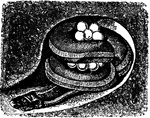
"Caecilian (Ichthyophis) with eggs." -Thomson, 1916

Caecilian

"Caecilian (Ichthyophis) with eggs." -Thomson, 1916

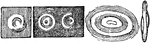
A particle of human blood as it appears when transparent and floating. 2. the same, seen as illuminated. 3. the same, one half illuminated. 4. a particle of frog's blood floating. 5. the same, seen edgewise. All these objects are magnified 500 diameters.

Blood Particle

A particle of human blood as it appears when transparent and floating. 2. the same, seen as illuminated.…
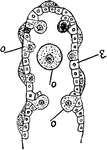
"Diagram of a portion of the ovary of Sea-urchin showing the eggs arising from the epithelium (reproductive epithelium) by constriction. e, epithelium; o, ova in different stages of growth." -Galloway, 1915

Sea Urchin Ovary

"Diagram of a portion of the ovary of Sea-urchin showing the eggs arising from the epithelium (reproductive…
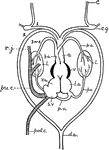
"Diagram of the heart and branchial arches in the Frog. c.g., carotid gland; l., lungs; l.a., left auricle; r.a., right auricle...a, aorta; au., auricle; c, carotid; c.v., cardinal veins (right and left); d.a., dorsal arteries; j, jugular veins; d.c., ductus Cuvieri; s.v., sinus venosus; v, ventricle." -Galloway, 1915

Frog Heart

"Diagram of the heart and branchial arches in the Frog. c.g., carotid gland; l., lungs; l.a., left auricle;…
A decorative border for spring with vines, a nest, and dragonflies.

Spring Border

A decorative border for spring with vines, a nest, and dragonflies.

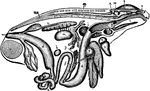
"General view of the viscera of a male frog, from the right side. a, stomach; b, urinary bladder; c, small intestine; cl, cloacal aperture; d, large intestine; e, liver; f, bile duct; g, gall bladder; h, spleen; i, lung; k, larynx; l, fat body; m, testis; n, ureter; o, kidney; p, pancreas; s, cerebral hemisphere; sp, spinal cord; t, tongue; u, auricle; ur, urostyle; v, ventricle; v.s, vesicula seminalis; w, optic lobe; x, cerebellum; y, Eustachian recess; z, nasal sac." -Parker, 1900

Frog Viscera

"General view of the viscera of a male frog, from the right side. a, stomach; b, urinary bladder; c,…
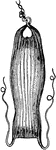
The egg case of a dogfish.

Dogfish Egg-Case

The egg case of a dogfish.

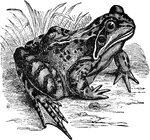
The common frog, Rana temporaria.

Common Frog

The common frog, Rana temporaria.

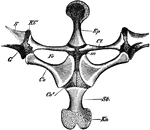
"Rana esculenta. The shoulder girdle from the ventral aspect. Co, coracoid; Co', epicoracoid; Cl, clavicle; G, glenoid cavity; Ep, episternum; Fe, fenestra between procoracoid and coracoid; KC, cartilage separating scapula and clavicle; Kn, xiphisternum; m, junction of epicoracoids; S, scapula; St, sternum." -Parker, 1900

Edible Frog Shoulder Girdle

"Rana esculenta. The shoulder girdle from the ventral aspect. Co, coracoid; Co', epicoracoid; Cl, clavicle;…
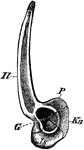
"Rana esculenta. Pelvic girdle from the right side. G, acetabulum; Il, P, ilium; Is, ischium; Kn, pubis." -Parker, 1900

Edible Frog Pelvic Girdle

"Rana esculenta. Pelvic girdle from the right side. G, acetabulum; Il, P, ilium; Is, ischium; Kn, pubis."…
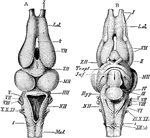
"Rana esculenta. The brain. A, from above; B, from below. ch. opt, optic chiasma; HH, cerebellum; Hyp, pituitary body; Inf, infundibulum; L. ol, olfactory lobe; Med, spinal cord; MH, mid-brain; NH, medulla oblongata; Th. opt, optic thalamus; Tr. opt, optic tract; VH, cerebral hemisphere; ZH, diencephalon; I-X, cerebral nerves; XII. (1), hypoglossal (first spinal) nerve." -Parker, 1900

Edible Frog Brain

"Rana esculenta. The brain. A, from above; B, from below. ch. opt, optic chiasma; HH, cerebellum; Hyp,…
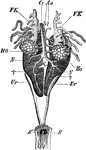
"Rana esculenta. Urinogenital organs of the male. Ao, dorsal aorta; Cl, cloaca; Cv, post-caval vein; FK, fat bodies; HO, testes; N, kidneys; S, apertures of ureters into cloaca; Ur, ureters." -Parker, 1900

Male Edible Frog Genital Organs

"Rana esculenta. Urinogenital organs of the male. Ao, dorsal aorta; Cl, cloaca; Cv, post-caval vein;…
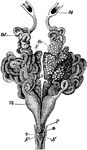
"Rana esculenta. Urinogenital organs of the female. N, kidneys; Od, oviduct; Ot, its coelomic aperture; Ov, left ovary (the right is removed); P, cloacal aperture of oviduct; S.S', cloacal apertures of ureters; Ut, uterine dilatation of oviduct." -Parker, 1900

Female Edible Frog Genital Organs

"Rana esculenta. Urinogenital organs of the female. N, kidneys; Od, oviduct; Ot, its coelomic aperture;…
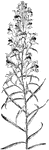
Of the Figwort family (Scrophulariaceae), the toad-flax (Linaria vulgaris).

Toad Flax

Of the Figwort family (Scrophulariaceae), the toad-flax (Linaria vulgaris).

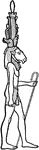
Chnemu creator-god, married to Hekt, a frog goddess.

Egyptian God, Chnemu

Chnemu creator-god, married to Hekt, a frog goddess.

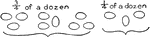
Visual of eggs showing 3/4 of a dozen and 1/4 of a dozen. 3x4=12, a dozen.

Dozen in Fourths

Visual of eggs showing 3/4 of a dozen and 1/4 of a dozen. 3x4=12, a dozen.

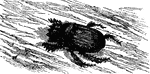
An extensive genus of coleopterous insects tribes, and answering to the section Lamellicornes of Latereille. They are sometimes called dung-beetles, from their habit of enclosing their eggs in pellet of dung, which are placed in holes excavated for their reception.

Sacred Beetle

An extensive genus of coleopterous insects tribes, and answering to the section Lamellicornes of Latereille.…
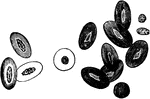
Blood corpuscles of a frog. Highly magnified. The appearance of blood cells in different animals varies in shape and size.

Frog Blood Corpuscles

Blood corpuscles of a frog. Highly magnified. The appearance of blood cells in different animals varies…
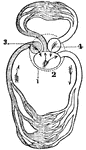
A diagram of the circulation of a frog. Labels: 1, The pericardium. 2, The single ventricle. 3, The right auricle. 4, The left auricle. The arrows indicate the direction of the blood.

Circulation of a Frog

A diagram of the circulation of a frog. Labels: 1, The pericardium. 2, The single ventricle. 3, The…
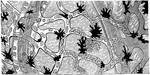
The circulation of the blood in the web of a frog's foot. A, an artery; B, capillaries crowded with disks, owing to a rupture just above, where the disks are jammed into an adjacent mesh; C, a deeper vein; the black spots are pigments cells.

Circulation of Blood in a Frog's Foot

The circulation of the blood in the web of a frog's foot. A, an artery; B, capillaries crowded with…
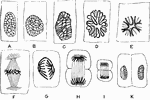
Karyokinesis. Labels: a, ordinary nucleus of a columnar epithelial cell; B, C, the same nucleus in the stage of convolution; D, the wreath or rosette from; E, the aster, or single star; F, a nuclear spindle the Descemet's endothelium of the frog's cornea; G, H, I, diaster; K, two daughter nuclei.

Karyokinesis

Karyokinesis. Labels: a, ordinary nucleus of a columnar epithelial cell; B, C, the same nucleus in the…
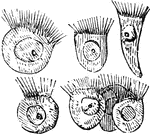
The spheroidal ciliated cells from the mouth of a frog.

Spheroidal Ciliated Cells from a Frog

The spheroidal ciliated cells from the mouth of a frog.

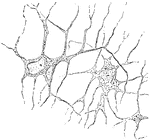
Horizontal preparation of the cornea of frog, stained in gold chloride; showing the network of branched cornea corpuscles. The ground substance is completely colorless.

Branched Cornea Corpuscles of a Frog

Horizontal preparation of the cornea of frog, stained in gold chloride; showing the network of branched…
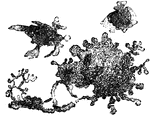
Flat, pigmented, branched connective tissue cells from the sheath of a large blood vessel of a frog's mesentery. The pigment is not distributed uniformly throughout the substance of the larger cell, consequently some parts of it look blacker than others (uncontracted state). In the two smaller cells most of the pigment is withdrawn into the cell body, so that they appear smaller, blacker, and less branched.

Connective Tissue Cells from a Frog

Flat, pigmented, branched connective tissue cells from the sheath of a large blood vessel of a frog's…
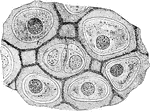
The matrix of hyaline cartilage has a dimly granular appearance like that of ground glass, and in man and higher mammals has no apparent structure. In some cartilages of the frog, however, even when examined in the fresh state, is is seem to be mapped out in polygonal blocks or cell-territories, each containing a cell in the center, and representing what is generally called the capsule of the cartilage cells. Shown is the fresh cartilage from a Triton.

Hyaline Cartilage Cells

The matrix of hyaline cartilage has a dimly granular appearance like that of ground glass, and in man…
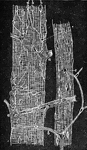
Two striped muscle fibers of the hyoglossus of frog. Labels: a, Nerve end plate; b, nerve fibers leaving the end plate; c, nerve fibers, terminating after diving into branches d, a nucleus in which two nerve fibers anastomose.

Striped Muscle Fibers of a Frog

Two striped muscle fibers of the hyoglossus of frog. Labels: a, Nerve end plate; b, nerve fibers leaving…
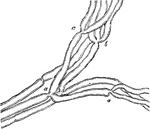
Small branch of a muscular nerve of the frog, near its termination, showing division of the fibers. Labels: a, into two; b, into three.

Muscular Nerve Showing Division of Fiber

Small branch of a muscular nerve of the frog, near its termination, showing division of the fibers.…
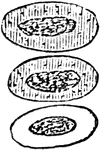
Acetic acid (dilute) causes the nucleus of the red blood cells in the frog to become more clearly defined; if the action is prolonged, the nucleus becomes strongly granulated, and all the coloring matter seems to be concentrated in it, the surrounding cell substance and outline of the cell becoming almost invisible; after a time the cells lose their color altogether. The cells shown represent the successive stages of change. A similar loss of color occurs in the red cells of human blood, which , however, from the absence of nuclei, seem to disappear entirely.

Effect of Acetic Acid on Red Blood Cells

Acetic acid (dilute) causes the nucleus of the red blood cells in the frog to become more clearly defined;…
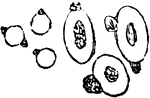
When a 2 percent fresh solution of tannic acid is applied to frog's blood it causes the appearance of a sharply defined little knob, projecting from the free surface (Robert's macula): the coloring matter becomes at the same concentrated in the nucleus, which grows more distinct. A somewhat similar effect is produced on the human blood corpuscle.

Effect of Tannin on Red Blood Cells

When a 2 percent fresh solution of tannic acid is applied to frog's blood it causes the appearance of…
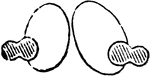
A 2 percent solution of boric acid applied to nucleated red blood cells of a frog will cause the concentration of all he coloring matter in the nucleus; the colored body thus formed gradually quits its central position , and comes to be partly, sometime entirely, protruded from the surface of the now colorless cell. When applied to non-nucleated mammalian corpuscle its effect merely resembles that of other dilute acids.

Effect of Boric Acid on Red Blood Cells

A 2 percent solution of boric acid applied to nucleated red blood cells of a frog will cause the concentration…
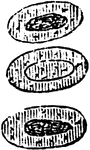
If the red blood cells of a frog be first exposed to the action of water vapor (which renders their outer pellicle more readily permeable to gases), and then acted on by carbonic acid, the nuclei immediately become clearly defined and strong granulated, when air or oxygen is admitted the original appearance is at once restored. The upper and lower cells in this figure show the effect of carbonic acid; the middle one the effect of the readmission of air. The effects can be reproduced five or six times in succession. If, however, the action of the carbonic acid be much prolonged, the granulated of the nucleus become permanent; it appears to depend on a coagulation of the paraglobulin.

Effect of Gases on Red Blood Cells

If the red blood cells of a frog be first exposed to the action of water vapor (which renders their…
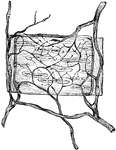
Ramifications of nerves and termination in muscular coat of a small artery of the frog.

Nerves in the Artery of a Frog

Ramifications of nerves and termination in muscular coat of a small artery of the frog.
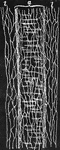
Surface view of an artery from the mesentery of a frog, ensheathed in a perivascular lymphatic vessel. Labels: a, The artery, with its circular muscular coat (media) indicated by broad transverse markings, with an indication of the adventitia outside. 1. Lymphatic vessel: its wall is a simple endothelial membrane.

Surface View of an Artery

Surface view of an artery from the mesentery of a frog, ensheathed in a perivascular lymphatic vessel.…
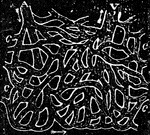
Capillaries (C) in the web of the frog's foot connecting a small artery (A) with a small vein (V).
Capillaries in Frog's Foot

Capillaries (C) in the web of the frog's foot connecting a small artery (A) with a small vein (V).

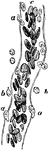
A large capillary from the frog's mesentery eight hours after irritation had been set up, showing emigration of leucocytes. Labels: a, Cells in the act of traversing the capillary wall; b, some already escaped.

Capillaries Showing Emigration of Leucocytes

A large capillary from the frog's mesentery eight hours after irritation had been set up, showing emigration…
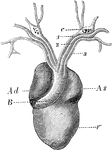
The heart of a frog (Rana esculenta) from the front. Labels: V, ventricle, Ad, right auricle; As, left auricle; B, bulbus arteriosus, dividing into right and left aorta.

Heart of a Frog

The heart of a frog (Rana esculenta) from the front. Labels: V, ventricle, Ad, right auricle; As, left…
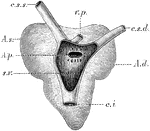
The heart of a frog (Rana esculenta) from the back. Labels: s.v., sinus venosus opened; c.s.s., left vena cava superior; c.s.d., right vena cava superior; c.i., vena cava inferior; v.p., vena pulmonales; A.d., right auricle; A.s., left auricle; A.p., opening of communication between the right auricle and the sinus venosus.

Heart of a Frog

The heart of a frog (Rana esculenta) from the back. Labels: s.v., sinus venosus opened; c.s.s., left…
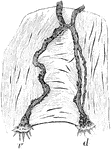
Course of the nerves in the auricular partition wall of the heart of a frog. Labels: d, dorsal branch; v, ventral branch.

Nerves of the Heart of a Frog

Course of the nerves in the auricular partition wall of the heart of a frog. Labels: d, dorsal branch;…
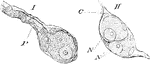
The nerve cells that compose the ganglia are generally unipolar, and seldom bipolar; sometimes two cells are said to exist in the same envelope, constituting the twin cells of Dogiel. The cells are large and have very large nucleoli. Shown are isolated nerve cells from the frog's heart. Labels: I, Usual form. II, Twin cell. C, capsule; N,nucleus; N', nucleolus; P, process.

Nerve Cells

The nerve cells that compose the ganglia are generally unipolar, and seldom bipolar; sometimes two cells…