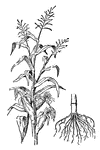
Geometric divider.

Geometric divider

Geometric divider.

Indian Corn or Maize is a well known species of cereal. It is used as food and is gathered in October and November.

Indian Corn

Indian Corn or Maize is a well known species of cereal. It is used as food and is gathered in October…
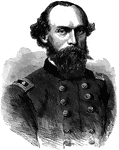
"General Granger, born in New York, in 1821, died in Santa Fe, N. M., January 10th, 1876, was graduated at the United States Military Academy in 1845; took part in the principal battles of the Mexican War. When the Civil War began he served on the staff of General McClellan in Ohio; then in Missouri; was brevetted major for gallant services at Wilson's Creek; and on September 2nd, 1861, became colonel of the Second Michigan Cavalry; on March 26th, 1862 he was made a brigadier general, and commanded the cavalry in the operations that led to the fall of Corinth. He became a major general of volunteers on September 17th, 1862. He distinguished himself in the battles of Chickamauga and Missionary Ridge. On January 15th, 1866, he was mustered out of the volunteer service." — Frank Leslie, 1896

General Gordon Granger

"General Granger, born in New York, in 1821, died in Santa Fe, N. M., January 10th, 1876, was graduated…
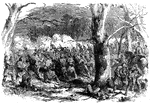
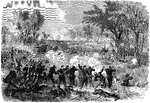
"Storming of Fort Donelson- decisive bayonet charge of the Iowa Second Regiment on the Confederate intrenchments at Fort Donelson, February 15th, 1862, resulting in the capture of the works on the following morning. The Iowa Second Regiment led the charge, followed by the rest in their order. The sight was sublime. Onward they sped, heedless of the bullets and balls of the enemy above. The hill was so steep, the timber cleared, that the Confederates left a gap in their lines of rifle pits on this crest of hill. Through this gap they were bound to go. Right up they went, climbing upon all fours, their line of dark-blue clothing advancing regularly forward, the white line of smoke from the top of the works opposed by a line of the Federal troops. "They reach the top. Numbers fall. The surprise was breathless. See, they climb over the works- they fall- they are lost! Another group, and still another and another, close up the gap. All is covered in smoke. The lodgment is made; the troops swarm up the hillside, their bright bayonets glittering in the sun. The firing slackens. Close behind the brigade Captain Stone's batery of rifled 10-pounders was tugging up the hill, the horses plunging, the riders whipping. Upward they go, where never vehicle went before- up the precipitous and clogged sides of the hill. No sooner on the crest than the guns were unlimbered, the men at their posts. Percussion shells and canister were shot spitefully from the Parrott guns at the flying enemy. The day was gained, cheers upon cheers rent the air, and in a few minutes all was hushed."" — Frank Leslie, 1896

Storming of Fort Donelson

"Storming of Fort Donelson- decisive bayonet charge of the Iowa Second Regiment on the Confederate intrenchments…
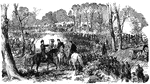
"Battle of Pea Ridge, Ark., fought March 6th, 7th and 8th, 1862, between the Federal forces, 13,000 strong, under Generals Curtis, Sigel, and Asboth, and the combined Confederate army of the Southwest, 25,000 strong, under Generals Van Dorn, Price and McCulloch- total defeat of the Confederates. The official report of this battle by General Curtis is as follows: "On Thursday, March 6th, the enemy commenced an attack on my right wing, assailling and following the rear guard of a detachment under General Sigel to my main lines on Sugar Creek Hollow, but ceased firing when he met my re-enforcements about 4 P.M. Early on the 7th I ordered an immediate advance of the cavalry and light artillery, under Colonel Osterhaus, with orders to attack and break what I supposed would be the re-enforced line of the enemy. This movement was in progress when the enemy commenced an attack on my right. The fight continued mainly at these points during the day, the enemy having gained the point held by the command of Colonel Carr at Cross Timber Hollow, but was entirely repulsed, with the fall of the commander, McCulloch. At sunrise on the 8th my right and centre renewed the firing, which was immediately answered by the enemy with renewed energy. I immediately ordered the centre and right wing forward, the right turning the left of the enemy and cross firing on his centre. This final position of the enemy was in the arc of a circle. A charge of infantry extending throughout the whole line completely routed the entire Confederate force, which retired in great confusion, but rather safely through the deep, impassable defiles of cross timber."" — Frank Leslie, 1896

Battle of Pea Ridge

"Battle of Pea Ridge, Ark., fought March 6th, 7th and 8th, 1862, between the Federal forces, 13,000…
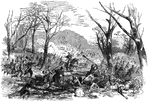
"Battle of Mill Spring, on the Cumberland River, near Jamestown, between a confederate force, 8,000 strong, under General Zollicoffer, and the Federal troops, 4,000 strong, commanded by General Thomas, fought Sunday, January 19th, 1862- flight of the Confederate Army. One of the most dashing, desperate and decisive battles of the war took place on Sunday, January 19th, 1862, when a Confederate army of 8,000 men, led by Generals Zollicoffer and Crittenden, were totally routed by General Thomas, at the head of about 4,000 Federal troops. The cannonading began at four o'clock in the morning, and the engagement soon became general. Zollicoffer found, however, that instead of surprising General Thomas, that able and vigilant officer was ready for him. The Confederates fought gallantly throughout that dismal Sabbath day, and owing to their decided superiority in numbers the result was doubtful till near the conclusion of the conflict. The death of Colonel Peyton, who fell gallantly at the head of his regiment, had materially damped the spirits of the Confederates, but the fall of their commander, Zollicoffer, about ten minutes past three in the afternoon, completed their rout. At that hour, as the Fourth Kentucky regiment was deploying on the flank of the Confederate army, Zollicoffer, attended by several of his aids, mistook his way in the underwood, and suddenly emerged before Colonel Fry, who was also with several officers. At first they mistook each other for friends, but upon the mistake being discovered one of the Confederate officers fired at Fry and shot his horse. Almost at the same instant Colonel Fry drew his revolver and shot General Zollicoffer through the heart. His aids, seeing their commander slain, deserted the body, which was taken charge of by the Federal troops, and carried to Somerset. The news spread like wildfire through the Confederate army, which fled with precipitation, and at half-past three not a confederate stood his ground." — Frank Leslie, 1896

Battle of Mill Spring

"Battle of Mill Spring, on the Cumberland River, near Jamestown, between a confederate force, 8,000…
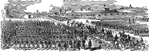
"Advance of the Army of the Potomac. Occupation of Winchester, VA., and the abandoned Confederate Fortifications, by a detachment of General Banks's Deivision of the Federal Army, consisting of the brigades of Generals Hamilton and Williams, March 12th, 1862. Our sketch represents the advance of the Federal troops upon the City of Winchester, and is thus described by our correspondent: 'A portion of General Banks's Division, under General Gorman, occupied the town of Berryville, VA., on the 11th. There were five hundred of the Confederate cavalry in the place, but upon the Third New York Cavalry, properly supported by artillery and infantry, charging them, they fled in confusion toward Winchester. During the night the pickets of General Gorman came in contact with a portion of Colonel Ashby's Confederate cavalry, and were compelled to fall back, but the general made a reconnoissance in force to within two miles of Winchester, and, charging upon the Confederates dispersed them, taking several prisoners, and killing or wounding four of the Confederates. This reconnoissance sealed the fate of Winchester. The enemy were blinded and misled by the movement of our troops, and they commenced the evacuation of the place on the afternoon of the 12th. General Hamilton advanced from Bunker hill, the Michigan Cavalry heading the column. The Confederate Cavalry, one thousand two hundred strong, and supported by a section of artillery, gave battle at five o'clock in the afternoon. Our cavalry was supported by the First maryland Infantry, and a battery of artillery. The fight was a short one. The Confederates fled, leaving their guns behind them, and at daylight on the 12th our troops entered the city as the rear guard of the enemy was flying out of it.'"— Frank Leslie, 1896

Army of the Potomac

"Advance of the Army of the Potomac. Occupation of Winchester, VA., and the abandoned Confederate Fortifications,…
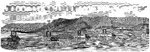
"General view of Columbus, Ky., and its fortications, looking down the river, showing the 'Iron Bluffs' crowned with batteries, the water batteries and the arrival of the Federal gunboats, March 4th, 1862. Our sketch of Columbus and its fortifications, which was called the Western Gibraltar by the Confederates, became untenable by them after the fall of Fort Henry, Donelson, Bowling Green, and especially Nashville. A glance at our illustration will show its immense strength on the river side, and it must be confessed that General Polk had not been slow to improve its natural advantages. The water batteries entirely command the river, and to silence them would have required all Commodore Foote's gallantry and skill. Our picture represents all the water batteries which are situated about a mile above the City of Columbus. The bluffs which are also crowned with cannon, are from seventy to eighty feet high."— Frank Leslie, 1896

Columbus, Kentucky

"General view of Columbus, Ky., and its fortications, looking down the river, showing the 'Iron Bluffs'…
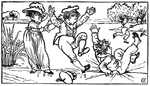
"Three children sliding on the ice, All on a summer's day. As it fell out they all fell in. The rest they ran away."

Three Children

"Three children sliding on the ice, All on a summer's day. As it fell out they all fell in. The rest…
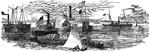
"Harrison's Landing, James River, Va. The commissariat depot and base of operations of General McClellan occupied by the Federal Army, July 1st, 1862. Our correspondent wrote: 'The Army of the Potomac has been compelled to fall back from before Richmond to a place of safety under the armament of the gunboats on the James River. The advance of our army, which ten days ago, was within sight of the steeples of the Confederate Capital, is now twenty-five miles distant. General McClellan has transferred his base of operations from the Pamunky River to a more advantageous position on the James River, and his camps from the pestilent swamps of the Chickahominy to the higher and healthier grounds of Harrison's Landing.'"— Frank Leslie, 1896

Harrison's Landing

"Harrison's Landing, James River, Va. The commissariat depot and base of operations of General McClellan…
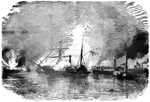
"Daring and desperate attack- surprise and capture of the United States gunboat <em>Harriet Lane</em> by the Confederates under General Magruder, and destruction of the flagship <em>Westfield</em>, in Galveston Harbor, Tex., January 1st, 1863. About two o'clock in the morning of January 1st, 1863, the Federal gunboats were attacked by five Confederate steamers, protected by double rows of bales of cotton, and loaded with troops armed with rifles, muskets, etc. The <em>Harriet Lane</em> was captured by boarding, after about all her officers, including Captain Wainwright and Lieutenant Commander Lee, and a crew of 130, all told, had been killed by muskettry from the Confederate steamers. The gunboats <em>Clifton</em> and <em>Owasco</em> were engaged and escaped, the former losing no men and but one wounded. The <em>Owasco</em> lost one killed and fifteen wounded. Two barks, loaded with coal, fell into the hands of the Confederates. The <em>Westfield</em> (flagship, Commodore Renshaw) was not engaged, being ashore in another channel. Her crew were transferred to transports, and Commodore Renshaw, fearing she would fall into the hands of the Confederates, blew her up. By some mismanagement or accident the exploion took place before a boat containing Commodore Renshaw, First Lieutenant Zimmerman and the boat's crew got away, and they were blown up with the ship. The Confederate force was estimated at 5,000, under the command of General Magruder. The Federal land force, under the command of Colonel Burrill, of Masschusetts, did not exceed 300, the residue not having disembarked at the time of the fight. The Federal loss was 160 killed and 200 taken prisoners. The navy suffered the most. The Confederate loss was much greater, as the Federal guns were firing grape and canister continually in their midst."&mdash; Frank Leslie, 1896

Harriet Lane

"Daring and desperate attack- surprise and capture of the United States gunboat Harriet Lane

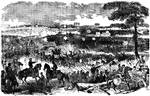
"Battle of Chancellorsville, Sunday, May 3rd, 1863. General Hooker repulsing the attack of the enemy. Early on May 3rd, Stuart renewed the attack upon Hooker's force, with the battle cry, 'Charge and remember Jackson!' and the advance was made with such impetuosity that in a short time he was in possession of the crest from which the Eleventh Corps had been driven the preceding day. No time was lost in crowning that eminence with all the heavy artillery obtainable, and as soon as this could be made to play upon the Federal lines a charge was successively ordered upon the position held by Generals Berry and French, both of whom were supported by the divisions of Williams and Whipple. After a severe struggle the Confederates succeeded in capturing the high ground where the Federals had posted some more heavy artillery, and in turning the latter upon the Federals, who soon had to fall back to their second and third lines of intrenchments. The Confederates followed close upon them, and made charge after charge in order to capture the new positions, but unayailingly and when re-enforcements arrived from Meade's corps they were forced to abadon the attack."— Frank Leslie, 1896

Battle of Chancellorsville

"Battle of Chancellorsville, Sunday, May 3rd, 1863. General Hooker repulsing the attack of the enemy.…
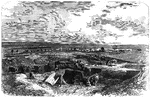
"View of the town of Centreville, Va., with the battlefield of Bull Run, Bull Run Mountains, Thoroughfare Gap, and the Blue Ridge in the distance. An undying interest centres around the field of Bull Run, so often the scene of battle, skirmish and military operations. The ground dyed with the blood of so many thousand American soldiers, where some of the mightiest armies have met in deadly strife, will long show, in its broken outlines, in its ruined dwellings, in its grass-grown earthworks, and in its sadder graves and unburied remains of mortality, the traces of war. We give a view of Centreville, with a battery of the Third Connecticut Heavy Artillery in the foreground, their caissons and shelter tents beside the grassy mound that marks the intrenchments thrown up by the Confederates in the fall and winter of 1861. The village of Centreville lies to the right, the battle ground of Bull Run lies beyond the last two houses on the right, and still further in the background are the Bull Run Mountains, divided opposite the last house by Thoroughfare Gap, and in the remote distance looms up the Blue Ridge."&mdash; Frank Leslie, 1896

Centreville

"View of the town of Centreville, Va., with the battlefield of Bull Run, Bull Run Mountains, Thoroughfare…
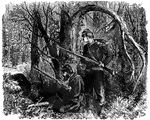
"The war in Tennessee. Federal pickets approached by Confederates in cedar bushes near Chattanooga. Our sketch shows the Confederate device for shooting down the Federal pickets. We have here not a whole wood marching, but single trees moving in the dusky twilight, continuously and stealthily, that their onward movement may be taken for the mere swaying of the trees in the wind. But the pickets in the third year of the war were keen of eye and quick of ear, and the hand on the trigger tells that some will fall in their cedar coffins to lie with no other cerements of the grave and molder away amid the crags and woods of that wild territory."— Frank Leslie, 1896

War in Tennessee

"The war in Tennessee. Federal pickets approached by Confederates in cedar bushes near Chattanooga.…
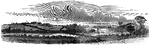
"The war in Virginia. General Meade recrossing the Rappahannock, October, 1863, before Lee's advance. General Meade, whose forces had been weakened to reinforce the Army of the Cumberland, was no longer in a condition to hold the position so long and so often occupied by the Federal army, and on October 10th began to fall back toward Washington, covering his retrograde movement so completely that General Lee was foiled in all his attempts to gain his rear, annoy his flanks or crush his rear guard. Our artist shows his army recrossing the Rappahannock."— Frank Leslie, 1896

Recrossing the Rappahannock

"The war in Virginia. General Meade recrossing the Rappahannock, October, 1863, before Lee's advance.…
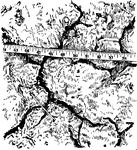
A patch of soil and grass which has cracked after having been worked too fine in the fall.

Cracks in the soil

A patch of soil and grass which has cracked after having been worked too fine in the fall.
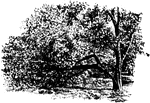
A tree, which has been blown over due to a rotten trunk

A Tree, Blown Over

A tree, which has been blown over due to a rotten trunk

"Second battle of Bull Run, fought Saturday, August 30th, 1862, between the Federal forces commanded by Major General Pope, and the Confederate forces by Generals Lee, Jackson and Longstreet. The battle began about twelve o'clock noon, and was waged with unwavering success for the Federal forces until about four o'clock in the afternoon. The fighting on both sides was desperate and destructive, either party frequently firing shrapnel and grape from the artillery. At about four o'clock the whole of General Pope's troops, save those under General Banks, were engaged at close quarters with the Confederate forces. The conflict was a desperate one. The firing on both sides was terrific, and the whole line of General Pope's command, from generals commanding army corps down to enlisted men, behaved with wonderful coolness, courage and determination, and fought with the most heroic valor from the beginning to the end. The tide of battle turned adversely for the Federals about half-past five o'clock, overwhelming numbers of re-enforcements being precipitated against the left wing under General McDowell, who was compelled to fall back."— Frank Leslie, 1896

Second Battle of Bull Run

"Second battle of Bull Run, fought Saturday, August 30th, 1862, between the Federal forces commanded…
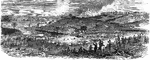
"The battle of the Wilderness, between General Grant and General Lee, May 5th and 6th, 1864. Our sketch of the first of the great battles of General Grant in Virginia will give a striking idea of the battleground, to be henceforth forever famous, like Manassas, Gettysburg, Pittsburg Landing or Fair Oaks. The eye can take in the five-mile line of battle, which for two days advanced and met hostile advances, gaining ground to be lost in a moment, but holding steadily to their lines till the furious Confederate charge on the Sixth Corps swept away Seymour's and Shaler's brigade of the Third Division and had well-nigh won the day. Sedgwick, soon to fall, saved the right; but the Federal loss in two days was not far from 15,000. Our correspondent gives this interesting account of General Grant during the battle: 'General Grant's headquarters were located in a field between the plank road and a small road leading to a little hamlet known as Parker's Store. During the fight, however, he was principally with General Meade, whose headquarters were on a piny knoll in the rear of Warren's corps. I had seen Grant at Vicksburg and in Tennessee, and his appearance was familiar; but as I strolled through the group of officers reclining under the trees at headquarters, I looked for him some time in vain, such was his insignificant, unpretending aspect and conduct while the battle was raging in all its fury. A stranger to the insignia of military rank would have little dreamed that the plain, quiet man who sat with his back against a tree, apparently heedless and unmoved, was the one upon whom the fortunes of the day, if not of the age and country, were hanging. It was only when some aid or orderly rode up in hot haste with a communication from some portion of the battlefield that his eyes upturnd to seek in those of the messenger the purport of the message. The consultation with General Meade, or the direct suggestion or command, all took place with the same imperturbability of countenance for which he has always been remarkable. No movement of the enemy seemed to puzzle or disconcert him. Fertile in resources, the petition for re-enforcement was speedily answered. And while all this transpired he stood calmly in the group, at times smoking his favorite cigar, a more vigorous or a more frequent puffing only indicating the inward working of his mind.'"— Frank Leslie, 1896

Battle of the Wilderness

"The battle of the Wilderness, between General Grant and General Lee, May 5th and 6th, 1864. Our sketch…
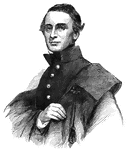
"Major Robert Anderson, the commander of Fort Sumter at the time of its fall, was born in Kentucky in the year 1805, and graduated at West Point in 1825. He was actively engaged through the Mexican War, and was severely wounded at Molino del Rey. In recognition of his services of his services at Fort Sumter he was appointed brigadier general by President Lincoln. He was relieved from duty in October, 1861, on account of failing health. He died in France in 1871."&mdash; Frank Leslie, 1896

Major Robert Anderson

"Major Robert Anderson, the commander of Fort Sumter at the time of its fall, was born in Kentucky in…
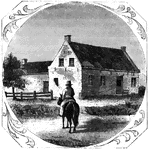
The Vankleek House. It was built by Myndert Vankleek, one of the first settlers in Dutchess county, in 1702, and was the first substantial house erected upon the site of Poughkeepsie. Its walls were very thick, and near the eaves they were pierced with lancet loop-holes for musketry. It was here that Ann Lee, the founder of the sect called Shaking Quakers, in this country, was lodged the night previous to her commitment to the Poughkeepsie jail, in 1776. She was a native of Manchester, England. During her youth she was employed in a cotton factory, and afterward as a cook in the Manchester infirmary. She married a blacksmith named Stanley; became acquainted with James and Jane Wardley, the originators of the sect in England, and in 1758 joined the small society they had formed. In 1770 she pretended to have received a revelation, while confined in prison on account of her religious fanaticism; and so great were the spiritual gifts she was believed to possess, that she was soon acknowledged a spirtual mother in Christ. Hence her name of Mother Ann. She and her husband came to New York in 1774. He soon afterward abandoned her and her faith, and married another woman. She collected a few followers, and in 1776 took up her abode in the woods of Watervliet, near Niskayuna, in the neighborhood of Troy. By some she was charged with witchcraft; and, because she was opposed to war, she was accused of secret correspondence with the British. A charge of high reason was preferred against her, and she was imprisoned in Albany during the summer. In the fall it was concluded to send her to New York, and banish her to the British army, but circumstances prevented the accomplishment of the design, and she was imprisoned in the Poughkeepsie jail until Governor Clinton, in 1777, hearing of her situation, released her. She returned to Watervliet, and her followers greatly increased. She died there in 1784, aged eighty-four years. Her followers sincerely believe that she now occupies that form or figure which John saw in his vision, standing beside the Savior.

Vankleek House

The Vankleek House. It was built by Myndert Vankleek, one of the first settlers in Dutchess county,…
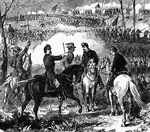
"Battle of Pea Ridge, Ark., fought March 6th, 7th and 8th, 1862, between the Federal forces, 13,000 strong, under Generals Curtis, Sigel, and Asboth, and the combined Confederate army of the Southwest, 25,000 strong, under Generals Van Dorn, Price and McCulloch- total defeat of the Confederates. The official report of this battle by General Curtis is as follows: 'On Thursday, March 6th, the enemy commenced an attack on my right wing, assailling and following the rear guard of a detachment under General Sigel to my main lines on Sugar Creek Hollow, but ceased firing when he met my re-enforcements about 4 P.M. Early on the 7th I ordered an immediate advance of the cavalry and light artillery, under Colonel Osterhaus, with orders to attack and break what I supposed would be the re-enforced line of the enemy. This movement was in progress when the enemy commenced an attack on my right. The fight continued mainly at these points during the day, the enemy having gained the point held by the command of Colonel Carr at Cross Timber Hollow, but was entirely repulsed, with the fall of the commander, McCulloch. At sunrise on the 8th my right and centre renewed the firing, which was immediately answered by the enemy with renewed energy. I immediately ordered the centre and right wing forward, the right turning the left of the enemy and cross firing on his centre. This final position of the enemy was in the arc of a circle. A charge of infantry extending throughout the whole line completely routed the entire Confederate force, which retired in great confusion, but rather safely through the deep, impassable defiles of cross timber.'" — Frank Leslie, 1896

Battle of Pea Ridge

"Battle of Pea Ridge, Ark., fought March 6th, 7th and 8th, 1862, between the Federal forces, 13,000…
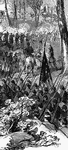
"Battle of Pea Ridge, Ark., fought March 6th, 7th and 8th, 1862, between the Federal forces, 13,000 strong, under Generals Curtis, Sigel, and Asboth, and the combined Confederate army of the Southwest, 25,000 strong, under Generals Van Dorn, Price and McCulloch- total defeat of the Confederates. The official report of this battle by General Curtis is as follows: 'On Thursday, March 6th, the enemy commenced an attack on my right wing, assailling and following the rear guard of a detachment under General Sigel to my main lines on Sugar Creek Hollow, but ceased firing when he met my re-enforcements about 4 P.M. Early on the 7th I ordered an immediate advance of the cavalry and light artillery, under Colonel Osterhaus, with orders to attack and break what I supposed would be the re-enforced line of the enemy. This movement was in progress when the enemy commenced an attack on my right. The fight continued mainly at these points during the day, the enemy having gained the point held by the command of Colonel Carr at Cross Timber Hollow, but was entirely repulsed, with the fall of the commander, McCulloch. At sunrise on the 8th my right and centre renewed the firing, which was immediately answered by the enemy with renewed energy. I immediately ordered the centre and right wing forward, the right turning the left of the enemy and cross firing on his centre. This final position of the enemy was in the arc of a circle. A charge of infantry extending throughout the whole line completely routed the entire Confederate force, which retired in great confusion, but rather safely through the deep, impassable defiles of cross timber.'" — Frank Leslie, 1896

Battle of Pea Ridge

"Battle of Pea Ridge, Ark., fought March 6th, 7th and 8th, 1862, between the Federal forces, 13,000…
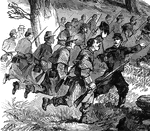
"Battle of Mill Spring, on the Cumberland River, near Jamestown, between a confederate force, 8,000 strong, under General Zollicoffer, and the Federal troops, 4,000 strong, commanded by General Thomas, fought Sunday, January 19th, 1862- flight of the Confederate Army. One of the most dashing, desperate and decisive battles of the war took place on Sunday, January 19th, 1862, when a Confederate army of 8,000 men, led by Generals Zollicoffer and Crittenden, were totally routed by General Thomas, at the head of about 4,000 Federal troops. The cannonading began at four o'clock in the morning, and the engagement soon became general. Zollicoffer found, however, that instead of surprising General Thomas, that able and vigilant officer was ready for him. The Confederates fought gallantly throughout that dismal Sabbath day, and owing to their decided superiority in numbers the result was doubtful till near the conclusion of the conflict. The death of Colonel Peyton, who fell gallantly at the head of his regiment, had materially damped the spirits of the Confederates, but the fall of their commander, Zollicoffer, about ten minutes past three in the afternoon, completed their rout. At that hour, as the Fourth Kentucky regiment was deploying on the flank of the Confederate army, Zollicoffer, attended by several of his aids, mistook his way in the underwood, and suddenly emerged before Colonel Fry, who was also with several officers. At first they mistook each other for friends, but upon the mistake being discovered one of the Confederate officers fired at Fry and shot his horse. Almost at the same instant Colonel Fry drew his revolver and shot General Zollicoffer through the heart. His aids, seeing their commander slain, deserted the body, which was taken charge of by the Federal troops, and carried to Somerset. The news spread like wildfire through the Confederate army, which fled with precipitation, and at half-past three not a confederate stood his ground." &mdash; Frank Leslie, 1896

Battle of Mill Spring

"Battle of Mill Spring, on the Cumberland River, near Jamestown, between a confederate force, 8,000…
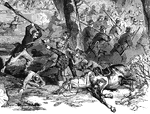
"Battle of Mill Spring, on the Cumberland River, near Jamestown, between a confederate force, 8,000 strong, under General Zollicoffer, and the Federal troops, 4,000 strong, commanded by General Thomas, fought Sunday, January 19th, 1862- flight of the Confederate Army. One of the most dashing, desperate and decisive battles of the war took place on Sunday, January 19th, 1862, when a Confederate army of 8,000 men, led by Generals Zollicoffer and Crittenden, were totally routed by General Thomas, at the head of about 4,000 Federal troops. The cannonading began at four o'clock in the morning, and the engagement soon became general. Zollicoffer found, however, that instead of surprising General Thomas, that able and vigilant officer was ready for him. The Confederates fought gallantly throughout that dismal Sabbath day, and owing to their decided superiority in numbers the result was doubtful till near the conclusion of the conflict. The death of Colonel Peyton, who fell gallantly at the head of his regiment, had materially damped the spirits of the Confederates, but the fall of their commander, Zollicoffer, about ten minutes past three in the afternoon, completed their rout. At that hour, as the Fourth Kentucky regiment was deploying on the flank of the Confederate army, Zollicoffer, attended by several of his aids, mistook his way in the underwood, and suddenly emerged before Colonel Fry, who was also with several officers. At first they mistook each other for friends, but upon the mistake being discovered one of the Confederate officers fired at Fry and shot his horse. Almost at the same instant Colonel Fry drew his revolver and shot General Zollicoffer through the heart. His aids, seeing their commander slain, deserted the body, which was taken charge of by the Federal troops, and carried to Somerset. The news spread like wildfire through the Confederate army, which fled with precipitation, and at half-past three not a confederate stood his ground." &mdash; Frank Leslie, 1896

Battle of Mill Spring

"Battle of Mill Spring, on the Cumberland River, near Jamestown, between a confederate force, 8,000…
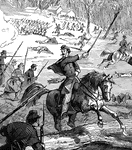
"Battle of Mill Spring, on the Cumberland River, near Jamestown, between a confederate force, 8,000 strong, under General Zollicoffer, and the Federal troops, 4,000 strong, commanded by General Thomas, fought Sunday, January 19th, 1862- flight of the Confederate Army. One of the most dashing, desperate and decisive battles of the war took place on Sunday, January 19th, 1862, when a Confederate army of 8,000 men, led by Generals Zollicoffer and Crittenden, were totally routed by General Thomas, at the head of about 4,000 Federal troops. The cannonading began at four o'clock in the morning, and the engagement soon became general. Zollicoffer found, however, that instead of surprising General Thomas, that able and vigilant officer was ready for him. The Confederates fought gallantly throughout that dismal Sabbath day, and owing to their decided superiority in numbers the result was doubtful till near the conclusion of the conflict. The death of Colonel Peyton, who fell gallantly at the head of his regiment, had materially damped the spirits of the Confederates, but the fall of their commander, Zollicoffer, about ten minutes past three in the afternoon, completed their rout. At that hour, as the Fourth Kentucky regiment was deploying on the flank of the Confederate army, Zollicoffer, attended by several of his aids, mistook his way in the underwood, and suddenly emerged before Colonel Fry, who was also with several officers. At first they mistook each other for friends, but upon the mistake being discovered one of the Confederate officers fired at Fry and shot his horse. Almost at the same instant Colonel Fry drew his revolver and shot General Zollicoffer through the heart. His aids, seeing their commander slain, deserted the body, which was taken charge of by the Federal troops, and carried to Somerset. The news spread like wildfire through the Confederate army, which fled with precipitation, and at half-past three not a confederate stood his ground." &mdash; Frank Leslie, 1896

Battle of Mill Spring

"Battle of Mill Spring, on the Cumberland River, near Jamestown, between a confederate force, 8,000…
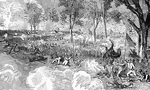
"Battle of Chancellorsville, Sunday, May 3rd, 1863. General Hooker repulsing the attack of the enemy. Early on May 3rd, Stuart renewed the attack upon Hooker's force, with the battle cry, 'Charge and remember Jackson!' and the advance was made with such impetuosity that in a short time he was in possession of the crest from which the Eleventh Corps had been driven the preceding day. No time was lost in crowning that eminence with all the heavy artillery obtainable, and as soon as this could be made to play upon the Federal lines a charge was successively ordered upon the position held by Generals Berry and French, both of whom were supported by the divisions of Williams and Whipple. After a severe struggle the Confederates succeeded in capturing the high ground where the Federals had posted some more heavy artillery, and in turning the latter upon the Federals, who soon had to fall back to their second and third lines of intrenchments. The Confederates followed close upon them, and made charge after charge in order to capture the new positions, but unayailingly and when re-enforcements arrived from Meade's corps they were forced to abadon the attack."— Frank Leslie, 1896

Battle of Chancellorsville

"Battle of Chancellorsville, Sunday, May 3rd, 1863. General Hooker repulsing the attack of the enemy.…
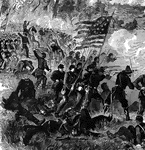
"Battle of Chancellorsville, Sunday, May 3rd, 1863. General Hooker repulsing the attack of the enemy. Early on May 3rd, Stuart renewed the attack upon Hooker's force, with the battle cry, 'Charge and remember Jackson!' and the advance was made with such impetuosity that in a short time he was in possession of the crest from which the Eleventh Corps had been driven the preceding day. No time was lost in crowning that eminence with all the heavy artillery obtainable, and as soon as this could be made to play upon the Federal lines a charge was successively ordered upon the position held by Generals Berry and French, both of whom were supported by the divisions of Williams and Whipple. After a severe struggle the Confederates succeeded in capturing the high ground where the Federals had posted some more heavy artillery, and in turning the latter upon the Federals, who soon had to fall back to their second and third lines of intrenchments. The Confederates followed close upon them, and made charge after charge in order to capture the new positions, but unayailingly and when re-enforcements arrived from Meade's corps they were forced to abadon the attack."— Frank Leslie, 1896

Battle of Chancellorsville

"Battle of Chancellorsville, Sunday, May 3rd, 1863. General Hooker repulsing the attack of the enemy.…
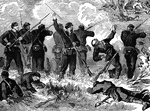
"Battle of Chancellorsville, Sunday, May 3rd, 1863. General Hooker repulsing the attack of the enemy. Early on May 3rd, Stuart renewed the attack upon Hooker's force, with the battle cry, 'Charge and remember Jackson!' and the advance was made with such impetuosity that in a short time he was in possession of the crest from which the Eleventh Corps had been driven the preceding day. No time was lost in crowning that eminence with all the heavy artillery obtainable, and as soon as this could be made to play upon the Federal lines a charge was successively ordered upon the position held by Generals Berry and French, both of whom were supported by the divisions of Williams and Whipple. After a severe struggle the Confederates succeeded in capturing the high ground where the Federals had posted some more heavy artillery, and in turning the latter upon the Federals, who soon had to fall back to their second and third lines of intrenchments. The Confederates followed close upon them, and made charge after charge in order to capture the new positions, but unayailingly and when re-enforcements arrived from Meade's corps they were forced to abadon the attack."— Frank Leslie, 1896

Battle of Chancellorsville

"Battle of Chancellorsville, Sunday, May 3rd, 1863. General Hooker repulsing the attack of the enemy.…
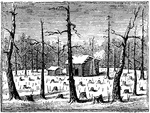
"Scene at the Cowpens. This name is derived from the cirumstance that, some years prior to the Revolution, before this section of country was settled, some persons in Camden (then called Pine-tree) employed two men to go up to the Thicketty Mountain, and in the grassy intervales among the hills, raise cattle. As a compensation, they were allowed the entire use of the cows during the summer for making butter and cheese, and the steers for tilling labor. In the fall, large numbers of the fattest cattle would be driven down to Camden to be slaughtered for beef, on account of the owners. This region, so favorable for rearing cows, on account of the grass and fine springs, was consequently called <em>The Cowpens</em>. The field was covered with blasted pines, stumps, and stocks of indian corn, and had a most dreary appearance."&mdash;Lossing, 1851

Cowpens

"Scene at the Cowpens. This name is derived from the cirumstance that, some years prior to the Revolution,…
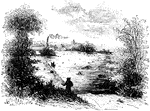
"View at the Cherokee Ford. This view is from the east bank of the river. Toward the extreme right is seen the dam, made to supply water-power for the iron-works delineated toward the left of the picture. The fording-place, which crosses a small island in the middle of the steam, is indicated by the slight fall toward the left."&mdash;Lossing, 1851

Cherokee Ford

"View at the Cherokee Ford. This view is from the east bank of the river. Toward the extreme right is…
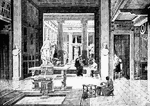
"A Roman house. In early times the private houses of the Romans were very simple, showing little attempt at adornment or luxury, but in the later days of the republic and under the empire, the dwellings of the wealthy were costly and beautiful."&mdash;Colby, 1899

House

"A Roman house. In early times the private houses of the Romans were very simple, showing little attempt…
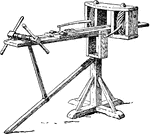
"Catapult from the Roman military system. The Roman army was divided into legions, each of which contained about 6,000 men, although at first the number was much smaller. Each legion was in turn subdivided into ten cohorts. Besides the legionary soldiers, the army comprised bodies of auxiliar troops from the provinces or the allies of Rome. The common weapons were the pilum, or javelin, and a short sword, but slings and bows were also used."&mdash;Colby, 1899

Catapult

"Catapult from the Roman military system. The Roman army was divided into legions, each of which contained…
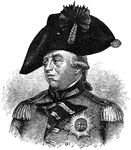
"George III (1760-1815). The first two Hanoverian kings were ignorant of English politics and obliged to rely on their ministers. Moreover, they cared more for Hanover than for England. But George II had English ideas. He was born and educated in England, and he made up his mind that he would rule in the manner of the old kings. He tried to restore the power of the crown at the expense of Parliament. In private morals and social relations he was better than his predecessors, and his character inspired respect. He had the loftiest ideas of royal dignity, and the greater part of his reign was taken up with the struggles with Parliament. But though he had some good qualities, he was narrow-minded, ill-educated, and imprudent. During the first twenty-four years of his reign he managed to estrange his people, check the prosperity of the nation, and lose forever the American colonies. His reign therefore was disastrous. The details of the struggle with the American colonies and the rise of the United States to the foremost rank among nations do not properly fall within the scope of this work. It is sufficient here to state that by the treaty of 1783 England's control over the thirteen colonies was lost forever. During the latter part of the reign of George III he was incapacitated for ruling. He was stricken with insanity, and the government passed into the hands of the prince regent, afterwards George IV. The most interesting side of the reign from the point of view of general history is the relations of England with foreign powers and the part where she played in the wars that arose from the French Revolution."&mdash;Colby, 1899

George III, King of England

"George III (1760-1815). The first two Hanoverian kings were ignorant of English politics and obliged…
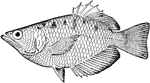
"To this fish has been ascribed the power of shooting drops of water to the distance of 3 or 4 feet, with sure aim, at insects, causing them to fall into the water, when it seizes and devours them."-Whitney, 1902

Archerfish

"To this fish has been ascribed the power of shooting drops of water to the distance of 3 or 4 feet,…
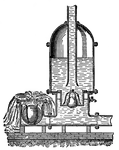
"The Hydraulic Ram is a machine for raising water, and depending for its action on the impulse of flowing water. The water falling from a reservoir passes into a pipe or chamber <em>(b)</em>, at the end of which there is a ball valve <em>(c)</em>. The rush of supply water at first closes this, and the water finding no exit there acquires pressure enough to open another valve <em>(d)</em> and pass into an air-vessel placed over it <em>(f)</em>. The cessation of pressure at valve <em>c</em> allows it to fall again; an outrush of water takes place there, relieving valve <em>d</em>, which again closes. The pressure of the flowing water upon valve <em>c</em> once more closes this valve, and valve <em>d</em> again opens, and an additional quantity of water is forced into the air-vessel; and so on by a series of pulsations which send the water along the service pipe, and, in properly arranged machines, raise it to a very considerable height, although the impulse is dervied only from the fall of a few feet."&mdash;(Charles Leonard-Stuart, 1911)

Hydraulic Ram

"The Hydraulic Ram is a machine for raising water, and depending for its action on the impulse of flowing…
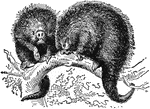
"The Porcupine is a rodent quadruped. The North American porcupine is about two feet long, and of sluggish habits. The quills are short, and concealed among the fur, and the tail is short. The 'tree porcupine' of South America has a prehensile tail, about 10 inches long. The porcupine of Southern Europe and Africa is about 28 inches long, exclusive of the tail. The head, fore quarters, and under surface are clothed with short spines, intermixed with hairs, crest on head and neck, hind quarters covered with long sharp spines, ringed with black and white, and erectile at will. They are but loosely attached to the skin and readily fall out, a circumstance which probably gave rise to the belief that the animal was able to project them at an enemy."&mdash;(Charles Leonard-Stuart, 1911)

Prehensile Tailed Porcupine

"The Porcupine is a rodent quadruped. The North American porcupine is about two feet long, and of sluggish…
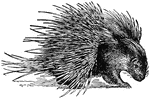
"The Porcupine is a rodent quadruped. The North American porcupine is about two feet long, and of sluggish habits. The quills are short, and concealed among the fur, and the tail is short. The 'tree porcupine' of South America has a prehensile tail, about 10 inches long. The porcupine of Southern Europe and Africa is about 28 inches long, exclusive of the tail. The head, fore quarters, and under surface are clothed with short spines, intermixed with hairs, crest on head and neck, hind quarters covered with long sharp spines, ringed with black and white, and erectile at will. They are but loosely attached to the skin and readily fall out, a circumstance which probably gave rise to the belief that the animal was able to project them at an enemy."&mdash;(Charles Leonard-Stuart, 1911)

Hystrix Crystata Porcupine

"The Porcupine is a rodent quadruped. The North American porcupine is about two feet long, and of sluggish…
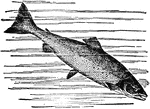
"The Salmon is a well-known fish, inhabiting both salt and fresh waters, and ranking prominent among the food fishes of the United States and other countries. It generally attains a length of from three to four feet, and an average weight of from 12 to 30 pounds. In the fall the salmon ascends rivers for the purpose of spawning, and often encounters obstacles. In many streams they are assisted by structures known as 'salmon ladders.'"&mdash;(Charles Leonard-Stuart, 1911)

Salmon

"The Salmon is a well-known fish, inhabiting both salt and fresh waters, and ranking prominent among…
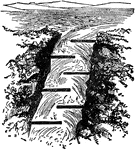
"The Salmon is a well-known fish, inhabiting both salt and fresh waters, and ranking prominent among the food fishes of the United States and other countries. It generally attains a length of from three to four feet, and an average weight of from 12 to 30 pounds. In the fall the salmon ascends rivers for the purpose of spawning, and often encounters obstacles. In many streams they are assisted by structures known as 'salmon ladders.'"&mdash;(Charles Leonard-Stuart, 1911)

Salmon Ladder

"The Salmon is a well-known fish, inhabiting both salt and fresh waters, and ranking prominent among…
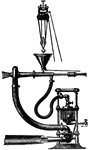
"Sand Blast is one of the most wonderful uses of sand, by means of which glass, stone, metals, or any other hard substance may be cut or engraved. If a stream of sharp sand be let fall from a high box (as high as the ceiling of a room) through a tube on to a plate of glass held under it, the sand will cut away little grains of the glass till at length the whole surface will be cut or scratched and it will look like ground glass. If, instead of cutting the glass all over, it is wanted to engrave a pattern or figure on it, the workman has only to cover the parts of the glass which he does not want cut with a stencil plate made of leather, rubber, paper, wax, etc., for the sand will not cut any soft substance. Metals and stones may also be cut by means of the sand blast, which will not only scratch the surface, but will cut it away to any depth."&mdash;(Charles Leonard-Stuart, 1911)

Sand Blast Apparatus

"Sand Blast is one of the most wonderful uses of sand, by means of which glass, stone, metals, or any…
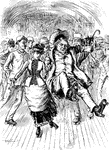
A group of people rollerskating indoors. The man in front is about to fall. All of the people are wearing hats.

Roller Skating

A group of people rollerskating indoors. The man in front is about to fall. All of the people are wearing…
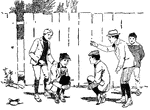
"Two players are made to sit on the ground draw their legs up, and clasp their hands together over their shins. A stout stick is then passed through under their knees, and over their arms at the bend of the elbows, as in the cut, and there they sit trussed like a couple of fowls. Thus prepared, the two cobatants are placed face to face, their toes touching, and are left to fight it out. This they do by striving to knock each other down, each to overbalance the other without loosing his own equilibrium. Two falls out of three decide the game; if both fall it is no 'round,' and does not count. As the player may not unclasp his hands even when down, he is quite helpless, and must be assisted by his friends." &mdash; Thomas Sheppard Meek

Cock-Fighting

"Two players are made to sit on the ground draw their legs up, and clasp their hands together over their…
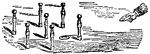
"This game is played by means of seven pins, made so that they may either be driven into the ground or fixed on a board. Each pin is numbered, from one to seven. There is a slight cup at the top of the pins. In each cup is placed a small ball or marble. To play the game, six of the pins are fixed in a circle, with the seventh in the middle; and the players, standing at a given distance, take the wooden quoits with which they try to knock the balls out of the cups. Before playing, they must name the pin at which they aim, and if they strike off the ball belonging to any other pin, the score goes to the adversary. If, however, he knocks off the ball at which he aims, and by the same throw strikes off one or more besides, he may score them all. in another version of the game, if the player can strike off the seven balls and have one or more quoits to spare, he may try to throw the quoits so as to fall upon the pins, and for every case in which he succeeds he adds the number of the pin to his score."&mdash; Thomas Sheppard Meek

Lawn Cupolette

"This game is played by means of seven pins, made so that they may either be driven into the ground…
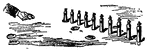
"This game, as seen from the illustration, is played with pegs which can be fastened firmly into a bard, and with a corresponding number of wooden rings or quoits. When the pegs are set in their places, the first player takes the quoits and, standing at a specified distance, endeavors to throw the rings over the pegs. for every ring that fairly encircles a peg the thrower scores the number which is attached to the peg; but should more than one ring fall on the same peg, the score goes to the opponent. In this, as in all games where a ring has to be thrown, the ring should be held just like a quoit, so that a spin may be communicated to it and make it fly steadily to its mark. Rules: 1) The game of Ringolette is adapted for two or more players. 2) The first player being decided upon, he places the board in the centre of the table, and standing about three feet or more from the board, commences his play. 3) Each player takes the eight rings, and plays by pitching the rings on the pegs. 4) Each ring that is fairly on the pegs counts according to the number indicated on the board. 5) Should a player place more than one ring on each peg, it scores to the opposition. 6) Three-score and one is a medium game; five-score and one a long game. These rules may be modified by agreement among the players, but not otherwise."&mdash; Thomas Sheppard Meek

Parlor Ringolette

"This game, as seen from the illustration, is played with pegs which can be fastened firmly into a bard,…
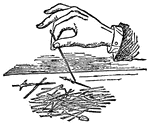
"This is a game of pure manual dexterity, and is rare practice for cultivating steadiness of hand and delicacy of touch. Its worst fault is that in the very nature of the game a constant series of deadlocks are inevitable, only to be overcome by the self-sacrifice of one or other of the players. Jackstraws are a number of thing narrow slips of wood, bone or ivory, each more or less notched, sometimes cut into fantastic shapes, and numbered. These being held together in a bundle, are allowed to fall on the table, and the players, two or more in number, each in turn pull them out one by one with a small hook. As long as a player can go on abstracting from the heap, without in any way shaking or disturbing more than one jackstraw at the time, his turn continues, and all he thus secures he keeps; at the least shake his turn ceases, and the next player goes on. When all the jackstraws have been thus abstracted, each player counts his heap, each jackstraw being valued at the number inscribed on it, and he who has most wins."&mdash; Thomas Sheppard Meek

Jackstraws

"This is a game of pure manual dexterity, and is rare practice for cultivating steadiness of hand and…
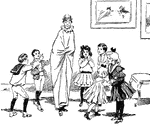
"This may be done in two ways: first and most difficult, by one boy standing on another's shoulders, and then putting over both a long loose garment, long enough to reach to the knees of the lower one. This method, however, may be made much more easy by the upper player putting his feet in a kind of stirrup fastened to straps passing over the under one's shoulder's, and hanging just down to the hips. Height, of course, is sacrificed, but greater safety is secured; the giant, too, can exhibit thus for a longer time, as the attitude is not so fatiguing. The other and simpler method is to place a huge mask, which should represent a head and neck, on the top of a pole about five feet long, with a cross-piece to represent arms, and then tying a long cloak- it should be made for the purpose: any common material will do- round the neck of the mask and get bodily inside. Now, by raising or depressing the pole, the giant may be made to attain an extra ordinary stature or to shrink down again to ordinary dimensions as well. The lower end of the cloak, about two feet from the bottom, must be fastened to the performer's waist, so that when the head is depressed the cloak may fall in folds, and not sweep the ground as it otherwise would. There is a very entertaining illusion of this sort exhibited under the name of 'The Nondescripts.' Two figures with enormous heads, alternately giants and dwarfs, run about the circus and indulge in the most surprising vagaries, being able apparently to contort themselves in every imaginable direction. Their final coup is to put their heads deliberately through their legs, and make their exit with their eyes thus looking over their own shoulders."&mdash; Thomas Sheppard Meek

The Giant

"This may be done in two ways: first and most difficult, by one boy standing on another's shoulders,…
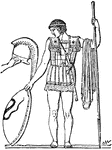
"After the fall of Athens Sparta stood without a rival in Greece." &mdash; Smith, 1882

Greek warriot

"After the fall of Athens Sparta stood without a rival in Greece." — Smith, 1882

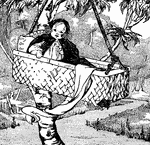
Rock-a-bye, baby, in the tree top; When the wind blows, the cradle will rock; When the bough breaks, the cradle will fall; Down will come baby, cradle and all.

Rock-A-Bye Baby

Rock-a-bye, baby, in the tree top; When the wind blows, the cradle will rock; When the bough breaks,…
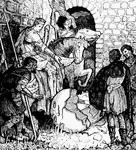
Humpty Dumpty sat on a wall; Humpty Dumpty had a great fall; And all the King's horses and all the King's men can't put Humpty Dumpty together again.

Humpty Dumpty

Humpty Dumpty sat on a wall; Humpty Dumpty had a great fall; And all the King's horses and all the King's…
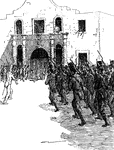
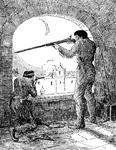
The fall of the Alamo

Alamo

The fall of the Alamo

The fall of the Alamo

Alamo

The fall of the Alamo

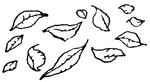
Leaves falling during the Fall

Fall

Leaves falling during the Fall

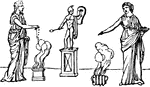
"Turibulum, a censer. The Greeks and Romans, when they sacrificed, commonly took a little frankincense out of the acerra, and let it fall upon the flaming altar. More rarely they used a censer, by means of which they burned the incense in greater profusion, and which was in fact a small moveable grate or foculus. he following wood-cut, taken from an ancient painting, shows the performance of both of these acts at the same time." &mdash Smith; 1873

Turibulum

"Turibulum, a censer. The Greeks and Romans, when they sacrificed, commonly took a little frankincense…
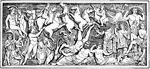

"The Fall of Phaethon" &mdash; Gayley, 1893

Phaethon

"The Fall of Phaethon" — Gayley, 1893

A doodad.

Doodad

A doodad.

A doodad.

Doodad

A doodad.

A doodad.

Doodad

A doodad.

A doodad.

Doodad

A doodad.

A doodad.

Doodad

A doodad.