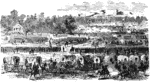
"Battle at Willis Church, Monday, June 30th, 1862- the Federal forces, under General Heintzelman, engaged with the enemy. This desperate battle between the Confederates on one hand and the divisions of General Heintzelman and Franklin on the other was fought on the morning of Monday, June 30th, 1862, at Willis Church, a place midway between the White Oak Swamp Bridge and Turkey Bend, where, later in the day, another fierce fight raged, the week of combat being closed next day by the deadly but drawn battle of Malvern Hill. Our sketch represents the position of part of the Federal army at ten o'clock in the morning, just as the battle was commencing. The baggage train is in the foreground, and the enemy is advancing upon the Federal lines, and covering the advance with a heavy shower of shells. Willis Church is on the left of the illustration, being what most of the Southern places of worship were, mere wooden barns." —Leslie, 1896

Battle at Willis Church

"Battle at Willis Church, Monday, June 30th, 1862- the Federal forces, under General Heintzelman, engaged…
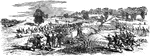
"The victory at Blue Ridge Pass, Sunday, September 14th, 1862- infantry charge, and rout of the Confederates. On Sunday, September 14th, 1862, having previously evacuated Frederick City, the rear of the Confederate army had reached the Blue Ridge Pass, on the line of the Federal road leading from Frederick City to Hagerstown and the fords of the Upper Potomac. Here it was overtaken by the Federal advance under Generals Hooker and Reno. The position was a strong one, and strongly guarded, but was carried after a severe action by the Federal forces, the Confederates falling back in disorder. In this engagement General Reno was killed on the Federal side, and General Garland on that of the Confederates." —Leslie, 1896

Blue Ridge Pass

"The victory at Blue Ridge Pass, Sunday, September 14th, 1862- infantry charge, and rout of the Confederates.…
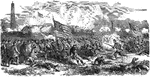
"Battle of Secessionville, James Island, S. C.- bayonet charge of Federal troops, commanded by General Stevens, upon the Confederate batteries on James Island, June 16th, 1862. Our sketch represents the desperate bayonet charge of the Federal troops which drove back the Confederates; but the Federals were so exhausted with their victory that the reconnoissance for the next day was postponed and some heavy guns having arrived, it was proposed to put them in battery in advance of General Steven's camp and try their effect upon the Confederate fort before renewing the project of an assault. The battery produced no effect upon the Confederate fort; and as its shells and shot commanded the Federal position and rendered its camp insecure, it became necessary to recur again to the old plan of the reconnoissance, and to attempt to reduce it by assault. The Federals were met by a murderous fire of grape and canister. Two regiments only reached the front, much cut up- the Eighth Michigan and the Seventy-ninth New York "Highlanders." The Twenty-eighth Massachusetts broke and scattered, while the Forty-sixth New York did little better. The first two drove the gunners from their guns; some mounted the parapet, and some even penetrated the work; but the other regiments, there being two besides those named, not rushing up to their support, they were obliged to retire after having really held it for nearly twenty minutes." —Leslie, 1896

Battle of Secessionville

"Battle of Secessionville, James Island, S. C.- bayonet charge of Federal troops, commanded by General…
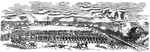
"Battle of Savages Station. Brigadier General Smith's division hotly engaged with the enemy, at noon, June 28th, 1862. Our correspondent described this battle as follows: "Having left our wounded, about thirteen hundred men, in the hospital, to the tender mercies of the Confederates, our troops fell back at daybreak on Sunday from their line of entrenchments. This extended from a space of white oak swamp, near Richmond, to the Chickahominy Creek, at New Bridge. The divisions of Hooker, Kearney and Sedgwick were thrown into the woods, where a number of batteries were masked to oppose the enemy, who, advancing cautiously, clambered over the ditches and parapets, and, seeing them abandoned, signaled the main body, who came up at double quick. Taking possession of our defenses with a cheer, they raised their flag amid loud yells of demoniacal satisfaction. Then, in close order and in line of battle, they marched down the Williamsburg Road, past the scene of the Seven Pines fight, and so approached where our troops were concealed at a point denominated Peach Orchard, being an insignificant stopping place on the railroad, midway between Hancocks and Savages. When they had come so close that our troops could toss a biscuit from our line into theirs, our batteries were unmasked, and an awful blaze of flame and projectile rose from the depths of the woods. Before the Confederates could rally, our men had poured a dozen volleys of musketry into them, covering the ground with the slain."" —Leslie, 1896

Battle of Savages Station

"Battle of Savages Station. Brigadier General Smith's division hotly engaged with the enemy, at noon,…
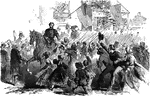
"General McClellan and the Federal troops passing through Frederick City, Md., in pursuit of the Confederate army- their enthusiastic reception by the inhabitants, September 12th, 1862. Most certainly it was distance that lent enchantment to the view of the eyes of the Marylanders, so far as the Confederate army was concerned, for it appeared that, instead of 50,000 recruits so confidently predicted by Mr. Miles, one of the Confederate Congress of Richmond, they did not actually realize more then 700, and of these nearly 300 refused to carry out their enlistments. All accounts proved that the Confederate army was of the Felstaffian regime, and not at all calculated to make a favorable impression upon the olfactory and pecuniary faculties of the Secessionists of Maryland. When the Confederate generals, with their staffs, entered Frederick City, they were at first welcomed, but when the ragged regiments made their appearance a change came over the spirit of their dream, and the inhabitants woke from their delusion. Our sketch reprsents the rapturous reception given to Gneral McClellan. It was a perfect ovation. Flowers were showered down upon the Federals, while the waving of flags and the cheers of the inhabitants completed the inspiring scene." —Leslie, 1896

Frederick City

"General McClellan and the Federal troops passing through Frederick City, Md., in pursuit of the Confederate…
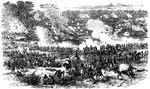
"Battle of White Oak Swamp Bridge, Monday June 30th, 1862- Ayres's, Mott's and Randall's batteries checking the advance of the Confederates. After the battle of Savage's Station the Federals continued on their retreat, and by eight o'clock on the morning of June 30th, 1862, they had crossed White Oak Swamp and Creek, after destroying the bridge over the latter and warding off the repeated attacks to which they were subjected throughout the night. After crossing White Oak Creek the Federals had quickly formed a new line of battle at Willis Church, General Hancock's forces being on the extreme right, while Porter's occupied the left, and Heintzelman's and Sumner's the intervening space. Jackson's advance was checked by the destruction of the bridge, and when he reached the creek, at about noon, he found the approaches well defended by artillery. Jackson opened upon Hancock's troops, and made repeated efforts to rebuild the bridge under cover of his heavy artillery, but he was every time repulsed. While this was going on Longstreet and Hill had come upon a Federal force at a place two miles away, called Frazier's Farm. Here stood Sumner and Hooker, on the extreme right, McCall somewhat in advance toward the centre and Kearny on the extreme left. When Longstreet found this force arrayed against him he waited for re-enforcements to come up, and it was four o'clock when he commenced the attack. McCall's left was first assailed by Kenper's brigade, which was met by the Pennsylvania Reserves under Colonel Simmons, who, after a bitter conflict, drove the Confederates into the woods with a loss of 250 killed and wounded and about 200 prisoners. Fresh troops then enabled the Confederates to drive back the Federals, who in turn lost heavily. Longstreet and Hill now pressed on, and the conflict became a severe one along the entire front. One point, then another, was vainly tried in the determined effort to break the Federal line. At length Wilcox's Alabama Brigade rushed across an open field upon McCall's left, directly against Randall's battery, which centered upon the Confederates a most galling fire. Nothing daunted, they moved on, and finally engaging in a desperate hand-to-hand fight, first captured Cooper's battery, and afterward Randall's battery, which had been doing such terrible execution. A charge was then ordered for the recapture of the guns. The Confederates bravely met the severe attacks that followed. A still more desperate hand-to-hand struggle took place for the possession of the lost batteries, which were finally recaptured. By dark the Confederates had retired into the woods, and the Federals remained on that portion of the field which they had lost earlier in the action. The Federal loss was about 1,800 killed and wounded, whilst that of the Confederates was over 2,000. Colonel Simmons and General Meade were both severely wounded, while General McCall was a made prisoner." —Leslie, 1896

Battle of White Oak Swamp Bridge

"Battle of White Oak Swamp Bridge, Monday June 30th, 1862- Ayres's, Mott's and Randall's batteries checking…

Peter White will ne'er go right. Would you know the reason why? He follows his nose, wherever he goes, and that stands all awry.

Peter White

Peter White will ne'er go right. Would you know the reason why? He follows his nose, wherever he goes,…
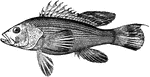
"Sea bass has a white, flaky flesh, and weighs from 1 to 3 pounds. This fish responds to any cooking methods, and is good in chowders."

Sea Bass

"Sea bass has a white, flaky flesh, and weighs from 1 to 3 pounds. This fish responds to any cooking…
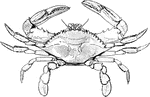
"Several species of crabs are taken from Florida coastal waters, probably the most common being the large blue crab, easily caught by line or net as the tide comes in, and always available at local markets."

Blue Crab

"Several species of crabs are taken from Florida coastal waters, probably the most common being the…
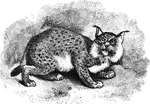
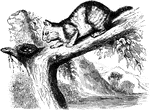
"<em>F. lynx</em> , has long fur, of a dull reddish gray above, with oblong spots of reddish gray upon the sides, the spots on the limbs rounder and smaller; whitish below, mottled with black. Length about three feet. The species varies much. In winter, the fur is much longer than it is in the summer, and has a hoary apperance in the former season, owing to the long hair being tipped with grayish white." &mdash; S. G. Goodrich, 1885

Lynx

"F. lynx , has long fur, of a dull reddish gray above, with oblong spots of reddish gray upon…

"The Canada Lynx of the Indians, has a round, broad head, large eyes, strong teeth, ears acute and tipped with long hairs. The body is robust, the legs thick and clumsy, the toes strong and imbedded in fur. The fur has a wooly appearance, the under part bing very close and soft. The general color of the back is gray, with a rufous tinge; the sides are gray, the under surface dull white." &mdash; S. G. Goodrich, 1885

Canada Lynx

"The Canada Lynx of the Indians, has a round, broad head, large eyes, strong teeth, ears acute and tipped…
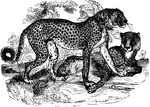
"In size and shape it is between the leopard and the hound. The color is yellowish fawn above, ad nearly pure white beneath. It is covered on the upper parts with numerous black spots, from half an inch to an inch in diameter. A slight mane runs along the neck. The hair generally has a crispness, distinguished it from the softness pf that of the cat's.

Cheetah

"In size and shape it is between the leopard and the hound. The color is yellowish fawn above, ad nearly…
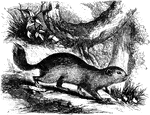
"Is about either inches long, and the tail one-third as long; its color is grayish-brown, marked with white rounded spots above; the color beneath is white. It lives solitary in burrows in the earth; feeds on grain and seeds, and frequently causes great destruction to the crops." &mdash; S. G. Goodrich, 1885

Souslik

"Is about either inches long, and the tail one-third as long; its color is grayish-brown, marked with…
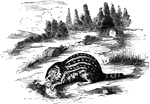
"The leopard spermophile is one of the most beautiful of all striped species of spermophile. It resembles the chipping-squirrel in size and appearance, but exceeds the pretty creaure in the splendor of its skin. The general color is bright reddish-brown, but along the back are deep brown stripes, each row having a row of square white spots running through it." &mdash; S. G. Goodrich, 1885

Leopard Spermophile

"The leopard spermophile is one of the most beautiful of all striped species of spermophile. It resembles…
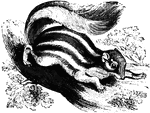
Tamia Striata. "It is about five inches long, and of a fawn-color above, striped wth five brown and two white bands; beneath, it is white. It is more wild that is preceding, and though it is lively, it has not the agility of the squirrel." &mdash; S. G. Goodrich, 1885

American Chipmunk

Tamia Striata. "It is about five inches long, and of a fawn-color above, striped wth five brown and…
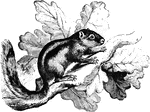
"Is about the size of the European squirrel, being nearly ten inches in length. It is grayish-brown, with four white longitudinal bands along the bkac. It inhabits Northern Africa, and lives on the palm trees." — S. G. Goodrich, 1885

Barbary Squirrel

"Is about the size of the European squirrel, being nearly ten inches in length. It is grayish-brown,…
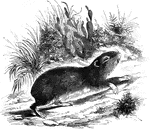
"In this animal, the fur is soft, its general hue gray, tinted with rufous on the hinder art of the back; throat white, chest whitish; abdomen white, suffused with pale ocherous yellow. It inhabits the interior of Brazil, and is confined to rock districts, where it seeks its retreat in holes among the fragments of the rocks." &mdash; S. G. Goodrich, 1885

Rock Cavy

"In this animal, the fur is soft, its general hue gray, tinted with rufous on the hinder art of the…
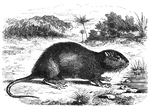
"This has ears of moderate size; fur long; upper parts of the snimal penciled with dusky and brownish-yellow in about equal proportions; sides and under parts of the prevailing tint, brown-yellow; tip of muzzle and chin white; a yellow patch immediately beneath the ear opening; feet dusky brown." &mdash; S. G. Goodrich, 1885

Coypu

"This has ears of moderate size; fur long; upper parts of the snimal penciled with dusky and brownish-yellow…
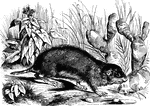
"Is reddish above and white beneath; body six inches long, and tail two inches. It lives near water, and mines the earth with its numerous galleries" &mdash; S. G. Goodrich, 1885

Brazilian Ctenomys

"Is reddish above and white beneath; body six inches long, and tail two inches. It lives near water,…
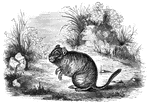
"In size and shape, it resembles the water rat. The fur is long and moderately soft; upper parts of the body penciled with black and pale brownish-yellow; dirty white beneath. The length of the body is four and a half inches; that of the tail is two inches." &mdash; S. G. Goodrich, 1885

Octodon

"In size and shape, it resembles the water rat. The fur is long and moderately soft; upper parts of…
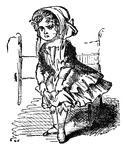
"Little Betty Blue Lost her holiday shoe. What can little Betty do? Give her another To match the other, And then she may walk in two."

Little Betty Blue

"Little Betty Blue Lost her holiday shoe. What can little Betty do? Give her another To match the other,…
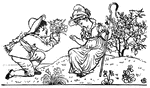
"The rose is red, the violet's blue, The pink is sweet, and so are you."

Rose is Red

"The rose is red, the violet's blue, The pink is sweet, and so are you."

"Battle of New Berne- Lieutenant Hammond capturing Colonel Avery, of South Carolina, while he was endeavoring to rally the flying Confederates. Our illustration represents the moment when Lieutenant Hammond, of the gunboat <em>Hetzel</em>, who served one of the guns of McCook's naval battery at the battle of New Berne, hearing that a Confederate colonel was, flag in hand, endeavoring to rally a South Carolina regiment, resolved to capture him. Riding up to the Confederate, the gallant Hammond, pointing his pistol at his head, demanded his surrender. A glance at the flying Confederates convinced the colonel that the day was lost, and he gave up his sword to the lieutenant. Two flags were also taken- one made of blue and white silk, elegantly fringed, with this inscription, 'Then conquer we must, for our cause is just,' with 'Victory or death.' The name of the Confederate officer taken was Colonel Avery; three hundred of his regiment were also captured at the same time."— Frank Leslie, 1896

Battle of New Berne

"Battle of New Berne- Lieutenant Hammond capturing Colonel Avery, of South Carolina, while he was endeavoring…
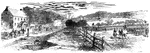
"Battle of Blue Ridge Pass, Sunday, September 14th, 1862- the first Federal victory in Maryland. On Sunday, the 14th day of September, having previously evacuated Frederick City, the rear of the Confederate army had reached the Blue Ridge Pass on the line of the national road leading from Frederick toward Hagerstown and the fords of the upper Potomac. Here it was overtaken by the Federal advance under Generals Hooker and Reno. The position was a strong one and strongly guarded, but was carried, after a severe action, by the Federal forces, the Confederates falling back in disorder. In this engagement General Reno was killed on the Federal side, and General Garland on that of the Confederates. The Federal loss was four hundred and forty-three killed, one thousand eight hundred and six wounded, and seventy-six missing; that of the Confederates, five hundred killed, two thousand three hundred and forty-three wounded, and one thousand five hundred prisoners."— Frank Leslie, 1896

Battle of Blue Ridge Pass

"Battle of Blue Ridge Pass, Sunday, September 14th, 1862- the first Federal victory in Maryland. On…
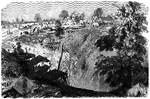
"Siege of Vicksburg. Life in the trenches- bivouac of Leggett's Brigade- McPherson's Corps at the White House. Our illustration shows the life led by the besieging troops. The deep ravine is studded with the rude huts, or quarters, burrowed in the earth. Here, at the White House, well riddled with Confederate shell, were bivouacked Leggett's Brigade of McPherson's Seventeenth Army Corps. To the left of the house an opening in the bank shows the entrance to the covered way by which the Confederate works were approached. The operation of mining the enemy's works is here shown. This was conducted by Captain Hickenloper, Chief Engineer of General McPherson's Staff. The sketch was made in the sap, within fifteen feet of the Confederate Fort Hill, behind which lay the Confederate sharpshooters, held at bay by Coonskin and other riflemen eagerly on the lookout for a Confederate head."&mdash; Frank Leslie, 1896

Siege of Vicksburg

"Siege of Vicksburg. Life in the trenches- bivouac of Leggett's Brigade- McPherson's Corps at the White…
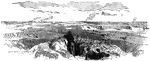
"The Federal siege works on Bogue Island, N. C., erected for the reduction of Fort Macon. Our sketch represents the covering of the working parties while constructing Captain Morris's Parrot-gun siege batteries on Bogue Island. Our correspondent said: 'Colonel White sometimes beguiles his leisure moments by throwing shells promiscuously about the sand spit upon which our works are located, doubtless to ascertain the exact position of the batteries and to annoy the working parties. The proceedings on such occasions are of the serio-comic order. At the word 'drop,' given by the sentinel in the 'rat hole' at the top of the sand hill upon seeing the flash from the gun at the fort, every man makes a bee-line at the double quick for the nearest cover, assuming a position as near the horizontal as possible. This gives comparative immunity from danger, and up to this time nobody has been hurt, except by falling pieces of shells which have exploded overhead.'"— Frank Leslie, 1896

Bogue Island

"The Federal siege works on Bogue Island, N. C., erected for the reduction of Fort Macon. Our sketch…
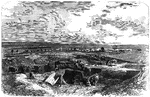
"View of the town of Centreville, Va., with the battlefield of Bull Run, Bull Run Mountains, Thoroughfare Gap, and the Blue Ridge in the distance. An undying interest centres around the field of Bull Run, so often the scene of battle, skirmish and military operations. The ground dyed with the blood of so many thousand American soldiers, where some of the mightiest armies have met in deadly strife, will long show, in its broken outlines, in its ruined dwellings, in its grass-grown earthworks, and in its sadder graves and unburied remains of mortality, the traces of war. We give a view of Centreville, with a battery of the Third Connecticut Heavy Artillery in the foreground, their caissons and shelter tents beside the grassy mound that marks the intrenchments thrown up by the Confederates in the fall and winter of 1861. The village of Centreville lies to the right, the battle ground of Bull Run lies beyond the last two houses on the right, and still further in the background are the Bull Run Mountains, divided opposite the last house by Thoroughfare Gap, and in the remote distance looms up the Blue Ridge."&mdash; Frank Leslie, 1896

Centreville

"View of the town of Centreville, Va., with the battlefield of Bull Run, Bull Run Mountains, Thoroughfare…
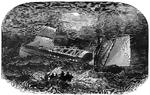
"The Banks Expedition- a Confederate Schooner running into the United States transport <em>Che-Kiang</em>, off the Florida reefs, on the night of December 11th, 1862, with the intention of sinking her. On the night of December 11th, 1862, as the United States transport <em>Che-Kiang</em>, laden with troops, was off the Florida Reefs, a schooner supposed to be a Confederate one, ran at full sail against the <em>Che-Kiang</em>. As the latter vessel was painted white and had no lights burning, there can be little doubt it was a daring and desperate attempt to wreck the transport, more especially as the schooner's crew, immediately after the collision, put off into a boat and rowed away with all expedition. After disengaging herself from the sinking schooner the <em>Che-Kiang</em> pursued her way, and reached Ship Island in such a leaky condition that the troops had to be landed."&mdash; Frank Leslie, 1896

Che-Kiang

"The Banks Expedition- a Confederate Schooner running into the United States transport Che-Kiang,…

"Siege of Charleston, S. C. Bombardment of Fort Moultrie and Batteries Bee and Beauregard by the monitors and <em>Ironsides</em>, September 7th-9th, 1863. The bombardment of Fort Moultrie and the batteries on Sullivan's Island, on the 7th and 8th of September, was of the most determined and virgorous character, the <em>Ironsides</em> devoting herself to the fort, while the monitors paid their respects to Batteries Bee and Bearegard. Our artist gives a striking sketch as viewed from a favorable point. Moultrie House is seen on the extreme right, and next to it Moultrieville on fire, the dark smoke of the burning houses contrasting with the white puffs of smoke from the cannon thundering along the whole line. Behind the <em>Irondsides</em> is Fort Moultrie; the Confederate battery to the extreme left is Battery Bee; and nearly in front of it, the second in the line of monitors, is the stanch <em>Weehawken</em>, aground. A striking feature in this picture is the effect of the ricochet shot knocking up a series of <em>jets d'eau</em>."&mdash; Frank Leslie, 1896

Fort Moultrie

"Siege of Charleston, S. C. Bombardment of Fort Moultrie and Batteries Bee and Beauregard by the monitors…
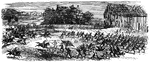
"Gallant charge of the Sixth Michigan cavalry over the enemy's breastworks, near falling Waters, Md., July 14th, 1863. The exploits of the Federal cavalry in Virginia, Maryland and Pennsylvania in 1863 would fill a volume in themselves. Among the many gallant charges there are few more brilliant than that of the Sixth Michigan at Falling Waters, where they rode, without drawing rein, right over the Confederate breastworks, scattering all before them. The cavalry were not more than sixty at most, but they charged up a steep hill in the face of a terrific fire; and though they lost in killed and wounded nearly two-thirds of their number, they captured almost the entire force of the enemy, with three regimental battle flags."— Frank Leslie, 1896

Falling Waters

"Gallant charge of the Sixth Michigan cavalry over the enemy's breastworks, near falling Waters, Md.,…

"Presentation of colors to the Twentieth United States [African American] Infantry, Colonel Bartram, at the Union League Clubhouse, New York, March 5th, 1864. The Twentieth Regiment, United States [African American] Troops, left Riker's Island at nine o'clock on the 5th of March, 1864, on board the steamer <em>John Romer</em>, and were conveyed to the foot of Twenty-first Street, East River, New York, where they were disembarked and formed in regimental line, and marched to Union Square, arriving in front of the Union League Clubhouse at one o'clock. A vast crowd of citizens, of every shade of color and every phase of social and political life, filled the square and streets, and every door, window, veranda, tree and housetop that commanded a view of the scene was peopled with spectators. Over the entrance of the clubhouse was a large platform, ornamented with flags and filled with ladies. In the street was another platform, tastefully decorated and occupied by prominent citizens. From the stand the colors were presented by President King of Columbia College, who addressed them with warmth and eloquence. After the presentation ceremony was over the men stacked arms and partook of a collation provided for them."— Frank Leslie, 1896

Presentation of Colors

"Presentation of colors to the Twentieth United States [African American] Infantry, Colonel Bartram,…

"Capture of Fort De Russy, La., on the 14th of March, 1864, by the Federal forces under General Andrew Jackson Smith. This fort was captured, March 14th, 1864, by the Federal forces under General A. J. Smith. The expedition left Vicksburg on March 10th, landed at Summerville, La., on the 13th, and marched to Bayou Glace, where General Scurri's Confederate brigade had been encamped, which fled on the approach of the transports, leaving considerable camp equipage and commissary stores. General Smith pushed forward to Yellow Bayou, where strong fortifications had been erected; but the Confederates again fled. As he came up the enemy was pressed, and some skirmishing occurred, resulting in the capture of several prisoners and a small wagon train. At daylight the entire command started for Fort de Russy, twenty-eight miles distant, hotly pursued by General Dick Taylor, who hoped to save the fort; but Smith had the lead, and at four o'clock in the afternoon the Third and Ninth Indiana Batteries opened on the fort, which replied vigorously with three of its heaviest guns. The cannonade continued an hour, when General Smith ordered the First and Second illinois Regiments, Sixteenth Corps, under General Mower, to charge the enemy's rifle pits and storm the fort. The Eighty-ninth and One Hundred and Nineteenth Indiana and Twenty-fourth Missouri Regiments charged over deep ditches and a thick abatis in the face of a galling fire, and within twenty minutes after the order was given the [African American] sergeant of the Fifty-eighth Illinois Volunteers planted the American flag upon the enemy's works."— Frank Leslie, 1896

Fort de Russy

"Capture of Fort De Russy, La., on the 14th of March, 1864, by the Federal forces under General Andrew…
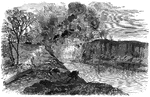
"Blowing out of the bulkhead of the Dutch Gap Canal, James River, Va., January 1st, 1865. At twelve minutes before four o'clock A. M., the mine was sprung, in the presence of General Butler and staff. A dense black smoke, at first immediately following the upheaval of the earth, was succeeded by a ponderous cloud of white smoke, which entirely filled the gap and concealed the result of the scheme. On rolling away it revealed the bank settled again into nearly its former position, but indented with a species of crater, into which the water ran slowly from the canal below. No connection between the canal and the river was immediately established, although as we have intimated, the disturbace of the embankment disposed it suitably for the gradual action of the current, and lightened the subsequent labors of the gang."&mdash; Frank Leslie, 1896

Dutch Gap Canal

"Blowing out of the bulkhead of the Dutch Gap Canal, James River, Va., January 1st, 1865. At twelve…
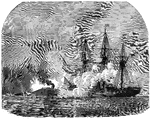
"Farragut's naval victory in Mobile Harbor. The <em>Hartford</em> engaging the Confederate ram <em>Tennessee</em>. Official report of the engagement: 'The engagement with the enemy's fleet took place on the west side of Mobile Bay, in the direction of Fort Powell, and out of range of the guns of Fort Morgan. The <em>Tennessee</em> boldly steamed in the direction of our fleet, as if for the purpose of running down and destroying the wooden vessels, without paying attention to the monitors, except to keep out of their way; but they persevered in following her and cutting her off, when her whole attention was forced to be directed to them. The fighting did not last long between them, however, for the flagship and the <em>Monongahela</em> steamed in the direction of the <em>Tennessee</em>, the <em>Monongahela</em> striking her amidships with her terrible prow, causing the huge Confederate monster to reel like a drunken man. The <em>Hartford</em> then grappled the <em>Tennessee</em>, but further bloodshed was saved by the latter hoisting the white flag from the pilot-house. Captain Pierre Giraud led the party who boarded the ram, and the Confederate Admiral Buchanana delivered up his sword to him.'"— Frank Leslie, 1896

Mobile Harbor

"Farragut's naval victory in Mobile Harbor. The Hartford engaging the Confederate ram Tennessee.…
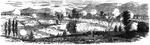
"Battle of Middletown, on the afternoon of the 19th of October, 1864. Great victory won by Major General Sheridan. Our sketch represents the gallant charge of the Sixth Corps, commanded by General Getty, which was made at about four o'clock in the afternoon of the 19th. It was this which decided the battle. The charge was made in face of a deadly and terrible fire from the Confederate batteries, under which the Federal troops only slightly wavered, though they never for an instant gave way. The battle ground is depicted in our sketch, lying at the foot of the Blue Ridge. The Confederate position is on the right, sheltered by a stone fence. That of the Sixth Corps is similarly protected on the left."&mdash; Frank Leslie, 1896

Battle of Middletown

"Battle of Middletown, on the afternoon of the 19th of October, 1864. Great victory won by Major General…
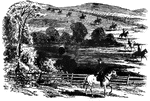
"Cavalry skirmishers advancing on the Confederate position in the pass of the Blue Ridge."&mdash; Frank Leslie, 1896

Blue Ridge

"Cavalry skirmishers advancing on the Confederate position in the pass of the Blue Ridge."— Frank…

"Siege of Petersburg- the Ninth Corps charging on the enemy's works after the explosion of the mine, July 30th, 1864. Immediately after the explosion of the mine a hundred cannons opened along the Federal front, and at half-past five the Ninth Corps charged, carrying the fort with a part of the line on each side. The Second Division, which was in the centre, advanced and carried the second line a short distance beyond the fort, and rested, holding ground with the utmost determination. It was at the time the [African American] Division, under General White, was pushed forward and ordered to charge and carry the crest of the hill, which would have decided the contest. The troops advanced in good order as far as the first line, where they received a galling fire, which checked them, and although quite a number kept on advancing, the greater number seemed to become utterly demoralized, part taking refuge in the fort, and the remainder running to the rear as fast as possible. They were rallied and again pushed forward, but without success, the greater part of the officers being killed or wounded."&mdash; Frank Leslie, 1896

Siege of Petersburg

"Siege of Petersburg- the Ninth Corps charging on the enemy's works after the explosion of the mine,…
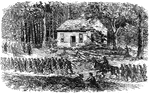
"Grant's movements south of the James- Battle of Poplar Spring Church- the Ninth Corps passing Poplar Spring Church and Confederate prisoners coming in, Friday afternoon, September 30th, 1864."&mdash; Frank Leslie, 1896

Battle of Poplar Spring Church

"Grant's movements south of the James- Battle of Poplar Spring Church- the Ninth Corps passing Poplar…
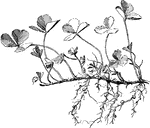
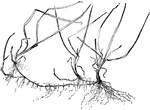
Branch of white clover showing the method of forming new plants.

White clover

Branch of white clover showing the method of forming new plants.

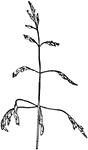
Blue grass showing the method of reproduction by underground stems, or stolons.

Blue grass

Blue grass showing the method of reproduction by underground stems, or stolons.

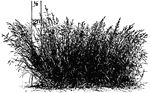
Kentucky blue-grass, grown from a single seed. Strongly stoloniferous.

Kentucky bue-grass

Kentucky blue-grass, grown from a single seed. Strongly stoloniferous.

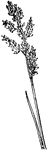
A closer view of a stalk of Kentucky blue-grass.

Kentucky blue-grass

A closer view of a stalk of Kentucky blue-grass.

Canada blue-grass, also known as wire-grass. Suitable for soils too poor to support Kentucky blue-grass.
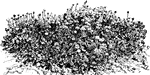
Canada blue-grass

Canada blue-grass, also known as wire-grass. Suitable for soils too poor to support Kentucky blue-grass.

A white clover plant grown from a single seed, showing spreading habit.

White clover

A white clover plant grown from a single seed, showing spreading habit.

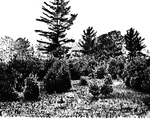
White pines coming into a pasture. On this land trees pay better than the poor pasture.

Pasture with Trees

White pines coming into a pasture. On this land trees pay better than the poor pasture.
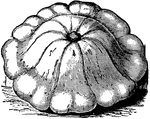
An extra early White Bush Squash.

White Bush Squash

An extra early White Bush Squash.

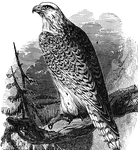
A white falcon, perched atop a branch.

White Falcon

A white falcon, perched atop a branch.

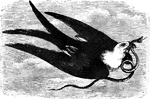
"The fork-tailed kite, (<em>N. furcatus</em>) is twenty-five inches long; the wings and tail black; neck and under parts white; the tail-feathers, twelve in number, are deeply forked, the lateral ones excessively elongated. It feeds on snakes, lizards, and frogs ; it also devours grasshoppers, locusts, and wasps, making attacks on the nests of the latter. This species is common in the South and Southwestern States, and also in the Western States, as far north as Wisconsin." &mdash Goodrich, 1859

Fork-Tailed Kite

"The fork-tailed kite, (N. furcatus) is twenty-five inches long; the wings and tail black;…
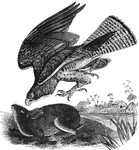
"<em>B. vulgaris</em> is twenty-two inches long, the head is large and the body heavy. Above, the color is chocolate-brown; grayish-white beneath. Its flight is low, and much of its time is spent in sitting on trees, in wooded districts, awaiting its prey, which consists of small quadrupeds, birds, reptiles, insects, and earthworms." &mdash Goodrich, 1859

Common Buzzard of Europe

"B. vulgaris is twenty-two inches long, the head is large and the body heavy. Above, the color…
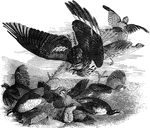
Also known as the American harrier, the marsh hawk (<em>C. Hudsonius</em>) is nineteen to twenty-one inches long. It is of a pale gray color, the underside is white with small reddish spots.

American Marsh Hawk

Also known as the American harrier, the marsh hawk (C. Hudsonius) is nineteen to twenty-one…
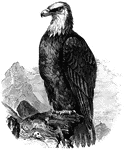
Bald (or white-headed) eagle, <em>H. leucocephalus</em>, common along sea-coasts, lakes, and rivers.

Bald Eagle

Bald (or white-headed) eagle, H. leucocephalus, common along sea-coasts, lakes, and rivers.
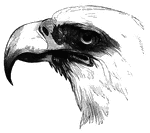
The head of a bald eagle. The distictive white plumage of this area earned it its nickname.

Head of a Bald Eagle

The head of a bald eagle. The distictive white plumage of this area earned it its nickname.
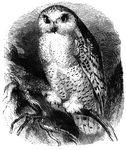
The white owl (also known as the snowy or ermine owl), found in the colder latitudes of the world. Its heavy coating of feathers is well-suited to arctic climes.

White Owl

The white owl (also known as the snowy or ermine owl), found in the colder latitudes of the world. Its…
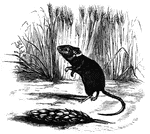
"It being four to five inches long, the tail nearly the length of the body. Its color is a yellowish-fawn above and white below; the eyes are large and prominent; ears large. It lives in the woods and fields in the summer, but in winter it resorts to the granaries." &mdash; S. G. Goodrich, 1885

Long Tailed Field Mouse

"It being four to five inches long, the tail nearly the length of the body. Its color is a yellowish-fawn…
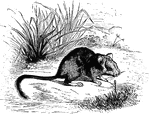
Hapalotis Albipes. "Nearly the size of a rabbit, but of mouse-like form, and is chiefly found in New South Whales." &mdash; S. G. Goodrich, 1885

White Footed Tree Rat

Hapalotis Albipes. "Nearly the size of a rabbit, but of mouse-like form, and is chiefly found in New…
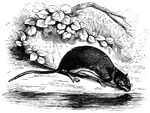
Has a chestnut color above and a white belly. They are found along the Swan River.

White Bellied Hydromys

Has a chestnut color above and a white belly. They are found along the Swan River.
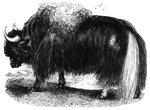
"The color of this animal in the wild and take, is black; the back and tail often white; the hair is thick and long; and the tail long, silky, and beautiful." &mdash; S. G. Goodrich, 1885

Yak

"The color of this animal in the wild and take, is black; the back and tail often white; the hair is…
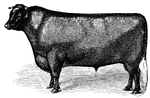
"The head is small and finely formed, the eye bright and clear, the horn light in substance and waxy in color; the chest dep, broad, and full, the brisket set prominently forward, the crops or spaces behind the shoulders full, hips wide, lions broad, the hair soft, the skin mellow and elastic; the colors full red, full white, or any combination of these." &mdash; S. G. Goodrich, 1885

Short Horn Cattle

"The head is small and finely formed, the eye bright and clear, the horn light in substance and waxy…
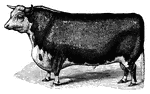
"The hereford breed are of a medium or dark red color, with white faces and sometimes white on the throat, back and bellies. They mature early, are not excelled for grazing, and make beef of the best quality." &mdash; S. G. Goodrich, 1885

Hereford Cattle

"The hereford breed are of a medium or dark red color, with white faces and sometimes white on the throat,…
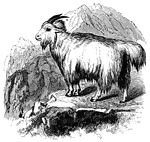
"Both male and female have small horns, and hair of a white color. They live in small flocks in the lofty heights of the great range from which they derive their name." &mdash; S. G. Goodrich, 1885

Rocky Mountain Goat

"Both male and female have small horns, and hair of a white color. They live in small flocks in the…